If your process involves food, pharmaceuticals, chemicals, or any duty where one fluid must never touch another, “cross-contamination” is not a technicality — it is a batch loss, a regulatory finding, or a safety incident. This is exactly why indirect (recuperative) heat exchangers are the default choice in contamination-sensitive applications: by design, the two fluids never share a passage.
But “rarely” is not “never.” Understanding why indirect exchangers resist cross-contamination — and under what specific conditions leaks can still occur — is what lets you specify a unit that stays leak-free for decades. This article explains the engineering behind the barrier, the failure modes that actually exist, and how to eliminate them at the specification stage.
The Fundamental Reason: A Physical Barrier, Not a Promise
An indirect heat exchanger works by conduction: heat passes through a solid metal wall while both fluids remain in their own sealed flow paths. There is no shared chamber, no mixing zone, no dependence on seals between two process streams — because the streams never meet.
Compare that to the alternatives:
• Direct contact (mixing) exchangers — cooling towers, quench systems — intentionally blend the two fluids. Cross-contamination is the operating principle.
• Regenerative exchangers — rotary thermal wheels, fixed-matrix regenerators — one surface alternately contacts the hot and cold streams. Carryover between streams is inherent to the design and typically limited to a few percent, no matter how well the unit is built.
An indirect exchanger avoids both problems by keeping a continuous wall between the fluids at every point. If the wall stays intact, cross-contamination is physically impossible — not just unlikely. This is why engineers searching for how to prevent cross-contamination in heat exchange consistently land on recuperative designs.
What the Barrier Actually Looks Like in Each Design
Not all barriers are equal. The construction determines how many potential leak paths exist:
Shell and Tube: One Wall, Two Sealed Chambers
Process fluid A flows inside the tubes; fluid B flows around them inside the shell. The tubesheet — a thick plate drilled and attached to hundreds of tubes — is the critical joint. Properly built (rolled, welded, or both), each tube-to-tubesheet joint is a permanent metallurgical seal. There is no gasket between the two process fluids at all — the only separation is metal.
Gasketed Plate: Gaskets Between Streams, Never Through Them
In a plate heat exchanger, elastomer gaskets seal each plate channel to the next, alternating hot and cold fluids plate by plate. The gaskets do separate the streams, but they are the most maintenance-sensitive barrier of any indirect type — which is why gasketed PHEs are standard in food and dairy (where CIP cleaning and scheduled regasketing are routine) but avoided in duties where a gasket failure would be catastrophic.
Welded and Brazed Designs: Zero Gaskets, Zero Carryover
Fully welded plate exchangers, brazed units, and printed-circuit exchangers eliminate elastomers entirely.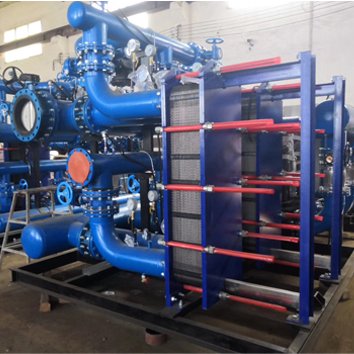 The barrier becomes 100% metal — the closest thing to absolute isolation available in heat transfer equipment. For aggressive or hazardous chemicals, this is the reason welded designs are specified even at higher cost.
The Real Failure Modes — and Why They Are Rare
Honest engineering means admitting where leaks can happen. There are exactly four ways an indirect exchanger can cross-contaminate, and every one of them is detectable and preventable at the design stage:
1. Tube or Plate Corrosion Through the Wall
The most common failure in old age: gradual thinning from corrosion, erosion, or stress-corrosion cracking until the wall perforates. A pinhole leak then lets fluid migrate under the pressure differential.
Why it’s rare in well-specified units: material selection based on the actual stream chemistry — including chlorides, sulfur, and pH at operating temperature — gives decades of corrosion allowance. Most perforation failures trace back to a material substitution made to cut cost, not to an inherent limitation.
2. Tube-to-Tubesheet Joint Leakage
The highest-stress joint in a shell-and-tube unit. Thermal cycling, vibration, and differential expansion can loosen rolled joints over years of service.
Why it’s rare: modern practice is strength-welded plus light-expanded joints — the weld provides the seal, the expansion locks the tube against vibration. Properly executed, this joint outlasts the tubes themselves.
3. Gasket Failure in Plate Exchangers
Elastomers age, harden, and crack — especially at elevated temperature or in the presence of incompatible chemicals. A blown gasket can let adjacent streams communicate.
Why it’s rare in managed service: gasket life is predictable and condition is visually inspectable in minutes by opening the unit. Scheduled regasketing every 3–5 years (or per condition monitoring) makes this failure almost exclusively a maintenance discipline issue, not a design flaw.
4. Cracked Welds in Welded Designs
Fatigue cracks at weld toes under severe thermal cycling.
Why it’s rare: qualified welding procedures, PWHT (post-weld heat treatment), and 100% NDT (RT/UT) on pressure-boundary welds per ASME VIII or PED catch defects before shipping. Field cracks require sustained abusive cycling — which proper startup/shutdown procedures prevent.
The Specification Choices That Make Cross-Contamination Virtually Impossible
If your application genuinely cannot tolerate mixing — and especially if the two fluids are both hazardous or both valuable — specify these features upfront:
Double Tubesheets
Two tubesheets per end, spaced with a thin atmospheric gap between them, with a leak-detection port. If a tube cracks or a joint leaks, fluid escapes to atmosphere through the port and triggers an alarm — it cannot reach the other stream. Double tubesheets are the standard answer in pharmaceutical water systems, certain reactor cooling services, and any duty where cross-contamination means regulatory action.
Search behavior this addresses: double tubesheet heat exchanger when required
Double-Wall Tubes
A tube inside a tube, vented in the shell-side header space. Same leak-to-atmosphere principle, with the added ability to run in conventional TEMA geometry. Common in U-tube high-pressure services where double tubesheets are mechanically impractical.
Leak Detection Systems
On critical units, specify an intermediate chamber with a low-point drain, pressure gauge, or online conductivity/pH monitoring. A rising level or changed chemistry in the intermediate space is your early-warning system — months before a developing leak becomes an event.
Material Purity Discipline
For food and pharma, specify material certificates (3.1 MTRs per EN 10204), controlled ferrite content in welds, and surface finishes (Ra ≤ 0.8 μm typical) that prevent product adhesion and bacterial harborage. Cross-contamination prevention is not only about leaks — it is also about cleanability.
How This Compares: A Quick Decision View
Requirement
Indirect (recuperative)
Regenerative (rotary/matrix)
Direct contact
Fluid isolation
Absolute (metallic barrier)
Limited (carryover %)
None (intentionally mixed)
Cross-contamination risk
~Zero if wall intact; leak-detectable
Inherent, design-limited
Total by design
Typical contamination-sensitive uses
Food, pharma, chemicals, H₂, ammonia
HVAC energy recovery only
Cooling towers, quench
If your process cannot tolerate even trace mixing, the indirect architecture is not a preference — it is the only correct category.
Frequently Asked Questions
Can an indirect heat exchanger leak and mix the two fluids?
Yes — if a tube or plate perforates from corrosion, or a gasket fails. But unlike direct-contact designs, every leak path in an indirect unit is detectable (leak detection ports, pressure/level monitoring, routine inspection) and preventable through correct material selection and joint construction. With double tubesheets, a leak cannot cross to the other stream at all.
What is a double tubesheet heat exchanger and when do I need one?
Two tubesheets per end with an atmospheric gap and a detection port between them. Specify it whenever cross-contamination is unacceptable and both fluids are valuable, hazardous, or regulatory-sensitive — pharma WFI, reactor cooling with toxic process fluid, potable-water-adjacent duties.
Are gasketed plate heat exchangers safe for food applications?
Yes — they are the industry standard in dairy, beverage, and food processing precisely because plates can be fully opened and visually inspected, and gaskets can be verified and replaced. Food-grade EPDM or NBR gaskets with 3-A or FDA compliance are routine. The maintenance regime, not the gasket itself, is what guarantees isolation.
How do I detect a leak in a welded plate heat exchanger before it becomes a problem?
Specifying a low-point drain or instrumentation on a monitoring chamber between fluid circuits, plus periodic sampling of the lower-pressure side for traces of the higher-pressure fluid’s chemistry, gives weeks to months of warning on a developing leak.
Is cross-contamination possible during CIP cleaning of a plate heat exchanger?
Only if cleaning circuits are incorrectly valved. Standard practice isolates each circuit and cleans sequentially; with correct procedures, CIP is a routine, contamination-free operation.