Most people in a process plant walk past the cooling tower every day without thinking about what it actually is. Strip away the fan, the fill, and the drift eliminators, and a cooling tower is simply a direct contact heat exchanger — arguably the most common one on Earth.
Unlike a shell-and-tube or plate exchanger, there is no metal wall between the fluids here. Hot process water is sprayed directly into a stream of air, the two mix intimately at the water’s surface, and heat leaves with the humid air. That direct mixing is both the tower’s greatest strength and the thing that defines where it can — and cannot — be used.
This article explains the working principle in plain engineering terms, the physics that makes it efficient, and how to evaluate whether a cooling tower is the right heat rejection method for your process.
What Makes a Heat Exchanger “Direct Contact”?
Every heat exchanger answers the same question — how do I move heat from fluid A to fluid B? — with one of three architectures:
1. Indirect (recuperative): fluids separated by a metal wall; heat crosses by conduction. Shell-and-tube, plate, air-cooled units.
2. Regenerative: one surface alternately touches both fluids; heat is stored and released. Rotary wheels, matrix regenerators.
3. Direct contact: the two fluids mix directly; heat transfers at every liquid-gas interface simultaneously. Cooling towers, quench towers, direct-contact condensers, steam injection heaters.
In a direct contact unit, the “heat transfer surface” is not manufactured — it is created dynamically. Every droplet, every splash, every wetted patch of fill is a transfer surface. This is why direct contact exchangers achieve enormous effective area at almost zero capital cost per square meter of that area. It is also why the two fluids end up sharing chemistry — which is acceptable for water-to-air (the air simply exhausts) and unacceptable for most liquid-to-liquid duties.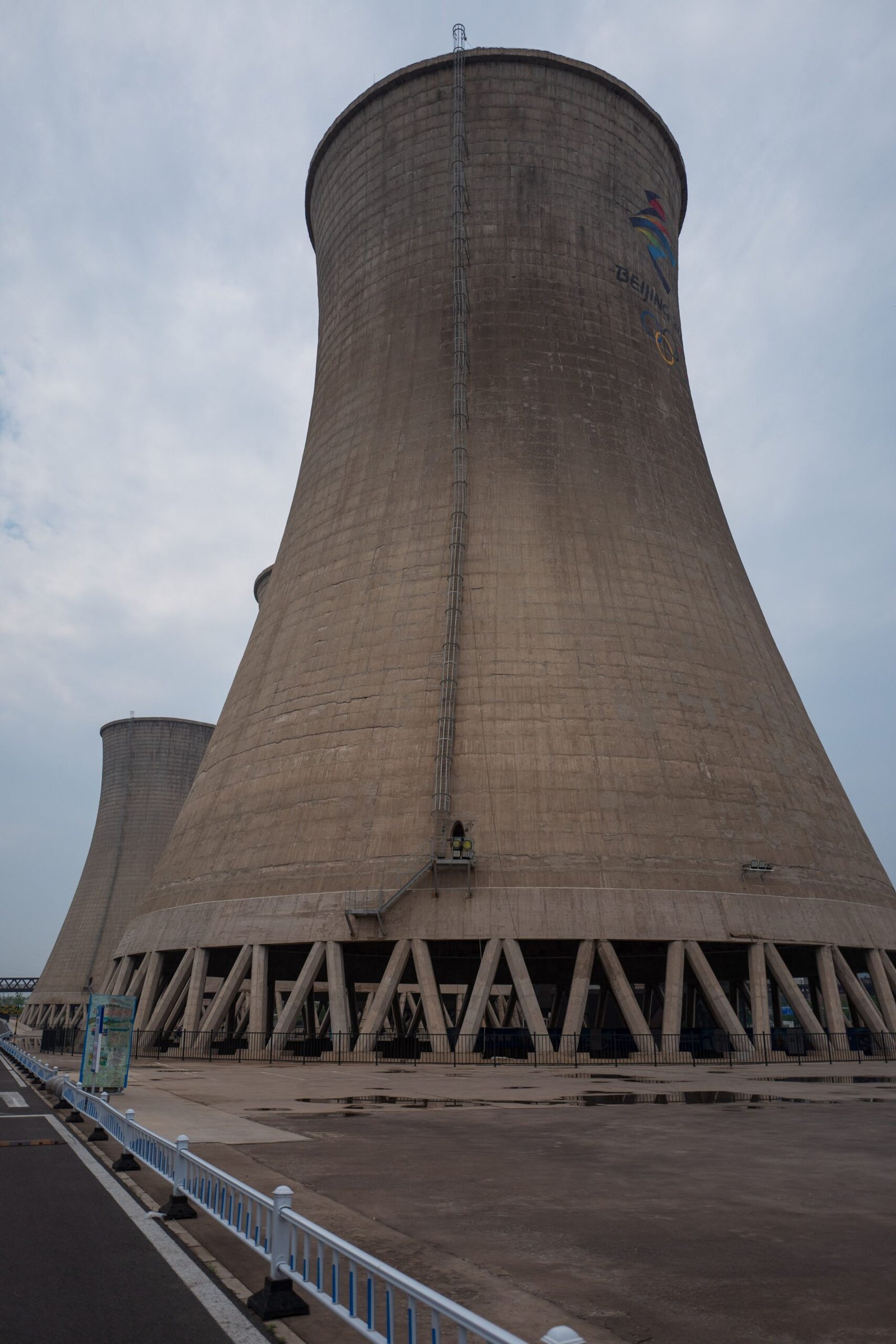
The Cooling Tower Working Principle, Step by Step
Follow one liter of hot water through a mechanical draft tower:
1. Hot water arrives at the top. Water from the process (condenser, compressor jacket, reactor cooling loop) enters the tower’s distribution basin at process temperature — typically 35–45°C in industrial service.
2. Distribution sprays break the water into droplets. Spray nozzles or distribution pans spread the water evenly across the tower’s cross-section. Droplet size matters: smaller droplets mean more surface area per liter, but also more drift loss and higher pump pressure.
3. Fill multiplies the air-water interface. The water falls through “fill” — structured or splash-type packing that spreads the flow into thin films and continuously re-divides it. This is where most of the heat transfer happens. Modern PVC film fill can pack 200–400 m² of wetted surface into one cubic meter of tower volume.
4. Air flows counter-current (or cross-current) through the fill. A fan at the top (induced draft) or bottom (forced draft) pulls or pushes ambient air across the falling water. The two streams never chemically interact with anything but each other — water evaporates into the air, and that evaporation is the engine of the whole process.
5. Cooled water collects in the basin. Water exits the fill at a temperature a few degrees above the ambient wet-bulb temperature — the theoretical floor of any evaporative process — and returns to the process loop.
6. Hot, humid air exits through the fan stack. The air leaves saturated or near-saturated, carrying the heat the water gave up. Drift eliminators above the fill strip out entrained water droplets before the air discharges.
That is the entire process. No tubes, no plates, no gaskets — just water, air, and surface area.
The Physics: Why Evaporation Does Most of the Work
Here is the part many specs get wrong. In a cooling tower, only a fraction of the heat leaves as sensible heat (warming the air). The majority leaves as latent heat of evaporation — energy absorbed when a small portion of the water (typically 1–2% of circulation) flashes into vapor.
The governing limit is the wet-bulb temperature of the ambient air — the temperature a thermometer reads with an evaporating wick on its bulb. Water in a tower cannot cool below wet-bulb, and practical towers approach it by 3–6°C (the “approach”). This is why:
• A tower in Houston in August (wet-bulb ~26°C) cannot deliver 20°C water no matter how big it is.
• The same tower in Denver (wet-bulb ~15°C in summer) easily delivers 20°C.
• Specifying cold-water temperature without stating the design wet-bulb is a specification error — always state both.
The key performance equation is the ** Merkel equation**, which integrates heat and mass transfer along the fill:
KaV/L = ∫ dT / (h′ − h)
where KaV/L is the tower characteristic (fill capability vs. water loading) and (h′ − h) is the enthalpy driving force between saturated air at the water temperature and the bulk air. You do not need to run the integral — manufacturers publish KaV/L curves per fill type — but you do need to know the concept to review a tower selection critically.
Types of Cooling Towers and When Each Fits
Counter-flow induced draft (most common): Air moves up, water falls down. Compact footprint, best thermal performance per volume, fan at the top keeps warm discharge air away from the air intake. The default choice for industrial process cooling.
Cross-flow induced draft: Air moves horizontally across falling water. Lower pump head (gravity distribution), easier maintenance access, but larger footprint and more sensitive to icing in cold climates. Popular in HVAC and power applications.
Forced draft: Fan pushes air at the base. Handles high static pressure losses and allows indoor/ducted installations; fan is in the moist airstream, which shortens motor and blade life. Common in modular and packaged units.
Natural draft (hyperbolic): No fan at all — buoyancy of the warm, humid air drives flow. Only economical at very large capacities (power plants, 10,000+ m³/h). No fan power, near-zero operating energy, but enormous capital cost and a fixed design point.
Closed-circuit (fluid cooler) hybrid: Worth mentioning because it solves the direct-contact contamination problem: process fluid runs through coils, and spray water evaporates over the coils from the outside. You get evaporative cooling with an indirect barrier — at roughly 1.5–2× the cost and some efficiency penalty.
Where Direct Contact Works — and Where It Doesn’t
The cooling tower’s logic only holds because one fluid (air) is free to absorb the other (water vapor) and exhaust to atmosphere. That defines the boundaries:
Genuine fits:
• Rejecting waste heat from water loops where the cooled water returns to a closed process (condensers, compressors, chillers, furnaces)
• Any duty where makeup water is cheap and blowdown disposal is manageable
• Quenching hot gas streams directly with liquid spray (direct-contact quench/condensers in chemical and incineration service)
Genuine mismatches:
• Cooling water you cannot afford to lose or contaminate (closed loops with treated/deionized water — use indirect or closed-circuit instead)
• Liquid-to-liquid duties (two process fluids must never mix — that is recuperative territory by definition)
• Locations with water scarcity or strict discharge limits — evaporative towers consume 1–3% of circulation as makeup per hour; in drought-prone regions this is increasingly a permit issue, and dry coolers or hybrid systems are displacing wet towers in Europe and the southwestern US
Sizing and Specifying: The Numbers That Matter
When buyers search for how to size a cooling tower, they usually need a handful of inputs nailed down:
1. Heat load (kW) — from your process water flow rate and the required temperature drop. Rule of thumb: each 1 m³/h of water cooled by 10°C rejects ~58 kW… verify: 1 m³/h ≈ 1000 kg/h × 4.18 kJ/kg·K × 10 K ≈ 41,800 kJ/h ≈ 11.6 kW. Correction: each m³/h per °C ≈ 1.16 kW; a 10°C drop at 100 m³/h ≈ 1,160 kW. State it correctly.
2. Water flow rate and temperature range (hot return vs. cold supply, typically 5–10°C range in process service).
3. Design wet-bulb temperature — use the 1% or 5% exceedance value for your site, not the average.
4. Approach and range — approach (cold water temp minus wet-bulb) of 3–5°C is aggressive; 5–7°C is economical.
5. Makeup water quality — hardness, silica, TDS determine cycles of concentration, blowdown rate, and chemical treatment program. Silica scaling is the silent killer of film fill.
6. Plume and drift constraints — in urban or cold-climate sites, visible plume and drift eliminator efficiency (0.001% of circulation is the current good-practice drift rate) may be permit conditions.
Get these six right and any reputable manufacturer can produce a selection. Miss the wet-bulb or the water chemistry, and you will own the consequences for twenty years.
Common Problems and How to Prevent Them
Scale and biological fouling in the fill. Hardness concentrates as water evaporates; biofilm grows in warm, wet, sunlight-exposed fill. Prevention: side-stream filtration, automatic blowdown on conductivity, and a disciplined biocide program. Structured film fill that clogs is often unrecoverable — clean early or replace.
Poor cold-water temperature in summer. Usually under-sizing against actual wet-bulb, or fan capacity degraded by blade pitch drift and motor wear. Confirm actual approach against design before blaming the tower.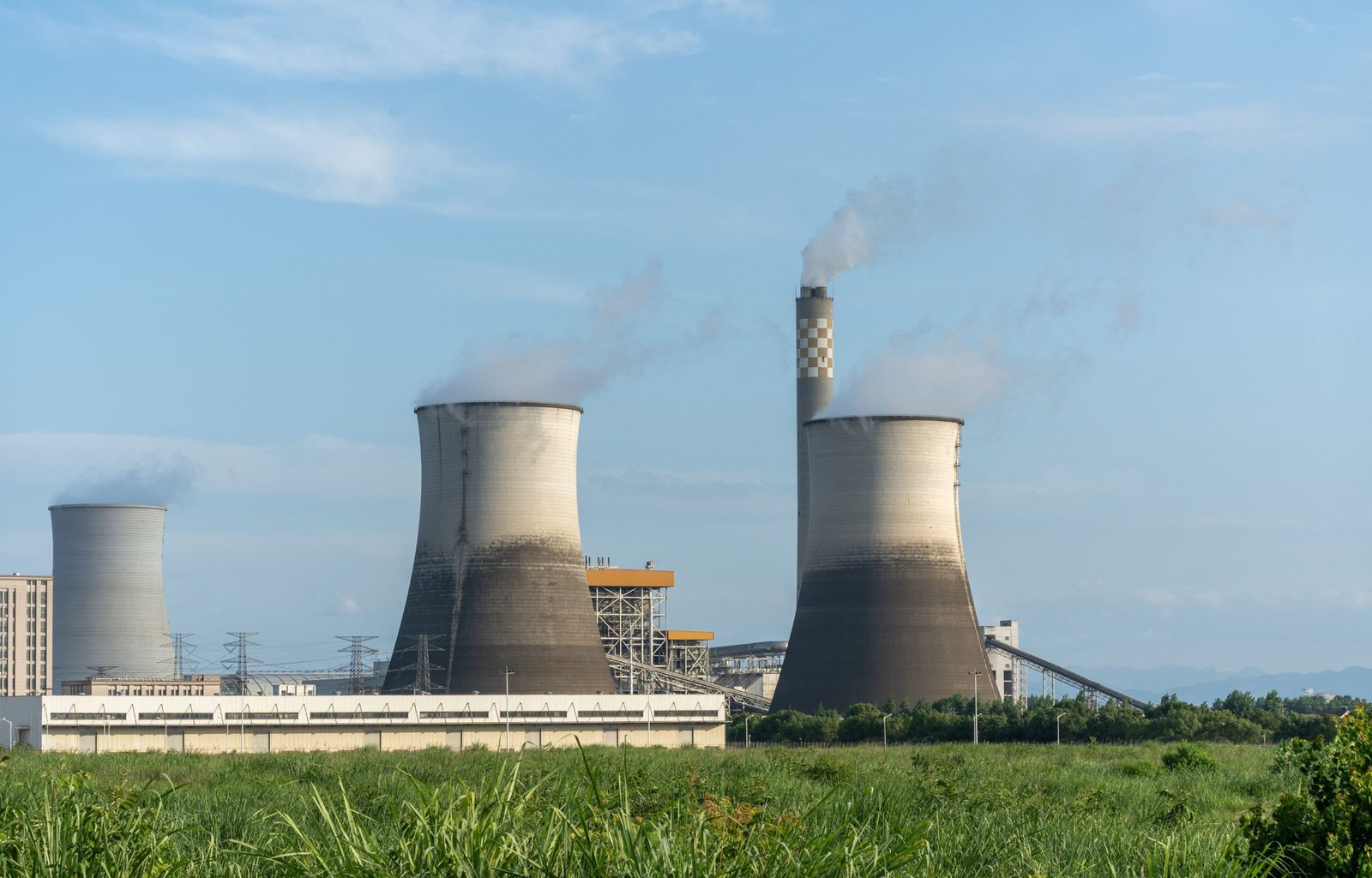
Excessive drift and water loss. Worn or missing drift eliminators, over-pumping beyond design flow, or excessive air velocity. Modern cellular drift eliminators should hold drift under 0.001% of circulation.
Winter icing (cross-flow towers especially). Variable-speed fan control, basin heaters, and ice-load-rated fill are the standard mitigations in cold climates.
Legionella risk. Cooling towers are regulated water systems in most jurisdictions now (ASHRAE 188 in the US, similar regimes in the EU). A documented water management plan is not optional — it is a legal and liability requirement.
Frequently Asked Questions
How does a cooling tower cool water without a heat exchanger surface?
It uses direct contact: hot water is sprayed and spread into thin films through fill while air passes through, and heat transfers at every air-water interface. Most of the heat leaves as latent heat through evaporation, which is why towers can cool water to within a few degrees of the ambient wet-bulb temperature — below what dry air cooling could ever achieve.
What is the difference between a cooling tower and a chiller?
A chiller is a refrigeration machine that uses a vapor-compression or absorption cycle to produce cold water, with a heat exchanger isolating the refrigerant from the process fluid. A cooling tower is passive heat rejection equipment — it cools water by evaporation against ambient air. In most plants, the chiller’s condenser heat is rejected
to the cooling tower; they work as a pair, not alternatives.
Can I use a cooling tower with process fluids other than water?
Direct-contact towers are water-to-air by nature. Cooling hydrocarbons, brines, or chemicals evaporatively requires a closed-circuit fluid cooler (coils kept the fluid inside, spray water outside) — the indirect barrier protects the process fluid from contamination and loss.
Why can’t my tower reach the cold-water temperature I specified?
Almost always one of three causes: actual wet-bulb exceeds design (hot, humid weather), reduced airflow (fan, motor, or blade pitch), or degraded fill (scaling, fouling, collapse). Verify approach temperature and airflow before investigating further.
How much water does a cooling tower consume?
Evaporation runs about 1% of circulation per 5.5°C of cooling range. Total makeup including blowdown and drift typically runs 1.5–3% of circulation, depending on cycles of concentration. A 500 m³/h tower can consume 40–60 m³/day — worth checking against local water budgets before committing.