Every heat rejection or heat recovery project eventually faces the same fork in the road: do we keep the fluids separated with a metal wall (indirect/recuperative), or do we let them touch (direct contact/mixing)?
The answer is rarely about which technology is “better” — it is about which one matches your fluids, your site constraints, and your lifecycle cost structure. Direct contact exchangers (cooling towers, quench towers, steam injection heaters, direct-contact condensers) can deliver dramatic capital and energy savings in the right duty. In the wrong duty, they are a contamination incident waiting to happen.
This article gives an honest comparison — strengths, weaknesses, and the specific conditions under which direct contact wins on total cost.
The Core Cost Logic: Why Direct Contact Can Be Cheaper
The entire economic case for direct contact rests on one engineering fact: it eliminates the heat transfer surface as a manufactured component.
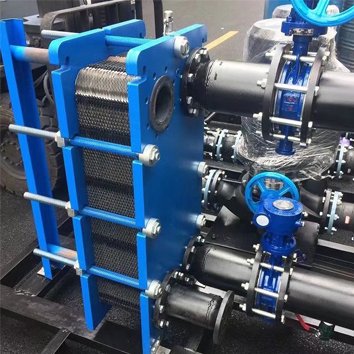
In an indirect exchanger, you pay to fabricate area — tubes, plates, fins, tubesheets, gaskets, welds, and the pressure vessel around them. Surface area costs money roughly proportional to its size, and high-pressure, high-alloy service multiplies that cost fast. A titanium shell-and-tube unit for aggressive chemistry can run into six figures while handling a fraction of the duty a simple spray column could absorb.
In a direct contact unit, the “surface” is created by atomizing, spraying, or cascading one fluid into the other. Droplets and thin films generate hundreds of square meters of interface per cubic meter of equipment volume — area that costs almost nothing. There are no tubes to plug, no gaskets to replace, no metallurgy to select beyond the shell and internals that see only one fluid at a time.
That single design difference drives every cost advantage below — and every limitation.
Where Direct Contact Wins: Five Duties It Dominates
1. Water-to-Air Heat Rejection (Cooling Towers)
This is the largest and most familiar case. A cooling tower rejects process heat by evaporating a small fraction of the circulating water directly into ambient air. There is no intermediate refrigerant loop, no finned coils, no metal barrier between water and air.
Why it beats indirect here: A dry (air-cooled) system must cool water with air across a finned coil — sensible heat only, limited by dry-bulb temperature. An evaporative tower cools by latent heat, limited by wet-bulb, which is typically 5–10°C lower. That difference means smaller equipment, lower fan power, and — in most climates — water cold enough to serve process condensers directly. Capital cost runs roughly 30–50% lower than an equivalent dry cooler train, and fan energy is a fraction.
The recurring searches cooling tower vs dry cooler cost and evaporative vs air cooled condenser almost always trace back to this physics gap.
2. Quenching Hot Gas Streams
Incineration off-gas, reformer effluent, Claus plant tail gas — hot process gas that must be dropped hundreds of degrees in seconds. A direct-contact quench tower sprays liquid into the gas stream. Heat transfer coefficients in direct contact are enormous (orders of magnitude above gas-side values in finned tubes), so a quench tower is tiny compared to any recuperative gas cooler capable of the same duty. Simultaneously, the spray scrubs particulates and acid gases — one vessel doing the work of a heat exchanger plus a scrubber.
3. Steam Injection Heating of Liquids
Direct steam injection into a water or process-liquid stream heats it to within a degree of the steam saturation temperature instantly. There is no heating surface, so there is no fouling, no hot wall to scale or burn product, and essentially no approach temperature penalty. For tankless hot water, CIP heating, and slurry heating duties, DSI systems cost a fraction of an equivalent shell-and-tube heater — and deliver faster temperature response.
4. Direct-Contact Condensers
In vacuum distillation and evaporation systems, mixing vapor with cold liquid directly condenses the vapor without a condensing surface. This eliminates the pressure drop of a tube-side condenser — which matters enormously when your column runs at 50–100 mbar absolute, where every millibar of condenser pressure drop costs separation efficiency and energy. Vacuum systems in desalination and food evaporation rely on this principle for exactly that reason.
5. Any Duty Where One Fluid Is Sacrificial
If one stream is water you can afford to lose (once-through cooling, quench water, spray liquid) and the other is air or gas, direct contact is often the default. The “cost” of mixing is simply the makeup water — and in water-abundant regions, that is cheap.
Where Direct Contact Loses: The Boundaries You Cannot Cross
The same mixing that creates the economics creates the limitations. Direct contact is disqualified the moment any of these conditions apply:
Both fluids are valuable or process-critical. The moment mixing contaminates either stream — hydrocarbon into cooling water, product into utility water — the recuperative wall stops being a cost and becomes a requirement. No lifecycle saving outweighs a batch loss or a contamination event.
You are cooling with treated or deionized water. A closed loop filled with expensive chemistry (glycol, brine, demineralized water) cannot be opened to atmosphere. Direct contact would destroy the fluid’s chemistry and the investment in it.
The cooled fluid must stay pressurized or contained. Direct contact happens at near-atmospheric conditions. High-pressure process streams need a barrier.
Water scarcity or discharge limits bite. A wet tower evaporates 1–2% of circulation continuously and requires blowdown. In drought-affected regions — increasingly common across the southwestern US, Spain, and parts of Australia — permit limits on consumptive water use can make a dry system the only legal option regardless of capital cost. This is driving real growth in adiabatic and hybrid pre-cooling systems as a middle path.
Plume, drift, or Legionella constraints apply. Visible plume complaints from neighbors and regulatory water-management regimes (ASHRAE 188 in the US) add operating obligations that narrow the wet tower’s advantage in urban and healthcare-adjacent sites.
The Honest Lifecycle Comparison
Total cost comparison between direct contact and indirect solutions involves four terms, and the ranking flips depending on your site:
| Cost term | Direct contact (e.g., cooling tower) | Indirect (e.g., dry cooler, shell-and-tube) |
|---|---|---|
| Capital | Low — no heat transfer surface | 2–4× higher for equivalent duty |
| Energy | Low fan power; pump head moderate | High fan power (dry systems); no evaporation loss |
| Water/consumables | Makeup + blowdown + treatment | Negligible (closed loop) |
| Maintenance | Fill, drift eliminators, water chemistry, winterization | Coils/fins, fans, gaskets; simpler chemistry but surface cleaning |
Rule of thumb we apply in screening: wet evaporative wins on 10-year total cost wherever water is available at reasonable price and discharge is permitted; dry or hybrid wins where water is constrained, in cold climates with icing risk, or where plume/drift limits apply. The crossover typically happens when makeup water cost exceeds roughly the fan-energy penalty of dry cooling — run the numbers for your site rather than trusting the rule.
A Worked Decision Framework
If you are screening a duty right now, answer these in order:
- Can the two streams mix without consequence? No → indirect, stop here. Yes → continue.
- Is one stream air or a ventable gas? No → the mixing must be liquid-liquid (steam injection, direct contact condensation) — evaluate separately. Yes → continue.
- Is the cooled stream closed-loop treated water? Yes → direct contact (open tower) is off the table; consider closed-circuit fluid cooler — the hybrid option with coils inside, spray outside.
- What is your 10-year water cost vs. energy cost? Wet wins where water is cheap; dry or hybrid wins where it is not.
- Are there plume, drift, noise, or regulatory constraints on site? Each one erodes the wet tower’s advantage.
Five questions, and most projects are decided by question one. The rest is engineering optimization.
Common Mistakes We See Buyers Make
Choosing wet because capital is cheap, then paying for water for 20 years. The tower is the cheap part; the water bill, treatment program, and blowdown disposal are the expensive parts. Always compare on NPV, not purchase order value.
Choosing dry in a hot, humid climate and undersizing the approach. Dry systems are limited by dry-bulb. In Gulf Coast or Southeast US summers, dry-bulb approaches of 10–15°C mean either enormous coil banks or elevated process temperatures. Check summer design conditions before committing.
Ignoring the hybrid middle path. Adiabatic pre-cooling pads and closed-circuit fluid coolers sit between the two poles — 60–80% of wet tower performance with a fraction of the water consumption. For many European and water-stressed North American sites, the hybrid is now the actual economic optimum.
Frequently Asked Questions
When is a direct contact heat exchanger cheaper than a shell-and-tube? Whenever the two fluids can mix without consequence and one of them is air, ventable gas, or sacrificial water. Eliminating the heat transfer surface removes the dominant capital cost and most fouling maintenance. Cooling towers, quench towers, and direct steam injection are the standard cases.
Is a cooling tower a direct contact heat exchanger? Yes — it is the most common one in existence. Hot water is sprayed directly into an airstream, and heat transfers at every droplet-air interface, mostly through evaporation. There is no metal wall between water and air.
What are the disadvantages of direct contact heat exchangers? The two fluids end up sharing chemistry, so contamination is inherent; the equipment operates near atmospheric pressure; consumptive water use and blowdown are continuous in wet systems; and visible plume, drift, and microbial control (Legionella) bring regulatory obligations.
Can I get evaporative cooling without contaminating my process fluid? Yes — a closed-circuit fluid cooler runs your process fluid inside finned coils while spraying water over the coils from outside. You get most of the evaporative advantage with a metal barrier protecting the loop. Cost sits between open towers and pure dry coolers.
How do I decide between a cooling tower and a dry cooler? Compare your 10-year water cost (makeup, treatment, blowdown, discharge) against the dry system’s extra fan energy and capital, using your site’s design wet-bulb and dry-bulb conditions. Wet wins in water-abundant sites with hot summers; dry or hybrid wins where water is expensive, restricted, or cold winters cause icing.