Walk into almost any coal-fired, biomass, or gas-fired power plant and you’ll find the same workhorse near the boiler outlet: the regenerative air preheater. It’s the single largest heat recovery device in the plant, and it quietly decides a big share of the unit’s fuel efficiency.
This article explains how regenerative air preheaters work in power plant service, why plant operators choose them over other designs, the failure modes that actually cost you money, and what to check when you’re specifying or upgrading one.
Why Power Plants Need Air Preheaters at All
Boiler flue gas leaves the economizer at 300–400 °C. Send that heat up the stack and you’re burning money. Preheat the combustion air with that waste heat instead, and three things happen:
Fuel consumption drops — every 20 °C rise in air temperature cuts fuel use by roughly 1%. Typical preheaters lift combustion air from ambient to 280–350 °C.
Combustion improves — hot air dries and ignites pulverized coal faster, stabilizing flame and cutting unburned carbon in fly ash.
Boiler thermal efficiency rises — a well-maintained air preheater adds 5–12 percentage points to overall boiler efficiency.
No other single piece of equipment on a power plant delivers that much efficiency for that little capital.
Why Regenerative Beats Recuperative for This Duty
Power plants move enormous gas volumes at moderate temperatures (350 °C and below on the gas side). Shell-and-tube or plate recuperators can’t compete here — the required surface area would be enormous, and soot-laden flue gas would foul it quickly.
The regenerative design solves both problems. A slowly rotating rotor packed with corrugated steel sheets passes continuously through the hot flue gas duct and the cold air duct. One side of the rotor charges with heat; the other side releases it. The corrugated packing offers huge surface area per unit volume, keeps the unit compact enough to retrofit between boiler and stack, and tolerates the dust load far better than finned or tubular surfaces.
That’s why the rotary regenerative air preheater — the Ljungström type, first patented in the 1920s — remains the industry standard a century later.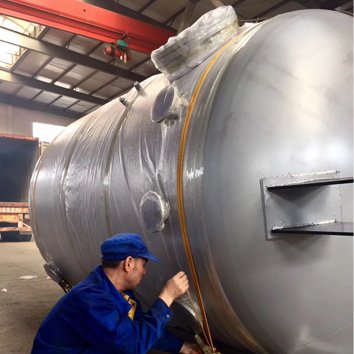
How a Rotary Regenerative Air Preheater Works
The cycle is continuous, not batch-style, which is what makes it ideal for steady boiler operation:
The rotor (typically 10–20 m diameter on utility boilers) turns at 1–3 rpm.
Hot flue gas at 300–400 °C flows through one sector of the rotor, heating the corrugated packing.
Cold combustion air flows through the opposite sector, absorbing the stored heat.
Seals along the rotor perimeter limit direct leakage between the gas and air sides.
Modern utility boilers use tri-sector or quad-sector preheaters: one gas sector, primary air sector(s) for the pulverizers, and secondary air sector(s) for the burners. This lets operators tune primary air temperature (for coal drying) independently from secondary air temperature (for combustion).
The Real-World Problems — and How Plants Fix Them
Air preheaters are reliable, but they sit in the toughest spot in the plant: corrosive, dusty, thermally cycling service. Four problems account for most of the lost efficiency and unplanned outages.
Air-to-gas leakage
Leakage past the radial and axial seals is the number-one efficiency killer. Design leakage starts at 6–8%; worn seals push it past 15–20%. Every percent of leakage forces ID and FD fans to work harder and drags boiler efficiency down. The fix is routine seal adjustment and, on older units, a seal upgrade or rebuild during planned outages. Continuous monitoring of fan power and gas outlet temperature catches leakage trends early.
Cold-end corrosion
Below the acid dew point (120–150 °C depending on sulfur content), sulfuric acid condenses on cold-end elements and eats them away. Two countermeasures work:
Cold-end enamel-coated elements — enamel resists acid attack far better than plain steel.
Bypass or steam air heaters — trim the air inlet temperature during low-load or cold-weather operation to keep the cold-end metal above the dew point.
For plants cofiring high-sulfur fuel or biomass with high chlorine, this is non-negotiable.
Fouling and plugging
Fly ash plus acid condensation forms a concrete-like deposit that plugs gas-side passages, raises pressure drop, and can force load reductions. Online sootblowing (steam or water lances) plus offline water washing every outage keeps the matrix clear. Adding the basket geometry that matches the ash characteristics — more open corrugation for high-dust coals — prevents the problem upstream.
Element basket wear
Cold-end baskets take the thermal and corrosive hit and typically need replacement every 3–5 years, hot-end baskets every 8–10. Keeping spare baskets on site turns a week-long outage into a day-long swap.
Specifying or Upgrading an Air Preheater: What Actually Matters
If you’re a plant engineer evaluating a new unit, a retrofit, or a supplier, these are the questions that separate a good decision from an expensive mistake:
Gas flow and temperature profile at full and part load. Size the rotor for your worst case, not just MCR (maximum continuous rating).
Coal/fuel analysis. Sulfur, chlorine, and ash content drive cold-end material selection and washing frequency.
Guaranteed leakage and efficiency at end-of-life, not just new-and-clean. Ask for the degradation curve in the contract.
Seal system design. Adjustable radial seals pay back fast on high-leakage units.
Basket material and coating spec. Enamel-coated cold-end elements cost more and save multiples of that in outage time.
Footprint and ductwork constraints. Rotary preheaters are compact axially but large in diameter — verify crane access for basket pulls.

Frequently Asked Questions
What type of heat exchanger is used as an air preheater in power plants? The rotary regenerative air preheater (Ljungström type) dominates. Its heat-storage matrix handles large dusty gas flows at compact size and stays cleanable — things recuperative designs can’t match at this duty.
How much does an air preheater improve boiler efficiency? Typically 5–12 percentage points, depending on flue gas inlet temperature and preheated air temperature. A modern preheater recovers 80–90% of the available flue gas heat.
What causes high leakage in a rotary air preheater, and how do you fix it? Radial and axial seal wear from thermal distortion and rotor “wagon wheel” sag. Fixes include seal adjustment, seal upgrades with tighter cold-end clearances, and sealing air systems. Routine measurement of gas-side O2 before and after the preheater quantifies leakage.
Can regenerative air preheaters handle biomass or waste-to-energy flue gas? Yes, with attention to cold-end corrosion (high-chlorine fuels condense hydrochloric acid) and fouling. Enamel-coated elements, more frequent washing, and correct basket geometry make it routine in European biomass plants.
The Bottom Line
The regenerative air preheater earned its century of dominance the honest way: no other heat exchanger recovers this much waste heat from this much dusty gas at this low a cost per megawatt. The efficiency is real, but only while leakage, corrosion, and fouling stay under control — which is a maintenance and specification discipline, not luck.