The evaporator is not just a coil in the cold room.
It controls temperature, humidity, frost, pull-down time, product shrink, and energy use. Choose the wrong one and you get long defrost cycles, ice on the floor, dehydrated product, high discharge pressure, and a compressor that runs harder than it should.
This guide covers how to select the right evaporator for food cold storage, freezers, and blast freezing.
Quick answer
| Application | Room temp | Evaporator type | Fin spacing | Defrost | Typical TD |
|---|---|---|---|---|---|
| Walk-in cooler | 35–45°F (2–7°C) | Unit cooler | 6–8 FPI | Air / off-cycle | 6–10°F (3–6°C) |
| Cold storage freezer | -10–0°F (-23–-18°C) | Heavy-duty unit cooler | 4–6 FPI | Electric or hot gas | 8–12°F (4–7°C) |
| Blast freezer | -20–-40°F (-29–-40°C) | Blast freezer evaporator | 3–4 FPI | Hot gas | 10–20°F (6–11°C) |
| Ammonia freezer | -20–0°F (-29–-18°C) | Steel / stainless coil | 4–6 FPI | Hot gas | 8–15°F (4–8°C) |
| CO2 freezer | -20–0°F (-29–-18°C) | High-pressure coil | 4–6 FPI | Hot gas / electric | 8–15°F (4–8°C) |
The right choice depends on the room, the product, the refrigerant, and how the defrost system works. There is no universal freezer evaporator.
1. Start with the application, not the coil
Food cold storage is not one duty. It is several.
Coolers hold product above freezing. Humidity matters. You do not want to dry out produce, meat, or dairy. A high-humidity cooler needs a larger coil with a lower TD and lower air velocity.
Freezers hold product below freezing. Frost builds. Defrost is critical. Fin spacing must allow frost to accumulate without blocking airflow. Drain pans and drain lines must be heated or protected.
Blast freezers pull product temperature down fast. Air velocity is high. TD is high. The evaporator must handle heavy frost and recover quickly after defrost. Hot gas defrost is common.
Specialty freezers include spiral freezers, tunnel freezers, plate freezers, and contact freezers. Each has different heat transfer. Plate freezers use contact. Spiral and tunnel freezers use forced air. Match the evaporator to the freezing method.
2. Calculate the real load
Do not size from room volume alone.
Total refrigeration load includes:
Transmission load through walls, floor, and ceiling
Product load: sensible heat above freezing, latent heat of freezing, sensible heat below freezing
Infiltration load: door openings, air changes, leaks
Defrost load: heat added during defrost
Internal loads: fans, lights, people, forklifts
Safety factor: 10–15% for pull-down, door use, and future load
Product load formula:
Above freezing: Q = m × cp × ΔT
Freezing: Q = m × latent heat
Below freezing: Q = m × cp × ΔT
For water-based products:
cp above freezing: 1 Btu/lb°F (4.18 kJ/kgK)
latent heat: 144 Btu/lb (334 kJ/kg)
cp below freezing: 0.5 Btu/lb°F (2.1 kJ/kgK)
Example: 2,000 lb/h of product entering at 50°F, freezing at 30°F, leaving at 0°F.
Above freezing: 2,000 × 1 × 20 = 40,000 Btu/h
Freezing: 2,000 × 144 = 288,000 Btu/h
Below freezing: 2,000 × 0.5 × 30 = 30,000 Btu/h
Product load = 358,000 Btu/h
Add all other loads. Then add a safety factor. The evaporator must meet the total load at design conditions, not just at a nominal rating.
3. Match the evaporator type
Unit cooler / air cooler
The standard choice for walk-in coolers and freezers. Ceiling-mounted, wall-mounted, or penthouse. Draw-through or blow-through. Electric or hot gas defrost.
Blast freezer evaporator
Built for high TD, high airflow, and heavy frost. Larger coil surface, wider fin spacing, and robust defrost. Often uses hot gas defrost.
Ammonia evaporator
Ammonia cannot use copper. Tubes and fins must be steel or stainless steel. High pressure and toxicity require code-compliant design and ventilation.
CO2 evaporator
CO2 systems run at much higher pressure. The coil and headers must be rated for it. CO2 is common in industrial refrigeration and some food plants.
Glycol / secondary loop evaporator
Used when refrigerant charge must be limited or when the plant uses a secondary coolant. Glycol changes heat transfer and pressure drop. Size accordingly.
4. Fin spacing and air velocity
Fin spacing decides how long the coil can run before defrost.
Coolers: 6–8 fins per inch (FPI). Tighter spacing gives more surface area and better humidity control.
Freezers: 4–6 FPI. Wider spacing allows frost to build without blocking air.
Blast freezers: 3–4 FPI. Maximum spacing for heavy frost and fast recovery.
Air velocity affects heat transfer and product dehydration.
Coolers: 200–500 fpm (1–2.5 m/s). Lower velocity protects product moisture.
Freezers: 500–1,000 fpm (2.5–5 m/s). Higher velocity improves heat transfer.
Blast freezers: 800–1,500 fpm (4–7.5 m/s). High velocity for fast freezing.
High velocity freezes faster but can dry product and increase fan energy. Balance speed, quality, and energy.
5. TD and humidity
TD is the difference between room air temperature and saturated suction temperature.
TD = Room air temperature − Evaporating refrigerant temperature
A low TD means a larger coil and higher evaporating pressure. The compressor uses less energy. Humidity stays higher. Product shrink is lower.
A high TD means a smaller, cheaper coil. But humidity drops, frost builds faster, and compressor energy rises.
Typical TD:
High-humidity cooler: 6–8°F (3–4°C)
Normal cooler: 8–12°F (4–7°C)
Freezer: 8–12°F (4–7°C)
Blast freezer: 10–20°F (6–11°C)
Do not default to a high TD to save on coil cost. The energy penalty over years is usually larger than the upfront savings.
6. Defrost strategy
Defrost is where many freezer evaporators fail.
Air defrost / off-cycle
Used for coolers above 35°F. Fans run, compressor stops, ice melts. Simple and low energy.
Electric defrost
Heaters in the coil melt frost. Common for small and medium freezers. Simple but higher energy use.
Hot gas defrost
Hot refrigerant gas flows through the coil. Fast and energy-efficient in large systems. Common for industrial freezers and blast freezers.
Drain pan and drain line
Must be heated. Drain lines must be trapped and protected from freeze-up. A blocked drain causes ice on the floor and unsafe conditions.
Defrost termination
Use temperature or pressure termination, not just time. Time-only defrost wastes energy and can overheat the coil.
Fan delay
After defrost, fans should delay restart until the coil is cold again. This prevents blowing warm, moist air into the room.
7. Refrigerant and materials
HFC / HFO refrigerants
Common in commercial refrigeration. Copper tubes and aluminum fins are standard. Check compatibility and oil return.
Ammonia (R717)
No copper. Use steel or stainless steel. High efficiency, but codes and safety are strict.
CO2 (R744)
High pressure. Coil, headers, and valves must be rated for CO2. Common in industrial and supermarket systems.
Glycol
Secondary loop. Lower freezing point. Higher viscosity than water. Size for glycol properties.
Materials:
Aluminum fins: standard, good heat transfer.
Copper tubes: standard for most refrigerants except ammonia.
Stainless steel: washdown, corrosive, or ammonia service.
Coated coils: epoxy or similar for corrosive environments.
EC fans: lower energy, variable speed, better part-load control.
8. Controls and expansion devices
Thermostatic expansion valve (TXV)
Mechanical, reliable, widely used. Needs proper superheat setting.
Electronic expansion valve (EEV)
Better superheat control, especially at part load. Works with variable-speed compressors and floating suction pressure.
Suction pressure control
Keeps evaporating temperature stable. Avoids coil starvation or flooding.
Defrost controls
Time, temperature, pressure, and demand defrost. Demand defrost saves energy by defrosting only when needed.
Fan cycling / variable speed
Reduces energy at low load. Helps maintain humidity.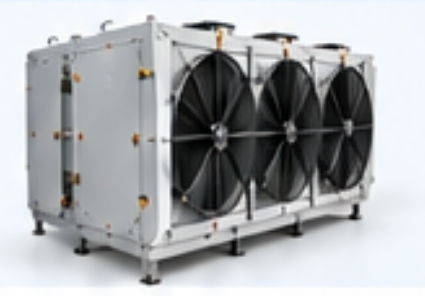
9. Energy and total cost
The evaporator affects energy in three ways:
Evaporating temperature. A lower TD and higher evaporating temperature reduce compressor power.
Fan power. Higher airflow and higher pressure drop cost energy. EC fans help.
Defrost energy. Electric defrost is simple but expensive to run. Hot gas and demand defrost save energy over time.
Compare total cost: purchase price + installation + fan energy + defrost energy + maintenance + product loss. The cheapest coil is rarely the lowest-cost coil over ten years.
10. Common mistakes
Sizing from room volume instead of calculated load.
Using a cooler coil in a freezer.
Too tight fin spacing for frosty duty.
Too high TD to save on coil cost.
Undersized drain pan or unheated drain line.
Time-only defrost.
Copper tubes in an ammonia system.
Ignoring door infiltration and defrost load.
No safety factor for pull-down.
Buying on price only.
11. Maintenance
Inspect coils monthly for frost, dirt, and damage.
Clean coils with compatible cleaners.
Check defrost termination and fan delay.
Clear drain pans and drain lines.
Check fan blades, motors, and bearings.
Verify superheat and suction pressure.
Look for refrigerant leaks.
Keep doors, curtains, and seals in good condition.
A clean, correctly defrosted coil can cut energy use and protect product quality.
FAQ
What type of evaporator is best for a cold storage freezer?
A heavy-duty unit cooler with 4–6 FPI, electric or hot gas defrost, and a heated drain pan. For blast freezing, use a blast freezer evaporator with 3–4 FPI and hot gas defrost.
What fin spacing should a freezer evaporator have?
4–6 FPI for most freezers. 3–4 FPI for blast freezers and heavy frost. 6–8 FPI for coolers.
What TD should I use for a freezer?
8–12°F (4–7°C) is typical. Blast freezers often use 10–20°F (6–11°C). Lower TD improves efficiency and humidity but requires a larger coil.
Can I use a copper evaporator with ammonia?
No. Ammonia attacks copper. Use steel or stainless steel.
Electric or hot gas defrost?
Electric is simpler and common for small freezers. Hot gas is faster and more efficient for large industrial freezers and blast freezers.
How do I prevent product dehydration?
Use a lower TD, lower air velocity, and proper humidity control. Do not oversize airflow.
How often should I defrost?
Only when needed. Use demand defrost or temperature termination. Time-only defrost wastes energy.