“Should I buy a shell and tube condenser or a plate condenser?” is one of the most common questions in refrigeration and process cooling — and one of the most frequently answered badly. The honest answer is that neither design is universally better. Each dominates in specific operating conditions, and choosing the wrong one typically costs you in one of three ways: higher energy bills for the life of the system, maintenance shutdowns you didn’t budget for, or a unit that simply can’t handle your water quality.
This guide gives you a clear, engineering-based framework for making the shell and tube vs plate condenser decision — covering heat transfer performance, fouling behavior, maintenance reality, refrigerant compatibility, and total cost of ownership.
1. What the Condenser Actually Does — and Why Selection Matters
The condenser’s job is to reject heat from the refrigeration or process cycle by condensing hot refrigerant vapor into liquid. Its performance is governed by one number above all others: the condensing temperature.
Every 1 °C reduction in condensing temperature cuts compressor energy consumption by roughly 2–3%. Over a 10–15 year service life, the condenser’s heat transfer efficiency matters far more to your operating cost than its purchase price. This is why condenser selection is an energy decision first and a procurement decision second.
The choice between shell and tube and plate designs determines how low you can push that condensing temperature — and how long the unit sustains that performance once real-world fouling sets in.
| Factor | Shell and Tube Condenser | Plate Condenser |
|---|---|---|
| Heat transfer coefficient | Good | Excellent (2–4× higher) |
| Approach temperature | 2–4 °C typical | 1–2 °C achievable |
| Refrigerant charge | Higher | 30–50% lower |
| Footprint & weight | Large, heavy | Compact, up to 80% smaller |
| Fouling tolerance | High — handles dirty water | Low — needs clean or treated water |
| Mechanical cleaning | Easy (tube brushing) | Gasketed: yes; brazed: no |
| Repair & re-tubing | Possible on site | Brazed: replace whole unit |
| Pressure rating | Very high, flexible | Gasketed: moderate; brazed: high |
| Ammonia compatibility | Excellent (steel construction) | Semi-welded plate versions available |
| First cost | Higher per kW in small sizes | Lower in small-to-medium sizes |
| Capacity expansion | Fixed | Gasketed: add plates later |
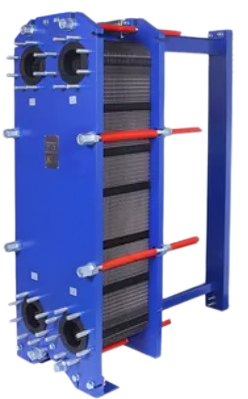
3. When a Plate Condenser Wins
Choose a plate condenser when your conditions look like this:
Clean or closed-loop cooling water. Plate condensers achieve their high efficiency through narrow, turbulent flow channels — and those same channels clog quickly with sediment, biological growth, or scaling water. If your cooling tower water is well-treated, or you run a closed glycol loop, this limitation disappears and you harvest the full efficiency benefit.
Energy cost is a priority. The tighter approach temperature (1–2 °C vs 2–4 °C) directly lowers condensing temperature. In a system running 6,000+ hours per year, this alone can justify the selection.
Space and refrigerant charge are constrained. Machine rooms in European cities, marine installations, and sites facing F-Gas charge reduction targets all favor plate designs. A brazed plate condenser delivering 500 kW can fit where a shell and tube unit simply cannot.
Small-to-medium capacity. Below roughly 1–2 MW, plate condensers usually win on first cost as well as operating cost. The economics flip at larger capacities.
4. When a Shell and Tube Condenser Wins
Shell and tube remains the right answer — often the only answer — in these situations:
Poor or variable water quality. Open cooling towers with hard water, once-through river or seawater cooling, and industrial sites with contaminated make-up water all demand the fouling tolerance of straight, brushable tubes. A plate condenser on dirty water is a maintenance contract waiting to happen.
Ammonia refrigeration. Welded steel shell and tube condensers are the industry standard for industrial ammonia plants. Semi-welded plate condensers exist for ammonia, but shell and tube dominates where safety codes, charge management, and decades of service track record matter.
Large capacities. Above a few megawatts, shell and tube designs scale more economically, and the footprint penalty becomes proportionally smaller.
On-site repairability matters. A shell and tube condenser with leaking tubes can be plugged or re-tubed in the field and returned to service. A failed brazed plate condenser is replaced, not repaired. In remote locations or critical process service, this difference is decisive.
High design pressures or temperatures. Shell and tube designs accommodate virtually any pressure class and exotic material — titanium, duplex, nickel alloys — for corrosive or seawater service.
5. The Fouling Question Decides More Projects Than Any Other Factor
If you take one thing from this guide: specify your water quality before you compare equipment.
Request a recent cooling water analysis and check hardness, chlorides, suspended solids, and biological load. Then apply this rule of thumb:
- Treated tower water, closed loop, or clean groundwater → plate condenser is viable and usually superior
- Untreated tower water, once-through natural water, or any history of scaling/biofouling → shell and tube, with a realistic fouling factor written into the specification
Many failed plate condenser installations trace back to a quotation stage where nobody asked about the water. A 1–2 °C approach on paper becomes 5–6 °C after two fouled summers — and the energy savings you paid for never materialize.
6. Six Costly Condenser Selection Mistakes
- Comparing quotations without the approach temperature. A cheaper condenser is often just a smaller one running a wider approach. Compare capacity and approach together.
- Choosing plate on questionable water quality. The efficiency gain evaporates with the first fouling season, and brazed units cannot be opened for cleaning.
- Ignoring refrigerant charge regulations. In Europe, F-Gas phase-down makes the lower charge of plate condensers a compliance advantage, not just a cost line.
- Specifying design-point performance only. Condensers spend most of their life at partial load and varying wet-bulb conditions. Ask for performance across the operating envelope.
- Forgetting water-side pressure drop. Excessive pressure drop forces larger circulation pumps — an energy cost that never appears on the condenser datasheet headline.
- Buying on first cost alone. Evaluate 10-year total cost: energy + cleaning + water treatment + expected service life.

7. Questions to Ask Your Condenser Supplier
Before issuing a purchase order, get written answers to:
- What condensing temperature and approach is guaranteed at my specified water inlet temperature and flow rate?
- What fouling factor is assumed — and what is the de-rated capacity if real fouling reaches twice that value?
- What is the refrigerant charge, and does the unit comply with PED, ASME, EN 378, or ASHRAE 15 as applicable?
- Can the unit be mechanically cleaned on site? What cleaning procedure do you recommend for my water analysis?
- What materials are offered for the water side, given my chloride and hardness levels?
- What is the water-side pressure drop at design flow?
- What are the lead time, spare parts availability, and typical service life in comparable installations?
Frequently Asked Questions
Is a plate condenser more efficient than shell and tube? Yes — plate condensers typically achieve heat transfer coefficients 2–4 times higher, enabling approach temperatures of 1–2 °C versus 2–4 °C for shell and tube. But this advantage only holds with clean water; fouling degrades plate performance much faster.
Can I use a plate condenser with ammonia? Yes, with semi-welded plate designs specifically rated for ammonia. However, shell and tube remains the dominant choice for industrial ammonia systems due to code acceptance, charge management, and field repairability.
Which condenser type is easier to maintain? Gasketed plate condensers can be opened for manual cleaning, but require gasket replacement over time. Brazed plate units cannot be opened at all. Shell and tube condensers allow simple mechanical tube brushing — often without full disassembly — making them easier to maintain on dirty water service.
How much smaller is a plate condenser? Typically 60–80% smaller in footprint and weight for the same duty — a decisive advantage in retrofit projects, marine applications, and cramped plant rooms.
What is a good approach temperature for a water-cooled condenser? For plate condensers, 1–2 °C; for shell and tube, 2–4 °C. Tighter approaches cost more heat transfer area but cut compressor energy continuously — usually an excellent trade for systems with high annual run hours.
Which is cheaper, shell and tube or plate? In small-to-medium capacities with clean water, plate condensers usually cost less to buy and less to run. At large capacities or with poor water quality, shell and tube wins on total cost of ownership.