For most HVAC applications using clean water or glycol, a gasketed plate heat exchanger (PHE) is the best choice because it delivers high thermal efficiency, a close temperature approach (1–3 °C), and a compact footprint at lower installed cost. For high-pressure, high-temperature, or fouling-prone duties, a shell and tube heat exchanger (STHE) is more suitable. For refrigeration circuits and small capacity, a brazed plate heat exchanger (BPHE) is often the best fit.
This guide explains exactly how to select the right heat exchanger for HVAC projects. You will learn:
The best exchanger type for chillers, heat pumps, district heating, data centers, and AHUs
Real selection logic, formulas, and decision criteria
Comparison tables for type, material, and performance
A step-by-step selection guide and pre-purchase checklist
Common mistakes that cause oversizing, fouling, and downtime
Cost, lead time, and certification factors for HVAC projects
Quick Answer
| HVAC Application | Best Heat Exchanger Type | Why |
|---|---|---|
| Chilled water / condenser water | Gasketed plate heat exchanger | High efficiency, close approach, compact |
| Heat pumps | Brazed or gasketed plate | Refrigerant compatibility, compact |
| District heating / cooling | Gasketed plate heat exchanger | High effectiveness, easy expansion |
| Data center liquid cooling | Brazed or gasketed plate | High heat flux, compact, reliable |
| Steam heating | Shell and tube or welded PHE | High temperature, pressure capability |
| Cooling tower water | Shell and tube or wide-gap PHE | Fouling tolerance |
| Marine / offshore HVAC | Titanium plate or shell and tube | Seawater corrosion resistance |
Table of Contents
What Is the Best Heat Exchanger for HVAC?
How to Choose the Right Heat Exchanger for HVAC
Comparison of Heat Exchanger Types for HVAC
Key Parameters for HVAC Heat Exchanger Selection
Step-by-Step Selection Guide for HVAC Heat Exchangers
Materials and Gaskets for HVAC Heat Exchangers
Maintenance and Fouling Prevention for HVAC Heat Exchangers
Cost, Lead Time, and Certification Factors
HVAC Heat Exchanger Selection Checklist
Common Mistakes and How to Avoid Them
FAQ
Key Takeaways
What Is the Best Heat Exchanger for HVAC?
The best heat exchanger for HVAC depends on the application, but for clean water and glycol systems, a gasketed plate heat exchanger is generally the best choice. It offers the highest thermal efficiency, the closest temperature approach, and the smallest footprint among common types. For refrigeration and small-capacity duties, brazed plate heat exchangers are often best. For high pressure, high temperature, or heavy fouling, shell and tube exchangers are more suitable.
H3: Why Gasketed Plate Heat Exchangers Dominate HVAC
High U-value: 3,000–7,000 W/m²·K for water–water, compared to 500–1,500 for STHE.
Close approach: 1–3 °C, ideal for heat recovery and low-grade energy.
Compact: 10–30% of the footprint of an equivalent STHE.
Expandable: Add plates to increase capacity if the frame has spare space.
Easy to clean: Open the frame and clean plates individually or use CIP.
Lower installed cost: Often 30–60% less than STHE for clean duty.
H3: When to Choose Brazed Plate Heat Exchangers
Refrigerant evaporators and condensers
Heat pumps and chillers with small capacity
Data center liquid cooling (CDU)
Applications with no gaskets allowed
High pressure up to 30–45 bar
Compact, maintenance-free operation
H3: When to Choose Shell and Tube Heat Exchangers
Steam heating and high-temperature hot water
High pressure (> 25 bar)
Heavy fouling or particulate-laden fluids
Large capacity (multi-MW)
Marine and offshore HVAC with seawater
Thermal cycling and mechanical stress
How to Choose the Right Heat Exchanger for HVAC
Choosing the right heat exchanger for HVAC requires matching the exchanger type to the application’s pressure, temperature, fouling, space, and cost constraints. Start with the duty, then evaluate each type against these criteria.
H3: Key Selection Criteria
| Criterion | What to Check | Impact |
|---|---|---|
| Heat duty | Q = ṁ × cp × ΔT | Determines area and type |
| Temperature approach | Required closeness | PHE for < 3 °C; STHE for > 5 °C |
| Pressure | Design pressure both sides | PHE up to 25 bar; STHE 100+ bar |
| Temperature | Design temperature | Gasket limit ~200 °C; STHE higher |
| Fouling | Fluid cleanliness | PHE for clean; STHE for dirty |
| Space | Available footprint | PHE compact; STHE large |
| Weight | Structural support | PHE light; STHE heavy |
| Maintenance | Cleaning access | PHE easy; STHE requires bundle removal |
| Cost | Installed and lifecycle | PHE lower for clean duty |
| Certification | PED, ASME, marine | Affects design and lead time |
H3: HVAC Application Selection Matrix
| Application | Recommended Type | Alternative |
|---|---|---|
| Chilled water | Gasketed PHE | Brazed PHE (small) |
| Condenser water | Gasketed PHE | Shell and tube (dirty) |
| Heat pump | Brazed PHE | Gasketed PHE |
| District heating | Gasketed PHE | Welded PHE |
| District cooling | Gasketed PHE | Brazed PHE |
| Data center CDU | Brazed PHE | Gasketed PHE |
| Steam heating | Shell and tube | Welded PHE |
| Cooling tower water | Shell and tube | Wide-gap PHE |
| Marine HVAC | Titanium PHE | Shell and tube (titanium) |
| AHU coils | Finned tube (separate category) | — |
Comparison of Heat Exchanger Types for HVAC
The three main heat exchanger types for HVAC are gasketed plate, brazed plate, and shell and tube. Each has distinct advantages and limitations.
H3: Comparison Table: Gasketed PHE vs Brazed PHE vs Shell and Tube
| Parameter | Gasketed PHE | Brazed PHE | Shell and Tube |
|---|---|---|---|
| Typical U (water–water) | 3,000–7,000 W/m²·K | 4,000–7,000 W/m²·K | 500–1,500 W/m²·K |
| Temperature approach | 1–3 °C | 1–2 °C | 5–10 °C |
| Max pressure | ~25 bar | 30–45 bar | 100+ bar |
| Max temperature | ~200 °C (gasket) | ~200 °C (braze) | 600 °C+ |
| Fouling tolerance | Low | Low | High |
| Cleaning | CIP or manual plate opening | Not serviceable | Tube cleaning, bundle removal |
| Expandable | Yes (add plates) | No | No |
| Footprint | Small | Very small | Large |
| Weight | Low | Very low | High |
| Installed cost (clean duty) | Low | Low | High |
| Best for | HVAC water systems | Refrigeration, heat pumps | High P/T, fouling, large duty |
H3: Which Type Is Best for Your HVAC Project?
Clean water, close approach, expandable: Gasketed PHE
Refrigerant, compact, high pressure: Brazed PHE
Steam, high temperature, dirty water: Shell and tube
Seawater, marine: Titanium gasketed PHE or titanium STHE
Key Parameters for HVAC Heat Exchanger Selection
The key parameters for HVAC heat exchanger selection are heat duty, LMTD, U-value, pressure drop, fouling factor, and temperature approach. Each must be calculated and checked before finalizing the type and size.
H3: Heat Duty (Q)
Q = ṁ × cp × ΔT
For HVAC water systems, cp ≈ 4,180 J/kg·K for water, 3,800 J/kg·K for 30% glycol, 3,600 J/kg·K for 50% glycol.
H3: LMTD
ΔTlm = (ΔT1 − ΔT2) / ln(ΔT1 / ΔT2)
Use counter-flow LMTD. Apply correction factor F for multi-pass or cross-flow.
H3: U-Value
| Service | PHE U (W/m²·K) | STHE U (W/m²·K) |
|---|---|---|
| Water–water | 3,000–7,000 | 500–1,500 |
| Water–glycol | 2,000–4,500 | 400–1,000 |
| Steam–water | 3,000–6,000 | 800–1,500 |
| Refrigerant condensing | 2,000–5,000 | 800–1,500 |
H3: Pressure Drop
| HVAC Circuit | Typical Allowable ΔP |
|---|---|
| Chilled water | 30–70 kPa |
| Condenser water | 30–80 kPa |
| Heating water | 30–70 kPa |
| Glycol loop | 50–100 kPa |
| Refrigerant | 20–50 kPa |
H3: Fouling Factors
| Fluid | Rf (m²·K/W) |
|---|---|
| Clean water | 0.0001 |
| Cooling tower water | 0.0002–0.0004 |
| Glycol | 0.0002–0.0004 |
| Steam | 0.0001 |
| Refrigerant | 0.0001–0.0002 |
H3: Temperature Approach
PHE: 1–3 °C achievable
STHE: 5–10 °C typical
Close approach increases area and cost. Confirm process need.
Step-by-Step Selection Guide for HVAC Heat Exchangers
Follow these steps to select the right heat exchanger for an HVAC project.
Step 1 — Define the duty.
Calculate Q = ṁ × cp × ΔT for the required heating or cooling.
Step 2 — List fluid properties.
Density, viscosity, specific heat, thermal conductivity, fouling tendency, corrosivity.
Step 3 — Establish design conditions.
Pressure, temperature, allowable pressure drop per side, and certifications (PED, ASME, marine).
Step 4 — Check temperature approach.
If < 3 °C, select a gasketed or brazed PHE. If > 5 °C, either type may work.
Step 5 — Check pressure and temperature limits.
If > 25 bar or > 200 °C, default to shell and tube unless a welded PHE is justified.
Step 6 — Evaluate fouling.
High solids or scaling → STHE or wide-gap PHE. Clean water → gasketed or brazed PHE.
Step 7 — Calculate required area.
A = Q / (U × LMTD × F). Compare area for candidate types.
Step 8 — Check pressure drop.
Ensure ΔP is within pump or system limits for both sides.
Step 9 — Select materials and gaskets.
316L stainless steel for clean water; titanium for seawater; EPDM or NBR gaskets for HVAC.
Step 10 — Compare total cost.
Include equipment, installation, maintenance, and energy over 10 years.
Step 11 — Verify certification.
Confirm PED, ASME, or marine requirements and lead time.
Step 12 — Request vendor calculation.
Ask for thermal calculation, drawing, and test certificates.
Materials and Gaskets for HVAC Heat Exchangers
Material and gasket selection for HVAC heat exchangers depends on fluid chemistry, temperature, and pressure. The most common materials are 316L stainless steel for plates and EPDM or NBR for gaskets.
H3: Plate and Tube Materials
| Fluid | Recommended Material |
|---|---|
| Clean water, HVAC | 316L stainless steel |
| Glycol mixtures | 316L stainless steel |
| Cooling tower water | 316L, titanium |
| Seawater, marine | Titanium, SMO 254, duplex |
| Steam | 316L, carbon steel (STHE) |
| Refrigerant | 316L, copper (brazed) |
H3: Gasket Materials (Gasketed PHE)
| Gasket | Temp Range | Best For |
|---|---|---|
| NBR | −20 to 110 °C | Chilled water, condenser water |
| EPDM | −35 to 150 °C | Hot water, steam, glycol |
| HNBR | −20 to 160 °C | Refrigerants, oils |
| FKM (Viton-compatible) | −20 to 200 °C | High-temperature HVAC |
| PTFE-encapsulated | −20 to 180 °C | Aggressive fluids |
H3: Material Selection Tips
Use 316L for most HVAC water and glycol systems.
Use titanium for seawater, brackish water, or high-chloride fluids.
Avoid carbon steel in closed loops unless treated with inhibitors.
Match gasket to temperature and fluid; EPDM for hot water, NBR for chilled water.
 Maintenance and Fouling Prevention for HVAC Heat Exchangers
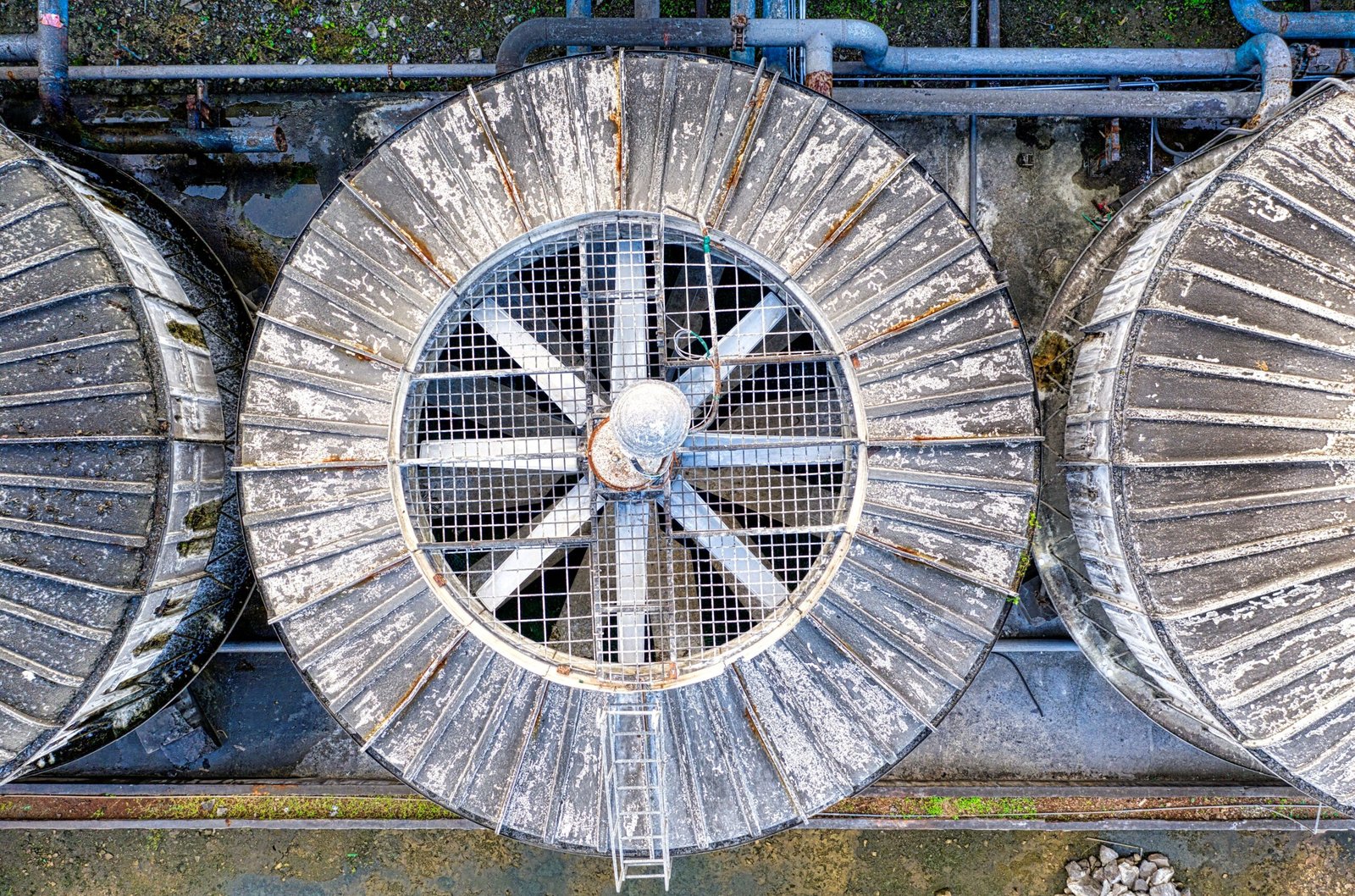 Maintenance and Fouling Prevention for HVAC Heat Exchangers
Maintenance and fouling prevention for HVAC heat exchangers focus on water treatment, filtration, cleaning schedules, and performance monitoring. Regular maintenance preserves efficiency and extends equipment life.
H3: Common Fouling in HVAC Systems
Scale from hard water
Biological growth in cooling towers
Particulate from open loops
Corrosion products from piping
Glycol degradation products
H3: Prevention Measures
Water softening or demineralization
pH control (7.5–8.5 for cooling water)
Biocide dosing for cooling towers
Filtration (50–200 micron)
Glycol monitoring and replacement
Closed-loop treatment with inhibitors
H3: Cleaning Methods
| Method | Best For | Downtime |
|---|---|---|
| CIP (clean-in-place) | Light scaling, biological | Low |
| Manual plate opening | Heavy deposits in PHE | Moderate |
| Hydrojetting | Tube-side fouling in STHE | Moderate |
| Bundle removal | Shell-side fouling in STHE | High |
H3: Monitoring
Track U-value and pressure drop
Clean when U drops 15% or ΔP rises 30%
Inspect gaskets and plates during cleaning
Keep spare gaskets on site
Cost, Lead Time, and Certification Factors
Cost, lead time, and certification for HVAC heat exchangers depend on type, material, size, and market requirements. Gasketed PHEs are typically lower cost for clean duty; STHEs are higher but more robust.
H3: Cost Factors
| Factor | Impact |
|---|---|
| Heat transfer area | Direct cost driver |
| Material (316L vs titanium) | 1.5–4× cost difference |
| Pressure rating | Higher pressure = thicker plates/tubes |
| Gasket material | FKM/PTFE higher than EPDM |
| Certification | Adds engineering and inspection cost |
| Custom vs standard | Custom adds 20–50% |
H3: Lead Time Factors
| Item | Typical Lead Time |
|---|---|
| Standard gasketed PHE | 2–4 weeks |
| Custom gasketed PHE | 4–8 weeks |
| Brazed PHE | 4–6 weeks |
| Standard STHE | 6–10 weeks |
| Custom STHE (exotic material) | 10–16 weeks |
| Certification (PED, ASME) | +2–6 weeks |
H3: Certification Requirements by Market
| Market | Requirement |
|---|---|
| Europe | PED 2014/68/EU, CE marking, EN 13445 |
| North America | ASME Section VIII, U-stamp, CRN |
| Middle East | ASME, PED, local authority |
| Southeast Asia | ASME, PED, national standards |
| Marine | ABS, DNV, Lloyd’s Register |
| Data center | PED, ASME, or local code |
HVAC Heat Exchanger Selection Checklist
Use this checklist before confirming any HVAC heat exchanger order.
- □
Heat duty (Q) calculated and verified
- □
Fluid properties confirmed (density, viscosity, cp, k)
- □
Design pressure and temperature defined
- □
Allowable pressure drop specified per side
- □
Temperature approach confirmed feasible
- □
Fouling factors selected
- □
Exchanger type chosen (gasketed PHE, brazed PHE, STHE)
- □
Material and gasket selected
- □
Certification requirements identified (PED, ASME, marine)
- □
Footprint, weight, and access verified
- □
Maintenance and cleaning method planned
- □
Spare parts strategy defined (gaskets, plates, tubes)
- □
Supplier thermal calculation and drawing requested
- □
Test certificates and traceability confirmed
- □
Lead time and delivery terms agreed
Common Mistakes and How to Avoid Them
1. Choosing PHE for dirty cooling tower water.
Narrow plate channels block easily. Use STHE or wide-gap PHE.
2. Ignoring allowable pressure drop.
A design that meets duty but exceeds ΔP will fail. Specify ΔP limits.
3. Undersizing for future capacity.
Select a PHE frame that allows adding plates, or size STHE with margin.
4. Using the wrong gasket material.
NBR for chilled water, EPDM for hot water and steam. Match to temperature and fluid.
5. Skipping fouling factors.
Ignoring fouling leads to undersized units and unexpected downtime.
6. Mixing materials incorrectly.
Dissimilar metals cause galvanic corrosion. Use compatible materials or isolation.
7. Forgetting certification requirements.
PED, ASME, or marine approvals affect design and lead time. Plan early.
8. Overlooking maintenance access.
STHE needs space for bundle removal; PHE needs space for plate opening.
9. Buying on price alone.
Cheapest unit may have higher operating cost or no spare parts support.
10. Not monitoring performance.
Track U and ΔP to detect fouling early. Clean at the trigger point.
FAQ
1. What is the best heat exchanger for HVAC?
For most HVAC water and glycol systems, a gasketed plate heat exchanger is the best choice due to high efficiency, close temperature approach, and compact size. For refrigeration, brazed plate is best. For high pressure or fouling, shell and tube is more suitable.
2. Which heat exchanger is best for chilled water?
A gasketed plate heat exchanger is best for chilled water because it achieves a close temperature approach and high efficiency in a small footprint. For small systems, a brazed plate may be used.
3. Can I use a plate heat exchanger for condenser water?
Yes, if the water is treated and filtered. For dirty cooling tower water, use a shell and tube or wide-gap plate heat exchanger to avoid blockage.
4. What is the best heat exchanger for a heat pump?
Brazed plate heat exchangers are commonly used in heat pumps because they handle refrigerant, are compact, and operate at higher pressures. Gasketed plate units are used for the water side in larger systems.
5. How do I size a heat exchanger for HVAC?
Calculate heat duty Q = ṁ × cp × ΔT, then required area A = Q / (U × LMTD × F). Check pressure drop, fouling, and temperature approach. Use vendor software for final sizing.
6. What material is best for HVAC heat exchangers?
316L stainless steel is standard for clean water and glycol. Titanium is used for seawater or high-chloride fluids. EPDM gaskets are common for hot water and steam; NBR for chilled water.
7. How much does an HVAC heat exchanger cost?
For clean duty, a gasketed plate heat exchanger often costs 30–60% less installed than a shell and tube. Cost depends on area, material, pressure rating, and certification.
8. What is the typical lead time for an HVAC heat exchanger?
Standard gasketed PHE: 2–4 weeks. Custom PHE: 4–8 weeks. Brazed PHE: 4–6 weeks. Shell and tube: 6–16 weeks depending on material and certification.
9. How often should I clean an HVAC heat exchanger?
Clean when U drops 15% or ΔP rises 30% from clean baseline. Typical HVAC exchangers need cleaning every 6–24 months depending on water quality.
10. What certifications are required for HVAC heat exchangers?
In Europe, PED and CE marking. In North America, ASME Section VIII and U-stamp. Marine applications may need ABS, DNV, or Lloyd’s Register. Check local codes.
11. Can I add plates to an HVAC plate heat exchanger?
Yes, if the frame has spare capacity. Adding plates increases area and capacity. Verify pressure drop and gasket compatibility.
12. Which heat exchanger is best for data center cooling?
Brazed plate heat exchangers are often used in CDUs for liquid cooling because they are compact, handle high heat flux, and operate at higher pressures. Gasketed plate units are used for larger capacities.
Key Takeaways
Gasketed plate heat exchangers are the best choice for most HVAC water and glycol systems due to high efficiency, close approach, and compact size.
Brazed plate heat exchangers are best for refrigeration, heat pumps, and data center cooling.
Shell and tube heat exchangers are best for high pressure, high temperature, and fouling-prone HVAC duties.
Select based on heat duty, temperature approach, pressure, fouling, space, and maintenance access.
Materials: 316L stainless steel for clean water; titanium for seawater; EPDM or NBR gaskets for HVAC.
Monitor U and ΔP, clean at the trigger point, and keep spare gaskets on site.
Certification (PED, ASME, marine) affects design, cost, and lead time — plan early.
Always request a vendor thermal calculation and drawing before finalizing selection.