Cooling towers and dry coolers both reject unwanted heat from industrial processes, HVAC systems, data centers, refrigeration systems, and other thermal equipment. However, they use fundamentally different heat-rejection methods.
A cooling tower transfers heat from process water to air, primarily through evaporation. A dry cooler transfers heat from a closed-loop fluid to ambient air through a finned heat exchanger without intentionally evaporating water.
The more efficient option depends on what “efficient” means for the project. A cooling tower can usually achieve a lower leaving-water temperature relative to ambient dry-bulb temperature and can provide strong heat rejection with relatively compact equipment. A dry cooler eliminates evaporative water consumption and can simplify water treatment and maintenance, but its performance is more dependent on ambient air temperature.
The right choice therefore requires more than comparing rated heat capacity. Engineers should evaluate thermal duty, ambient conditions, approach temperature, water availability, fan power, pump power, maintenance, climate, operating hours, fluid temperature, system pressure, and total cost of ownership.
Cooling Tower vs Dry Cooler: Quick Answer
A cooling tower is generally more thermally effective when low process-fluid temperatures are required in a warm climate, because evaporative cooling can reject heat at temperatures approaching the ambient wet-bulb temperature. A dry cooler is generally more efficient from a water-use and maintenance perspective because it does not rely on evaporation.
The practical choice is:
- Choose a cooling tower when low leaving-water temperatures, high heat-rejection capacity, and water availability are priorities.
- Choose a dry cooler when water conservation, low maintenance, closed-loop operation, or avoidance of water treatment is more important.
- Consider a hybrid or adiabatic system when the project needs low temperatures during peak conditions but wants to reduce annual water consumption.
- Compare annual energy + water + treatment + maintenance costs, rather than comparing equipment purchase prices alone.
The key distinction is simple:
Cooling towers use evaporation to improve heat rejection; dry coolers use sensible heat transfer through an air-cooled heat exchanger.
How Does a Cooling Tower Work?
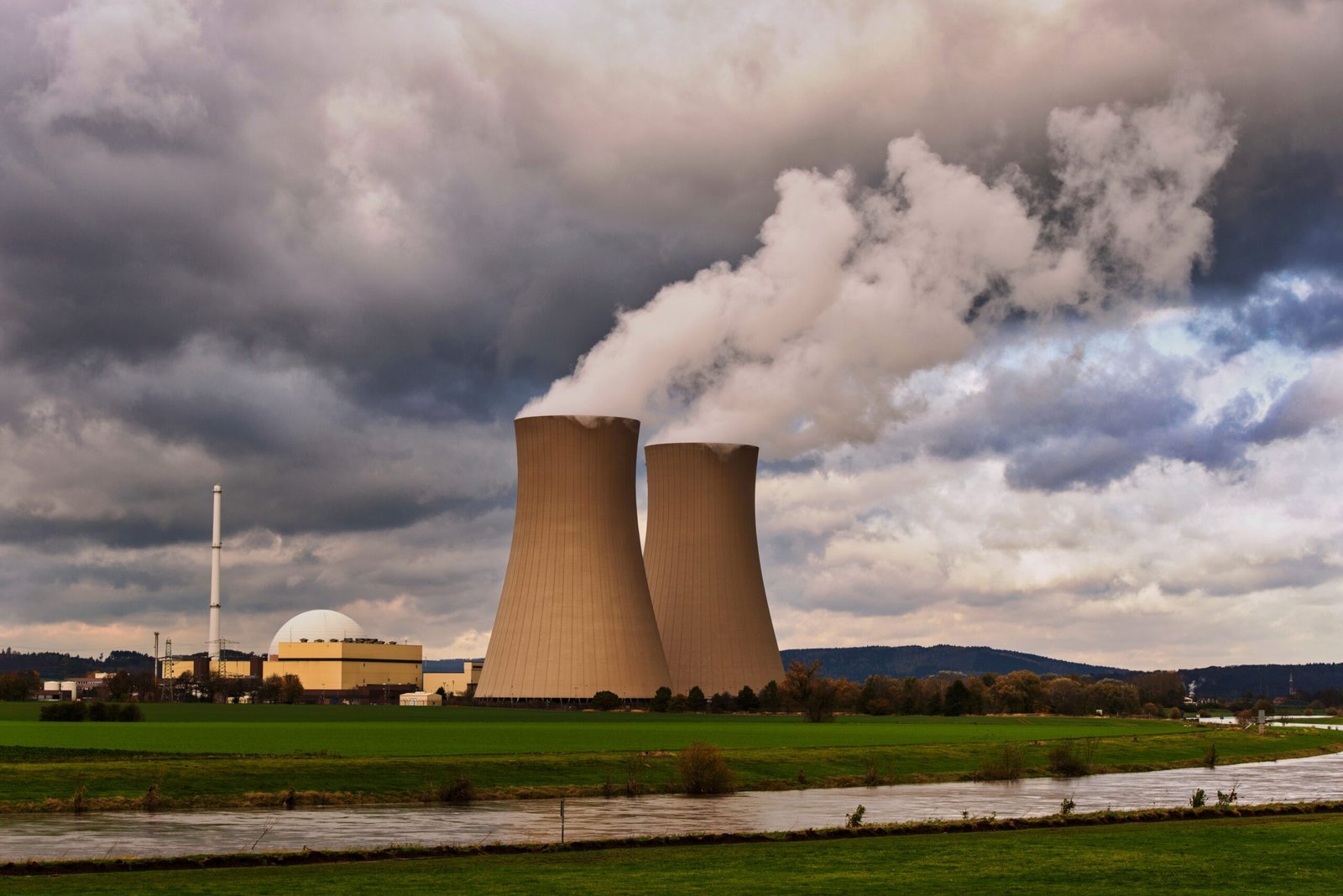
A cooling tower cools circulating water by bringing it into contact with an airflow. A portion of the water evaporates, and the latent heat associated with evaporation removes heat from the remaining water.
In a typical open cooling tower, hot water is distributed over fill material while fans or natural draft move air through the tower. The water exits at a lower temperature and returns to the process.
The fundamental heat balance can be expressed as:
Q = m × Cp × ΔT
Where:
- Q = heat rejection, typically kW
- m = water mass flow rate, kg/s
- Cp = specific heat capacity of water, kJ/kg·K
- ΔT = water temperature difference, °C or K
Evaporation provides an additional heat-rejection mechanism that makes cooling towers particularly effective in hot climates.
Why Wet-Bulb Temperature Matters
The limiting ambient temperature for an evaporative cooling tower is closely related to ambient wet-bulb temperature, rather than dry-bulb temperature alone.
For example, if outdoor air is 35°C (95°F) dry-bulb but has a wet-bulb temperature of 25°C (77°F), an evaporative cooling tower has a much lower theoretical cooling limit than a dry cooler exposed to the 35°C air temperature.
This is one of the biggest technical differences between the two technologies.
Cooling Tower Performance Factors
Performance depends on:
- Entering water temperature
- Leaving water temperature
- Water flow rate
- Ambient wet-bulb temperature
- Airflow
- Tower approach
- Heat-transfer fill
- Fan performance
- Water distribution
- Fouling and scaling
- Operating load
The approach is commonly expressed as:
Cooling tower approach = Cold-water temperature − Ambient wet-bulb temperature
A smaller approach generally requires a larger or more sophisticated tower and can increase capital cost and fan energy.
How Does a Dry Cooler Work?
A dry cooler is essentially an air-cooled heat exchanger designed to reject heat from a liquid or other closed-loop fluid directly to ambient air.
Hot fluid passes through tubes, while fans move air across the external finned surfaces. Heat flows from the fluid through the tube wall and fins into the air.
Unlike an evaporative cooling tower, the dry cooler does not intentionally consume process water through evaporation.
A simplified heat-transfer relationship is:
Q = U × A × ΔTlm
Where:
- Q = heat-transfer duty
- U = overall heat-transfer coefficient
- A = effective heat-transfer area
- ΔTlm = logarithmic mean temperature difference, or LMTD
The exact thermal design also considers air-side and liquid-side heat-transfer coefficients, fin efficiency, fluid properties, fouling, airflow, and temperature differences.
Dry Cooler Performance Factors
Important parameters include:
- Ambient dry-bulb temperature
- Fluid inlet temperature
- Required fluid outlet temperature
- Fluid flow rate
- Airflow
- Heat-transfer surface area
- Fan speed
- Fin design
- Tube material
- Fluid viscosity
- Glycol concentration
- Allowable pressure drop
The biggest limitation is that the dry cooler cannot normally cool the fluid below the ambient dry-bulb temperature.
For example, if the ambient air is 35°C (95°F), a dry cooler cannot practically produce a 30°C (86°F) outlet fluid temperature under steady sensible heat-transfer conditions. A temperature difference is required to transfer heat from the fluid into the air.
Which Is More Energy Efficient: Cooling Tower or Dry Cooler?
There is no universal answer because “energy efficiency” can mean several different things.
A cooling tower may achieve a lower fluid temperature at high ambient temperatures because evaporative cooling uses the wet-bulb temperature as its practical reference. However, it requires fans, pumps, and water-treatment equipment.
A dry cooler avoids evaporative water consumption but may require substantial fan power when ambient temperatures are high and the required fluid-to-air temperature difference becomes small.
Thermal Efficiency
For high-temperature rejection requirements, a cooling tower often has an advantage because evaporation provides a strong heat-transfer mechanism.
A dry cooler relies primarily on sensible heat transfer. Its required heat-transfer surface can become large when the ambient air temperature approaches the desired fluid temperature.
Electrical Efficiency
Electrical consumption depends heavily on equipment sizing and control strategy.
A dry cooler typically requires:
- Fan power
- Pump power for the circulating loop
A cooling tower typically requires:
- Fan power
- Circulating pump power
- Water-treatment equipment where applicable
- Makeup-water system
Neither technology should automatically be labeled “more energy efficient” without comparing the complete operating system.
Water Efficiency
Here the answer is much clearer.
A dry cooler uses substantially less cooling water because it does not reject heat through evaporation.
A cooling tower requires makeup water because water is lost through:
- Evaporation
- Blowdown
- Drift
- Maintenance and system losses
This can be a decisive factor in water-stressed locations.
Cooling Tower vs Dry Cooler: Temperature Performance
Temperature requirements often determine the technology before price is even considered.
Cooling Tower
Cooling towers can produce water temperatures relatively close to the ambient wet-bulb temperature, depending on tower design and operating conditions.
This makes them attractive for:
- Industrial process cooling
- Large HVAC systems
- Chiller condenser-water systems
- Power generation
- Manufacturing processes
- High-temperature heat rejection
Dry Cooler
Dry coolers are limited by ambient dry-bulb temperature.
If the required fluid temperature is significantly above the maximum outdoor temperature, a dry cooler can work very effectively.
If the required fluid temperature is only a few degrees above the summer design dry-bulb temperature, the required heat-transfer area and airflow can become substantial.
Example
Consider a hypothetical process requiring a circulating-water temperature of approximately 30°C (86°F).
If summer ambient dry-bulb temperature reaches 35°C (95°F), a conventional dry cooler cannot normally maintain a 30°C outlet because the air is already hotter than the target water temperature.
An evaporative cooling tower may still be able to produce water near 30°C if the ambient wet-bulb temperature is sufficiently lower.
This illustrates why climate data must be included in equipment selection.
When Is a Dry Cooler More Efficient?
A dry cooler is often the better choice when the process can tolerate a higher fluid temperature and water consumption needs to be minimized.
Typical applications include:
- Data center cooling
- Industrial machinery cooling
- Hydraulic systems
- Laser and welding equipment
- Power electronics
- Closed-loop process cooling
- Free cooling systems
- HVAC systems with suitable temperature requirements
- Refrigeration and condenser systems
Dry Cooler Advantages
1. No Evaporative Water Consumption
The primary advantage is the absence of intentional evaporation.
This is valuable where:
- Water is expensive
- Water supply is limited
- Wastewater discharge is restricted
- Water treatment is undesirable
- Environmental requirements favor low water consumption
2. Lower Water Treatment Requirements
A dry system does not normally require the same cooling-water treatment program as an open evaporative tower.
There is no cooling-tower basin exposed to the same biological and mineral concentration issues.
However, the closed-loop fluid may still require:
- Corrosion protection
- Glycol management
- Filtration
- Fluid quality monitoring
3. Lower Risk of Water-Related Fouling
Because there is no evaporative concentration of dissolved minerals in a tower basin, dry systems avoid many scale-related problems associated with open cooling-water circuits.
4. Easier Closed-Loop Operation
The process fluid can remain inside a closed circuit, reducing exposure to atmospheric contaminants.
This is particularly useful when the fluid is:
- Glycol-water
- Corrosion-sensitive
- Chemically treated
- Expensive
- Required to remain clean
When Is a Cooling Tower More Efficient?
A cooling tower becomes attractive when the required process temperature is low relative to the outdoor dry-bulb temperature.
Typical applications include:
- Large industrial cooling systems
- Chilled-water plants
- HVAC condenser-water systems
- Chemical processing
- Food and beverage manufacturing
- Plastics processing
- Power plants
- Refineries and petrochemical facilities
- Large-scale process cooling
The major advantage is evaporative heat rejection.
Because evaporation can reject substantial heat without requiring an extremely large temperature difference between the process water and ambient air, cooling towers can provide high heat rejection capacity in relatively compact equipment.
Cooling Tower vs Dry Cooler: Water Consumption
Water consumption can be one of the most important economic differences.
A cooling tower’s makeup-water requirement is related to evaporation, blowdown, drift, and other losses.
For a simplified evaporation estimate, the heat removed by evaporation can be approximated using the latent heat of vaporization:
Q ≈ m_evap × h_fg
Where:
- Q = heat rejected through evaporation
- m_evap = evaporated water mass flow
- h_fg = latent heat of vaporization
The actual makeup-water requirement is higher than evaporation alone because blowdown is required to control the concentration of dissolved solids.
Cycles of Concentration
Cooling tower operators often control water chemistry using cycles of concentration.
Higher cycles can reduce blowdown and makeup-water consumption, but excessive concentration can increase scaling and corrosion risk.
Therefore, water efficiency is not simply a matter of minimizing blowdown. The water-treatment strategy must remain compatible with:
- Water chemistry
- Materials
- Scaling tendency
- Corrosion
- Biological control
- Local regulations
A dry cooler avoids this entire evaporative-water-management cycle.
How Climate Changes the Decision
Climate is one of the strongest selection factors.
Hot and Dry Climate
A dry cooler may experience very high summer air temperatures, making it difficult to achieve low fluid temperatures.
An evaporative tower can benefit from a comparatively lower wet-bulb temperature, although water availability may be a concern.
Hot and Humid Climate
Cooling tower performance is influenced strongly by high wet-bulb temperatures. The cooling advantage over dry cooling can therefore become smaller than it would be in a hot, dry climate.
However, the tower may still outperform a dry cooler when low water temperatures are required.
Cool or Mild Climate
Dry coolers become increasingly attractive because the ambient air provides a large temperature difference.
Free cooling can sometimes reduce compressor or chiller operating hours substantially.
Water-Stressed Region
A dry cooler may be favored even if its thermal efficiency is lower because the project can avoid substantial water consumption and water-treatment costs.
This can be particularly relevant to industrial installations in areas with limited water availability.
Cooling Tower vs Dry Cooler: Decision-Making Framework
| Factor | Cooling Tower | Dry Cooler | What the Buyer Should Check |
|---|---|---|---|
| Heat rejection | Very strong with evaporation | Depends on air temperature and surface area | Required kW or BTU/h |
| Ambient reference | Wet-bulb temperature | Dry-bulb temperature | Summer design conditions |
| Water consumption | Required | Very low during normal operation | Water availability and cost |
| Low fluid temperature | Strong capability | Limited by ambient air | Required outlet temperature |
| Maintenance | Water treatment and cleaning required | Generally simpler | Maintenance resources |
| Scaling risk | Significant in water circuit | Lower in dry heat exchanger | Water/fluid chemistry |
| Biological control | Important for evaporative systems | Generally much less relevant | Site requirements |
| Fan power | Required | Required | Annual operating hours |
| Pump power | Required | Required for liquid loop | Flow and pressure drop |
| Closed-loop fluid | Usually possible through separate heat exchanger | Natural configuration | Fluid quality requirements |
| Climate sensitivity | Wet-bulb dependent | Dry-bulb dependent | Local weather data |
| Footprint | Often compact for high duty | Can become large at high ambient temperature | Available installation area |
| Water treatment | Required for open towers | Usually unnecessary for ambient-side cooling | Operating cost |
| Noise | Fans and water flow | Fans | Site noise limits |
| Corrosion | Water chemistry can be significant | Depends on fluid and materials | Material compatibility |
| Initial cost | Varies | Varies | Complete installed cost |
| Total operating cost | Water + power + treatment | Mainly power + maintenance | Annual lifecycle cost |
Cooling Tower vs Dry Cooler: Which Has Lower Maintenance?
Dry coolers generally have simpler maintenance because they do not require routine evaporative-water management. Cooling towers require more attention to water chemistry, biological control, blowdown, drift, basin cleaning, fill condition, and scale or corrosion.
Typical cooling tower maintenance includes:
- Cleaning basins
- Inspecting fill
- Checking nozzles
- Monitoring water chemistry
- Controlling biological growth
- Checking fans and motors
- Inspecting drift eliminators
- Managing blowdown
- Inspecting corrosion
- Monitoring scaling
Dry cooler maintenance commonly focuses on:
- Cleaning finned surfaces
- Inspecting fans
- Checking motors and controls
- Checking fluid quality
- Inspecting tubes and headers
- Maintaining pumps
- Checking glycol concentration where applicable
Dry coolers are not maintenance-free. Air-side fouling from dust, pollen, industrial contaminants, or insects can significantly reduce heat-transfer performance.
What About a Hybrid or Adiabatic Cooler?
A hybrid system can combine the advantages of dry and evaporative cooling.
An adiabatic cooler normally operates as a dry cooler under favorable conditions and uses water-assisted cooling when ambient temperatures become high.
This approach can reduce annual water consumption compared with continuous evaporative cooling while maintaining better peak-temperature performance than a conventional dry cooler.
Hybrid systems can be attractive where:
- Water is available but expensive
- Peak summer temperatures are problematic
- Most of the year can be operated dry
- Water conservation is important
- Process temperature requirements are relatively demanding
The economic evaluation should compare annual water consumption, fan energy, controls, maintenance, and capital cost rather than evaluating only peak cooling capacity.
Common Cooling Tower and Dry Cooler Selection Mistakes
1. Comparing Equipment by Heat Capacity Alone
Two systems may both be rated for 1 MW of heat rejection but have very different operating conditions.
Better approach: Compare performance at the actual design temperatures, flow rates, ambient conditions, and allowable pressure drops.
2. Ignoring Summer Design Conditions
Using average annual temperatures can produce an undersized system.
Better approach: Design around the relevant summer design dry-bulb and wet-bulb conditions, depending on technology.
3. Assuming a Dry Cooler Can Reach Any Fluid Temperature
A dry cooler cannot normally cool fluid below the ambient air temperature.
Better approach: Check the required outlet temperature against the site’s maximum design dry-bulb temperature.
4. Ignoring Water Costs
A cooling tower’s equipment price may look attractive until water, chemicals, treatment, blowdown, and wastewater costs are included.
Better approach: Calculate annual water and treatment costs.
5. Ignoring Fan Energy
A dry cooler can require substantial airflow at high ambient temperatures.
Better approach: Compare annual fan energy under the actual operating profile.
6. Selecting a Tower Without Water Chemistry Data
Poor water chemistry can cause scaling, corrosion, and biological problems.
Better approach: Provide available water analysis and establish an appropriate treatment strategy.
7. Oversizing Without Considering Control
Oversizing can increase capital cost and may cause poor part-load operation if the control strategy is inadequate.
Better approach: Evaluate fan speed control, staging, bypasses, and expected load profile.
8. Comparing Only Purchase Price
The cheapest equipment may not be the cheapest system to operate.
Better approach: Compare total cost of ownership over the expected service period.
9. Ignoring Installation Space
A dry cooler can require a large finned surface, while a cooling tower requires consideration of airflow, plume, access, basin, and water connections.
Better approach: Review the complete installation layout before final selection.
Cooling Tower vs Dry Cooler: Cost and Total Cost of Ownership
The purchase price depends on the required capacity, materials, controls, design conditions, accessories, and installation requirements.
For cooling towers, cost can include:
- Tower structure
- Fill
- Fans
- Motors
- Pumps
- Water distribution
- Basin
- Water treatment
- Chemical dosing
- Makeup-water system
- Blowdown system
- Drift control
- Installation
For dry coolers, major costs can include:
- Finned heat exchanger
- Fans
- Motors
- Headers
- Frame
- Pumps
- Controls
- Glycol or other system fluid
- Installation
The correct economic comparison should consider:
Total annual cost = electricity + water + treatment + maintenance + replacement/repair costs
A project with inexpensive water and strict temperature requirements may favor a cooling tower.
A project with expensive water, limited water supply, or high maintenance costs may favor a dry cooler even if its initial purchase price is higher.
Cooling Tower vs Dry Cooler: Which Should You Choose?
Use the following decision logic.
Choose a Cooling Tower If:
- You need relatively low circulating-water temperatures.
- Summer ambient temperatures are high.
- Water is reasonably available.
- High heat-rejection density is important.
- Evaporative cooling provides a significant thermal advantage.
- Water treatment infrastructure is acceptable.
- The project can manage maintenance requirements.
Choose a Dry Cooler If:
- Water consumption must be minimized.
- The process can operate at a higher fluid temperature.
- Ambient temperatures provide sufficient temperature difference.
- A closed-loop system is preferred.
- Low water-treatment requirements are important.
- The process fluid must remain isolated from ambient contamination.
- Maintenance simplicity is a major consideration.
Consider a Hybrid System If:
- Peak ambient temperatures create difficulty for dry cooling.
- Water consumption must remain controlled.
- The system can operate dry for much of the year.
- The project requires strong peak-temperature performance.
What Information Should You Provide to a Supplier?
A reliable cooling-system selection cannot be based only on “I need a 500 kW cooler.”
Provide as much of the following information as possible:
- Required heat rejection — kW or BTU/h
- Fluid type
- Fluid flow rate — m³/h, L/min, or GPM
- Fluid inlet temperature
- Required outlet temperature
- Maximum ambient temperature
- Ambient wet-bulb temperature where a cooling tower is being considered
- Ambient dry-bulb temperature for dry-cooler evaluation
- Operating hours per year
- Annual load profile
- Allowable pressure drop
- Available water quality data
- Water cost
- Electrical cost
- Installation space
- Noise limitations
- Fluid chemistry
- Required materials
- Connection specifications
- Applicable project standards
- Control requirements
- Quantity
- Delivery destination
- Required documentation and testing
This information allows the supplier and engineering team to compare the alternatives on an equivalent basis.
 Cooling Tower and Dry Cooler Selection Checklist
 Cooling Tower and Dry Cooler Selection Checklist
Before requesting a quotation, confirm:
Thermal Requirements
Heat-rejection duty
Fluid flow rate
Fluid inlet temperature
Required outlet temperature
Maximum operating load
Minimum operating load
Required operating range
Climate
Summer design dry-bulb temperature
Summer design wet-bulb temperature
Typical annual temperature profile
Seasonal operating conditions
Cooling Tower Information
Water quality
Makeup-water availability
Blowdown requirements
Water-treatment strategy
Drift requirements
Noise limits
Plume considerations
Dry Cooler Information
Fluid composition
Glycol concentration if applicable
Maximum ambient temperature
Required approach temperature
Available electrical power
Allowable pressure drop
Fin cleaning requirements
Mechanical and Commercial Requirements
Connection size and type
Material requirements
Installation dimensions
Weight limitations
Control requirements
Applicable standards
Quantity
Packaging
Destination country
Delivery schedule
Required technical documentation
Frequently Asked Questions
Is a cooling tower more efficient than a dry cooler?
A cooling tower is generally more thermally effective when low fluid temperatures are required in warm conditions, while a dry cooler is more water-efficient. The better solution depends on temperature requirements, climate, water cost, energy consumption, and maintenance requirements.
Does a dry cooler use water?
A conventional dry cooler does not require continuous evaporative water consumption. It rejects heat by passing ambient air over a finned heat exchanger. The closed-loop fluid may still require periodic filling or treatment, but this is fundamentally different from the continuous makeup-water requirement of an evaporative cooling tower.
Can a dry cooler replace a cooling tower?
A dry cooler can replace a cooling tower when the required fluid temperature can be maintained above the relevant ambient dry-bulb temperature. If the process requires temperatures close to or below summer ambient conditions, conventional dry cooling may not provide sufficient capacity.
Why can cooling towers achieve lower water temperatures?
Cooling towers use evaporation, so their thermal performance is related to ambient wet-bulb temperature rather than only dry-bulb temperature. This can provide a significantly lower cooling-water temperature than a dry cooler can achieve under the same weather conditions.
Which system uses more electricity?
Neither technology is always more electrically efficient. Fan power, pump power, operating temperatures, control strategy, heat-transfer area, and annual load profile all affect electricity consumption. A proper comparison should use annual operating data rather than rated motor power alone.
Which system requires less maintenance?
Dry coolers generally require less maintenance because they avoid evaporative-water treatment. They still require inspection and cleaning of fans, fins, coils, pumps, and fluid circuits.
Are dry coolers suitable for data centers?
Dry coolers can be suitable for data centers when the cooling architecture and required supply-fluid temperatures are compatible with outdoor conditions. They can also support free-cooling strategies and reduce water consumption.
Are cooling towers suitable for industrial process cooling?
Yes, cooling towers are widely applicable to industrial process cooling where significant heat rejection and relatively low circulating-water temperatures are required. Water quality, treatment, corrosion, scaling, and biological control must be addressed.
Which is better in a hot climate?
A cooling tower often has a thermal advantage in hot climates because evaporative cooling uses the lower wet-bulb temperature. However, water availability and treatment costs can make dry or hybrid cooling more attractive in some locations.
Which is better in a water-scarce region?
A dry cooler is often preferable in water-scarce regions because it avoids continuous evaporative water consumption. The trade-off is potentially higher fan power, larger equipment, or higher fluid temperatures during hot weather.
Does a dry cooler require glycol?
Not necessarily. Glycol is commonly used when freeze protection or other fluid-property requirements justify it, but the correct fluid depends on the application, operating temperature, materials, and system design.
What is the main difference between a cooling tower and a dry cooler?
The main difference is the heat-rejection mechanism: a cooling tower primarily uses evaporation, while a dry cooler transfers heat directly from a circulating fluid to ambient air through a finned heat exchanger.
Can a hybrid system reduce water consumption?
Yes. A hybrid or adiabatic system can operate in dry mode during favorable conditions and use water-assisted cooling during periods of high ambient temperature, potentially reducing annual water consumption compared with continuous evaporative operation.
How do I compare cooling tower and dry cooler costs?
Compare total lifecycle cost rather than equipment price alone. Include electricity, water, chemicals, maintenance, treatment, installation, replacement parts, and expected operating hours.
How to Choose a Cooling Equipment Supplier or Export Partner
The supplier should be able to translate your operating conditions into a technically appropriate cooling-system specification.
For a cooling tower or dry cooler project, evaluate whether the supplier can provide clear information about:
- Thermal design conditions
- Heat-rejection capacity
- Flow rates
- Inlet and outlet temperatures
- Pressure drop
- Materials
- Fan selection
- Motor requirements
- Water or fluid requirements
- Maintenance considerations
- Controls
- Dimensions and weight
- Testing and inspection documentation
- Packaging and export requirements
For custom applications, the ability to communicate accurately with the actual manufacturing and engineering teams is particularly important. A trading company should not simply forward a generic product catalogue; it should understand the customer’s operating conditions and coordinate the technical requirements with the appropriate manufacturer.
We work closely with qualified manufacturing partners and engineering teams to provide product sourcing, technical coordination, customization, quality control, and international export support. Depending on the application, this can include cooling equipment, air-cooled heat exchangers, heat exchangers for closed-loop systems, and related heat-transfer equipment.
The final equipment selection should always be confirmed through appropriate thermal and mechanical design based on the actual operating conditions.