Choosing the right heat exchanger tubes is a design decision, not simply a matter of selecting a tube diameter and material. Tube geometry, wall thickness, metallurgy, length, arrangement, fluid velocity, pressure, temperature, corrosion, fouling, and vibration all affect the performance and service life of a heat exchanger.
For shell-and-tube heat exchangers, an unsuitable tube can create problems ranging from excessive pressure drop and poor heat transfer to corrosion, leakage, vibration damage, and premature replacement. The correct choice must therefore consider both the thermal requirements and the mechanical environment.
This guide explains the main factors engineers, procurement teams, OEMs, and industrial buyers should evaluate when selecting heat exchanger tubes. It also explains common tube materials, tube dimensions, tube layouts, manufacturing options, and the information a supplier needs before recommending a suitable specification.
Quick Answer: How Do You Choose the Right Heat Exchanger Tubes?
The right heat exchanger tube is selected by matching tube material, outside diameter, wall thickness, length, tube type, tube arrangement, and mechanical properties to the operating conditions.
The most important information includes:
- Fluid on the tube side and shell side
- Operating and design temperature
- Operating and design pressure
- Flow rate
- Required heat duty
- Allowable pressure drop
- Fluid chemistry and chloride content
- Fouling tendency
- Corrosion and erosion risks
- Required heat exchanger life
- Tube outside diameter and wall thickness
- Tube length and layout
- Tube-to-tubesheet connection
- Cleaning method
- Applicable design and material standards
There is no universally best heat exchanger tube material. 316L stainless steel, duplex stainless steel, copper alloys, titanium, carbon steel, nickel alloys, and other materials each suit different operating conditions. Final selection should be confirmed through thermal and mechanical design.
What Are Heat Exchanger Tubes and Why Do They Matter?
Heat exchanger tubes provide the heat-transfer surface between two fluids in many shell-and-tube heat exchangers. Typically, one fluid flows through the tubes while the second fluid flows around the outside of the tubes on the shell side.
Heat passes through the tube wall:
Tube-side fluid → tube wall → shell-side fluid
The tube material and geometry directly affect heat transfer, pressure drop, mechanical strength, corrosion resistance, fouling behavior, and service life.
A simplified heat-transfer relationship is:
Q = U × A × ΔTlm
Where:
- Q = heat-transfer duty
- U = overall heat-transfer coefficient
- A = effective heat-transfer area
- ΔTlm = logarithmic mean temperature difference, or LMTD
Tube selection influences several of these factors. Tube diameter affects flow velocity and heat-transfer area. Wall thickness affects thermal resistance and mechanical strength. Material affects thermal conductivity and corrosion resistance. Tube length and tube count determine available heat-transfer area.
A tube that looks suitable dimensionally may still be unsuitable thermally or chemically.
What Factors Should You Consider When Selecting Heat Exchanger Tubes?
The selection should start with the operating conditions rather than the tube material alone. A practical selection process normally evaluates fluid compatibility, thermal duty, pressure and temperature, tube geometry, mechanical requirements, fouling, corrosion, vibration, and maintenance requirements.
1. Identify the Tube-Side Fluid
The first question is: What fluid will flow through the tubes?
The fluid determines many of the tube requirements.
Typical tube-side fluids include:
- Cooling water
- Chilled water
- Glycol solutions
- Process water
- Seawater
- Steam
- Condensate
- Hydraulic oil
- Lubricating oil
- Refrigerants
- Hydrocarbon fluids
- Chemical solutions
- Food-processing fluids
- Gas or vapor
Do not select a tube solely because a material is generally described as “corrosion resistant.” Actual fluid chemistry matters.
For example, chloride-containing water can create corrosion concerns for some stainless steels. Seawater service may require more corrosion-resistant materials such as titanium or suitable copper alloys, depending on the application and conditions.
Problem
A buyer specifies “stainless steel tubes” without providing the actual fluid chemistry.
Why It Happens
Stainless steel is treated as a single material category, even though different grades have significantly different corrosion behavior.
How to Solve It
Provide the supplier with:
- Fluid name
- Concentration
- Chloride level where relevant
- pH
- Operating temperature
- Contaminants
- Dissolved gases where relevant
- Cleaning chemicals
- Expected operating conditions
Example
A tube exchanger handling ordinary treated cooling water may have very different material requirements from one handling warm seawater. Both are technically “water service,” but their corrosion environments are not equivalent.
How Does Tube Material Affect Heat Exchanger Performance?
Tube material affects corrosion resistance, thermal conductivity, mechanical strength, fabrication, cost, and service life.
Common heat exchanger tube materials include:
| Tube Material | Typical Advantages | Typical Considerations |
|---|---|---|
| Carbon steel | Low cost, good strength | Corrosion protection may be required |
| 304 stainless steel | General corrosion resistance | Not suitable for every chloride environment |
| 316/316L stainless steel | Better resistance to many corrosive environments | More expensive than carbon steel |
| Duplex stainless steel | High strength and good corrosion resistance | Material and fabrication require careful control |
| Copper / copper alloys | High thermal conductivity | Compatibility depends strongly on fluid chemistry |
| Titanium | Excellent resistance in many seawater/chloride applications | Higher material cost |
| Nickel alloys | Strong corrosion resistance in demanding chemical services | High cost |
| Aluminum alloys | Low weight and high thermal conductivity | Limited by corrosion and temperature conditions |
The “best” material depends on the complete operating environment.
Thermal Conductivity Is Not the Only Consideration
A material with higher thermal conductivity does not automatically make a better heat exchanger tube.
The overall heat-transfer coefficient is affected by multiple resistances, including:
- Tube-side convection
- Tube-wall conduction
- Shell-side convection
- Fouling
- Fluid properties
- Flow regime
- Surface condition
A simplified resistance relationship illustrates why:
1/U ≈ 1/hi + Rf,i + Rwall + Rf,o + 1/ho
Where:
- hi = tube-side heat-transfer coefficient
- ho = shell-side heat-transfer coefficient
- Rf,i = inside fouling resistance
- Rf,o = outside fouling resistance
- Rwall = tube-wall thermal resistance
Therefore, choosing a material only because it has high thermal conductivity can lead to a poor decision if that material has inadequate corrosion resistance or mechanical strength.
How Do Tube Diameter and Wall Thickness Affect Selection?
Tube outside diameter and wall thickness are two of the most important dimensional specifications.
Common industrial tube outside diameters include approximately:
- 12.7 mm (0.5 in)
- 15.88 mm (0.625 in)
- 19.05 mm (0.75 in)
- 25.4 mm (1 in)
Actual available sizes depend on the heat exchanger design, manufacturer, applicable standards, and application.
Tube Diameter
Smaller tubes can provide a high heat-transfer surface relative to exchanger volume, but they may increase pressure drop and be more difficult to mechanically clean.
Larger tubes may reduce pressure drop and improve cleanability, but can require more exchanger volume for a given heat-transfer area.
Tube diameter affects:
- Fluid velocity
- Reynolds number
- Pressure drop
- Heat-transfer coefficient
- Fouling behavior
- Cleaning access
- Tube count
- Shell diameter
- Overall exchanger dimensions
Wall Thickness
Wall thickness must provide sufficient mechanical strength and corrosion allowance while avoiding unnecessary thermal resistance and material cost.
A thicker wall can improve resistance to:
- Internal pressure
- External pressure
- Corrosion allowance
- Mechanical damage
- Erosion
However, increasing wall thickness also increases the distance heat must conduct through the tube wall and can increase material cost.
Problem
A buyer specifies a tube by outside diameter but does not specify wall thickness.
Why It Happens
Tube dimensions are sometimes treated as interchangeable when the same outside diameter can be available in multiple wall thicknesses.
How to Solve It
Specify:
- Outside diameter
- Wall thickness
- Material grade
- Tube length
- Required manufacturing standard
- Heat treatment condition where relevant
- Tolerance requirements
The final wall thickness should be established by mechanical design, corrosion allowance, pressure requirements, and applicable design rules.
How Does Flow Velocity Affect Heat Exchanger Tube Selection?
Flow velocity has a major effect on both heat transfer and tube reliability.
Higher velocity can increase turbulence and improve the tube-side heat-transfer coefficient. However, excessive velocity can cause:
- High pressure drop
- Erosion
- Vibration
- Noise
- Increased pumping power
- Localized damage at entrances or restrictions
Very low velocity can reduce turbulence and heat transfer while increasing the risk of fouling or deposition in some services.
This creates an important design balance:
Too low → poor heat transfer and potentially more fouling
Too high → excessive pressure drop, erosion, vibration, and operating cost
The appropriate velocity depends on the fluid, material, temperature, cleanliness, geometry, and design requirements.
What Should the Buyer Provide?
For tube-side selection, provide:
- Normal flow rate
- Minimum flow rate
- Maximum flow rate
- Fluid density
- Viscosity
- Specific heat
- Thermal conductivity
- Operating temperature
- Allowable pressure drop
For difficult fluids, actual or reliable design-property data is preferable to assumptions.
How Do Pressure and Temperature Affect Tube Selection?
Heat exchanger tubes must withstand both the design pressure and design temperature, not merely the normal operating values.
Important parameters include:
- Normal operating pressure
- Maximum operating pressure
- Design pressure
- Normal operating temperature
- Maximum design temperature
- Minimum design temperature where relevant
- Pressure difference across the tube wall
The tube wall is subjected to a pressure differential between the tube side and shell side. The mechanical design must also consider thermal expansion, support conditions, tubesheet connections, and applicable design requirements.
A tube that is adequate for a low-pressure water system may not be appropriate for high-pressure steam, refrigerant, chemical, or process applications.
Problem
The purchaser provides operating pressure but not design pressure.
Why It Happens
Normal operating conditions are readily available from the process specification, while design conditions may be listed separately in the equipment datasheet.
How to Solve It
Provide both normal and design conditions. If the design pressure and temperature are not known, the supplier should not assume them without engineering confirmation.
What Heat Exchanger Tube Types Are Available?
The correct tube construction depends on exchanger geometry, application, maintenance strategy, and manufacturing requirements.
Straight Tubes
Straight tubes are common in many shell-and-tube heat exchangers.
Advantages include:
- Straightforward construction
- Easier access for some mechanical cleaning methods
- Suitable for removable tube bundles
- Familiar manufacturing and inspection procedures
They may be used in fixed-tubesheet or removable-bundle configurations depending on exchanger design.
U-Tubes
U-tube heat exchangers bend the tubes into a U shape.
Advantages can include:
- Accommodation of thermal expansion
- Compact arrangement
- Reduced need for expansion joints in some designs
However, the curved section can make mechanical cleaning more difficult, and tube replacement considerations differ from those of straight tubes.
Finned Tubes
Finned tubes increase the external surface area available for heat transfer.
They can be useful when one fluid has a significantly lower heat-transfer coefficient, such as certain gas-side applications.
Fin selection involves additional considerations including:
- Fin material
- Fin height
- Fin density
- Fin thickness
- Fin attachment
- Fouling
- Corrosion
- Thermal expansion
Finned tubes should therefore be treated as a heat-transfer design decision rather than simply a higher-area version of a plain tube.
How Does Tube Arrangement Affect Heat Exchanger Performance?
Tube arrangement determines how tubes are distributed within the shell and influences heat-transfer area, shell-side flow, pressure drop, vibration risk, and exchanger size.
Common tube layouts include:
- Triangular
- Rotated triangular
- Square
- Rotated square
Triangular Tube Layout
Triangular arrangements can provide high tube density and effective shell-side turbulence.
They can therefore be attractive when compactness and heat-transfer performance are important.
The limitation is that mechanical cleaning between tubes can be more difficult.
Square Tube Layout
Square arrangements provide clearer spaces between rows of tubes.
This can be advantageous where mechanical cleaning or inspection between tubes is important.
The trade-off is that a square layout may require more shell area for the same number of tubes.
Practical Selection
Do not choose tube pitch and layout independently from maintenance requirements. A process with frequent mechanical cleaning may require a different arrangement from a clean closed-loop system.
How Do Fouling and Corrosion Affect Tube Selection?
Fouling and corrosion are two of the most important reasons for premature heat exchanger tube failure.
Fouling
Fouling creates an additional thermal resistance between the fluid and tube wall.
Common fouling mechanisms include:
- Scale formation
- Biological growth
- Suspended solids
- Oil deposits
- Chemical precipitation
- Process-product buildup
A tube design should therefore consider both the expected fouling rate and the cleaning method.
Problem
The exchanger performs well when new but gradually loses capacity.
Why It Happens
Fouling increases thermal resistance and can also reduce effective flow area, increasing pressure drop.
How to Solve It
Evaluate:
- Fluid cleanliness
- Water treatment
- Tube velocity
- Fouling tendency
- Cleaning frequency
- Chemical cleaning compatibility
- Mechanical cleaning requirements
Do not simply compensate for severe fouling by making the exchanger much larger. Correct process control and maintenance may provide a better long-term solution.
Corrosion
Corrosion can occur through several mechanisms:
- General corrosion
- Pitting
- Crevice corrosion
- Galvanic corrosion
- Erosion-corrosion
- Stress-related corrosion mechanisms
Material selection should account for the actual chemical environment, temperature, contaminants, and operating conditions.
For demanding applications, material compatibility should be reviewed by qualified engineering personnel rather than determined solely from a general material chart.
What Is the Best Tube Material for Different Applications?
There is no universal best heat exchanger tube material. A practical starting point is to match the material to the fluid and corrosion environment.
| Application | Possible Tube Materials | Key Considerations |
|---|---|---|
| General treated water | Carbon steel, stainless steel | Water chemistry and corrosion control |
| Chilled water | Stainless steel, copper alloys, other suitable materials | Glycol concentration and corrosion inhibitors |
| Process water | Stainless steel, duplex, carbon steel, others | Water chemistry and contaminants |
| Seawater | Titanium, suitable copper alloys, selected duplex grades | Chlorides, biofouling, velocity |
| Oil service | Carbon steel, stainless steel, selected alloys | Temperature, sulfur, additives, chemistry |
| Chemical processing | Stainless steel, duplex, nickel alloys, titanium, others | Exact chemical composition is critical |
| Refrigeration | Copper alloys, stainless steel, other compatible materials | Refrigerant, pressure, temperature |
| High-temperature service | Stainless steel, alloy steels, nickel alloys, others | Creep, oxidation, pressure, thermal cycling |
This table is only a preliminary screening tool. Final material selection requires application-specific engineering review.
Heat Exchanger Tube Selection: A Practical Decision Framework
Use the following sequence when preparing a tube specification or RFQ.
| Selection Factor | Why It Matters | What the Buyer Should Provide |
|---|---|---|
| Fluid | Determines compatibility and fouling risk | Fluid name and composition |
| Flow rate | Determines velocity and pressure drop | m³/h, L/min, kg/h, etc. |
| Temperature | Affects heat transfer and material performance | Inlet/outlet and design temperature |
| Pressure | Determines mechanical requirements | Operating/design pressure |
| Heat duty | Determines required thermal capacity | kW or BTU/h |
| Tube material | Controls corrosion resistance and strength | Preferred grade or application |
| Tube OD | Affects velocity, area, and exchanger size | mm or in |
| Wall thickness | Affects strength and thermal resistance | mm or standard designation |
| Tube length | Influences heat-transfer area and exchanger size | mm or m |
| Tube layout | Affects shell-side flow and cleaning | Triangular/square, etc. |
| Fouling | Influences thermal design and maintenance | Fluid cleanliness and fouling history |
| Cleaning | Determines tube accessibility | Chemical/mechanical/CIP |
| Tube-to-tubesheet joint | Affects sealing and reliability | Expansion, welding, or combined method |
| Design life | Influences material and corrosion allowance | Required service period |
| Standards | Controls design and documentation | Applicable project standards |
What Information Should You Send a Heat Exchanger Tube Supplier?
A supplier can make a much better recommendation when the RFQ contains operating information rather than only a tube size.
Ideally, provide:
- Application
- Heat exchanger type
- Tube-side fluid
- Shell-side fluid
- Flow rate for both sides
- Tube-side inlet and outlet temperature
- Shell-side inlet and outlet temperature
- Operating pressure
- Design pressure
- Operating and design temperature
- Required heat duty
- Allowable pressure drop
- Fluid chemistry
- Fouling conditions
- Existing tube material
- Existing tube OD and wall thickness
- Tube length
- Tube count if replacing an existing bundle
- Tube arrangement and pitch if known
- Tube-to-tubesheet connection
- Cleaning method
- Applicable standards
- Quantity required
- Delivery destination
For a replacement project, photographs, drawings, previous datasheets, nameplates, tube samples, or inspection reports can be particularly useful.
New Heat Exchanger Tubes vs Replacement Tubes
Selecting tubes for a new heat exchanger and replacing tubes in an existing exchanger are different tasks.
New Heat Exchanger
The designer can optimize:
- Tube diameter
- Tube length
- Tube count
- Material
- Tube pitch
- Layout
- Pass arrangement
- Shell diameter
- Baffle arrangement
- Pressure drop
This provides greater freedom to optimize thermal and mechanical performance.
Replacement Tubes
A replacement must normally fit an existing design.
Critical dimensions can include:
- Existing tube OD
- Wall thickness
- Tube length
- Tube pitch
- Tube count
- Tube-hole diameter
- Tubesheet thickness
- Tubesheet material
- Tube-to-tubesheet joint
- Baffle hole diameter
- Baffle spacing
- Pass arrangement
- Shell dimensions
A replacement tube should not be selected only because it has the same outside diameter as the old tube.
A material change or wall-thickness change can affect pressure rating, heat transfer, fabrication, corrosion behavior, and tube-to-tubesheet joining.
Heat Exchanger Tube Manufacturing and Quality Considerations
For industrial applications, tube manufacturing quality can be as important as nominal material selection.
Depending on the project, buyers may need to evaluate:
- Seamless or welded construction
- Dimensional tolerances
- Surface condition
- Straightness
- Material identification
- Heat treatment
- Tube-wall consistency
- Non-destructive examination
- Hydrostatic or other pressure testing where specified
- Eddy-current testing where applicable
- Material certificates
- Positive material identification where required
- Tube-to-tubesheet compatibility
The appropriate inspection program depends on the tube material, application, design code, purchaser specification, and risk level.
Do not automatically request every possible inspection. Testing should be matched to the actual technical and contractual requirements.
Common Heat Exchanger Tube Selection Mistakes
1. Choosing Material Only by Price
Problem: The lowest-cost tube material is selected without evaluating corrosion.
Why it fails: Premature corrosion can create leakage, downtime, and replacement costs that far exceed the original material savings.
Better approach: Compare material cost against expected service life, maintenance, fluid compatibility, and failure consequences.
2. Matching Only the Existing Tube Diameter
Problem: A replacement tube has the same OD but different wall thickness or material.
Why it fails: Mechanical, thermal, and fabrication characteristics can change.
Better approach: Match the complete tube specification and verify the design.
3. Ignoring Fluid Chemistry
Problem: The buyer specifies only “water,” “oil,” or “chemical.”
Why it fails: Water and oil compositions vary substantially, and contaminants can strongly affect corrosion.
Better approach: Provide actual fluid chemistry and operating temperature.
4. Selecting Very Small Tubes to Maximize Area
Problem: Small tubes appear attractive because they provide high surface-area density.
Why it fails: Pressure drop, fouling, cleaning access, and manufacturing constraints may become unfavorable.
Better approach: Optimize tube diameter together with flow velocity, pressure drop, fouling, and maintenance requirements.
5. Using Excessive Wall Thickness Without Need
Problem: A thick tube is selected as a simple safety measure.
Why it fails: Material cost increases and thermal resistance may increase without solving the actual design problem.
Better approach: Determine wall thickness from mechanical design, corrosion allowance, manufacturing requirements, and applicable standards.
6. Ignoring Vibration
Problem: Tube velocity and shell-side flow are evaluated only from a heat-transfer perspective.
Why it fails: Flow-induced vibration can cause tube wear, fatigue, or tube-to-baffle damage.
Better approach: Include vibration assessment in the mechanical design for applicable shell-and-tube configurations.
7. Treating a Material Chart as a Final Engineering Decision
Problem: A general compatibility chart is used to select the tube material.
Why it fails: Temperature, concentration, contaminants, velocity, stress, and combined exposure can change material behavior.
Better approach: Use material compatibility data as a screening tool and confirm demanding applications through engineering review.
 Plate Heat Exchanger vs Shell-and-Tube Tubes: When Does Tube Selection Matter?
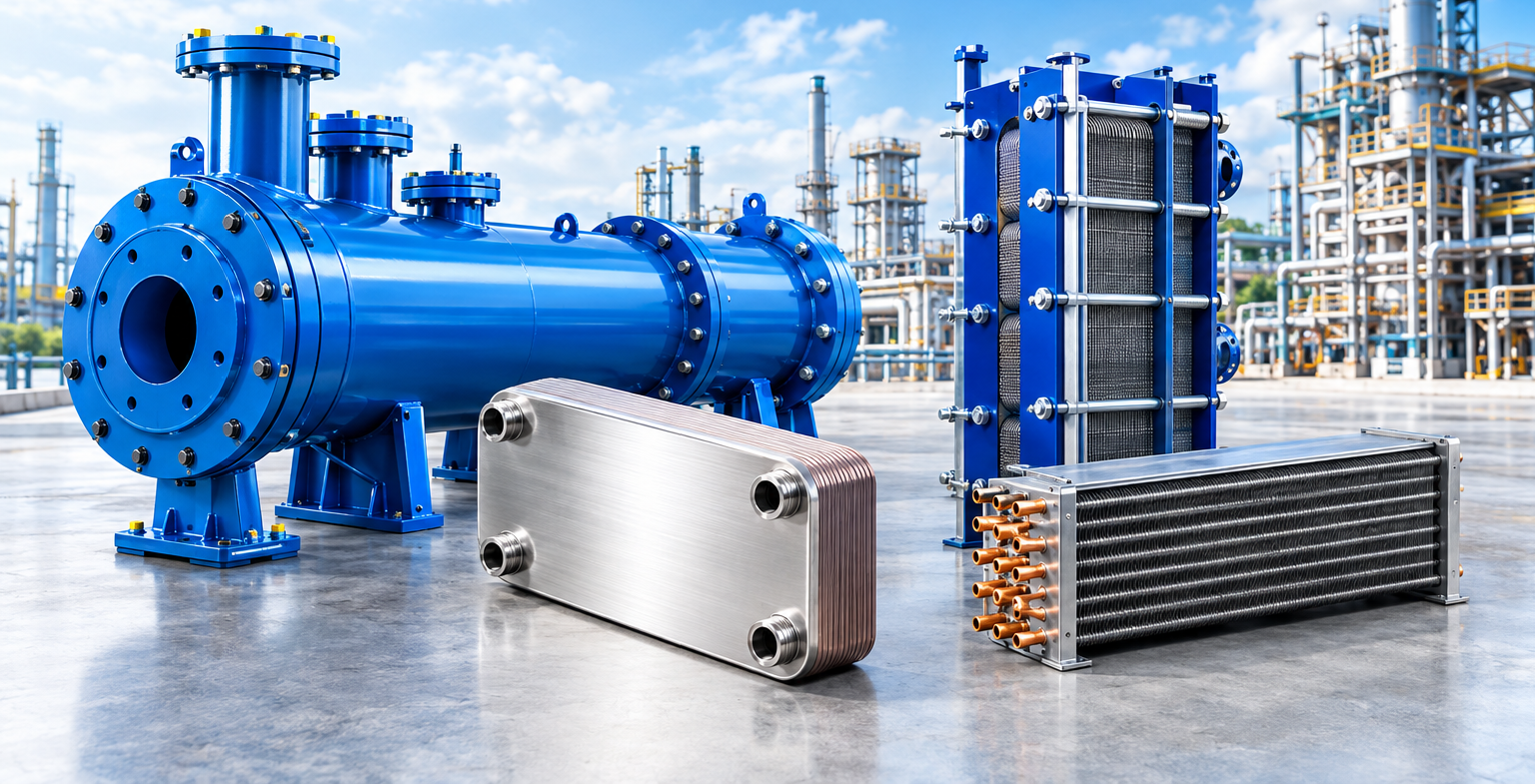 Plate Heat Exchanger vs Shell-and-Tube Tubes: When Does Tube Selection Matter?
Plate heat exchangers and shell-and-tube heat exchangers solve many of the same heat-transfer problems but use different heat-transfer surfaces.
| Factor | Shell-and-Tube | Plate Heat Exchanger |
|---|---|---|
| Heat-transfer surface | Tubes | Corrugated plates |
| Typical compactness | Moderate | High |
| High-pressure applications | Strong option | Application-dependent |
| High-temperature applications | Strong option | Application-dependent |
| Mechanical tube cleaning | Possible in suitable designs | Different cleaning approach |
| Tube replacement | Relevant | Not applicable |
| Gasket consideration | Usually not the main heat-transfer boundary | Major consideration for gasketed types |
| Seawater service | Possible with appropriate tubes | Possible with suitable plates |
| Thermal expansion | Important design consideration | Different structural behavior |
For high-pressure, high-temperature, dirty, or mechanically cleanable services, shell-and-tube designs can offer important advantages. For compact liquid-to-liquid duties, plate heat exchangers can often provide high heat-transfer efficiency in a smaller footprint.
The correct choice depends on the complete process requirements.
What Affects Heat Exchanger Tube Cost?
Heat exchanger tube pricing depends on more than length and material weight.
Major cost factors include:
- Material grade
- Tube OD
- Wall thickness
- Tube length
- Quantity
- Seamless or welded construction
- Special alloy requirements
- Manufacturing tolerances
- Heat treatment
- Surface requirements
- Inspection and testing
- Certification and documentation requirements
- Tube-to-tubesheet fabrication
- Finned construction
- Custom dimensions
- Packaging
- International shipping
High-alloy materials such as titanium and nickel alloys can significantly increase material cost compared with common carbon steel or stainless steel.
For a complete heat exchanger, the tube cost is only one part of the total system cost. Design, tubesheets, baffles, shell, fabrication, inspection, testing, packaging, and logistics can all contribute significantly.
The lowest initial tube price is therefore not necessarily the lowest total cost of ownership.
Heat Exchanger Tube Selection Checklist
Before requesting a quotation, confirm the following:
Process Conditions
Application identified
Tube-side fluid identified
Shell-side fluid identified
Flow rates provided
Inlet temperatures provided
Required outlet temperatures provided
Heat duty provided
Operating pressure provided
Design pressure provided
Operating and design temperatures provided
Tube Specification
Tube material
Tube outside diameter
Wall thickness
Tube length
Straight or U-tube
Plain or finned tube
Tube layout
Tube pitch
Tube-to-tubesheet connection
Reliability
Fouling tendency evaluated
Corrosion risk evaluated
Fluid chemistry available
Cleaning method identified
Vibration considered
Required service life defined
Inspection requirements defined
Commercial
Quantity
Required documentation
Applicable standards
Packaging requirements
Destination country
Delivery schedule
OEM or compatible replacement requirement
Frequently Asked Questions About Heat Exchanger Tubes
What is the best material for heat exchanger tubes?
There is no single best material for all heat exchangers. Stainless steel, duplex stainless steel, copper alloys, titanium, carbon steel, and nickel alloys are selected according to fluid chemistry, temperature, pressure, corrosion risk, mechanical requirements, and cost.
What is the most common heat exchanger tube size?
Common shell-and-tube exchanger tube outside diameters include approximately 12.7 mm (0.5 in), 15.88 mm (0.625 in), and 19.05 mm (0.75 in), although many other sizes are available. The correct size depends on thermal, hydraulic, mechanical, and maintenance requirements.
How does tube diameter affect heat exchanger performance?
Tube diameter affects fluid velocity, pressure drop, heat-transfer coefficient, heat-transfer area, fouling behavior, and exchanger size. Smaller tubes can increase surface-area density but may create higher pressure drop or cleaning challenges.
What is the difference between tube OD and tube ID?
Tube OD is the outside diameter of the tube, while tube ID is the internal diameter. For a simple uniform-wall tube, ID is approximately the OD minus twice the wall thickness. Actual dimensions and tolerances depend on the applicable tube specification.
Are stainless steel tubes good for heat exchangers?
Stainless steel tubes are suitable for many heat exchanger applications because they offer useful corrosion resistance and mechanical performance. However, the correct grade must be selected according to fluid chemistry, temperature, chloride concentration, and other operating conditions.
Are titanium tubes suitable for seawater heat exchangers?
Titanium is widely considered for demanding seawater and chloride-containing applications because of its strong corrosion resistance in many such environments. The final material selection still depends on the complete service conditions, fabrication requirements, and project specifications.
Should heat exchanger tubes be seamless or welded?
Either construction can be appropriate depending on material, dimensions, pressure, application, applicable standards, and manufacturing requirements. The choice should be made according to the equipment design and relevant tube specification rather than assuming one construction is universally superior.
What causes heat exchanger tubes to fail?
Common causes include corrosion, erosion, flow-induced vibration, fatigue, fouling, freezing, excessive pressure, thermal cycling, mechanical damage, and tube-to-tubesheet problems. Failure analysis should identify the actual mechanism before selecting replacement tubes.
How thick should a heat exchanger tube be?
There is no universal wall thickness. It should be determined from design pressure, temperature, tube diameter, material strength, corrosion allowance, manufacturing requirements, and applicable design rules.
Can I replace carbon steel tubes with stainless steel tubes?
A material change may be possible, but it should be treated as an engineering change rather than a simple substitution. Tube strength, thermal performance, corrosion behavior, tube-to-tubesheet joining, galvanic effects, and compatibility with the existing exchanger should be reviewed.
How do you calculate heat exchanger tube area?
For a simplified tube surface calculation, tube area can be estimated from the relevant tube diameter and length. For a complete exchanger, effective heat-transfer area depends on the tube dimensions, tube count, arrangement, heat-transfer surface definition, and design configuration.
What information does a supplier need to quote replacement heat exchanger tubes?
A supplier should ideally receive the existing tube material, OD, wall thickness, length, tube count, tube arrangement, exchanger model or drawing, fluid conditions, pressure, temperature, and any inspection or material requirements. Photos and the original datasheet are also useful.
How can tube fouling be reduced?
Fouling can often be reduced through appropriate fluid velocity, water treatment, filtration, material selection, process control, and scheduled cleaning. The appropriate method depends on the type and source of fouling.
What is the difference between a heat exchanger tube and a boiler tube?
The terms describe tubes used in different equipment and service environments, although there can be overlap in applicable materials and manufacturing standards. Boiler tubes are designed for specific boiler functions and conditions, while heat exchanger tubes are selected according to the exchanger’s thermal, hydraulic, and mechanical requirements.
Can heat exchanger tubes be customized?
Yes. Heat exchanger tubes can be supplied in different materials, diameters, wall thicknesses, lengths, surface configurations, and constructions depending on manufacturing capability and applicable specifications. Customization should be based on an engineering drawing or clearly defined operating requirements.
How to Choose a Heat Exchanger Tube Supplier
A reliable supplier should do more than provide a material grade and unit price. The supplier or export partner should be able to understand the application and coordinate the technical details with the actual manufacturing team.
Before placing an order, evaluate whether the supplier can provide:
- Clear technical communication
- Complete tube specifications
- Material documentation where required
- Appropriate manufacturing standards
- Dimensional control
- Relevant inspection and testing
- Traceability where applicable
- Suitable packaging for international shipment
- Export documentation
- Replacement-part support
- Customization coordination
- Technical communication with the manufacturing partner
- Clear clarification of what is manufactured and what is supplied
For international buyers, this distinction is particularly important. A trading company can provide substantial value through sourcing, technical coordination, quality control, documentation, logistics, and export management, but it should clearly distinguish its role from that of the actual manufacturer.
We work closely with qualified manufacturing partners and engineering teams to provide product sourcing, technical coordination, customization, quality control, and international export support for heat exchanger tubes and related heat-transfer equipment.
Need Help Selecting the Right Heat Exchanger Tubes?
If you are specifying tubes for a new shell-and-tube heat exchanger or replacing tubes in an existing unit, send us your operating conditions, tube dimensions, material requirements, drawings, or equipment datasheet.