Choosing between a fin tube and a bare tube is primarily a heat-transfer design decision. The better option depends on the fluid on each side of the tube, heat-transfer coefficients, available space, fouling, pressure drop, temperature, corrosion, and maintenance requirements.
Fin tubes add extended surface area to the outside or inside of a tube. This can substantially increase heat-transfer capacity when one fluid has a much lower heat-transfer coefficient than the other, particularly in gas-side and air-side applications. Bare tubes, by contrast, are simpler, easier to clean, and often well suited to liquid-to-liquid duties.
Selecting the wrong tube type can result in an oversized exchanger, excessive pressure drop, unnecessary material cost, difficult cleaning, or inadequate thermal performance. This guide explains when fin tubes make sense, when bare tubes are preferable, and what engineers and buyers should consider before requesting a quotation.
Fin Tube vs Bare Tube: Quick Answer
Fin tubes are generally better when the fluid outside the tube has a low heat-transfer coefficient, such as air or many gases. Bare tubes are generally better when both fluids transfer heat effectively, especially in liquid-to-liquid applications where compact external fins provide little benefit.
The main difference is the available heat-transfer surface.
- Bare tube: heat is transferred directly through the tube’s outside surface.
- Fin tube: fins extend from the tube surface, increasing the external heat-transfer area.
- Fin tubes: can provide much more heat-transfer area within a similar exchanger envelope.
- Bare tubes: are generally easier to clean and mechanically inspect.
- Fin tubes: can be more sensitive to fouling, fin damage, corrosion, and manufacturing quality.
- Bare tubes: are often preferred for cleanable liquid services.
- Fin tubes: are particularly useful for air coolers, gas coolers, boilers, economizers, radiators, and other services with a relatively low heat-transfer coefficient on one side.
The correct choice should be confirmed through thermal, hydraulic, mechanical, fouling, and maintenance analysis rather than by surface area alone.
What Is the Difference Between a Fin Tube and a Bare Tube?
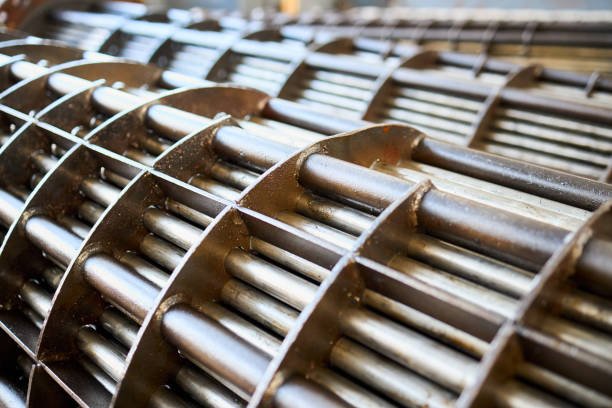
A bare tube has a relatively smooth external surface. A fin tube has additional material attached to or formed from the tube to increase heat-transfer surface area.
The basic heat-transfer path remains:
Hot fluid → tube wall → fin/tube surface → cold fluid
The important difference is that the fin increases the surface available for convection on the finned side.
A simplified heat-transfer relationship is:
Q = U × A × ΔTlm
Where:
- Q = heat-transfer duty
- U = overall heat-transfer coefficient
- A = effective heat-transfer area
- ΔTlm = logarithmic mean temperature difference, or LMTD
Adding fins primarily increases the available surface area A. However, the actual improvement in heat transfer is not simply proportional to the geometric fin area because the entire fin does not necessarily operate at the same temperature as the tube wall.
This is described by fin efficiency.
A well-designed fin increases effective heat-transfer area. An oversized, poorly selected, heavily fouled, or poorly attached fin may provide much less useful performance than its geometric area suggests.
When Is a Fin Tube Better Than a Bare Tube?
A fin tube is usually advantageous when there is a significant imbalance between the heat-transfer coefficients on the two sides of the tube.
The classic example is air-to-liquid heat transfer.
Water flowing inside a tube can transfer heat relatively effectively because liquid-side convection is usually much stronger than air-side convection. If the outside of the tube is exposed to air, the air-side resistance can dominate the overall thermal resistance.
Adding fins increases the air-contacting surface area and helps compensate for the low air-side heat-transfer coefficient.
Typical fin-tube applications include:
- Air-cooled heat exchangers
- Air heaters
- Air coolers
- Gas coolers
- Radiators
- Economizers
- Waste-heat recovery
- Boiler heat-transfer sections
- Process gas coolers
- HVAC coils
- Condensers and evaporators
- Fired-heater convection sections
Problem
A bare-tube exchanger does not provide enough heat-transfer capacity within the available footprint.
Why It Happens
The low heat-transfer coefficient on the air or gas side creates a large thermal resistance. Increasing bare-tube area may require a much larger exchanger.
How to Solve It
Consider extended surfaces such as fins if the application allows them. The design should evaluate:
- Required heat duty
- Air/gas flow rate
- Fluid temperature
- Fin material
- Fin efficiency
- Air-side pressure drop
- Fouling
- Cleaning requirements
- Available installation space
What to Provide to the Supplier
Provide:
- Air or gas flow rate
- Tube-side fluid and flow rate
- Both-side inlet and outlet temperatures
- Design temperature
- Pressure and allowable pressure drop
- Heat duty
- Fouling conditions
- Available dimensions
- Required material
- Fan information if forced or induced air is used
Example
Consider a liquid cooler using ambient air. The liquid inside the tubes may have a relatively high convective heat-transfer coefficient, while the air outside the tubes has a much lower coefficient. Increasing the external surface with fins can therefore produce substantially more useful heat-transfer area than simply using a larger number of bare tubes.
When Is a Bare Tube Better?
A bare tube is often preferable when the external fluid already has a relatively high heat-transfer coefficient or when cleaning and reliability are more important than maximum surface-area density.
Common applications include:
- Water-to-water heat exchangers
- Oil coolers
- Shell-and-tube process exchangers
- Condensers
- Some evaporators
- Chemical-process heat exchangers
- Dirty-fluid services requiring mechanical cleaning
- High-pressure tube-side services
- Applications where fin damage or fouling is a major concern
Bare tubes also offer a simpler construction.
There is no fin layer to account for, so the external surface is easier to inspect and clean. For services with suspended solids, heavy deposits, or frequent mechanical cleaning requirements, this can be a major advantage.
Problem
A buyer assumes that adding fins will always improve the exchanger.
Why It Happens
More physical surface area appears to mean more heat transfer.
How to Solve It
First identify which side of the exchanger controls the thermal resistance. If the limiting resistance is not on the finned side, adding fins may provide limited benefit while increasing cost and maintenance complexity.
Example
For a clean water-to-water shell-and-tube exchanger, both sides may already have relatively strong convection. A bare-tube design may provide sufficient heat transfer without the added complexity of external fins.
Fin Tube vs Bare Tube: Technical Comparison
| Factor | Fin Tube | Bare Tube |
|---|---|---|
| Heat-transfer area | High | Lower per unit tube length |
| Best use | Low heat-transfer coefficient side | Moderate/high coefficient services |
| Air-side applications | Excellent candidate | Often requires much more surface |
| Liquid-to-liquid service | Application-dependent | Often suitable |
| Compactness | High potential | Lower surface-area density |
| Fouling resistance | Application-dependent; fins can collect deposits | Generally easier to keep clean |
| Mechanical cleaning | More difficult on finned surfaces | Usually easier |
| Fin damage risk | Yes | No |
| Manufacturing complexity | Higher | Lower |
| Material cost | Usually higher | Usually lower |
| Pressure drop | Depends on fin geometry and flow arrangement | Generally simpler to predict |
| Inspection | More complex | Simpler |
| Replacement | Fin geometry must match design | Tube dimensions are primary |
| Maintenance | Can be more demanding | Generally simpler |
| Air/gas heat transfer | Strong advantage | Often inefficient in compact designs |
| Dirty external service | Can be problematic | Often preferable |
Neither design is universally better. The correct selection depends on the thermal bottleneck and operating environment.
How Do Fins Improve Heat Transfer?
The primary function of a fin is to increase the surface area available for convection.
Without fins, heat can leave the tube only through the tube’s external surface. With fins, heat can spread from the tube into the fin material and then transfer from the larger fin surface to the surrounding fluid.
However, fin temperature decreases as heat travels farther from the tube. Consequently, the outer portion of a fin is normally less effective than the portion close to the tube.
This is why fin efficiency matters.
A simplified concept is:
Effective fin area = Geometric fin area × Fin efficiency
The exact relationship depends on fin geometry, material thermal conductivity, thickness, temperature conditions, and convection coefficient.
High-Conductivity Materials
Materials with high thermal conductivity can help distribute heat along the fin.
Common fin materials may include:
- Aluminum
- Copper
- Steel
- Stainless steel
The appropriate choice depends on temperature, corrosion, mechanical requirements, manufacturing method, and compatibility with the tube.
A high-conductivity fin is not automatically the best option. Corrosion, thermal expansion, galvanic compatibility, and operating temperature must also be considered.
What Types of Fin Tubes Are Available?
Fin tubes can be manufactured using several different fin configurations and attachment methods.
1. Extruded or Integral Fin Tubes
The fin structure is formed from the tube or an integrated material arrangement.
These designs can provide strong thermal contact between tube and fin.
They may be useful where reliable heat transfer and mechanical integrity are important.
2. L-Foot or Embedded-Fin Tubes
The fin is mechanically formed around or into the tube surface.
These configurations can provide practical extended surfaces while maintaining a relatively economical construction.
3. Helically Wound Fin Tubes
A strip or wire is wound around the tube to create a continuous or segmented fin.
These are widely used in various air-cooled and process heat-transfer applications.
4. Welded Fin Tubes
The fin is attached to the tube by a welding process.
This can provide strong mechanical attachment and may be selected for demanding operating conditions.
The exact welding method and quality requirements depend on the tube and fin materials and the application.
5. Internally Finned Tubes
Fins can also be located inside the tube.
Internal fins are used where additional internal surface area or enhanced turbulence is required, including some specialized heat-transfer applications.
The important distinction is that fin placement should follow the side with the greatest thermal resistance, not simply the side that is easiest to manufacture.
How Does the Heat-Transfer Coefficient Affect Fin Tube Selection?
The heat-transfer coefficient is one of the most important reasons to use a fin tube.
The overall thermal resistance can be simplified conceptually as a combination of:
- Tube-side convection resistance
- Tube-wall conduction resistance
- Shell-side or air-side convection resistance
- Fouling resistance
If one side has a much lower heat-transfer coefficient, that side can dominate the total resistance.
For example:
Liquid → tube → air
may have a much larger air-side convection resistance than tube-side liquid resistance.
In this situation, increasing the air-side area with fins can significantly improve exchanger performance.
By contrast:
Water → tube → water
may have relatively strong convection on both sides. The benefit of external fins may therefore be much smaller.
Practical Rule
Use fins to address a genuine heat-transfer limitation, not simply to increase the amount of metal on the tube.
The final decision should be based on a thermal design rather than a generic rule.
How Do Fin Tubes Affect Pressure Drop?
Fins increase heat-transfer surface area, but they can also change the flow path.
For air-side or gas-side flow, fin spacing, height, thickness, and arrangement influence:
- Flow velocity
- Turbulence
- Pressure drop
- Fan power
- Heat-transfer coefficient
- Fouling
- Noise
A design with very dense fins may provide high surface area but create excessive air-side pressure drop.
This creates a trade-off:
More fin area → potentially more heat transfer
but also:
More restrictive geometry → potentially higher pressure drop and fan power
For forced-air systems, the additional operating cost of fans or blowers should be considered as part of the heat exchanger design.
Problem
The buyer requests the highest possible fin density.
Why It Happens
Higher fin density appears to provide more surface area and therefore more capacity.
How to Solve It
Specify both:
- Required heat duty
- Maximum allowable pressure drop
Then optimize fin density rather than maximizing it.
What to Provide to the Supplier
Provide:
- Air/gas flow rate
- Air inlet temperature
- Required air outlet temperature
- Allowable pressure drop
- Fan or blower operating conditions
- Fouling conditions
- Available face area
How Does Fouling Affect Fin Tube Selection?
Fouling can significantly reduce the advantage of a finned surface.
Dense fins create narrow passages where dust, dirt, biological material, oil, or other deposits can accumulate. Once fouled, the effective heat-transfer performance can decrease while air-side pressure drop increases.
Fouling is especially relevant in:
- Dusty industrial environments
- Outdoor air coolers
- Exhaust gas systems
- Process gas applications
- Oil-contaminated air streams
- Agricultural or biomass facilities
- Poorly filtered air systems
Fin Tube Problem
A highly finned exchanger performs well when clean but loses capacity rapidly in a dirty environment.
Better Approach
Consider:
- Wider fin spacing
- Appropriate filtration
- Accessible cleaning surfaces
- Lower fouling tendency
- Suitable fin geometry
- Regular maintenance
- Air-side pressure-drop monitoring
A lower fin density can sometimes provide better lifetime performance than a highly compact design that becomes heavily fouled.
How Do Fin Tubes Affect Cleaning and Maintenance?
Bare tubes are generally easier to clean than externally finned tubes.
For bare tubes, mechanical cleaning methods can often access the tube surface relatively directly. The exact method depends on the exchanger design and whether cleaning is required on the tube side or shell side.
Finned surfaces require more careful consideration.
Potential maintenance methods include:
- Compressed air
- Water washing
- Low-pressure cleaning
- Chemical cleaning where compatible
- Specialized fin cleaning equipment
- Vacuum cleaning
The cleaning method must not deform or damage the fins.
Problem
The buyer selects a dense fin arrangement without considering how the exchanger will be cleaned.
Why It Happens
The design is optimized for initial heat-transfer capacity rather than the full maintenance cycle.
How to Solve It
Define the cleaning method during equipment selection.
Ask:
- How often will cleaning occur?
- Is the contamination dry or wet?
- Is mechanical access required?
- Can the fin surfaces tolerate water or chemical cleaning?
- What happens if the exchanger cannot be fully cleaned?
Practical Example
For an air-cooled exchanger installed in a dusty industrial environment, a slightly more open fin configuration may be preferable if it can be cleaned more reliably and maintain airflow over a longer operating period.
How Do Fin Tube Materials Affect Performance and Reliability?
Tube and fin materials must be selected together.
Common combinations may include:
- Steel tube + steel fin
- Stainless steel tube + stainless steel fin
- Copper tube + aluminum fin
- Aluminum tube + aluminum fin
- Alloy tube + compatible fin material
The selection depends on:
- Operating temperature
- Corrosion environment
- Thermal conductivity
- Thermal expansion
- Mechanical strength
- Galvanic compatibility
- Manufacturing process
- Cost
Galvanic Corrosion
When dissimilar metals are electrically connected in the presence of an electrolyte, galvanic corrosion can become a concern.
For example, copper and aluminum combinations can be widely used in heat-transfer equipment, but the overall construction must account for the operating environment and corrosion-control strategy.
Material compatibility should therefore be reviewed rather than assuming that any tube-fin combination is acceptable.
Fin Tube vs Bare Tube for Different Applications
The following table provides a preliminary selection framework.
| Application | Likely Preference | Reason |
|---|---|---|
| Air-cooled heat exchanger | Fin tube | Air-side heat-transfer coefficient is relatively low |
| Gas cooler | Fin tube often advantageous | Increased gas-side surface area |
| Radiator | Fin tube | High air-side surface-area requirement |
| HVAC air coil | Fin tube commonly used | Compact air-side heat transfer |
| Water-to-water exchanger | Bare tube often suitable | Both sides can have relatively high heat-transfer coefficients |
| Oil-to-water exchanger | Usually bare tube | Liquid-side heat transfer can be sufficient |
| Dirty water service | Bare tube often easier | Better cleaning access |
| Seawater shell-and-tube service | Bare tube often considered | Corrosion resistance and cleanability may dominate |
| Waste-heat recovery from gas | Fin tube often advantageous | Gas-side resistance can be significant |
| High-fouling external fluid | Application-dependent | Fin density can worsen fouling |
| High-pressure liquid service | Bare tube often practical | Simpler mechanical construction |
These are starting points rather than universal rules.
What Should Buyers Check Before Choosing Fin Tubes?
A fin tube specification should include more than tube material and diameter.
Important parameters include:
Tube
- Tube material
- Tube OD
- Wall thickness
- Tube length
- Tube-side pressure
- Tube-side temperature
- Tube-side fluid
- Tube-side flow rate
Fin
- Fin material
- Fin type
- Fin height
- Fin thickness
- Fin spacing or fins per unit length
- Fin attachment method
- Fin efficiency
- Maximum operating temperature
- Corrosion environment
Heat Exchanger
- Required heat duty
- Heat-transfer area
- Air/gas flow rate
- Shell-side flow arrangement
- Allowable pressure drop
- Fouling factor
- Cleaning method
- Installation dimensions
- Required service life
Without these parameters, a supplier may be able to quote a physical product but cannot reliably confirm whether it is thermally suitable.
Fin Tube vs Bare Tube: Customer Decision Table
| Decision Factor | Choose Fin Tube When | Choose Bare Tube When |
|---|---|---|
| Low heat-transfer coefficient | One side is air/gas or otherwise weak | Both sides transfer heat effectively |
| Compactness | Small footprint is important | Space is less restrictive |
| Air cooling | Air-side area is limiting | Not normally the main application |
| Fouling | Surface can remain reasonably clean | Heavy fouling is expected |
| Cleaning | Non-mechanical cleaning is acceptable | Mechanical cleaning is important |
| Pressure drop | Additional flow resistance is acceptable | Very low pressure drop is critical |
| Maintenance | Fin cleaning can be managed | Simple inspection and cleaning are priorities |
| Cost | Higher initial cost is justified by capacity | Lower-cost construction is preferred |
| Heat transfer | Extended surface is needed | Bare surface is sufficient |
| Environment | Fin material is compatible | Corrosion or fin damage is a concern |
Common Fin Tube and Bare Tube Selection Mistakes
1. Assuming Fin Tubes Are Always More Efficient
More surface area does not automatically mean proportionally more heat transfer.
Better approach: Determine the controlling thermal resistance and evaluate fin efficiency.
2. Ignoring Air-Side Pressure Drop
A dense fin configuration can increase air-side pressure drop.
Better approach: Set a maximum allowable pressure drop and evaluate fan power together with thermal capacity.
3. Using Dense Fins in a Dirty Environment
Narrow fin passages can accumulate dust and deposits.
Better approach: Consider fouling conditions and cleaning access before selecting fin density.
4. Comparing Tubes by Surface Area Alone
Two finned tubes with the same nominal area may have different fin efficiency, contact resistance, flow characteristics, and fouling behavior.
Better approach: Compare effective thermal performance, not geometric area alone.
5. Ignoring Fin Attachment Quality
Poor contact between tube and fin increases thermal contact resistance.
Better approach: Specify the required fin attachment method and quality requirements.
6. Choosing Materials Independently
A corrosion-resistant tube combined with an unsuitable fin material does not automatically create a corrosion-resistant exchanger.
Better approach: Evaluate the complete tube-fin material combination.
7. Replacing a Finned Tube Without Matching Fin Geometry
A replacement tube with the same tube OD may still have different fin height, pitch, material, or attachment.
Better approach: For replacement work, match the complete tube-fin specification and confirm thermal performance.
8. Ignoring Maintenance
A highly compact exchanger can become uneconomical if it is difficult to clean.
Better approach: Consider the entire operating and maintenance cycle before optimizing initial size.
How Much Does a Fin Tube Cost Compared With a Bare Tube?
A fin tube generally costs more per tube than a comparable bare tube because it requires additional material, manufacturing operations, and quality control.
However, cost per tube is not the correct basis for comparing the two designs.
A fin tube may allow:
- Smaller exchanger dimensions
- Fewer tubes
- Lower overall equipment volume
- Reduced installation footprint
- Higher heat-transfer capacity within the same space
Conversely, a bare-tube exchanger may provide:
- Lower tube cost
- Simpler fabrication
- Easier cleaning
- Easier inspection
- Lower maintenance complexity
The relevant comparison is therefore total installed and operating cost, not just tube purchase price.
Factors affecting fin-tube pricing include:
- Tube material
- Fin material
- Tube diameter
- Wall thickness
- Fin height
- Fin thickness
- Fin spacing
- Fin attachment method
- Tube length
- Quantity
- Manufacturing tolerances
- Testing and inspection
- Packaging
- Customization
- Shipping
What Is Better for a New Heat Exchanger: Fin Tube or Bare Tube?
The answer depends on the thermal design.
A fin tube is generally a strong candidate when:
- One fluid is air or gas
- The gas-side heat-transfer coefficient is low
- Space is limited
- High heat-transfer surface density is required
- The finned surface can be kept reasonably clean
A bare tube is generally a strong candidate when:
- Both fluids are liquids
- Tube-side and shell-side heat transfer are relatively strong
- Mechanical cleaning is important
- Fouling is significant
- Simple inspection is preferred
- Fin damage is a concern
- The additional surface area is not needed
The correct approach is to compare both concepts using the same design duty, temperatures, flow rates, pressure-drop limits, materials, fouling assumptions, and operating environment.
Fin Tube vs Bare Tube for Replacement Projects
Replacement applications require extra caution because the existing exchanger establishes physical constraints.
Before replacing a bare tube with a finned tube, or vice versa, verify:
- Shell dimensions
- Tube OD
- Tube length
- Tube count
- Tube pitch
- Baffle spacing
- Baffle hole dimensions
- Fin height
- Fin spacing
- Tube material
- Fin material
- Tube-to-tubesheet connection
- Flow arrangement
- Heat-transfer duty
- Pressure drop
- Cleaning method
- Available installation space
A finned tube cannot simply be substituted because it has the same tube diameter.
Changing from bare to finned tubes can alter shell-side flow area, heat-transfer area, pressure drop, vibration characteristics, and maintenance requirements.
Similarly, removing fins may reduce the heat-transfer capacity substantially.
For replacement work, the existing exchanger should be evaluated before changing the tube construction.
What Should You Send a Fin Tube or Bare Tube Supplier?
A supplier should receive enough information to distinguish a physical replacement request from a new thermal design.
For a New Heat Exchanger
Provide:
- Application
- Heat duty
- Tube-side fluid
- Shell-side fluid
- Flow rates
- Inlet temperatures
- Outlet temperatures
- Operating pressure
- Design pressure
- Operating temperature
- Design temperature
- Allowable pressure drop
- Fouling conditions
- Installation dimensions
- Preferred materials
- Applicable standards
- Quantity
- Destination
For Replacement Tubes
Provide:
- Existing exchanger manufacturer
- Model
- Serial number if available
- Existing tube drawing
- Tube material
- Tube OD
- Wall thickness
- Tube length
- Tube count
- Tube layout
- Fin dimensions if applicable
- Fin material
- Fin attachment method
- Photos
- Nameplate information
- Existing operating conditions
- Reason for replacement
An original drawing or datasheet is particularly valuable because tube geometry alone may not fully define the original thermal design.
Heat Exchanger Tube Selection Checklist
Before approving a fin tube or bare tube specification, check:
Thermal
Required heat duty
Inlet and outlet temperatures
Fluid properties
Heat-transfer coefficients
LMTD
Required heat-transfer area
Fouling factor
Fin efficiency where applicable
Hydraulic
Tube-side flow rate
Shell-side or air-side flow rate
Tube-side pressure drop
Shell-side pressure drop
Air-side pressure drop where applicable
Fan/blower power where applicable
Mechanical
Tube OD
Wall thickness
Tube length
Tube material
Fin material
Fin dimensions
Fin attachment
Design pressure
Design temperature
Thermal expansion
Vibration risk
Reliability
Corrosion risk
Fouling risk
Cleaning method
Inspection requirements
Expected service life
Replacement requirements
Commercial
Quantity
Applicable standards
Documentation
Packaging
Shipping destination
Delivery requirements
OEM or customized requirements
Frequently Asked Questions
Is a fin tube better than a bare tube?
A fin tube is better when additional surface area is needed to overcome a low heat-transfer coefficient, particularly on an air or gas side. A bare tube is often better for liquid-to-liquid service, heavy fouling, or applications where cleaning simplicity is important.
Why are fins used on heat exchanger tubes?
Fins increase the effective heat-transfer surface area. They are especially useful when the fluid outside the tube has a relatively low heat-transfer coefficient, because additional area can compensate for the higher external thermal resistance.
Do fin tubes transfer more heat than bare tubes?
A fin tube can transfer substantially more heat than a bare tube of similar basic dimensions when the finned side is the limiting thermal resistance. The actual improvement depends on fin efficiency, geometry, fluid flow, temperature difference, fouling, and overall exchanger design.
Are fin tubes suitable for water-to-water heat exchangers?
Fin tubes are usually not necessary when both fluids are liquids with relatively high heat-transfer coefficients, although specialized designs may use them. Bare tubes are often sufficient and provide simpler cleaning and construction.
Are fin tubes good for air cooling?
Yes. Fin tubes are commonly used for air cooling because air generally has a lower convective heat-transfer coefficient than liquids. External fins provide substantially more air-side surface area without requiring a proportional increase in exchanger size.
Do fin tubes increase pressure drop?
They can increase pressure drop because fin geometry changes the flow passage. The effect depends on fin height, spacing, thickness, air or gas velocity, and exchanger arrangement. Thermal performance and pressure drop should therefore be designed together.
Are fin tubes more expensive than bare tubes?
Fin tubes normally cost more per tube because of additional material and manufacturing. However, they can reduce the overall exchanger size and tube count, so the complete equipment cost may still be competitive.
Are fin tubes harder to clean?
Externally finned tubes can be harder to clean than bare tubes, especially when fin spacing is narrow. The cleaning method and expected fouling should be considered before selecting fin geometry.
What is fin efficiency?
Fin efficiency describes how effectively a fin transfers heat compared with an ideal fin whose entire surface is at the base temperature. It depends on fin material, geometry, thickness, thermal conductivity, and convection conditions.
Can a bare tube be replaced with a fin tube?
A bare tube should not be replaced with a fin tube without checking the exchanger design. The change can affect heat-transfer area, shell-side flow, pressure drop, vibration, installation clearance, and cleaning.
Can a fin tube be replaced with a bare tube?
It may be physically possible in some replacement situations, but the loss of extended surface area can significantly reduce thermal capacity. A thermal redesign or performance verification is normally required.
Which is better for dirty air: fin tube or bare tube?
Neither is automatically better. Fin tubes can provide high heat-transfer capacity but may collect deposits between fins. A wider fin spacing, suitable cleaning system, filtration, or alternative exchanger design may be preferable for heavily contaminated air.
Which fin material is best?
There is no universal best fin material. Aluminum, copper, steel, stainless steel, and other materials may be appropriate depending on temperature, corrosion, thermal conductivity, mechanical requirements, and compatibility with the tube.
What information is needed to select a fin tube?
The supplier normally needs heat duty, both-side fluids, flow rates, inlet and outlet temperatures, operating and design pressures, allowable pressure drop, fouling conditions, tube and fin materials, available dimensions, and required service life.
How to Choose a Fin Tube or Bare Tube Supplier
The supplier should understand that tube selection is part of the heat exchanger design rather than an isolated commodity purchase.
For a technically demanding project, evaluate whether the supplier can coordinate:
- Tube and fin material selection
- Thermal requirements
- Tube dimensions
- Fin geometry
- Manufacturing specifications
- Material documentation
- Inspection requirements
- Tube-to-tubesheet compatibility
- Quality control
- Packaging
- International export documentation
- Replacement-part requirements
- Communication with the actual manufacturing team
For replacement work, the ability to interpret drawings, nameplate data, existing tube specifications, and operating conditions is particularly valuable.
We work closely with qualified manufacturing partners and engineering teams to provide product sourcing, technical coordination, customization, quality control, and international export support for fin tubes, bare tubes, shell-and-tube heat exchangers, and related heat-transfer equipment.
Need Help Choosing Between Fin Tubes and Bare Tubes?
Send us your heat duty, fluid conditions, flow rates, temperatures, pressure requirements, existing tube specifications, or equipment drawings.