When purchasing a heat exchanger for an industrial project, choosing the correct thermal capacity and materials is only part of the decision. The equipment may also need to comply with pressure equipment codes, regional product regulations, electrical safety requirements, or customer-specific specifications before it can be installed and operated.
For international buyers, four terms frequently appear in supplier quotations and technical documents: ASME, PED, CE, and UL. These designations are not interchangeable. Each serves a different purpose, and the requirements depend on the equipment design, operating conditions, intended application, destination market, and applicable legislation.
Confusing these requirements can lead to rejected equipment, additional inspection costs, delayed shipments, or expensive redesigns. A supplier may offer an ASME-coded heat exchanger that does not automatically satisfy European conformity requirements, while a CE-marked product may not meet a US customer’s ASME specification.
This guide explains what each designation means, how the requirements differ, which heat exchangers may need them, and what purchasing teams should confirm before placing an order with an international heat exchanger supplier.
Quick Answer: What Is the Difference Between ASME, PED, CE, and UL?
ASME is a code-based framework for pressure equipment construction, PED is an EU directive governing applicable pressure equipment, CE marking indicates conformity with applicable EU legislation, and UL is a product safety certification and testing system commonly associated with the North American market. Their applicability depends on the equipment and intended use.
| Designation | What it means | Primary relevance | Does it apply to every heat exchanger? |
|---|---|---|---|
| ASME | Construction code requirements for pressure equipment, including applicable heat exchangers | United States and international projects specifying ASME construction | No |
| PED | Pressure Equipment Directive 2014/68/EU | Applicable pressure equipment placed on the EU market | No |
| CE | European conformity marking under applicable EU legislation | Products covered by legislation requiring CE marking | No |
| UL | Product safety certification and related conformity services | North American electrical and other product safety requirements | No |
The most important purchasing principle is to identify the applicable legal requirements and project specifications before selecting a certification route.
A heat exchanger may require ASME construction, PED conformity and CE marking, electrical safety evaluation, or a combination of requirements. Other units may not require any of these specific designations. The correct answer must come from the actual equipment classification and intended installation.
1. What Is ASME Certification for Heat Exchangers?
ASME certification for heat exchangers generally refers to construction in accordance with the applicable provisions of the ASME Boiler and Pressure Vessel Code (BPVC), often Section VIII for pressure vessels, where the equipment falls within its scope and the project requires it.
ASME is the American Society of Mechanical Engineers. Its Boiler and Pressure Vessel Code provides technical rules addressing matters such as design, materials, fabrication, examination, testing, and documentation for covered pressure equipment.
For a shell-and-tube heat exchanger, the shell and associated pressure-retaining components may fall within a pressure-vessel code scope. However, the exact construction requirements depend on the design, pressure boundaries, configuration, code edition, and applicable project specification.
What does an ASME stamp mean?
An applicable ASME Code certification mark or stamp indicates that the equipment was constructed under the relevant Code requirements by an organization holding the required ASME authorization, subject to the applicable scope and certification rules.
It is not simply a label indicating that a product has undergone a pressure test.
A pressure test alone does not demonstrate compliance with all applicable design calculations, material requirements, fabrication controls, examinations, and documentation requirements.
Buyers should distinguish between:
- A heat exchanger designed or manufactured to an ASME-related specification.
- A heat exchanger constructed under the applicable ASME Code requirements.
- A heat exchanger eligible for the relevant ASME certification marking and documentation.
- A heat exchanger that has undergone pressure testing but does not carry ASME Code certification.
These descriptions are not equivalent.
Which heat exchangers may require ASME construction?
ASME construction may be specified for:
- Shell-and-tube heat exchangers used in industrial processes.
- Pressure-containing heat transfer equipment in chemical and petrochemical facilities.
- Oil and gas process equipment.
- Industrial steam and hot-water systems.
- Pressure equipment used in power generation.
- OEM equipment supplied under an ASME-based project specification.
Not every heat exchanger used in these industries necessarily requires an ASME stamp. The applicable code, equipment classification, local rules, and contract requirements must be confirmed.
Plate heat exchangers, brazed plate heat exchangers, and custom heat transfer units should also be evaluated according to their specific construction and applicable code scope rather than assumed to be automatically included or excluded.
What should buyers verify?
Before purchasing an ASME heat exchanger, ask the supplier or responsible manufacturer to confirm:
- Which ASME BPVC section and edition apply.
- Whether the complete heat exchanger or only a particular pressure-retaining component is covered.
- Whether the responsible manufacturing organization holds the required authorization for the intended certification scope.
- Whether the equipment will carry the applicable ASME certification mark or stamp.
- Which nameplate details, data reports, inspection records, and material documents will be supplied.
- Whether additional local registration or customer approval is required at the installation destination.
A supplier’s general statement that a product is “ASME compliant” should not replace written confirmation of the applicable code scope and deliverables.
Example: Shell-and-tube heat exchanger for a US industrial project
Consider a purchasing team sourcing a shell-and-tube heat exchanger for a US industrial facility. The project specification requires construction to ASME BPVC Section VIII.
The buyer should confirm the required code scope, design conditions, construction documentation, marking, inspection arrangements, and any applicable state or local requirements before approving the quotation.
A standard pressure test report alone would not satisfy a requirement for ASME Code construction.
Practical recommendation: If ASME construction is mandatory, state the required Code section, edition where specified, certification marking, documentation, and inspection requirements directly in the request for quotation (RFQ).
2. What Is PED for Heat Exchangers?
The Pressure Equipment Directive (PED) 2014/68/EU establishes requirements for applicable pressure equipment placed on the European Union market when the equipment falls within the Directive’s scope.
PED is not simply a voluntary quality standard. It is a European Union legal framework addressing pressure equipment safety, conformity assessment, and associated obligations.
Whether a heat exchanger falls within PED and which conformity assessment procedure applies depend on the equipment’s characteristics and classification.
When does PED apply?
PED generally concerns pressure equipment with a maximum allowable pressure, PS, greater than 0.5 bar above atmospheric pressure, subject to the Directive’s scope and exclusions.
The classification of an applicable heat exchanger depends on factors including:
- Maximum allowable pressure, PS.
- Volume or nominal size, depending on the equipment classification.
- Whether the equipment is classified as a vessel, piping, or an assembly.
- The fluid contained and its fluid group.
- The relevant equipment category and applicable classification rules.
- The intended use and the manufacturer’s defined equipment configuration.
Fluid classification is particularly important. PED distinguishes between Fluid Group 1, covering specified hazardous fluids, and Fluid Group 2, covering other fluids within the Directive’s classification framework.
A heat exchanger handling water, for example, cannot automatically be assigned a classification without reviewing the equipment’s pressure, configuration, and other relevant parameters.
What are the PED equipment categories?
Applicable PED pressure equipment is classified according to the Directive’s rules. Depending on the equipment and its parameters, it may fall under Category I, II, III, or IV.
There are also pressure equipment cases covered by Article 4(3), commonly described as sound engineering practice (SEP), where the equipment is not subject to the same CE-marking route under PED as equipment in the classified categories.
Not every pressure-containing heat exchanger requires CE marking under PED. The correct classification must be established using the Directive’s applicable rules.
For equipment in a category requiring a conformity assessment procedure involving a notified body, the appropriate notified body must participate within the scope of that procedure. The level and type of involvement depend on the selected conformity assessment route.
A notified body is an organization designated to carry out specified conformity assessment tasks under applicable EU legislation. It is not the same as an ordinary testing laboratory or a supplier’s internal quality department.
What documentation may be required?
Depending on the classification and conformity assessment route, the documentation for a PED-covered heat exchanger may include:
- Design and manufacturing information.
- Risk and hazard analysis, as applicable.
- Material documentation and traceability records.
- Inspection and testing records.
- Applicable conformity assessment documentation.
- EU Declaration of Conformity, where required.
- Operating instructions and safety information.
- Required nameplate details and CE marking.
- Notified-body identification details where applicable.
The precise documentation package must match the equipment’s classification and the legal requirements that apply to it.
What should European buyers ask?
For heat exchangers supplied to EU installations, request written confirmation of:
- Whether PED applies.
- The equipment’s PED classification and the basis for that classification.
- The applicable conformity assessment procedure.
- Whether a notified body is required and, if so, its role.
- Whether the product requires CE marking under PED or another applicable EU legal framework.
- Which declaration, technical documentation, inspection reports, and operating instructions will be supplied.
- Whether additional customer-specific or sector-specific requirements apply.
Example: Plate heat exchanger for an EU industrial facility
A European buyer needs a plate heat exchanger for an industrial cooling circuit. The equipment operates under pressure, and the purchasing specification requests PED documentation.
The supplier should not assume that the same conformity route applies to every plate heat exchanger. The classification must be established from the equipment’s relevant pressure and volume parameters, fluid classification, and configuration.
Once the applicable route is identified, the buyer can confirm the required assessment, marking, and documentation before production begins.
Practical recommendation: Ask for the PED classification and conformity route in writing rather than relying on a quotation that only states “CE available.”
3. What Does CE Marking Mean for Heat Exchangers?
CE marking indicates that a product is declared to conform to the applicable EU legislation requiring that marking. It allows the product to be placed on the EU market when the relevant legal requirements have been satisfied.
CE marking is not a universal quality certificate, a guarantee of service life, or proof that an independent organization has tested every product.
The applicable legislation and conformity assessment route determine what the manufacturer must do before affixing the marking.
Does every heat exchanger need CE marking?
No. A heat exchanger needs CE marking only when it falls within applicable EU legislation that requires CE marking and the relevant conditions are met.
For example, PED may apply to pressure equipment. Other legislation may also be relevant to a complete product or packaged system, depending on its design and intended use.
However, it is incorrect to assume that every standalone heat exchanger automatically requires CE marking under the same rules.
Some pressure equipment may fall under PED’s sound engineering practice provisions. Other products may be covered by different EU legislation or may not be subject to a CE-marking requirement at all.
The correct assessment must consider the actual product rather than its commercial name alone.
Who is responsible for CE marking?
The manufacturer defined under the applicable legislation is responsible for fulfilling the relevant obligations, which may include conformity assessment, technical documentation, issuing a declaration, and affixing the CE marking.
For a product supplied through a trading or export company, the parties must establish which legal entity is the manufacturer or otherwise assumes the relevant responsibilities under the applicable legislation.
The exporter, importer, distributor, and manufacturer may have different legal obligations. The fact that a trading company coordinates an order does not automatically make it the product’s manufacturer.
For custom OEM equipment, this responsibility should be agreed before production.
Does CE marking require a third-party organization?
Not always.
The required conformity assessment procedure depends on the applicable legislation and product classification. Some procedures allow the manufacturer to assess conformity without mandatory third-party certification. Other procedures require involvement by a notified body.
Under PED, for example, notified-body involvement depends on the equipment’s category and applicable conformity assessment route.
Therefore, buyers should not treat a third-party certificate as universally mandatory for every CE-marked heat exchanger.
CE marking versus a Declaration of Conformity
These are related but distinct.
- CE marking: The marking affixed to the product in accordance with applicable legislation.
- EU Declaration of Conformity: The formal declaration issued by the responsible manufacturer identifying the product and applicable legislation, among other required information.
- Technical documentation: The supporting documentation required to demonstrate conformity.
- Third-party certificate: A document issued by a relevant independent organization within its defined scope, where applicable.
A Declaration of Conformity should identify the relevant product and legislation. Buyers should check that the declaration matches the supplied model or equipment configuration.
A generic CE certificate that does not establish the applicable legal basis or identify the relevant product should not be accepted as sufficient evidence by itself.
What should buyers check on CE-related documents?
Confirm that:
- The product or equipment identification matches the quotation and delivered unit.
- The responsible legal entity is correctly identified.
- The applicable legislation is stated accurately.
- The declaration is issued by the responsible party.
- Any required notified-body involvement is documented.
- The marking and instructions meet applicable requirements.
- Any separate pressure equipment, electrical, machinery, or system requirements have been addressed where relevant.
Practical recommendation: Ask the supplier which legislation requires CE marking for the specific product and request the applicable Declaration of Conformity and supporting documents.
4. What Is UL Certification for Heat Exchangers?
UL is associated with product safety testing and certification, particularly in North American markets. UL certification may be relevant to electrical components, controls, and certain complete products or assemblies that incorporate heat exchangers.
However, UL certification is not a universal pressure-vessel certification for heat exchangers. Whether it is needed depends on the product, the applicable safety requirements, the installation, and the customer’s specifications.
When might UL be relevant?
UL requirements may arise when a heat exchanger is incorporated into equipment such as:
- Industrial cooling systems with electrical controls.
- Liquid cooling systems for electrical or electronic equipment.
- Packaged HVAC equipment.
- Refrigeration equipment.
- Equipment with pumps, motors, sensors, or control panels.
- OEM systems supplied to customers with specified component or system certification requirements.
The relevant certification scope might cover an electrical component, a control assembly, a complete packaged product, or another defined product category.
It should not be assumed that certification of one component establishes certification of the complete heat transfer system.
UL Listed, UL Recognized, and tested products
The scope and meaning of UL-related terms depend on the applicable program and product category.
| Term | General meaning | What buyers should verify |
|---|---|---|
| UL Listed | A product has been evaluated under an applicable UL certification program for its defined use and scope | The exact product, model, intended use, and certification status |
| UL Recognized Component | A component has been evaluated for use within specified conditions in a larger end product | Conditions of acceptability and the complete system’s requirements |
| UL testing or evaluation | Testing or evaluation has been performed within a defined scope | Whether it resulted in certification, a report, or another specific deliverable |
These terms should not be treated as interchangeable.
A heat exchanger component with a recognized status may still need to be incorporated into a complete system that meets the applicable requirements.
Does a heat exchanger need UL certification for the US market?
Not necessarily. UL certification is not a universal legal requirement for all heat exchangers sold in the United States.
The applicable requirements depend on the product category, electrical configuration, local rules, end-user requirements, and relevant installation standards. Some customers may specify UL certification contractually even where it is not a universal legal requirement.
Other conformity assessment organizations and certification routes may be acceptable for particular applications, subject to the applicable rules and authority having jurisdiction.
For pressure equipment, ASME construction and applicable local pressure-equipment requirements are separate considerations from electrical product safety certification.
What should buyers confirm?
Before specifying UL certification, ask:
- Is the requirement for the heat exchanger itself, a component, or the complete packaged system?
- Which exact product category and certification scope apply?
- Must the product be UL Listed, use UL Recognized Components, or meet another specified requirement?
- Does the customer’s installation standard accept the proposed certification route?
- Who is responsible for certification of the final assembly?
- Which models, components, and configurations are covered?
Practical recommendation: For an OEM liquid cooling or packaged HVAC project, define certification requirements for both the heat exchanger and the complete system. Do not assume that component-level certification automatically covers the final assembly.
5. ASME vs PED vs CE vs UL: Which Requirement Does Your Heat Exchanger Need?
The correct compliance route depends on the intended market and the function of the equipment. These designations address different questions, so one does not automatically replace another.
Comparison table
| Factor | ASME | PED | CE marking | UL |
|---|---|---|---|---|
| Main purpose | Code-based construction of covered pressure equipment | Legal requirements for applicable pressure equipment placed on the EU market | Indicates conformity with applicable EU legislation requiring CE marking | Product safety certification and related evaluation within a defined scope |
| Typical market relevance | US projects and international contracts specifying ASME | EU market for applicable pressure equipment | EU market for products covered by relevant CE-marking legislation | North American product safety requirements and customer specifications |
| Focus | Design, materials, fabrication, examination, testing, and records under applicable Code rules | Pressure equipment safety and conformity assessment | Conformity with applicable EU legislation | Safety of the evaluated product, component, or system within the certification scope |
| Third-party involvement | Required as prescribed by the relevant ASME certification program and Code scope | Depends on the applicable conformity assessment route | Depends on the applicable legislation and conformity assessment procedure | Depends on the chosen certification or evaluation program |
| Applies to every heat exchanger? | No | No | No | No |
| Typical evidence | Applicable Code marking, nameplate, data reports, and associated records | Applicable conformity documentation, assessment records, declaration, and marking where required | CE marking and relevant declaration and supporting documentation | Applicable listing, recognition, certificate, or evaluation records |
| Replaces the other requirements? | No | No | No | No |
Which one should you choose?
Use the following decision framework as a starting point.
If the equipment will be installed in the EU:
- Determine whether the heat exchanger falls within PED.
- Establish its classification and conformity assessment route.
- Identify any other applicable EU legislation.
- Confirm whether CE marking is required and which documents must accompany the equipment.
- Review customer-specific pressure equipment or industry requirements.
If the equipment will be installed in the United States:
- Confirm whether the project or applicable rules require ASME Code construction.
- Establish the applicable pressure equipment and installation requirements.
- Identify any electrical or system-level safety certification requirements.
- Confirm whether UL or another acceptable product safety evaluation is specified.
- Verify any state, local, end-user, or sector-specific obligations.
If the equipment will be installed in Canada:
- Determine the applicable provincial or territorial pressure equipment requirements.
- Check whether registration, such as a Canadian Registration Number (CRN), is required for the particular equipment.
- Review any applicable construction code and electrical or system safety requirements.
- Confirm the documentation and approval route with the responsible authority or qualified compliance specialist.
If the equipment will be supplied to the UK, Middle East, Australia, or Southeast Asia:
- Confirm the current requirements for the specific destination.
- Identify any pressure equipment registration, conformity marking, import, or local approval requirements.
- Review the customer’s project specification.
- Confirm whether the requested ASME, PED-related, CE, UL, or alternative documentation is relevant and acceptable.
Do not assume that approval for one market automatically authorizes installation in another.
Can a heat exchanger have both ASME and PED compliance?
Yes, a heat exchanger can be designed and documented to meet requirements associated with both ASME construction and PED, where feasible and appropriate. However, ASME construction does not automatically establish PED conformity, and PED conformity does not automatically establish ASME Code construction.
The design, materials, fabrication, inspection, documentation, and conformity assessment arrangements must satisfy each applicable set of requirements.
For custom equipment intended for international projects, it is usually more efficient to determine the target markets and compliance requirements before the design is finalized.
 6. What Tests and Documents Support Heat Exchanger Certification?
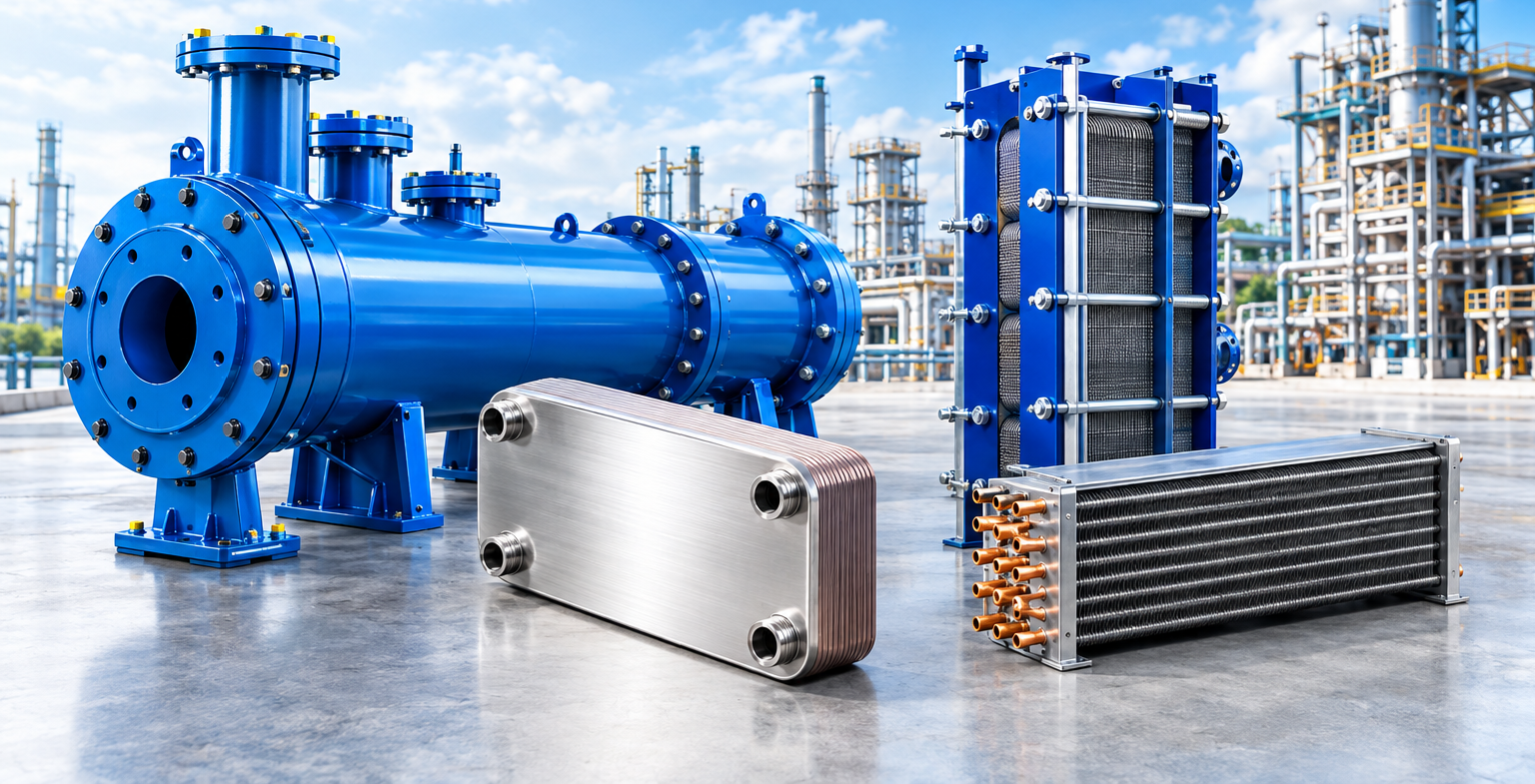 6. What Tests and Documents Support Heat Exchanger Certification?
Certification and conformity claims should be supported by documentation appropriate to the equipment, applicable requirements, and contract.
A test report is not the same as a product certificate. A material certificate is not proof of complete equipment conformity. Buyers should understand what each document demonstrates and what it does not demonstrate.
Common heat exchanger tests and records
| Test or document | What it can establish | What it does not establish by itself |
|---|---|---|
| Hydrostatic pressure test report | Results of a specified pressure test under documented conditions | Thermal performance, complete code compliance, or service life |
| Leak test report | Results of a defined leakage test and acceptance criteria | Full pressure equipment conformity or rated heat duty |
| Thermal performance test report | Measured thermal performance under specified test conditions | Universal performance under every operating condition |
| Non-destructive examination (NDE) report | Results of specified examination methods applied to relevant components or welds | That every part of the unit has been examined or that all requirements are satisfied |
| Material inspection certificate | Material information and test results within the document’s defined scope | Compliance of the finished heat exchanger with all applicable requirements |
| Dimensional inspection report | Recorded dimensions against specified tolerances or requirements | Pressure integrity or thermal performance |
| Declaration of Conformity | A responsible party’s formal declaration under applicable legislation | Automatic approval under every country’s rules |
| ASME Code data report or nameplate information, where applicable | Evidence associated with the relevant Code construction and certification scope | Compliance with unrelated local requirements |
| ISO 9001 certificate | The quality management system’s certified scope | Certification of every product or proof of a particular heat exchanger’s performance |
| Instrument calibration records | Evidence relating to measurement equipment calibration | Product conformity on their own |
Not every heat exchanger requires every test or document in this table. The applicable design code, product classification, customer specification, and intended service determine the necessary scope.
Pressure testing versus thermal performance testing
Pressure testing evaluates pressure-boundary integrity under a defined test procedure. Thermal performance testing evaluates heat transfer under specified operating conditions.
These tests answer different questions.
A heat exchanger may pass a pressure test but fail to achieve the required thermal duty because its heat transfer area, flow distribution, fouling allowance, or operating conditions are unsuitable.
Conversely, a unit that demonstrates adequate thermal performance under a test condition still needs to satisfy applicable pressure-boundary requirements.
Buyers should specify both tests when both are necessary.
Hydrostatic versus pneumatic testing
Hydrostatic testing uses a liquid as the test medium. Pneumatic testing uses a gas.
Hydrostatic testing generally stores less energy than pneumatic testing because liquids are much less compressible than gases. However, hydrostatic testing can still be hazardous and must follow an approved procedure.
Pneumatic testing can present substantially greater stored-energy hazards and requires a qualified, documented risk-controlled procedure. It should never be selected casually as a faster substitute for hydrostatic testing.
Test pressure, duration, medium, temperature limits, and acceptance criteria must be established by the applicable code, approved procedure, and contractual requirements. There is no single universal pressure or test duration suitable for every heat exchanger.
What should a useful test report contain?
Depending on the test and applicable requirements, buyers should look for:
- Equipment identification, including model or serial number where applicable.
- Test date.
- Test method and governing specification.
- Test medium and relevant conditions.
- Test pressure or thermal operating conditions, as applicable.
- Acceptance criteria and results.
- Relevant instrument identification and calibration traceability.
- Inspector, authorized signatory, or responsible organization, where applicable.
- Any deviations, limitations, or corrective actions.
- A clear connection between the report and the delivered equipment.
For custom OEM heat exchangers, the purchase order should identify required inspection and test records before production starts.
7. How Do Requirements Differ by Heat Exchanger Type and Application?
Certification requirements depend on more than the heat exchanger’s product name. Construction method, pressure boundaries, fluid hazards, electrical integration, and the final system design all influence the compliance route.
Shell-and-tube heat exchangers
Shell-and-tube heat exchangers often contain distinct shell-side and tube-side pressure boundaries. The two sides may operate at different pressures and temperatures.
The applicable design and inspection requirements should therefore consider both sides, their materials, their pressure ratings, and credible differential-pressure conditions.
Where ASME or another pressure equipment code applies, the responsible designer and manufacturer must determine the relevant code scope and documentation.
Buyers should provide the design pressure and temperature for each side rather than supplying only one overall operating pressure.
Plate heat exchangers
Plate heat exchangers may be gasketed, brazed, welded, or constructed using other joining methods.
For gasketed plate heat exchangers, buyers should consider the plate pack, frame, gasket material, design pressure, and fluid compatibility. For brazed or welded units, the joining method and construction details influence inspection and testing.
The applicable pressure equipment classification cannot be determined solely from the fact that the equipment uses plates.
Brazed plate heat exchangers
Brazed plate heat exchangers use a brazing alloy to join plates into a compact assembly. Their pressure integrity and performance depend on the design, materials, brazed joints, and operating conditions.
Buyers should confirm the applicable construction and testing requirements, rated operating limits, and fluid compatibility. If the unit is incorporated into a larger refrigeration or electrical system, additional system-level requirements may apply.
A component-level certificate should not be treated as proof that the complete system meets every applicable requirement.
Air-cooled and liquid cooling heat exchangers
Air-cooled heat exchangers and liquid cooling units may incorporate fans, motors, pumps, sensors, and control systems.
In these cases, compliance can involve several layers:
- Pressure-boundary requirements for fluid-containing components.
- Electrical safety requirements for motors, controls, and wiring.
- Product or system requirements for the complete assembly.
- Environmental and operating limitations.
- Customer-specific requirements for data centers, industrial equipment, or other applications.
UL certification may be relevant to particular electrical components or the complete product, but the exact certification scope must be confirmed.
Food, pharmaceutical, and hygienic applications
For food and pharmaceutical applications, regulatory and customer requirements may extend beyond pressure safety.
Relevant considerations can include wetted-material compatibility, cleanability, surface finish, gasket selection, contamination control, traceability, and the ability to meet the specified cleaning or sterilization process.
There is no single universal “food-grade heat exchanger certificate” that automatically satisfies every food or pharmaceutical application.
The buyer should define the process fluid, cleaning chemicals, temperature cycle, hygiene requirements, and applicable sector standards before equipment selection.
Which requirements apply to different heat exchanger types?
| Equipment type | Important considerations | Potential compliance needs |
|---|---|---|
| Shell-and-tube | Separate shell-side and tube-side design conditions; welded pressure boundaries where applicable | ASME or another applicable pressure equipment code; PED classification for EU use |
| Gasketed plate | Plate pack, frame, gasket compatibility, pressure and temperature limits | Applicable pressure equipment requirements and relevant declarations |
| Brazed plate | Brazed joint integrity, pressure rating, fluid compatibility | Applicable pressure equipment requirements; possible system-level requirements |
| Air-cooled | Pressure-containing components, fans, motors, electrical controls | Pressure equipment and electrical or product safety requirements as applicable |
| Liquid cooling unit | Coolant compatibility, leakage risks, electrical integration, system configuration | Pressure equipment, electrical, and system-level requirements as applicable |
| Custom OEM system | Integration of multiple components, final intended use, legal manufacturer responsibilities | A combination of applicable product and system requirements |
These are starting points, not definitive classifications. The final compliance route must be confirmed for the actual design and destination.
8. Common Mistakes When Buying Certified Heat Exchangers
Certification-related purchasing errors often arise because buyers specify a label without defining the legal or technical requirements behind it.
Mistake 1: Assuming CE, ASME, and UL are interchangeable
What buyers do: Request “international certification” without identifying the intended market or product requirements.
Why it causes problems: The supplier may offer documentation that does not satisfy the installation authority, end user, or project specification.
What to do instead: State the destination country, applicable code or regulation, intended use, and required documentation in the RFQ.
Mistake 2: Treating a pressure test as proof of ASME construction
What buyers do: Accept a pressure test report as evidence that a heat exchanger is ASME-certified.
Why it causes problems: Pressure testing is only one part of the relevant construction and certification requirements.
What to do instead: Confirm the required Code scope, authorization, marking, and associated records.
Mistake 3: Assuming every EU heat exchanger needs CE marking under PED
What buyers do: Require a PED CE mark without asking whether the equipment falls within the relevant category or conformity route.
Why it causes problems: The requirement may be misclassified, or the documentation may not match the applicable legal framework.
What to do instead: Ask for the equipment classification and the basis for the proposed conformity route.
Mistake 4: Confusing ISO 9001 with product certification
What buyers do: Treat a supplier’s ISO 9001 certificate as proof that a particular heat exchanger meets all technical requirements.
Why it causes problems: ISO 9001 addresses a quality management system within a defined scope. It does not independently establish product pressure integrity, thermal capacity, or conformity with every product regulation.
What to do instead: Review the relevant product design documents, test reports, material records, and conformity documents separately.
Mistake 5: Accepting a generic certificate that does not identify the product
What buyers do: Accept a certificate without checking the model, equipment identity, certification scope, or responsible organization.
Why it causes problems: The document may not apply to the delivered unit or its configuration.
What to do instead: Match the certificate and supporting reports to the model, serial number, design, or other appropriate product identification.
Mistake 6: Defining certification requirements after production begins
What buyers do: Request additional code stamping, inspection, or documentation only after the equipment has been manufactured.
Why it causes problems: The design, materials, inspection points, or manufacturing process may not support the newly requested requirements without rework or delay.
What to do instead: Agree on the code, conformity route, test plan, inspection points, marking, and document list before approving production.
Mistake 7: Assuming certification in one country guarantees acceptance elsewhere
What buyers do: Purchase equipment with documentation accepted for one market and assume it can be installed in another.
Why it causes problems: Regional regulations, registration requirements, and installation rules may differ.
What to do instead: Confirm destination-specific requirements before placing the order, including local registration where applicable.
Mistake 8: Specifying UL certification for the wrong part of a system
What buyers do: Request UL certification for a heat exchanger when the customer’s actual requirement concerns the electrical panel or complete packaged assembly.
Why it causes problems: The supplied component may not address the certification requirement for the final product.
What to do instead: Identify whether the required evaluation covers a component, subsystem, or complete system, and assign responsibility accordingly.
Mistake 9: Failing to define the required documentation package
What buyers do: Ask for “all certificates” without listing the required documents.
Why it causes problems: Buyers and suppliers may have different interpretations of what is included.
What to do instead: Attach a document schedule to the RFQ or purchase order. Identify required declarations, test reports, material records, inspection reports, operating instructions, and certification documents as applicable.
9. What Affects Heat Exchanger Certification and Compliance Costs?
The cost of supplying a compliant heat exchanger depends on the equipment, the applicable rules, the required inspection scope, and the amount of documentation or third-party involvement.
There is no reliable universal certification price for all heat exchangers. A compact brazed plate unit and a custom shell-and-tube exchanger designed for demanding pressure conditions may have substantially different compliance requirements.
Main cost factors
| Cost factor | Why it affects cost |
|---|---|
| Design code and engineering scope | May require specific design calculations, reviews, materials, and construction controls |
| Equipment pressure and temperature | Can influence classification, design requirements, and inspection scope |
| Materials and traceability | Special alloys and specified material documentation can increase procurement and verification costs |
| Non-destructive examination | Additional examination methods, coverage, and reporting require time and resources |
| Pressure and leak testing | Test arrangements depend on the equipment, procedure, acceptance criteria, and required records |
| Thermal performance testing | May require controlled test conditions, instrumentation, and additional engineering |
| Third-party assessment | Applicable assessment, inspection, or certification involvement can add fees |
| Nameplates and documentation | Special markings, declarations, traceability, and document formats require coordination |
| Customization | Non-standard designs can increase engineering and compliance coordination |
| Destination requirements | Registration, local approvals, or additional documents may be required |
| Inspection scheduling | Witness points, hold points, travel, and schedule constraints can affect project cost |
| Rework or retesting | Late specification changes or failed tests can create additional costs |
How can buyers avoid unnecessary costs?
The most effective approach is to define the compliance scope before requesting a final quotation.
Provide the supplier with the destination market, design conditions, applicable code or customer specification, required markings, inspection requirements, and document list.
Ask the supplier to distinguish between:
- Standard factory inspection and testing included in the base quotation.
- Additional tests required by the project.
- Third-party inspection or conformity assessment fees.
- Special materials and traceability requirements.
- Certification or registration costs.
- Documentation and export requirements.
- Any exclusions or assumptions.
A lower quotation may exclude an inspection or documentation item that another supplier has already included. Comparing the total price without comparing the technical scope can therefore produce a misleading result.
Should buyers choose the cheapest certified heat exchanger?
Not without confirming that the products and compliance packages are equivalent.
Two quotations may both mention “CE,” “ASME,” or “UL,” yet differ in equipment scope, certification status, documentation, inspection coverage, and responsibility for local approval.
Compare the complete technical and commercial package rather than relying on a certification label alone.
10. How to Specify ASME, PED, CE, or UL Requirements in an RFQ
A well-prepared request for quotation reduces ambiguity between the buyer, exporter, manufacturing partner, inspection organization, and end user.
The objective is not to request every possible certificate. It is to identify which requirements actually apply to the equipment and which documents must be delivered.
Heat exchanger compliance checklist
Before contacting a supplier, prepare the following information.
A. Application and destination
- Intended application and industry.
- Country of final installation.
- End-user or project requirements.
- Whether the equipment is a standalone exchanger or part of a packaged system.
- Whether the equipment is a new design, replacement unit, or OEM component.
B. Design conditions
- Heat exchanger type and configuration.
- Fluid on each side.
- Design pressure and temperature for each side.
- Operating pressure and temperature for each side.
- Flow rates and required thermal duty.
- Allowable pressure drop.
- Material requirements and fluid compatibility.
- Relevant connection and installation details.
C. Compliance requirements
- Required construction code, if specified.
- Whether ASME Code construction and marking are required.
- Whether PED applies and whether classification has been established.
- Whether CE marking is required under applicable legislation.
- Whether UL certification is required and for which product or component.
- Whether Canadian registration or other destination-specific approval is required.
- Applicable customer or industry standards.
- Required third-party assessment, inspection, or witness points.
D. Testing and documentation
- Pressure test and leak test requirements.
- Thermal performance test requirements, if applicable.
- Required NDE methods and scope, where applicable.
- Material certificates and traceability requirements.
- Required declarations and conformity documentation.
- Nameplate and marking details.
- Inspection and test plan.
- Required report format and language.
- Operating instructions and maintenance documentation.
- Final document approval and submission deadlines.
E. Commercial requirements
- Quantity and delivery schedule.
- Packaging and transport requirements.
- Required spare parts.
- Inspection arrangements before shipment.
- Export documentation.
- Warranty and after-sales expectations.
- Responsibilities for any required registration or final system approval.
Sample RFQ wording
The following template can be adapted for a project. Replace the bracketed fields with the actual requirements.
Heat Exchanger Compliance and Documentation Requirements
Please quote a heat exchanger for the following application: [application and industry], to be installed in [destination country].
Equipment type: [plate / shell-and-tube / brazed plate / air-cooled / liquid cooling / other].
Design conditions: [design pressure and temperature for each side, fluid details, flow rates, and required thermal duty].
Required code or standard: [specify applicable code, edition, and project requirements, if established].
Compliance requirements: Please confirm whether ASME construction, PED conformity, CE marking, UL certification, local registration, or other approvals are applicable to the proposed equipment. Identify the relevant scope and responsible legal entity.
Please list the inspection and testing included in your quotation, together with any optional tests, third-party inspection, certification, registration, or documentation costs.
Please provide a document schedule identifying the applicable declarations, material records, inspection reports, pressure or leak test reports, performance test reports, nameplate details, and other required documentation.
Please identify all assumptions, exclusions, and information required from the buyer before design approval and production.
This wording encourages the supplier to clarify the compliance route instead of simply confirming that a particular label is available.
11. How to Choose a Reliable Heat Exchanger Supplier or Export Partner
A reliable heat exchanger supplier should be able to explain the proposed product, identify the responsible manufacturer, and coordinate the documentation required for the intended application and destination.
For international purchasing, buyers should evaluate both technical suitability and the supplier’s ability to manage the commercial and compliance process.
What should buyers evaluate?
Technical communication: The supplier should ask for design pressure, temperature, fluid details, flow rate, thermal duty, and destination rather than recommending a product based only on a general description.
Manufacturer identification: Buyers should know which organization is responsible for manufacturing the equipment and which legal entity assumes the applicable product responsibilities.
Code and regulatory understanding: The supplier should distinguish between ASME construction, PED conformity, CE marking, UL certification, and local registration.
Document traceability: Certificates, test reports, and declarations should correspond to the actual product, applicable scope, and delivered configuration.
Quality control coordination: The supplier should be able to clarify how the manufacturer will conduct the agreed inspections and tests, who will review the records, and whether third-party inspection is required.
Customization capability: For OEM or project-specific equipment, the supplier should coordinate design requirements, connections, materials, markings, inspection points, and document schedules with the manufacturing partner.
Export coordination: Packaging, shipping, document preparation, and delivery scheduling should align with the purchase order and project requirements.
After-sales support: Buyers should clarify the availability of operating instructions, spare parts information, replacement components, and technical communication after delivery.
Working with an international heat exchanger trading company
A trading and export company can support the purchasing process by coordinating between the customer, qualified manufacturing partners, engineering teams, and relevant inspection or conformity assessment organizations.
We work closely with qualified manufacturing partners and engineering teams to provide product sourcing, technical coordination, customization, quality control, and international export support.
For ASME, PED, CE, and UL-related requirements, the appropriate approach is to review the application and destination first, establish the applicable scope, and then coordinate the required product documentation and assessment arrangements with the responsible parties.
A supplier should not issue or promise a certificate that falls outside its authority or the actual certification scope of the equipment.
The goal is to help buyers obtain a technically suitable heat exchanger with a clearly defined compliance package, reducing uncertainty before production and shipment.
12. Frequently Asked Questions About Heat Exchanger Certification
1. Does every heat exchanger need ASME certification?
No. ASME Code construction is required when applicable rules or project specifications require it. The need for ASME certification depends on the equipment’s design, scope, installation requirements, and contract.
2. Does every heat exchanger sold in Europe need PED CE marking?
No. PED applies to pressure equipment within its scope, but the classification and conformity assessment route depend on the equipment’s characteristics. Some equipment falls under sound engineering practice provisions rather than the same CE-marking route used for categorized equipment.
3. Is CE marking the same as third-party certification?
No. CE marking indicates conformity with applicable EU legislation requiring that marking. Some conformity assessment procedures require a notified body, while others allow the manufacturer to assess conformity without mandatory third-party involvement.
4. Can an ASME-certified heat exchanger be sold in Europe?
Potentially, but ASME construction alone does not automatically establish PED conformity or satisfy every EU requirement. The equipment must meet the applicable EU legal requirements for the intended market and use.
5. Does UL certification apply to all heat exchangers?
No. UL certification is relevant only when the product, component, complete assembly, or customer specification falls within a relevant certification scope. It is not a universal pressure equipment certification.
6. What is the difference between PED and CE marking?
PED is a specific EU directive governing applicable pressure equipment. CE marking is used under applicable EU legislation that requires it. PED may provide the legal basis for CE marking of qualifying pressure equipment, but the two terms do not mean the same thing.
7. Does a pressure test report prove ASME compliance?
No. A pressure test report records the results of a defined test. ASME Code construction involves additional requirements that may include design, materials, fabrication, examination, testing, marking, and documentation.
8. What documents should accompany a certified heat exchanger?
The required package depends on the equipment and applicable requirements, but may include the relevant declaration of conformity, material records, inspection reports, pressure or leak test reports, applicable Code data reports, nameplate information, and operating instructions.
9. Does ISO 9001 certify a heat exchanger?
No. ISO 9001 certification relates to a quality management system within a defined scope. It does not independently certify every heat exchanger manufactured or supplied by an organization.
10. Does a CE-marked heat exchanger automatically meet US requirements?
No. CE marking addresses applicable European legal requirements and does not automatically satisfy US pressure equipment, electrical safety, installation, or customer-specific requirements.
11. Is a Canadian Registration Number required for every imported heat exchanger?
No. Canadian pressure equipment registration requirements depend on the province or territory, equipment classification, and applicable rules. Buyers should confirm whether registration is required for the specific equipment and installation.
12. Can a trading company supply an ASME or PED-compliant heat exchanger?
Yes, a trading or export company can coordinate the supply of equipment that meets the applicable requirements through qualified manufacturing partners. Buyers should verify the responsible manufacturer, the actual certification scope, and the documents applicable to the supplied unit.
13. What is the difference between a product certificate and a material certificate?
A product certificate or conformity document addresses the product or a defined certification scope, while a material certificate provides information about specified materials and their properties or test results. A material certificate alone does not establish complete heat exchanger compliance.
14. Can one certificate cover a complete heat transfer system?
Sometimes, but only when the certification or conformity assessment scope actually covers the complete system and its configuration. Component certificates should not be assumed to establish conformity of a packaged system containing additional pressure or electrical components.
15. When should certification requirements be confirmed?
Certification and documentation requirements should be established before the final quotation and production approval. Early confirmation allows the design, materials, inspection plan, assessment arrangements, markings, and document package to be coordinated before manufacturing begins.
Conclusion: Confirm Compliance Before You Order
ASME, PED, CE, and UL address different aspects of equipment construction, regulatory conformity, and product safety. The correct requirements for a heat exchanger depend on its design, pressure conditions, intended application, final destination, and project specification.
For buyers, the safest purchasing approach is to establish the applicable code and legal requirements first, confirm who is responsible for conformity, and define the required tests, inspections, markings, and documentation in the RFQ or purchase order.
A certificate name alone is not enough. The documentation must match the actual equipment, its intended use, and the applicable certification or conformity assessment scope.