High-density data centers face a different cooling challenge from conventional server facilities. As more computing power is concentrated into individual racks, the amount of heat generated within a limited space increases. Traditional room-level air conditioning may no longer provide sufficient airflow or effectively remove heat from every server.
This is particularly important for AI training clusters, GPU servers, high-performance computing (HPC), and other applications with concentrated thermal loads.
Choosing the right high-density data center cooling solution requires more than selecting an air conditioner with a larger cooling capacity. Operators must evaluate rack power density, server thermal design, airflow distribution, coolant requirements, heat rejection capacity, energy consumption, and maintenance access.
Available technologies include precision air conditioning, in-row cooling, rear door heat exchangers, direct-to-chip liquid cooling, immersion cooling, and hybrid air-liquid cooling systems.
This guide compares these solutions, explains where each is most suitable, and outlines the engineering considerations that data center owners, facility managers, and MEP engineers should address before purchasing cooling equipment.
1. Why Do High-Density Data Centers Need Specialized Cooling Solutions?
The main challenge in high-density data centers is not simply the total amount of heat generated. It is the concentration of heat within individual racks and the ability to remove it under real operating conditions.
A conventional data center may distribute IT equipment across many racks with relatively moderate power consumption per rack. AI and GPU infrastructure can concentrate much greater electrical loads into a smaller physical area.
This creates several engineering challenges.
1.1 High Rack Power Density Creates Cooling Pressure
Rack power density refers to the electrical power consumed by the IT equipment installed in a rack, usually expressed in kilowatts per rack (kW/rack).
As rack power increases, the cooling system must remove more heat from a limited space.
For an initial estimate:
Where:
\(Q_{\text{rack}}\) = approximate rack heat load
\(P_{\text{rack}}\) = rack electrical power consumption
Both values are expressed in kW.
This approximation assumes that nearly all IT electrical power is ultimately converted into heat within the facility. Actual cooling design must also consider the heat distribution between liquid-cooled components, air-cooled components, and other facility loads.
A high rack power rating does not automatically mean that liquid cooling is mandatory. Suitability depends on server airflow requirements, component-level thermal design, cooling supply conditions, and the facility’s ability to deliver the required cooling.
1.2 Common Cooling Problems in High-Density Data Centers
Operators may encounter several problems as rack density increases.
Cooling Problem | Main Cause | Possible Engineering Response |
|---|---|---|
Server overheating | Insufficient cooling at server inlets | Review airflow, cooling capacity and rack configuration |
Localized hot spots | Uneven airflow or concentrated heat loads | Use in-row cooling, containment or rack-level cooling |
Insufficient airflow | High airflow demand and distribution restrictions | Improve air distribution or evaluate liquid cooling |
High fan energy consumption | Large airflow requirements and excessive resistance | Optimize airflow and consider heat removal closer to the source |
Coolant flow instability | Incorrect hydraulic design or pump limitations | Review CDU, piping, valves and flow requirements |
Limited expansion capacity | Cooling infrastructure not designed for future rack loads | Plan modular cooling capacity and distribution infrastructure |
1.3 Why AI and GPU Data Centers Have Different Requirements
AI training and inference workloads often use high-performance GPUs and CPUs that generate concentrated heat.
The thermal design of these systems may require:
High-capacity component-level heat removal
Stable coolant supply temperatures
Adequate coolant flow
Coordinated rack and facility cooling
Redundant cooling infrastructure
Continuous temperature and flow monitoring
The actual requirements vary by server platform. Some GPU systems support direct-to-chip cooling, while others use different thermal architectures.
Before choosing equipment, operators should obtain the server manufacturer’s thermal specifications rather than assuming all GPU racks have identical cooling requirements.
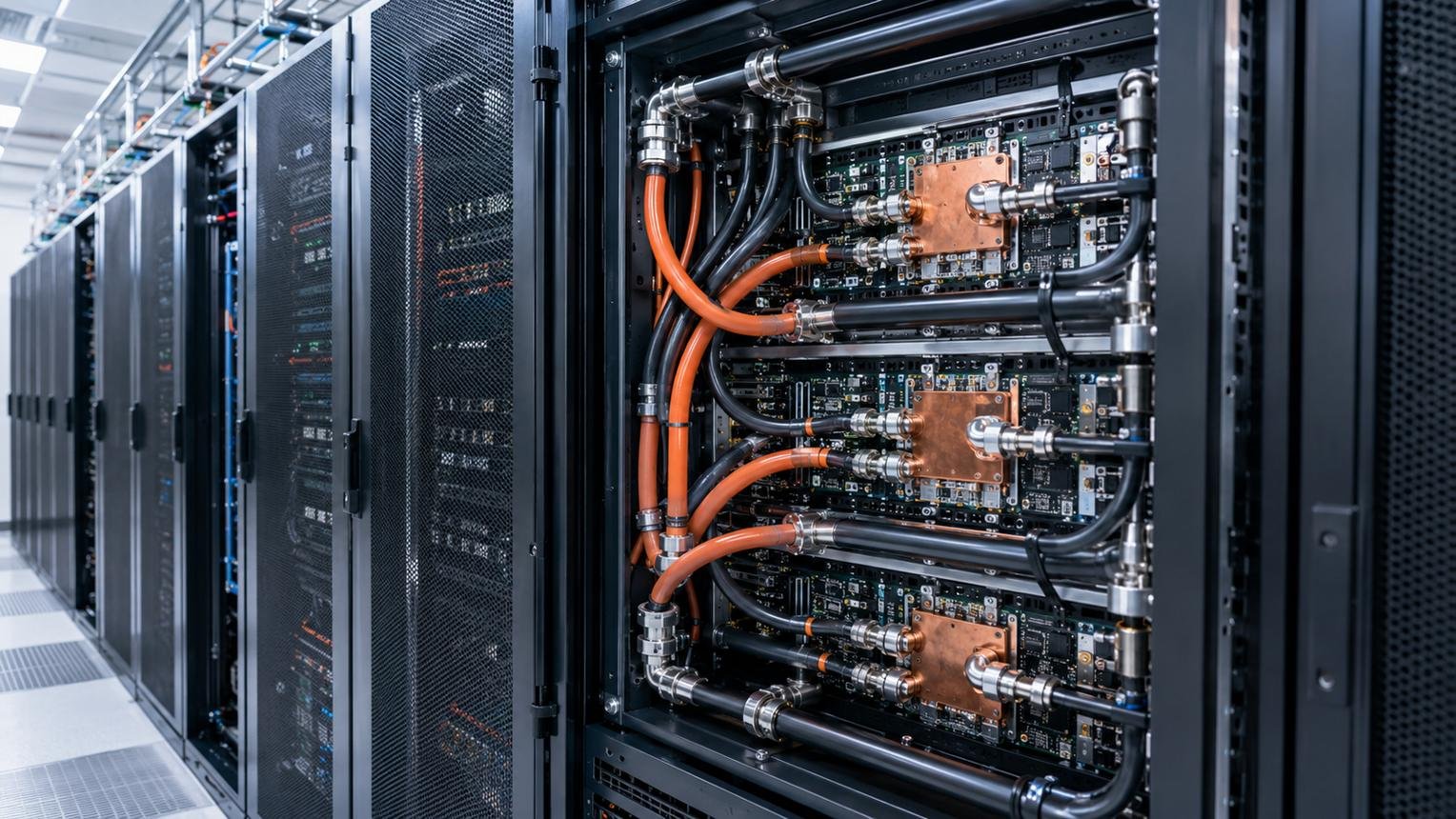
2. Best Air Cooling Solutions for High-Density Data Centers
Air cooling remains an important part of modern data center thermal management. Even facilities using liquid cooling often need air cooling for residual server heat, networking equipment, and conventional IT racks.
The following technologies can help improve air cooling performance.
2.1 Precision Air Conditioning Systems
Precision air conditioners are designed for environments with continuous IT heat loads and controlled operating requirements.
Compared with conventional comfort air conditioning, data center precision cooling equipment is designed around the thermal characteristics of IT spaces, including sensible cooling requirements, airflow management, and operating continuity.
Common configurations include:
CRAC units
CRAH units
Constant temperature and humidity precision air conditioners
Downflow and upflow precision cooling systems
CRAC systems typically use direct-expansion refrigeration to cool return air.
CRAH systems use chilled-water coils and depend on a separate chilled-water plant.
Precision air conditioning is suitable for conventional server rooms and data center zones where the required airflow and cooling capacity can be delivered effectively.
However, simply increasing the nominal cooling capacity of room-level air conditioning does not necessarily solve high-density rack hot spots. Air distribution and server inlet conditions must also be evaluated.
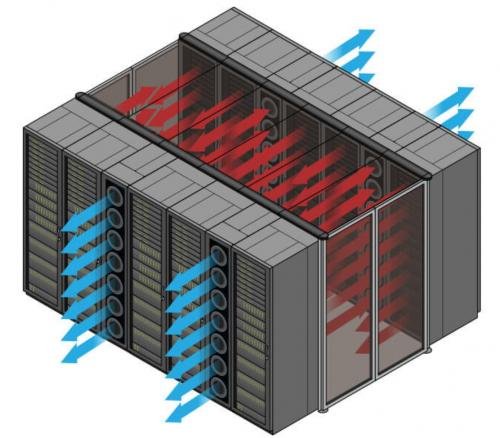
2.2 In-Row Cooling Systems
In-row cooling places cooling units close to the server racks, usually between rack cabinets.
Instead of relying entirely on room-level air circulation, the system removes heat near the point where it is generated.
A typical in-row cooling arrangement works as follows:
Servers draw in cool air through their front panels.
Heated exhaust air leaves the rear of the racks.
The in-row cooling unit receives the hot air.
Heat transfers to a refrigerant or chilled-water circuit.
Cooled air is delivered back toward the server intake side.
Advantages:
Cooling is delivered close to the IT load.
Airflow paths can be shorter than in some room-level configurations.
Cooling capacity can be distributed across selected rack rows.
Modular deployment may support phased expansion.
Limitations:
Requires careful coordination with rack layout and airflow direction.
Maintenance access must be planned.
Performance depends on the cooling unit, air distribution, and overall room configuration.
It may not be sufficient for every high-density GPU deployment.
In-row cooling is worth evaluating when rack-level heat loads are increasing but the IT equipment still relies primarily on air cooling.
2.3 Rear Door Heat Exchangers (RDHx)
A rear door heat exchanger is installed at the back of a server rack to remove heat from the server exhaust air.
The server fans push hot air through the heat exchanger, where heat transfers into a circulating liquid loop.
The cooled air then leaves the rear of the rack.
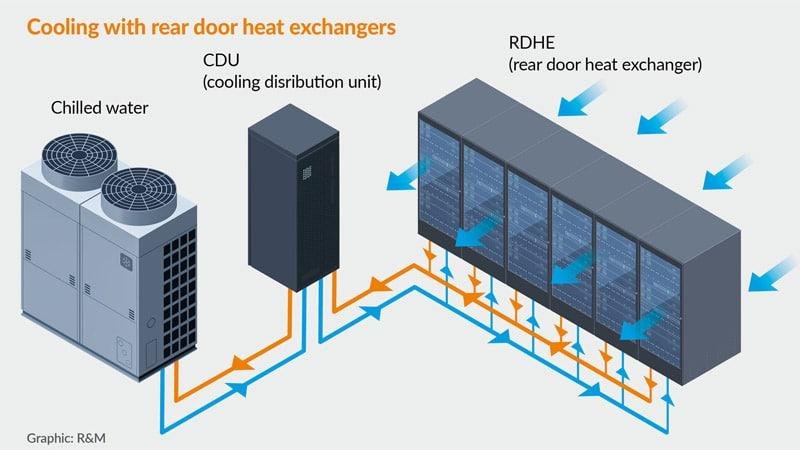
Rear door heat exchangers are available in different configurations, including passive and active designs. Their operating principles and airflow requirements vary.
Advantages:
Removes heat close to the server rack.
Can reduce the amount of heat released into the data center room.
May help support higher rack densities in suitable applications.
Can be considered for facilities where a full direct-to-chip conversion is not practical.
Limitations:
Requires a suitable liquid distribution loop.
Adds weight and service requirements at the rear of the rack.
Must be compatible with rack dimensions and server airflow.
Does not necessarily eliminate the need for room-level cooling.
RDHx systems are particularly relevant when operators want to improve rack-level heat removal while continuing to use air-cooled servers.
2.4 Cold Aisle Containment
Cold aisle containment separates the cold supply air entering server fronts from hot exhaust air leaving server rears.
Common components include:
Aisle doors
Roof panels
End-of-row barriers
Rack sealing
Blanking panels
Containment helps reduce hot-air recirculation and cold-air bypass.
It does not add cooling capacity by itself. Instead, it improves the effectiveness of the cooling capacity already provided by the HVAC system.
For high-density racks, containment should be evaluated alongside server airflow requirements, supply-air temperature, fan performance, and cooling unit capacity.
3. Best Liquid Cooling Solutions for High-Density Data Centers
When rack-level heat loads become difficult to manage with airflow alone, liquid cooling becomes an important option.
Liquid cooling transports heat through a circulating fluid, allowing heat removal closer to processors or other high-power components.
The two main approaches are direct-to-chip liquid cooling and immersion cooling.
3.1 Direct-to-Chip Liquid Cooling
Direct-to-chip liquid cooling uses cold plates attached to supported heat-generating components, such as CPUs and GPUs.
Coolant flows through channels inside the cold plates and absorbs heat directly from the components.
A typical system includes:
Cold plates
Coolant manifolds
Supply and return piping
Coolant Distribution Unit (CDU)
Circulation pumps
Heat exchangers
Facility cooling loop
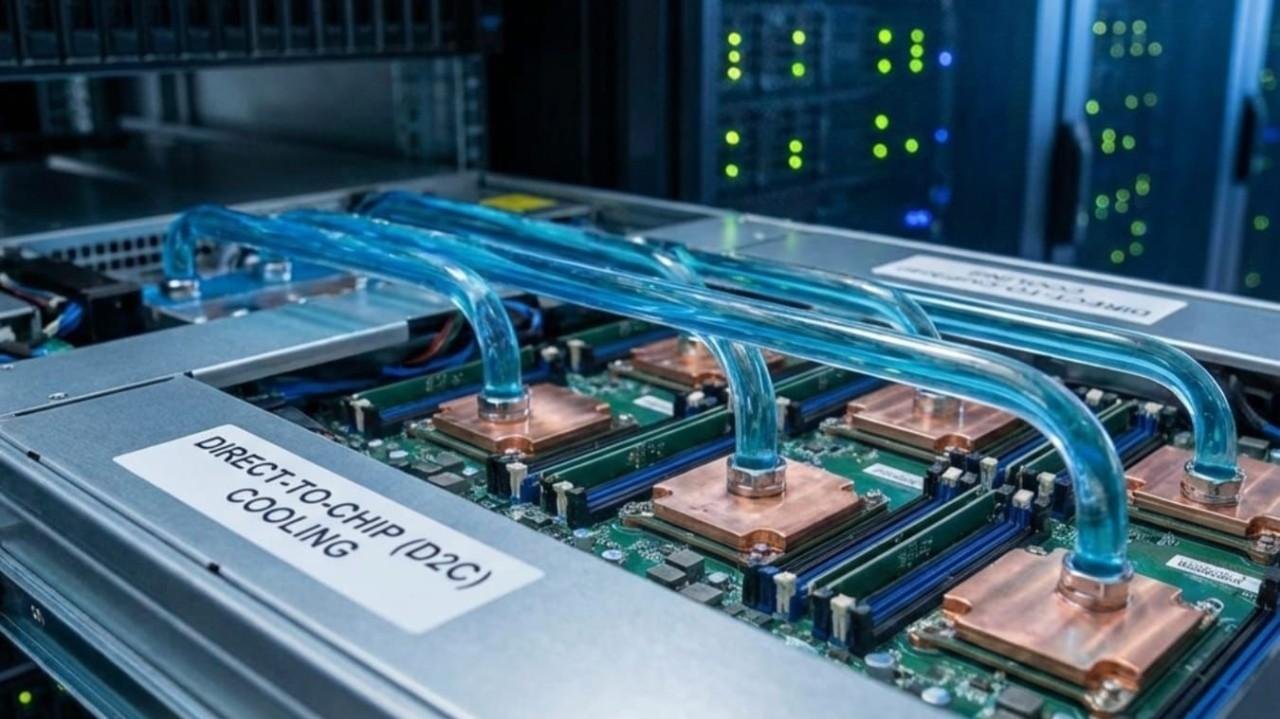
How the system works:
The CDU circulates coolant through the technology cooling loop.
Coolant flows through the rack distribution manifold.
Cold plates receive coolant through their supply connections.
Heat transfers from supported components into the coolant.
Heated coolant returns to the CDU.
A heat exchanger transfers the heat to the facility cooling loop.
The facility system rejects the heat through a chiller, dry cooler, or another suitable arrangement.
The CDU may use a liquid-to-liquid heat exchanger or another configuration appropriate to the project. Its role and design should be confirmed against the actual system architecture.
Advantages:
Removes heat directly from supported high-power components.
Reduces dependence on room-level airflow for those components.
Supports high-density GPU and HPC applications.
Can be integrated into modular rack-level or row-level architectures.
Limitations:
Requires compatible server hardware.
Introduces coolant piping and hydraulic interfaces.
Requires appropriate leak detection and isolation procedures.
Needs coordinated facility cooling infrastructure.
Does not necessarily remove all heat from the server.
The last point is important. Power supplies, memory, storage, networking interfaces, and other components may still release heat into the room. A direct-to-chip installation may therefore require supporting air cooling.
3.2 Coolant Distribution Units (CDUs)
The CDU is one of the most important components in many direct-to-chip liquid cooling architectures.
It manages coolant circulation and, depending on configuration, transfers heat between the technology cooling loop and the facility cooling loop.
Common CDU components include:
Pumps
Heat exchangers
Filters or strainers
Control valves
Temperature sensors
Pressure sensors
Flow monitoring
Control and alarm systems
When selecting a CDU for a high-density data center, engineers should evaluate the following.
Selection Factor | Why It Matters |
|---|---|
Thermal capacity | Must match the heat load assigned to the CDU |
Coolant flow rate | Determines whether the required heat can be transported |
Supply temperature | Must meet server and cold plate requirements |
Return temperature | Affects the temperature difference available for heat transfer |
Pressure drop | Influences pump selection and hydraulic performance |
Operating pressure | Must be compatible with connected equipment |
Heat exchanger design | Determines heat transfer between coolant loops |
Redundancy | Supports availability and maintenance planning |
Monitoring | Helps identify abnormal temperature, pressure or flow conditions |
A CDU should not be selected using thermal capacity alone. Its flow, pressure, coolant compatibility, heat exchanger performance, and control strategy must all match the project.
3.3 Immersion Cooling
Immersion cooling places servers or selected IT components inside a tank containing dielectric fluid.
Unlike direct-to-chip cooling, which uses cold plates attached to individual components, immersion cooling transfers heat directly from immersed equipment into the dielectric fluid.
There are two main configurations.
Single-phase immersion cooling
The dielectric fluid remains liquid during operation. Pumps circulate the heated fluid through a heat exchanger, where heat transfers to a secondary cooling loop.
Two-phase immersion cooling
The dielectric fluid boils as it absorbs heat. The resulting vapor rises to a condenser, releases heat, and returns to the liquid phase.
Advantages:
Direct heat transfer from immersed components
Reduced dependence on conventional server airflow
Potential suitability for specialized high-density computing environments
Different system configurations for different thermal requirements
Limitations:
Requires compatible IT hardware and materials.
Tank access and server servicing procedures differ from conventional racks.
Fluid compatibility and management are essential.
Facility teams need appropriate operating and maintenance procedures.
Integration with heat rejection equipment must be planned.
Immersion cooling should be evaluated as a complete IT and facility architecture, not simply as a replacement for room air conditioning.
4. How to Choose the Right Cooling Solution for High-Density Racks
There is no universal rack power threshold that determines when air cooling must be replaced by liquid cooling.
The correct decision depends on actual server specifications, airflow performance, component thermal design, operating conditions, and facility infrastructure.
The following factors should guide the selection.
4.1 Evaluate Rack Power Density
Start by collecting the actual and planned electrical loads for each rack.
Important information includes:
Current rack power consumption
Maximum expected rack power
Number and type of servers
CPU and GPU configurations
Server airflow requirements
Planned equipment upgrades
Rack layout and available space
Do not rely solely on the average power density across the data hall. Individual racks may have much higher thermal loads than the facility average.
4.2 Understand the Server’s Cooling Requirements
Before purchasing liquid cooling equipment, confirm whether the server platform supports the proposed cooling method.
For direct-to-chip cooling, verify:
Which components are liquid-cooled
Cold plate compatibility
Required coolant type
Supply and return temperature limits
Required coolant flow
Maximum allowable pressure
Connection interfaces
Residual air cooling requirements
For immersion cooling, verify server and component compatibility with the selected dielectric fluid, including materials, connectors, cables, and service procedures.
4.3 Assess Existing Cooling Infrastructure
An existing data center may have sufficient room-level cooling capacity but lack the infrastructure required for liquid cooling.
Review the following before selecting a solution.
Infrastructure Area | Key Questions |
|---|---|
Electrical capacity | Can the facility support the additional cooling equipment? |
Chilled-water system | Are supply temperature, flow and capacity suitable? |
Coolant distribution | Is there sufficient space for pipes, manifolds and connections? |
Floor loading | Can the facility support additional equipment and liquid-filled systems? |
Service access | Can pumps, CDUs and heat exchangers be maintained safely? |
Heat rejection | Can chillers or dry coolers handle the additional thermal load? |
Monitoring | Can temperature, pressure, flow and leak alarms be integrated into facility operations? |
For retrofit projects, pipe routing, installation access, operational disruption, and compatibility with existing equipment can significantly affect project cost and complexity.
4.4 Compare Total Cost of Ownership
The initial equipment price is only one part of the financial decision.
A meaningful comparison should include:
Cooling equipment purchase price
Installation and infrastructure modifications
Piping and electrical work
Energy consumption
Water consumption where applicable
Maintenance labor
Coolant management
Spare parts
Equipment replacement
Future expansion costs
Liquid cooling may offer operational advantages in high-density environments, but those advantages should be assessed against the complete system cost.
Air cooling may remain more economical where existing HVAC infrastructure can support the planned IT load.
5. How to Design a Reliable High-Density Data Center Cooling System
Cooling capacity is only one aspect of system design. Reliability, maintainability, control, and future expansion are equally important.
5.1 Calculate Cooling Capacity Correctly
A starting estimate for IT heat load is:
For the complete facility, engineers should also account for:
UPS and electrical distribution losses
Lighting
Occupants
Building envelope heat gains
Other mechanical and electrical loads
When selecting equipment, distinguish between nominal cooling capacity and the capacity available under actual design conditions.
For air cooling, review sensible cooling capacity, airflow, supply-air temperature, and static pressure.
For liquid cooling, review heat transfer capacity, coolant flow, temperature difference, pressure drop, and operating pressure.
5.2 Calculate Liquid Coolant Flow Requirements
For a liquid cooling circuit, the heat transfer relationship is:
Where:
\(Q\) = heat transferred, in kW when SI units are used consistently
\(\dot{m}\) = coolant mass flow rate, in kg/s
\(c_p\) = coolant specific heat capacity, in kJ/(kg·K)
\(\Delta T\) = coolant temperature rise, in K
This equation provides a basis for estimating the coolant flow required to transport a specified thermal load.
The final hydraulic design must also consider fluid properties, pipe dimensions, component pressure drop, pump curves, cold plate requirements, and system operating limits.
5.3 Design for Redundancy
Cooling failure can threaten IT equipment availability. High-density facilities should therefore define their required redundancy strategy during the design stage.
Possible arrangements include:
Redundant precision cooling units
Multiple chilled-water pumps
Redundant CDUs
Backup heat rejection capacity
Dual power supplies for critical cooling equipment
Independent distribution paths where required
Common design concepts include N, N+1, and 2N configurations. However, equipment count alone does not establish system resilience. Engineers must also evaluate common-mode failures, control dependencies, electrical paths, isolation arrangements, and maintenance procedures.
5.4 Plan for Monitoring and Control
High-density cooling systems should provide sufficient operational visibility to detect developing problems.
For air cooling, monitor:
Server inlet temperatures
Supply and return air temperatures
Fan operating status
Cooling unit alarms
Chilled-water temperatures and flow where applicable
For liquid cooling, monitor:
Coolant supply and return temperatures
Flow rate
Pressure and differential pressure
Pump operating status
CDU alarms
Leak detection
Filter condition where monitored
Monitoring data should be reviewed as trends rather than relying only on individual readings. A gradual decline in flow or increase in return temperature may indicate a developing issue before a critical alarm occurs.
6. Air Cooling vs. Liquid Cooling: Which Solution Is Best?
The following comparison summarizes the main differences for high-density data center applications.
Cooling Solution | Best-Fit Applications | Main Advantages | Main Limitations |
|---|---|---|---|
Precision air conditioning | Conventional server rooms and moderate-density racks | Established technology and broad IT compatibility | Depends on effective airflow distribution |
In-row cooling | Higher-density air-cooled rack rows | Cooling close to the heat source | Requires careful row layout and airflow coordination |
Rear door heat exchanger | Racks requiring additional heat removal | Removes heat at the rack exhaust | Requires liquid infrastructure and compatible rack design |
Direct-to-chip cooling | Supported high-density CPU and GPU servers | Direct heat removal from processors | Requires compatible servers and coolant infrastructure |
Single-phase immersion | Compatible specialized server environments | Direct heat transfer into dielectric fluid | Requires tank-based infrastructure and fluid management |
Two-phase immersion | Specialized high-density applications | Uses phase change for heat transfer | More complex fluid and system requirements |
Hybrid air-liquid cooling | Mixed-density data centers and AI infrastructure | Supports different rack types in one facility | Requires coordinated air and liquid system design |
Recommended Selection by Application
Conventional enterprise data centers
Precision air conditioning, CRAC or CRAH systems, and cold aisle containment may be sufficient where rack loads and airflow requirements remain within the system’s capabilities.
High-density air-cooled racks
In-row cooling or rear door heat exchangers may be appropriate when the server equipment remains air-cooled but room-level airflow becomes difficult to manage.
AI and GPU server clusters
Direct-to-chip liquid cooling is a strong option when supported by the server platform and facility infrastructure.
Specialized HPC environments
Direct-to-chip or immersion cooling may be considered according to equipment compatibility, operational requirements, and system design.
Mixed IT environments
Hybrid air-liquid cooling can support conventional racks and high-density liquid-cooled racks within the same facility.
7. Common Mistakes When Selecting High-Density Cooling Equipment
Even a technically capable cooling system can underperform when the equipment is selected without complete project information.
Avoid these common mistakes.
1. Selecting equipment based only on nominal cooling capacity
A unit’s rated capacity does not guarantee that it can meet the required load at the project’s actual operating conditions. Check airflow, water temperatures, coolant conditions, and performance curves.
2. Ignoring residual server heat
Direct-to-chip liquid cooling may remove heat from CPUs and GPUs but leave other components dependent on room-level air cooling.
3. Choosing a CDU without checking hydraulic compatibility
Flow rate, pressure drop, operating pressure, coolant properties, and heat exchanger performance must match the connected equipment.
4. Underestimating heat rejection requirements
The facility must be able to reject the heat transferred from the server room or liquid cooling loop. Chillers and dry coolers must be evaluated under local ambient design conditions.
5. Ignoring maintenance access
Pumps, filters, valves, cold plate connections, rear door heat exchangers, and CDUs all require inspection and service access.
6. Designing only for current rack loads
Future GPU upgrades and higher-density server platforms may require additional cooling capacity. Expansion provisions should be considered early.
Conclusion: Selecting the Best Cooling Solution for High-Density Data Centers
The best high-density data center cooling solution depends on how much heat the IT equipment generates, where that heat is concentrated, and how effectively the facility can remove it.
Precision air conditioning, in-row cooling, and rear door heat exchangers can address many air-cooled rack applications. Direct-to-chip liquid cooling is particularly relevant for supported high-density GPU and HPC servers. Immersion cooling provides another option for specialized IT environments.
For facilities with mixed rack densities, hybrid air-liquid cooling can provide a practical way to support different server platforms without forcing the entire data center into one cooling architecture.
Before selecting equipment, evaluate rack power density, server compatibility, cooling capacity, coolant flow, pressure requirements, heat rejection infrastructure, redundancy, maintenance access, and total cost of ownership.
Planning a high-density data center or AI infrastructure project?
Our equipment portfolio includes precision air conditioners, CRAC and CRAH systems, in-row cooling, rear door heat exchangers, direct-to-chip liquid cooling systems, CDUs, chillers, and dry coolers.
Click here to schedule a technical consultation for your high-density data center cooling project. Share your rack power requirements, server configuration, facility conditions, and expansion plans to begin evaluating a suitable cooling architecture.
Frequently Asked Questions
1. What is the best cooling system for a high-density data center?
There is no single best solution for every facility. Direct-to-chip liquid cooling is particularly relevant for supported high-density GPU and HPC servers. In-row cooling and rear door heat exchangers can support higher-density air-cooled racks. Hybrid systems may be suitable for facilities with different rack power densities.
2. When should a data center switch from air cooling to liquid cooling?
A switch should be considered when the existing air cooling architecture cannot reliably deliver the required server inlet conditions or remove the rack heat load within acceptable airflow, space, and energy constraints. The decision should be based on server thermal specifications and facility engineering analysis, not a universal rack power threshold.
3. Is direct-to-chip liquid cooling suitable for all GPU servers?
No. The server platform must support the required cold plates, coolant connections, fluid specifications, flow rates, and operating pressures. Some components may also continue to rely on air cooling.
4. What is the difference between a rear door heat exchanger and direct-to-chip liquid cooling?
A rear door heat exchanger removes heat from hot server exhaust air through a liquid-cooled heat exchanger mounted at the rack rear. Direct-to-chip cooling transfers heat from supported processors through cold plates attached directly to the components.
Both use liquid infrastructure, but they remove heat at different points in the thermal path.
5. How do I select the right CDU for a high-density data center?
Evaluate the required thermal capacity, coolant supply and return temperatures, flow rate, pressure drop, operating pressure, fluid compatibility, heat exchanger configuration, pump arrangement, monitoring, and redundancy. The CDU must match the requirements of the connected servers and facility cooling loop.
6. Can air cooling and liquid cooling operate in the same data center?
Yes. Hybrid cooling systems can use liquid cooling for selected high-density racks while retaining precision air conditioning for conventional servers and residual heat. The two systems must be coordinated so that the total facility cooling capacity matches the actual heat load.