Industrial drying is a fundamental process in manufacturing. From removing moisture from agricultural products to processing chemical powders, pharmaceutical ingredients, minerals, and industrial materials, manufacturers rely on drying equipment to achieve consistent product quality and maintain production efficiency.
However, selecting an industrial dryer involves more than determining how much moisture needs to be removed. Different materials respond differently to heat, airflow, pressure, and drying time. An unsuitable drying method can result in uneven moisture content, product degradation, excessive energy consumption, and production bottlenecks.
So, what is an industrial dryer, how does it work, and which type is suitable for your production process?
This guide explains the working principles of industrial drying equipment, compares common dryer types, explores their applications, and outlines the key factors manufacturers should evaluate before purchasing a drying system.
1. What Is an Industrial Dryer?
An industrial dryer is a machine or integrated processing system designed to remove moisture or other volatile components from materials using controlled heat and mass transfer.
Unlike household dryers, industrial drying equipment is engineered for manufacturing and processing environments where production throughput, moisture consistency, product quality, and operating costs are critical.
Industrial dryers process a wide range of materials, including:
Powders and fine particles
Granules and pellets
Agricultural products and food ingredients
Chemicals and pharmaceutical materials
Minerals, ores, and industrial solids
Wood, paper, textiles, and other manufactured products
Slurries, pastes, and wet filter cakes
The objective is not necessarily to remove all moisture. In many manufacturing processes, materials must reach a specific final moisture content to meet product specifications, maintain stability, or prepare for subsequent production stages.
For example, excessive drying may damage heat-sensitive materials, while insufficient drying may cause storage problems, inconsistent product performance, or difficulties during packaging and transportation.
Therefore, an industrial drying system must be designed around the physical characteristics of the material and the requirements of the final product.
2. How Does Industrial Drying Equipment Work?
Most industrial drying processes rely on two fundamental mechanisms: heat transfer and mass transfer.
Heat must reach the moisture contained in the material, while the resulting vapor must move away from the material and be discharged or recovered by the drying system.
2.1 The Basic Industrial Drying Process
A typical industrial drying process involves several stages.
Step 1: Material feeding
Wet materials enter the drying system through a feeding mechanism. Depending on the equipment design, feeding may be continuous or performed in batches.
The material may require preliminary operations such as crushing, mixing, filtration, or dewatering before entering the dryer.
Step 2: Heat application
The dryer supplies thermal energy to the material through hot air, heated surfaces, steam, infrared radiation, or another suitable heat source.
The selected heating method depends on the material’s properties, moisture characteristics, and temperature tolerance.
Step 3: Moisture evaporation
As the material absorbs heat, moisture evaporates from its surface.
Additional moisture inside the material gradually moves toward the surface through internal diffusion, capillary movement, or other transport mechanisms.
The rate of moisture removal depends on factors such as:
Initial moisture content
Material particle size and structure
Drying temperature
Air velocity and humidity
Material thickness
Residence time
Surface area exposed to the drying medium
Step 4: Moisture discharge
Water vapor is carried away by the exhaust airflow or removed through a vacuum system, depending on the dryer configuration.
Some systems incorporate filtration, condensation, or heat recovery to manage exhaust air and improve overall process efficiency.
Step 5: Product discharge and moisture control
The dried material leaves the equipment after reaching the required processing conditions.
Depending on the application, moisture sensors, temperature sensors, and automated control systems can help monitor and regulate the drying process.
2.2 Main Heat Transfer Methods
Industrial dryers use different methods to transfer heat to materials.
Heat transfer method | Working principle | Typical applications |
|---|---|---|
Convection | Heated air or gas transfers heat to the material | Food, chemicals, minerals, granules |
Conduction | Heat passes through a heated contact surface | Slurries, pastes, filter cakes |
Radiation | Infrared or radiant energy heats the material | Coatings, textiles, specialized products |
Vacuum-assisted heating | Reduced pressure lowers the boiling temperature of moisture | Heat-sensitive materials and specialized chemical products |
Some industrial dryers combine multiple heat transfer mechanisms to achieve the required drying performance.
The correct approach depends on the material, production requirements, and available energy sources.
3. What Are the Main Types of Industrial Dryers?
Industrial drying equipment is available in several configurations. Each type has different operating characteristics, material handling capabilities, and application limitations.
Understanding these differences is essential when comparing industrial dryer manufacturers and evaluating equipment quotations.
3.1 Rotary Drum Dryer
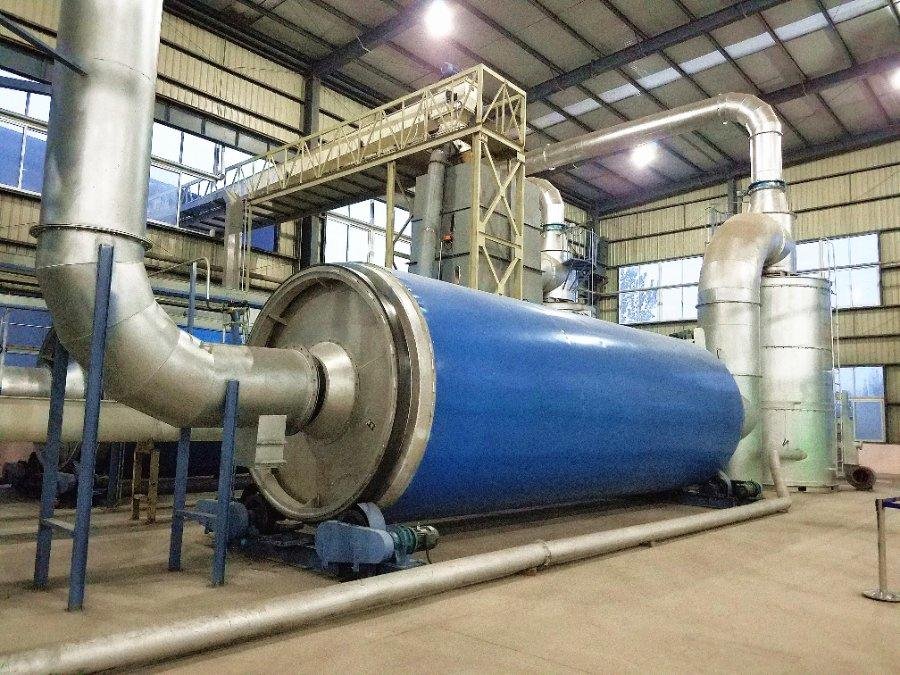
A rotary drum dryer consists of a rotating cylindrical drum, a material feeding system, a heating arrangement, and a discharge mechanism.
Wet materials enter the drum and move through it as the cylinder rotates. Internal lifting flights can lift and redistribute the material, increasing its contact with the drying gas.
Depending on the configuration, rotary dryers may use direct or indirect heating.
Typical applications:
Sand and minerals
Biomass and wood chips
Agricultural materials
Industrial sludge
Fertilizer and chemical granules
Advantages:
Suitable for continuous production
Can handle relatively large material throughput
Accommodates various granular and bulk solid materials
Robust construction for industrial environments
Limitations:
May require substantial installation space
Some materials can experience uneven drying if feeding and operating conditions are poorly controlled
Dust generation and exhaust gas treatment may require additional equipment
Not automatically suitable for every heat-sensitive material
3.2 Rotary Vacuum Dryer
A rotary vacuum dryer combines controlled heating with reduced-pressure operation.
Under vacuum conditions, moisture can evaporate at a lower temperature than it would at atmospheric pressure. The rotating vessel also helps mix the material and expose different portions to the heated surface.
This configuration can be useful when conventional atmospheric drying temperatures could damage the product.
Typical applications:
Pharmaceutical intermediates
Fine chemicals
Heat-sensitive powders
Specialty chemical products
Advantages:
Supports lower-temperature drying
Can operate in a controlled, enclosed environment
Suitable for certain heat-sensitive materials
Limitations:
Higher equipment and system complexity
Requires vacuum generation and sealing arrangements
Material handling and discharge design require careful consideration
3.3 Fluidized Bed Dryer

A fluidized bed dryer uses upward-moving heated air to suspend and agitate particles within a processing chamber.
When the airflow reaches an appropriate velocity, the particles behave in a fluid-like manner. This creates substantial contact between the drying gas and the material.
The resulting heat and mass transfer can provide relatively rapid and uniform drying for suitable particle materials.
Typical applications:
Pharmaceutical granules
Chemical powders
Fertilizer granules
Food ingredients
Industrial particles
Advantages:
Effective gas-solid contact
Suitable for continuous or batch configurations
Can provide consistent drying when particle properties and airflow are properly controlled
Limitations:
Not suitable for every particle size or material type
Sticky or highly cohesive materials may cause agglomeration
Fine particles may require effective dust collection
Airflow must be carefully matched to particle properties
3.4 Spray Dryer

A spray dryer converts liquid feed into fine droplets and exposes them to a stream of heated drying gas.
Moisture evaporates rapidly from the droplets, producing dry particles that are collected through a cyclone separator, bag filter, or another suitable collection system.
Spray drying is particularly useful for converting liquid solutions, suspensions, and emulsions into powders.
Typical applications:
Milk powder
Food ingredients
Pharmaceutical materials
Ceramic powders
Chemical products
Detergent powders
Advantages:
Converts liquid feed directly into powder
Provides continuous processing
Allows control over certain powder properties through process design
Limitations:
Requires appropriate atomization and droplet control
Heat-sensitive products need careful temperature management
Exhaust gas treatment and powder recovery are important design considerations
Equipment investment and operating complexity can be substantial
3.5 Belt Dryer

A belt dryer uses a moving conveyor belt to transport materials through one or more heated drying zones.
Hot air passes through or across the material layer, depending on the equipment design.
Belt dryers are commonly used for materials that can be distributed across a conveyor in a relatively uniform layer.
Typical applications:
Fruits and vegetables
Food ingredients
Biomass
Agricultural products
Industrial sludge
Chemical materials
Advantages:
Continuous operation
Adjustable residence time
Suitable for large-scale processing
Can support multiple temperature and airflow zones
Limitations:
Material distribution affects drying uniformity
Thick or uneven material layers can create moisture differences
Conveyor cleaning and maintenance need consideration
3.6 Tray Dryer

A tray dryer is a batch-operated system in which materials are spread across trays and placed inside a heated chamber.
Heated air circulates around the trays to remove moisture from the materials.
Tray dryers are relatively straightforward in design and are often used when production batches are smaller or when product changeovers are frequent.
Typical applications:
Pharmaceutical products
Laboratory and pilot-scale materials
Food ingredients
Chemical powders
Small-batch specialty products
Advantages:
Relatively simple operating principle
Flexible batch processing
Suitable for smaller production volumes
Can accommodate different tray arrangements
Limitations:
Batch operation may limit overall throughput
Tray positioning and airflow distribution affect drying consistency
Manual loading and unloading may increase labor requirements
3.7 Comparison of Common Industrial Dryer Types
Dryer type | Best suited for | Operating mode | Key consideration |
|---|---|---|---|
Rotary drum dryer | Bulk solids and granules | Usually continuous | Material movement and residence time |
Rotary vacuum dryer | Certain heat-sensitive solids | Usually batch | Vacuum and temperature control |
Fluidized bed dryer | Suitable powders and granules | Batch or continuous | Particle size and fluidization |
Spray dryer | Solutions and suspensions | Continuous | Atomization and powder recovery |
Belt dryer | Layered solids and agricultural products | Continuous | Layer thickness and airflow |
Tray dryer | Small-batch materials | Batch | Temperature and airflow uniformity |
There is no universally best industrial dryer. The appropriate configuration depends on the physical properties of the material, the required moisture reduction, and the production process.
4. What Industries Use Industrial Drying Equipment?
Industrial dryers are used across manufacturing sectors where moisture removal is necessary for product preparation, quality control, or downstream processing.
4.1 Food and Agricultural Processing
Drying helps preserve products, reduce moisture-related deterioration, and prepare ingredients for further processing.
Common materials include:
Fruits and vegetables
Grain and cereal products
Milk powder
Food additives
Agricultural residues
The selected dryer must account for product appearance, flavor, nutritional properties, and final moisture requirements.
4.2 Chemical and Pharmaceutical Manufacturing
Chemical and pharmaceutical processes often require controlled drying to achieve specific moisture levels and maintain product consistency.
Applications include:
Chemical powders
Pharmaceutical intermediates
Granulated materials
Active ingredient processing
Specialty chemical products
Temperature sensitivity, contamination prevention, material compatibility, and cleaning requirements can be important selection factors.
4.3 Mining and Mineral Processing
Mining operations use industrial dryers to reduce moisture in bulk materials before storage, transportation, or further processing.
Typical materials include:
Silica sand
Mineral concentrates
Coal
Limestone
Clay
Metal-bearing ores
Rotary drum dryers are frequently considered for bulk material applications, although the final choice depends on material properties and process requirements.
4.4 Wood, Biomass, and Building Materials
Drying is an important part of preparing wood and biomass materials for manufacturing or energy applications.
Typical applications include:
Wood chips
Sawdust
Biomass pellets
Agricultural residues
Building material components
Moisture control can influence storage stability, combustion performance, processing behavior, and final product quality.
4.5 Textile, Paper, and Other Manufacturing Industries
Drying equipment is also used to remove moisture from fabrics, paper products, coatings, and other manufactured materials.
The drying system must maintain appropriate temperature and moisture conditions while avoiding unwanted changes to the product’s physical properties.
5. How to Choose the Right Industrial Dryer for Your Production Process
Choosing the correct industrial dryer is one of the most important decisions in designing a manufacturing process.
An unsuitable machine may achieve the required moisture reduction but still create problems through excessive energy consumption, poor product quality, or insufficient production capacity.
Before requesting an industrial drying equipment quotation, evaluate the following factors.
5.1 Material Characteristics
Start by identifying the material that needs to be dried.
Important characteristics include:
Physical state: liquid, slurry, paste, powder, granules, or bulk solids
Particle size and distribution
Bulk density
Initial moisture content
Material stickiness and cohesiveness
Heat sensitivity
Chemical composition
Corrosiveness and abrasiveness
These properties influence the selection of the drying technology, feeding mechanism, internal structure, and material-contact surfaces.
For example, a free-flowing granular material may be suitable for a rotary drum dryer or fluidized bed dryer, while a liquid solution may require spray drying.
5.2 Initial and Target Final Moisture Content
Moisture reduction requirements directly affect dryer design and energy consumption.
Buyers should provide both initial moisture content and target final moisture content.
For example, consider a production process handling 1,000 kg of wet material per hour, with an initial moisture content of 30% on a wet basis and a target final moisture content of 10% on a wet basis.
The initial dry solids mass is:
1,000 × (1 − 0.30) = 700 kg/h
The required final total product mass is:
700 ÷ (1 − 0.10) = 777.8 kg/h
Therefore, the approximate water removal requirement is:
1,000 − 777.8 = 222.2 kg/h
This calculation provides an initial estimate of the evaporation load.
Actual equipment sizing must also consider the material’s drying behavior, heat losses, operating conditions, and process configuration.
5.3 Required Production Capacity
Determine whether your production process requires batch or continuous drying.
Important questions include:
How many kilograms or tons must be processed per hour?
Is production continuous or intermittent?
How many operating hours are required per day?
Will production capacity increase in the future?
Does the process involve multiple products?
The dryer should match the actual production requirement rather than an assumed maximum capacity.
5.4 Drying Temperature and Product Quality
Different materials have different temperature tolerances.
Excessive heat may cause:
Color changes
Chemical degradation
Loss of volatile components
Changes in particle structure
Reduced product functionality
Unwanted agglomeration
For heat-sensitive products, vacuum drying or other controlled low-temperature technologies may be worth evaluating.
However, low-temperature drying does not automatically guarantee better results. The complete drying cycle, moisture transport behavior, and operating conditions must also be considered.
5.5 Energy Source and Operating Costs
Industrial dryers may use different energy sources, including:
Electricity
Natural gas
LPG
Steam
Thermal oil
Biomass
Other process heat sources
The lowest equipment purchase price does not necessarily result in the lowest long-term operating cost.
When comparing industrial dryer suppliers, evaluate:
Installed equipment cost
Energy consumption
Labor requirements
Maintenance expenses
Consumables and replacement parts
Exhaust treatment requirements
Expected operating hours
Product losses and production downtime
A comprehensive evaluation should compare the total cost of ownership rather than focusing exclusively on the initial purchase price.
5.6 Installation, Automation, and Maintenance
The dryer must fit the actual production facility.
Consider:
Available installation space
Equipment height and floor loading
Material feeding and discharge connections
Electrical and utility requirements
Ventilation and exhaust arrangements
Dust collection and environmental controls
Cleaning and maintenance access
Automation and process monitoring
For larger industrial projects, the dryer should also be evaluated as part of the complete production line rather than as an isolated machine.

6. Common Industrial Drying Problems and How to Solve Them
Even when the correct type of dryer is selected, improper operating conditions can reduce performance.
The following problems are frequently encountered in industrial drying operations.
6.1 Uneven Drying Results
Possible causes:
Uneven material feeding
Inconsistent material thickness
Poor airflow distribution
Inadequate mixing or agitation
Incorrect residence time
Variation in initial moisture content
Practical solutions:
Improve material distribution before drying, check airflow balance, and evaluate whether the equipment provides sufficient material movement.
For belt dryers, material layer thickness and air distribution should be checked.
For rotary dryers, material feeding, drum rotation, and internal material movement should be evaluated.
6.2 Excessive Drying Time
Possible causes:
Insufficient heat input
Low airflow or unsuitable air humidity
Excessive material loading
Large particle size or thick material layers
Poor internal moisture migration
Practical solutions:
Review the material feeding rate, drying temperature, airflow, and residence time.
If internal moisture migration is the limiting factor, simply increasing the temperature may not solve the problem and could damage the material.
6.3 High Energy Consumption
Possible causes:
Excessive exhaust heat loss
Poor insulation
Inefficient heat transfer
Excessive initial moisture content
Inappropriate operating conditions
Unnecessary drying beyond the target moisture level
Practical solutions:
Evaluate upstream mechanical dewatering where applicable, optimize the drying endpoint, improve insulation, and investigate exhaust heat recovery.
For materials that can be mechanically dewatered, reducing the moisture load before thermal drying may lower the overall energy requirement.
6.4 Material Damage During Drying
Possible causes:
Excessive product temperature
Long exposure to heat
Excessive mechanical agitation
Inappropriate drying technology
Poor control of moisture removal
Practical solutions:
Evaluate lower-temperature operation, adjust residence time, and select a dryer that matches the material’s physical and thermal characteristics.
Laboratory or pilot-scale drying tests can help identify suitable process conditions before full-scale equipment selection.
6.5 Production Capacity Does Not Meet Expectations
Possible causes:
Equipment selected using nominal capacity rather than actual evaporation requirements
Incorrect material properties used during design
Insufficient heating capacity
Feeding or discharge bottlenecks
Unaccounted process variations
Practical solutions:
Evaluate the complete material balance, evaporation load, feeding system, and discharge arrangement.
Equipment capacity should be assessed using the actual material and required operating conditions, not simply the advertised throughput of the machine.
7. How Much Does Industrial Drying Equipment Cost?
The price of industrial drying equipment varies considerably depending on its technology, configuration, capacity, and application.
There is no reliable universal price for an industrial dryer without understanding the process requirements.
The main factors affecting industrial dryer prices include:
Pricing factor | How it affects equipment cost |
|---|---|
Dryer type | Different technologies have different structural and system requirements |
Processing capacity | Larger processing requirements may require larger equipment and supporting systems |
Material characteristics | Corrosive, abrasive, sticky, or sensitive materials may require specialized designs |
Heating system | Heating source and configuration influence equipment cost |
Construction materials | Stainless steel and specialized alloys may increase costs |
Automation | Advanced instrumentation and control systems affect the total price |
Environmental equipment | Dust collection, filtration, and exhaust treatment add system costs |
Customization | Special feeding, discharge, and integration requirements affect the quotation |
When requesting an industrial dryer price, buyers should provide sufficient technical information to allow suppliers to evaluate the application.
Comparing quotations based only on equipment dimensions or nominal capacity can lead to incorrect purchasing decisions.
A technically suitable quotation should clearly identify the proposed drying technology, operating conditions, main equipment configuration, and scope of supply.
8. What Information Should You Prepare Before Requesting an Industrial Dryer Quotation?
To obtain a meaningful industrial drying equipment quotation, prepare the following information:
Required information | Example or description |
|---|---|
Material name | Sand, biomass, chemical powder, food ingredients |
Material physical state | Liquid, slurry, paste, granules, powder |
Initial moisture content | Percentage on a clearly defined wet or dry basis |
Target final moisture | Required moisture content after drying |
Processing capacity | kg/h or tons/day |
Material temperature tolerance | Maximum acceptable product temperature, if known |
Heating source | Electricity, natural gas, steam, biomass, etc. |
Production mode | Batch or continuous |
Installation location | Country and facility environment |
Special requirements | Corrosion resistance, dust control, automation, hygiene |
Additional information such as particle size distribution, bulk density, material photos, and laboratory test results can help improve the accuracy of equipment evaluation.
If some parameters are not available, provide the information you have and identify the unknowns for further technical assessment.
Frequently Asked Questions About Industrial Dryers
1. What is the main purpose of an industrial dryer?
The main purpose of an industrial dryer is to remove moisture or other volatile components from materials to achieve a required final moisture level, improve product stability, support downstream processing, or meet manufacturing specifications.
2. What are the most common types of industrial dryers?
Common industrial dryer types include rotary drum dryers, rotary vacuum dryers, fluidized bed dryers, spray dryers, belt dryers, and tray dryers.
Each type is designed for different material characteristics and production requirements.
3. Which industrial dryer is best for heat-sensitive materials?
The most suitable dryer depends on the material’s thermal stability, moisture characteristics, and required production conditions.
Rotary vacuum dryers and other vacuum drying systems are often considered for heat-sensitive materials because reduced pressure can lower the temperature required for moisture evaporation.
Other low-temperature drying technologies may also be appropriate depending on the application.
4. How do I calculate the required capacity of an industrial dryer?
Dryer capacity should be determined using the wet material feed rate, initial moisture content, and target final moisture content.
The water evaporation requirement can be estimated using a material balance:
Water evaporation rate = Initial wet feed rate − Final dried product rate
The final equipment design must also account for material drying characteristics, heat transfer, residence time, and operating conditions.
5. What affects industrial dryer energy consumption?
Energy consumption depends on the amount of moisture removed, the material’s thermal properties, drying temperature, heat transfer efficiency, exhaust losses, equipment insulation, and operating conditions.
Upstream mechanical dewatering and appropriate heat recovery may help reduce overall energy requirements where technically feasible.
6. Can one industrial dryer process different types of materials?
Some industrial dryers can process multiple materials, but compatibility must be evaluated individually.
Differences in particle size, stickiness, moisture content, heat sensitivity, and chemical properties can significantly affect drying performance.
For facilities processing different products, the supplier should evaluate material compatibility, cleaning requirements, and the operating conditions needed for each product.
Find the Right Industrial Drying Solution for Your Production Needs
Selecting industrial drying equipment requires a clear understanding of the material, moisture removal requirements, production capacity, and operating environment.
A suitable drying system should achieve the required final moisture content while maintaining product quality, supporting production efficiency, and keeping operating costs under control.
If you are evaluating industrial drying equipment for a new production facility or looking to improve an existing drying process, prepare your material information and production requirements before selecting a machine.
Looking for an industrial drying solution for your production process?
Contact our team to discuss your material characteristics, initial and target moisture content, required processing capacity, heating source, and operating conditions.
Share your application details to request an industrial dryer evaluation and quotation based on your actual production requirements.