Moisture control is a critical part of many industrial manufacturing processes. Excess moisture can affect product quality, increase transportation costs, cause storage problems, and interfere with downstream production. For manufacturers processing powders, granules, agricultural products, chemicals, minerals, or other wet materials, selecting the right industrial drying equipment directly affects production efficiency and operating costs.
However, industrial drying is not simply a matter of applying heat until a material becomes dry. Different materials require different drying conditions, and an unsuitable drying system can cause uneven moisture removal, excessive energy consumption, product degradation, or production bottlenecks.
Manufacturers must consider material characteristics, initial and final moisture content, processing capacity, heat sensitivity, energy availability, and the overall production process before choosing a drying machine.
This guide explains the main types of industrial drying equipment, their working principles, industrial applications, and the technical factors manufacturers should evaluate when planning a new drying system or upgrading an existing production line.
1. What Is Industrial Drying Equipment?
Industrial drying equipment refers to machinery and integrated processing systems designed to remove moisture or other volatile components from materials through controlled heat and mass transfer.
These systems are widely used in manufacturing facilities where materials must reach a specific moisture level before storage, packaging, transportation, or further processing.
Unlike general-purpose heating equipment, industrial dryers are designed around particular material properties and production requirements.
Common materials processed by industrial drying systems include:
Powders and fine particles
Granules and pellets
Wet agricultural products
Food ingredients
Chemical compounds
Pharmaceutical intermediates
Minerals and ores
Biomass and wood materials
Industrial sludge and filter cakes
Textiles and paper products
The purpose of drying is not necessarily to eliminate all moisture. Many products require a controlled final moisture content to maintain their physical, chemical, or functional properties.
For example, excessive drying can damage heat-sensitive materials, while insufficient drying may lead to product instability, poor storage performance, or difficulties in subsequent manufacturing operations.
How Does Industrial Drying Work?
Industrial drying primarily involves two interconnected processes:
Heat transfer: Thermal energy is supplied to the material to promote moisture evaporation.
Mass transfer: Moisture moves from inside the material toward its surface, evaporates, and is transported away by the drying medium or removed through another suitable process.
A typical industrial drying operation follows these stages:
Material feeding: Wet materials enter the dryer through a conveyor, hopper, pump, or other feeding mechanism.
Heat application: The system supplies heat through hot air, heated surfaces, steam, infrared radiation, or another suitable method.
Moisture migration: Internal moisture moves toward the material surface.
Evaporation: Moisture changes from liquid to vapor.
Vapor removal: Exhaust air, vacuum equipment, or another removal mechanism carries moisture away.
Product discharge: The dried material exits after reaching the required processing conditions.

The drying rate depends on several interacting factors, including material thickness, particle size, initial moisture content, temperature, airflow, humidity, and residence time.
Understanding these factors is essential because increasing temperature alone does not always improve drying performance. If internal moisture migration becomes the limiting factor, additional heat may increase energy consumption without significantly reducing drying time.
2. Main Types of Industrial Drying Equipment
Industrial drying equipment is available in different configurations, each designed for particular materials and production requirements.
The following are some of the most widely used industrial drying technologies.
2.1 Rotary Drum Dryers
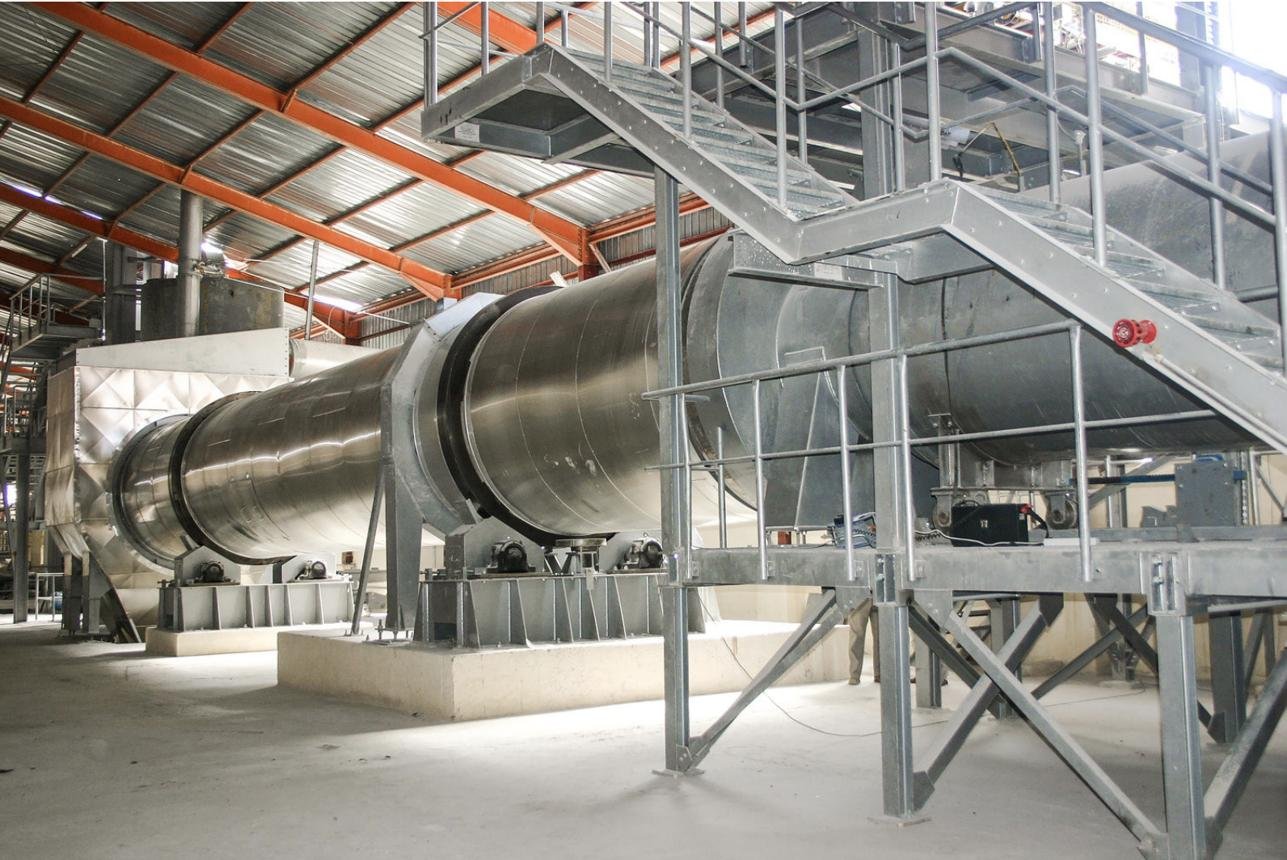
A rotary drum dryer uses a rotating cylindrical drum to move wet materials through a heated drying environment.
As the drum rotates, internal lifting flights may lift and redistribute the material, increasing its exposure to the drying medium.
Depending on the application, rotary dryers can use direct or indirect heating configurations.
Typical applications:
Sand and minerals
Biomass and wood chips
Fertilizer materials
Agricultural residues
Industrial sludge
Chemical granules
Main advantages:
Suitable for continuous processing
Can handle substantial quantities of bulk solids
Adaptable to different material handling requirements
Appropriate for various industrial production environments
Selection considerations:
Material abrasiveness, stickiness, particle size, residence time, exhaust treatment, and heat sensitivity must be evaluated before selecting a rotary dryer.
2.2 Fluidized Bed Dryers

A fluidized bed dryer uses upward-flowing heated air to suspend and agitate particles inside a processing chamber.
When airflow reaches an appropriate velocity, the particles behave in a fluid-like state. This creates effective contact between the drying gas and the material.
Fluidized bed drying is commonly used for particles with suitable size, density, and flow characteristics.
Typical applications:
Pharmaceutical granules
Chemical powders
Fertilizer granules
Food ingredients
Industrial particles
Main advantages:
Effective gas-solid heat and mass transfer
Suitable for batch and continuous configurations
Can provide consistent drying under properly controlled conditions
Selection considerations:
Particle size distribution, minimum fluidization velocity, particle attrition, dust generation, and material cohesion should be assessed.
Sticky or highly cohesive materials may agglomerate and prevent stable fluidization.
2.3 Spray Dryers

A spray dryer converts liquid feed into fine droplets and exposes them to heated drying gas.
Moisture evaporates rapidly from the droplets, producing dry particles that are collected through cyclones, bag filters, or other suitable separation equipment.
Spray drying is particularly suitable for converting liquid solutions, suspensions, and emulsions into powders.
Typical applications:
Milk powder
Food ingredients
Pharmaceutical materials
Ceramic powders
Chemical products
Detergent powders
Main advantages:
Converts liquid feed directly into powder
Supports continuous production
Allows control of certain powder characteristics through process design
Selection considerations:
Feed viscosity, solids concentration, atomization method, droplet size, thermal sensitivity, and powder recovery efficiency are important design factors.
2.4 Belt Dryers

A belt dryer transports materials through one or more heated drying zones using a moving conveyor belt.
Heated air passes through or across the material layer, depending on the dryer configuration.
Belt dryers are commonly used when materials can be distributed across a conveyor in a relatively uniform layer.
Typical applications:
Fruits and vegetables
Agricultural products
Biomass
Food ingredients
Industrial sludge
Chemical materials
Main advantages:
Continuous operation
Adjustable residence time
Suitable for large-scale processing
Can use multiple drying zones with different operating conditions
Selection considerations:
Material layer thickness, airflow distribution, belt loading, cleaning requirements, and product handling characteristics affect drying consistency.
2.5 Vacuum Dryers
Vacuum drying equipment operates under reduced pressure, allowing moisture to evaporate at a lower temperature than under atmospheric conditions.
Depending on the design, heat can be supplied through heated vessel walls, shelves, internal surfaces, or other heating arrangements.
Vacuum drying is often considered for materials that are sensitive to elevated temperatures or require an enclosed processing environment.
Typical applications:
Specialty chemicals
Pharmaceutical intermediates
Heat-sensitive powders
Certain electronic and advanced materials
Main advantages:
Supports lower-temperature evaporation
Can provide a controlled processing environment
Useful for selected heat-sensitive materials
Selection considerations:
Vacuum level, heat transfer area, material loading, moisture release characteristics, sealing, and discharge arrangements must be evaluated.
Vacuum operation alone does not guarantee uniform or rapid drying. Material behavior and equipment configuration remain critical.
2.6 Tray Dryers
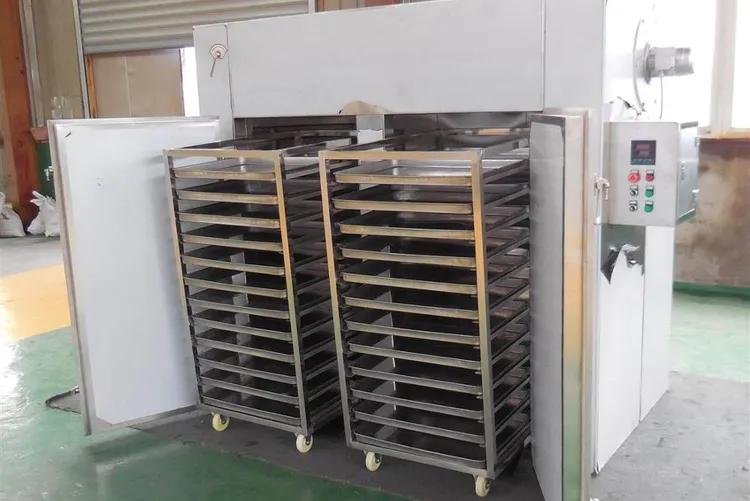
A tray dryer is a batch-operated system in which materials are placed on trays inside a heated chamber.
Hot air circulates around the trays, transferring heat to the materials and carrying away evaporated moisture.
Tray dryers are commonly considered for smaller production batches and applications requiring flexible product changeovers.
Typical applications:
Pharmaceutical materials
Chemical powders
Food ingredients
Specialty products
Pilot-scale processing
Main advantages:
Relatively straightforward operation
Flexible batch processing
Suitable for smaller production volumes
Can accommodate different tray arrangements
Selection considerations:
Air circulation, tray loading, product layer thickness, temperature uniformity, and labor requirements should be considered.
Comparison of Industrial Dryer Types
Dryer type | Suitable materials | Operating mode | Main selection consideration |
|---|---|---|---|
Rotary drum dryer | Bulk solids, minerals, biomass | Usually continuous | Material movement and residence time |
Fluidized bed dryer | Suitable powders and granules | Batch or continuous | Particle characteristics and airflow |
Spray dryer | Solutions and suspensions | Continuous | Atomization and powder recovery |
Belt dryer | Layered solids and agricultural products | Continuous | Layer thickness and air distribution |
Vacuum dryer | Selected heat-sensitive materials | Usually batch | Vacuum and temperature control |
Tray dryer | Small-batch materials | Batch | Airflow uniformity and loading |
No single industrial drying machine is suitable for every application. The correct technology must be selected according to the material and production requirements.
3. Industrial Drying Applications Across Different Industries
Industrial drying systems support a wide range of manufacturing processes. Their configurations differ depending on the physical and chemical characteristics of the materials being processed.
3.1 Food and Agricultural Processing
Drying helps reduce moisture-related deterioration, improve storage stability, and prepare agricultural materials for further processing.
Common applications include:
Fruits and vegetables
Grain and cereal products
Food powders
Milk powder
Agricultural residues
Food additives
Food drying requires attention to product appearance, flavor, nutritional properties, hygiene, and final moisture content.
3.2 Chemical and Pharmaceutical Manufacturing
Chemical and pharmaceutical industries often require precise moisture control to achieve product specifications and support downstream manufacturing.
Common applications include:
Chemical powders
Pharmaceutical intermediates
Granulated compounds
Specialty chemicals
Certain active pharmaceutical ingredients
Material compatibility, temperature sensitivity, contamination control, cleaning procedures, and process consistency are important equipment selection factors.
3.3 Mining and Mineral Processing
Mineral drying is used to reduce moisture before transportation, storage, or subsequent processing.
Typical materials include:
Silica sand
Limestone
Clay
Coal
Mineral concentrates
Metal-bearing ores
The material’s abrasiveness, particle size distribution, moisture content, and dust characteristics influence the appropriate dryer design.
3.4 Biomass and Wood Processing
Industrial drying equipment is used to prepare wood and biomass materials for manufacturing, pellet production, and other applications.
Typical materials include:
Sawdust
Wood chips
Biomass residues
Agricultural waste
Wood-processing byproducts
Moisture control can influence storage conditions, material handling, pelletizing behavior, and downstream energy applications.
3.5 Textile, Paper, and Building Materials
Drying equipment is also used to remove moisture from textiles, paper, coatings, and construction-related materials.
The drying process must achieve the required moisture level without causing shrinkage, deformation, surface defects, or other unwanted product changes.
4. How to Select the Right Industrial Drying Equipment
Choosing industrial drying equipment requires more than comparing machine dimensions, heating power, or advertised production capacity.
The most important step is understanding the actual process requirements.
4.1 Identify Material Characteristics
Start by defining the material that needs to be dried.
Important information includes:
Material name and composition
Physical state: liquid, slurry, paste, powder, granules, or bulk solids
Particle size distribution
Bulk density
Initial moisture content
Stickiness and cohesiveness
Abrasiveness and corrosiveness
Heat sensitivity
Chemical and physical stability
These characteristics determine how the material behaves during heating, moisture migration, and mechanical movement.
For example, a free-flowing granular material may be suitable for a rotary drum or fluidized bed dryer, while a liquid solution may require spray drying.
4.2 Calculate the Required Moisture Removal
Initial and target final moisture content are essential for estimating the drying load.
Consider an example:
Wet material feed: 1,000 kg/h
Initial moisture content: 30% on a wet basis
Target final moisture content: 10% on a wet basis
First, calculate the dry solids mass:
1,000 × (1 − 0.30) = 700 kg/h
Next, calculate the final product mass:
700 ÷ (1 − 0.10) = 777.8 kg/h
Finally, calculate the water removal requirement:
1,000 − 777.8 = 222.2 kg/h
Example: Industrial dryer moisture balance
Wet material feed
1,000 kg/h
Water to remove
222.2 kg/h
Dry solids
700 kg/h
Final product
777.8 kg/h
Illustrative mass balance. Assumes no loss of dry solids and moisture percentages expressed on a wet basis.
This calculation estimates the evaporation load, not the complete dryer capacity or heating requirement.
Actual equipment sizing must account for material drying characteristics, heat losses, exhaust conditions, and operating conditions.
4.3 Determine Production Capacity and Operating Mode
Manufacturers should establish whether the process requires batch or continuous drying.
Consider:
Required feed rate in kg/h or tons/day
Daily operating hours
Production shifts
Batch size, if applicable
Product changeover frequency
Future production expansion
Feeding and discharge requirements
A dryer that cannot handle the actual evaporation load may become a bottleneck even if its advertised material throughput appears sufficient.
4.4 Evaluate Temperature and Product Quality Requirements
Different materials have different thermal limits.
Excessive temperature or prolonged exposure may cause:
Chemical degradation
Color changes
Loss of volatile compounds
Structural changes
Product agglomeration
Reduced product functionality
For heat-sensitive materials, vacuum drying or another controlled low-temperature technology may be appropriate.
The required product temperature should be distinguished from the drying medium temperature. They are not necessarily the same.
4.5 Compare Heating Sources and Energy Costs
Industrial dryers may use:
Electricity
Natural gas
LPG
Steam
Thermal oil
Biomass
Recovered process heat
The most economical option depends on local energy prices, utility availability, operating hours, and process requirements.
When comparing equipment, evaluate total operating costs rather than only the initial purchase price.
4.6 Consider Automation, Installation, and Maintenance
A complete industrial drying system may include feeding equipment, heating units, conveyors, exhaust systems, dust collectors, control panels, and discharge equipment.
Evaluate:
Available installation space
Electrical and utility connections
Floor loading and structural requirements
Exhaust and ventilation arrangements
Dust collection requirements
Cleaning and maintenance access
Spare parts availability
Temperature and moisture monitoring
Integration with existing production equipment
The dryer should be assessed as part of the complete manufacturing process.
5. How to Improve Industrial Drying Efficiency and Avoid Common Problems
Industrial drying performance depends on equipment design, material characteristics, and operating conditions.
The following problems can reduce production efficiency and increase manufacturing costs.
5.1 Uneven Drying
Common causes:
Uneven material feeding
Inconsistent material layer thickness
Poor airflow distribution
Insufficient material mixing
Inappropriate residence time
Practical solutions:
Improve material distribution, check airflow balance, and verify that the equipment provides sufficient material movement.
For belt dryers, inspect layer thickness and air distribution. For rotary dryers, evaluate material feeding, drum operation, and internal lifting arrangements.
5.2 Excessive Drying Time
Common causes:
Insufficient heat transfer
Unsuitable airflow conditions
Excessive material loading
Large particle size
Slow internal moisture migration
Practical solutions:
Review temperature, airflow, material loading, and residence time.
If internal moisture migration is the limiting factor, increasing the heating temperature may not provide a meaningful improvement and could damage the material.
5.3 High Energy Consumption
Common causes:
Excessive exhaust heat losses
Poor equipment insulation
Unnecessary moisture removal
High initial moisture content
Inappropriate heating conditions
Practical solutions:
Consider upstream mechanical dewatering where feasible, improve insulation, optimize the drying endpoint, and investigate exhaust heat recovery.
Mechanical dewatering can reduce the amount of water that must be evaporated thermally, although its suitability depends on the material.
5.4 Material Damage During Drying
Common causes:
Excessive product temperature
Prolonged heat exposure
Excessive mechanical agitation
Unsuitable drying technology
Practical solutions:
Evaluate lower-temperature operation, adjust residence time, and select a dryer compatible with the material’s physical and thermal properties.
Material testing or pilot-scale trials can help establish appropriate drying conditions.
5.5 Insufficient Production Capacity
Common causes:
Incorrect evaporation load estimates
Inaccurate material data
Insufficient heating capacity
Feeding or discharge bottlenecks
Unaccounted production variations
Practical solutions:
Review the material balance, evaporation requirements, feeding system, and complete production line.
Do not evaluate dryer capacity solely by the quantity of wet material entering the machine. The moisture removal requirement is equally important.
6. Industrial Drying Equipment Cost and Purchasing Considerations
Industrial drying equipment prices vary according to technology, capacity, construction materials, heating configuration, automation, and supporting equipment.
A simple tray dryer and a complete continuous industrial drying line have very different design and manufacturing requirements.
What Factors Affect Industrial Dryer Prices?
Factor | Effect on equipment cost |
|---|---|
Dryer technology | Determines equipment structure and process complexity |
Processing capacity | Influences equipment dimensions and heating requirements |
Material characteristics | May require specialized internal structures or materials |
Heating configuration | Affects thermal system design and utility requirements |
Construction materials | Stainless steel and specialized alloys can increase cost |
Automation | Additional sensors, instruments, and controls affect pricing |
Environmental systems | Dust collection and exhaust treatment add costs |
Customization | Special feeding, discharge, and integration requirements affect the quotation |
Questions to Ask an Industrial Dryer Manufacturer
Before purchasing, manufacturers should ask potential suppliers:
What material properties were considered in the proposed equipment design?
What initial and final moisture contents is the proposed system designed around?
What is the expected evaporation capacity under the specified operating conditions?
How is temperature and airflow controlled?
What heating source does the system require?
How is exhaust moisture and dust handled?
What cleaning and maintenance procedures are required?
What utilities and installation conditions are necessary?
Does the quotation include feeding, discharge, and supporting equipment?
What technical information supports the proposed equipment selection?
These questions help buyers compare suppliers on engineering suitability rather than price alone.
What Information Is Required for an Industrial Drying Equipment Quotation?
Prepare the following information before contacting a manufacturer:
Information | Details required |
|---|---|
Material | Name, composition, and physical state |
Initial moisture | Percentage and measurement basis |
Target moisture | Required final moisture percentage |
Processing capacity | kg/h or tons/day |
Particle characteristics | Size, density, and distribution |
Temperature limits | Maximum acceptable product temperature |
Heating source | Electricity, gas, steam, or other |
Production mode | Batch or continuous |
Installation location | Country and facility environment |
Special requirements | Corrosion resistance, dust control, hygiene, automation |
Material samples, photographs, laboratory results, and existing process information can further support equipment evaluation.
If some technical parameters are unknown, provide the available information and identify what needs to be confirmed through testing.
Frequently Asked Questions About Industrial Drying Equipment
1. What are the main types of industrial drying equipment?
The main types include rotary drum dryers, fluidized bed dryers, spray dryers, belt dryers, vacuum dryers, and tray dryers.
Each technology is designed for different material properties, moisture removal requirements, and production configurations.
2. How do I choose the right industrial drying equipment?
Start with the material’s physical properties, initial moisture content, target final moisture, required production capacity, and heat sensitivity.
Then compare suitable dryer technologies based on energy sources, operating costs, installation requirements, maintenance, and product quality.
3. What factors affect industrial drying efficiency?
Drying efficiency is influenced by temperature, airflow, humidity, heat transfer, material particle size, moisture migration, residence time, and equipment insulation.
Optimizing these factors requires considering the complete material and energy balance rather than changing one operating parameter independently.
4. How can manufacturers reduce industrial drying energy consumption?
Potential measures include reducing moisture through mechanical dewatering before thermal drying, improving insulation, optimizing exhaust conditions, recovering suitable waste heat, and avoiding unnecessary drying beyond the target moisture content.
The appropriate measures depend on the material and equipment configuration.
5. How much does industrial drying equipment cost?
Industrial dryer prices depend on equipment type, capacity, material characteristics, construction materials, heating system, automation, and supporting equipment.
A meaningful quotation requires information about the material, moisture reduction requirements, processing capacity, and operating conditions.
6. Can one industrial dryer handle different materials?
Some dryers can process multiple materials, but compatibility must be evaluated individually.
Particle size, stickiness, moisture content, heat sensitivity, chemical compatibility, and cleaning requirements can all affect performance.
For facilities handling several products, suppliers should evaluate the operating conditions required for each material.
Conclusion: Choosing an Industrial Drying System That Meets Your Production Requirements
Industrial drying equipment plays an important role in manufacturing quality, production efficiency, and operating cost control.
The right system is determined by the interaction between material properties, moisture removal requirements, production capacity, drying technology, energy availability, and facility conditions.
Rather than selecting a machine based solely on advertised capacity or purchase price, manufacturers should evaluate the complete drying process and confirm that the proposed equipment can meet their actual production requirements.
Looking for industrial drying equipment for your manufacturing facility?
Contact our team to discuss your material characteristics, initial and target moisture content, required processing capacity, heating source, and production conditions.
Share your application details to request an industrial drying equipment evaluation and quotation based on your actual manufacturing requirements.