Choosing an industrial drying machine is not simply a matter of comparing equipment prices, heating power, or advertised production capacity. The right dryer must match the physical properties of your material, the required moisture reduction, production throughput, product quality standards, and available energy resources.
A machine that works well for one manufacturing process may perform poorly in another. For example, a rotary drum dryer may be suitable for bulk mineral materials, while a spray dryer is designed to convert liquid feed into powder. Heat-sensitive chemical products may require a vacuum drying system, whereas certain granular materials can be processed efficiently in a fluidized bed dryer.
Selecting the wrong technology can lead to uneven drying, excessive energy consumption, damaged products, insufficient production capacity, and unnecessary maintenance costs.
This guide explains how manufacturers can evaluate different industrial drying machines, identify the most suitable drying technology, calculate moisture removal requirements, and compare equipment suppliers before making a purchasing decision.
1. Start With Your Material: The Foundation of Industrial Dryer Selection
Before comparing industrial drying equipment, identify exactly what needs to be dried.
Material characteristics determine how moisture moves, how heat should be applied, and how the material behaves during processing.
Two materials with the same initial moisture content may require completely different drying technologies.
1.1 Identify the Physical State of Your Material
Start by determining whether your material is a liquid, slurry, paste, powder, granule, or bulk solid.
Material type | Typical examples | Potential drying technologies |
|---|---|---|
Liquid solutions | Milk solutions, chemical solutions | Spray dryer |
Slurries | Mineral slurries, chemical suspensions | Spray dryer or suitable indirect drying system |
Wet pastes | Chemical pastes, filter cakes | Vacuum dryer or suitable conductive dryer |
Powders | Chemical powders, food ingredients | Fluidized bed, tray, or vacuum dryer |
Granules | Fertilizer, pharmaceutical granules | Fluidized bed or rotary drum dryer |
Bulk solids | Sand, minerals, biomass | Rotary drum or belt dryer |
These are preliminary technology options rather than universal recommendations. Actual suitability depends on viscosity, particle characteristics, moisture behavior, heat sensitivity, and other process conditions.
1.2 Evaluate Material Characteristics
Beyond physical state, examine the following properties:
Particle size and distribution
Bulk density
Initial moisture content
Stickiness and cohesiveness
Abrasiveness
Corrosiveness
Heat sensitivity
Chemical composition
Mechanical strength
Tendency to agglomerate
For example, fine powders may become airborne during processing and require effective dust collection. Sticky materials may adhere to equipment surfaces or form agglomerates. Abrasive minerals may require wear-resistant construction.
These characteristics influence the dryer structure, material-contact surfaces, feeding mechanism, and discharge design.
1.3 Determine Whether the Material Is Heat-Sensitive
Some materials cannot tolerate prolonged exposure to elevated temperatures.
Excessive heat may cause:
Chemical degradation
Color changes
Loss of volatile compounds
Changes in product structure
Reduced functional properties
Unwanted agglomeration
For these applications, vacuum drying or another controlled low-temperature technology may be worth evaluating.
However, the material’s actual temperature tolerance must be established through technical data or testing. A low drying temperature does not automatically guarantee better product quality.
2. Calculate Moisture Removal and Required Production Capacity
One of the most common equipment selection mistakes is purchasing a dryer based only on the amount of wet material entering the machine.
The actual drying requirement depends on how much water must be removed.
2.1 Determine Initial and Final Moisture Content
Before requesting an industrial drying machine quotation, establish:
Initial moisture content
Target final moisture content
Required wet material feed rate
Whether moisture percentages are expressed on a wet or dry basis
For most preliminary industrial dryer calculations, moisture content is often expressed on a wet basis.
The basic formula is:
Where:
\(M_d\) = Dry solids mass
\(M_i\) = Initial wet material mass
\(X_i\) = Initial moisture fraction on a wet basis
The final product mass is:
The water evaporation requirement is:
Where \(X_f\) is the target final moisture fraction.
2.2 Practical Industrial Dryer Capacity Calculation
Consider a manufacturing facility with the following requirements:
Wet material feed: 1,000 kg/h
Initial moisture content: 30%
Target final moisture content: 10%
First, calculate the dry solids mass:
Next, calculate the final product mass:
Finally, calculate the water removal requirement:
Industrial drying capacity example
Wet feed rate
1,000
kg/h
Water removal
222.2
kg/h
Dry solids
700 kg/h
Final product
777.8 kg/h
The required evaporation capacity is approximately 222.2 kg of water per hour.
This is a preliminary mass balance, not a complete equipment specification. The final dryer design must also account for heat transfer, material drying behavior, exhaust conditions, heat losses, and operating conditions.
2.3 Match the Dryer to Your Production Requirements
Manufacturers should also determine whether their production process requires batch or continuous drying.
Batch drying is often appropriate when:
Production volumes are relatively small.
Products change frequently.
Different materials require separate processing cycles.
Flexible operating conditions are important.
Continuous drying is often appropriate when:
Production operates for extended periods.
Material feeding is relatively consistent.
High throughput is required.
The drying process is integrated into a continuous production line.
The correct choice depends on the entire manufacturing process, not simply the desired dryer capacity.
3. Compare Different Types of Industrial Drying Machines
After understanding the material and production requirements, identify the drying technologies that may be suitable.
3.1 Rotary Drum Dryer
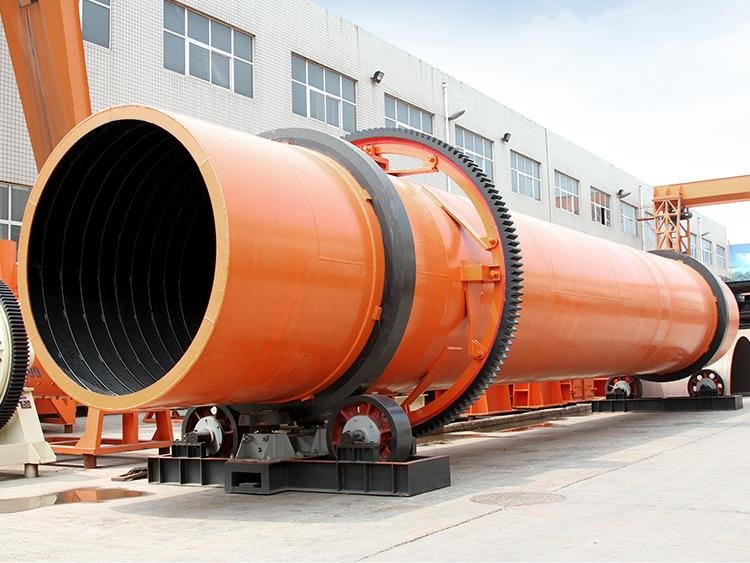
A rotary drum dryer uses a rotating cylindrical drum to move materials through a heated drying environment.
Internal lifting flights may raise and redistribute the material, improving its contact with the drying gas.
Suitable applications:
Sand
Minerals
Biomass
Wood chips
Fertilizer materials
Industrial sludge
Advantages:
Suitable for continuous processing
Handles various bulk solid materials
Can accommodate substantial material throughput
Limitations:
Requires appropriate material movement and residence time
May require dust collection and exhaust treatment
Not automatically suitable for highly heat-sensitive materials
Best selection scenario: Manufacturing facilities processing bulk solids that can tolerate the mechanical movement and thermal conditions of rotary drying.
3.2 Fluidized Bed Dryer

A fluidized bed dryer uses upward-flowing heated air to suspend and agitate particles.
This creates effective contact between the drying gas and individual particles.
Suitable applications:
Pharmaceutical granules
Chemical powders
Fertilizer granules
Food ingredients
Suitable industrial particles
Advantages:
Effective heat and mass transfer
Can support batch or continuous configurations
Suitable for relatively uniform particle drying
Limitations:
Requires appropriate particle size and density
Sticky materials may agglomerate
Fine particles may require additional dust collection
Best selection scenario: Processing free-flowing powders and granules with suitable fluidization characteristics.
3.3 Spray Dryer

A spray dryer converts liquid feed into fine droplets using an atomization system. Heated gas removes moisture from the droplets, producing dry powder.
Suitable applications:
Milk powder
Food ingredients
Chemical solutions
Pharmaceutical materials
Ceramic powders
Advantages:
Converts liquid feed directly into powder
Supports continuous production
Allows adjustment of certain powder characteristics
Limitations:
Requires suitable atomization
Powder recovery and exhaust treatment must be considered
Heat-sensitive materials require careful process evaluation
Best selection scenario: Manufacturing processes that need to convert liquid solutions, suspensions, or emulsions into powders.
3.4 Belt Dryer
A belt dryer transports materials through heated drying zones on a moving conveyor.
Hot air passes through or across the material layer.
Suitable applications:
Agricultural products
Fruits and vegetables
Biomass
Food ingredients
Industrial sludge
Advantages:
Continuous operation
Adjustable residence time
Can accommodate multiple drying zones
Limitations:
Material layer thickness affects drying uniformity
Requires suitable airflow distribution
Cleaning and conveyor maintenance must be considered
Best selection scenario: Continuous drying of materials that can be spread relatively evenly over a conveyor belt.
3.5 Vacuum Dryer
A vacuum dryer operates at reduced pressure, allowing moisture to evaporate at lower temperatures than under atmospheric conditions.
Depending on the configuration, heat may be supplied through heated walls, shelves, or other contact surfaces.
Suitable applications:
Heat-sensitive chemicals
Pharmaceutical intermediates
Specialty powders
Selected advanced materials
Advantages:
Supports lower-temperature evaporation
Can provide an enclosed processing environment
Suitable for certain heat-sensitive products
Limitations:
More complex equipment and sealing requirements
Requires vacuum generation
Heat transfer and material discharge require careful design
Best selection scenario: Materials that cannot tolerate the temperatures associated with conventional atmospheric drying.
3.6 Tray Dryer
A tray dryer uses heated air circulating through a chamber containing material-loaded trays.
Suitable applications:
Small-batch chemical products
Pharmaceutical materials
Food ingredients
Pilot-scale production
Advantages:
Straightforward operating principle
Flexible batch processing
Suitable for smaller production requirements
Limitations:
Batch operation can restrict throughput
Tray loading affects airflow and drying uniformity
May require additional labor
Best selection scenario: Small-scale or specialized production where batch flexibility is more important than continuous throughput.
Industrial Dryer Comparison Table
Dryer type | Material form | Production mode | Main consideration |
|---|---|---|---|
Rotary drum | Bulk solids and granules | Continuous | Material movement |
Fluidized bed | Suitable powders and granules | Batch/continuous | Fluidization characteristics |
Spray dryer | Liquids and suspensions | Continuous | Atomization |
Belt dryer | Layered solids | Continuous | Airflow and layer thickness |
Vacuum dryer | Selected wet solids | Usually batch | Temperature and vacuum |
Tray dryer | Powders and other batch materials | Batch | Air circulation |
4. Evaluate Energy Consumption, Product Quality, and Operating Costs
An industrial drying machine should not be selected based on purchase price alone.
Energy consumption, maintenance requirements, product losses, and production downtime can significantly influence long-term operating costs.
4.1 Compare Available Heating Sources
Common industrial dryer heating sources include:
Electricity
Natural gas
LPG
Steam
Thermal oil
Biomass
Recovered process heat
Evaluate local energy prices, utility availability, heating requirements, and operating hours.
A heating source that appears economical in one country may not be the best option in another because energy prices and infrastructure differ.
4.2 Understand the Factors Affecting Energy Consumption
Industrial dryer energy requirements are influenced by:
Quantity of water removed
Initial material temperature
Required evaporation conditions
Material thermal properties
Exhaust temperature and humidity
Equipment insulation
Heat transfer efficiency
Operating conditions
A practical way to reduce thermal drying demand is to remove as much water as reasonably possible through upstream mechanical dewatering when the material allows it.
For example, filtration or pressing may reduce the moisture entering the thermal dryer.
However, mechanical dewatering is not suitable for every material, so the complete process must be evaluated.
4.3 Protect Product Quality
A drying system must achieve the required moisture level without damaging the product.
Consider:
Maximum acceptable product temperature
Required final moisture consistency
Color and appearance requirements
Chemical stability
Particle structure
Volatile component retention
Contamination control
For sensitive materials, laboratory testing or pilot-scale trials can help establish suitable drying conditions.
4.4 Calculate Total Cost of Ownership
When comparing industrial drying machine prices, consider the complete operating cost.
Cost category | What to evaluate |
|---|---|
Initial purchase | Equipment and manufacturing costs |
Installation | Foundation, transport, utilities, and commissioning scope |
Energy | Electricity, gas, steam, or other heating sources |
Labor | Loading, unloading, monitoring, and cleaning |
Maintenance | Replacement parts and servicing |
Environmental systems | Dust collection and exhaust treatment |
Downtime | Lost production during maintenance or equipment failure |
Product losses | Off-specification or damaged materials |
The lowest initial purchase price may not represent the lowest long-term cost.
5. How to Evaluate Industrial Dryer Manufacturers and Request a Quotation
After identifying suitable drying technologies, the next step is evaluating equipment suppliers.
A professional industrial dryer manufacturer should be able to explain how its proposed equipment relates to the material properties and operating requirements provided by the buyer.
5.1 Questions to Ask Before Purchasing
Before selecting a supplier, ask:
What material properties were considered in the equipment design?
What initial and final moisture contents does the proposal assume?
What is the expected water evaporation capacity?
What operating temperatures are required?
What heating source does the machine use?
How are temperature and airflow controlled?
How is exhaust moisture and dust handled?
What maintenance procedures are required?
What utilities and installation conditions are necessary?
What supporting equipment is included in the quotation?
Request clear technical documentation and distinguish between confirmed specifications and preliminary design assumptions.
5.2 Prepare the Information Required for an Industrial Dryer Quotation
Use the following checklist when contacting an industrial drying equipment supplier.
Industrial Dryer Inquiry Checklist
Information to prepare before requesting a quotation.
0 of 11 prepared
0%
Providing this information helps suppliers understand the actual application and reduces the risk of receiving an unsuitable equipment proposal.
5.3 Request Technical Clarification Before Comparing Prices
Two industrial drying machine quotations may appear similar but include very different configurations.
Compare:
Main dryer structure
Heating system
Feeding and discharge equipment
Control instrumentation
Dust collection
Exhaust treatment
Electrical requirements
Installation and commissioning scope
Spare parts and maintenance documentation
Do not compare quotations based exclusively on machine dimensions, nominal throughput, or total price.
Frequently Asked Questions
1. How do I choose the best industrial drying machine for my material?
Start by identifying the material’s physical state, particle size, initial moisture, target final moisture, heat sensitivity, and required processing capacity.
Then shortlist drying technologies that can handle those conditions. Material testing and technical evaluation may be necessary before final equipment selection.
2. Which industrial dryer is best for powder materials?
The answer depends on powder characteristics.
Fluidized bed dryers are often suitable for free-flowing powders and granules with appropriate particle properties. Vacuum dryers may be suitable for selected heat-sensitive powders, while tray dryers can serve smaller batch applications.
Sticky, cohesive, or very fine powders require additional evaluation.
3. Should I choose a batch dryer or a continuous dryer?
Batch dryers are generally appropriate for smaller production volumes, frequent product changes, or specialized processing requirements.
Continuous dryers are often preferable for stable, high-throughput manufacturing processes.
The decision should consider production schedules, material characteristics, labor, and downstream equipment integration.
4. How do I calculate the required industrial dryer capacity?
Calculate the dry solids mass from the wet feed rate and initial moisture content, then determine the final product mass using the target moisture content.
The difference between initial wet feed and final product mass represents the approximate water removal requirement, assuming no loss of dry solids.
This evaporation load is a starting point for equipment sizing, not a complete specification.
5. How can I reduce industrial dryer energy consumption?
Potential measures include reducing incoming moisture through mechanical dewatering, improving insulation, optimizing exhaust conditions, recovering suitable waste heat, and avoiding unnecessary moisture removal.
The appropriate measures depend on the material and drying technology.
6. What should I consider when comparing industrial dryer prices?
Compare the complete equipment configuration, processing capacity, evaporation requirements, heating system, construction materials, automation, environmental equipment, installation requirements, and maintenance costs.
A technically suitable system with a lower total cost of ownership may be more economical than a cheaper machine with insufficient performance.
Find the Right Industrial Drying Machine for Your Production Process
Choosing the right industrial drying machine requires a clear understanding of your material, moisture removal requirements, production capacity, and operating conditions.
The best solution is not necessarily the largest or most expensive machine. It is the system that can meet your production requirements while maintaining product quality and controlling operating costs.
Looking for an industrial drying machine for your manufacturing facility?
Contact our team to discuss your material characteristics, initial and target moisture content, processing capacity, heating source, and equipment requirements.
Share your application details to request an industrial drying equipment evaluation and quotation based on your actual production needs.