Wet raw materials can create significant problems in industrial production. Excess moisture may reduce product quality, interfere with downstream processing, increase transportation costs, and make storage more difficult. For manufacturers handling large quantities of bulk solids, an efficient drying process is essential to maintaining stable production.
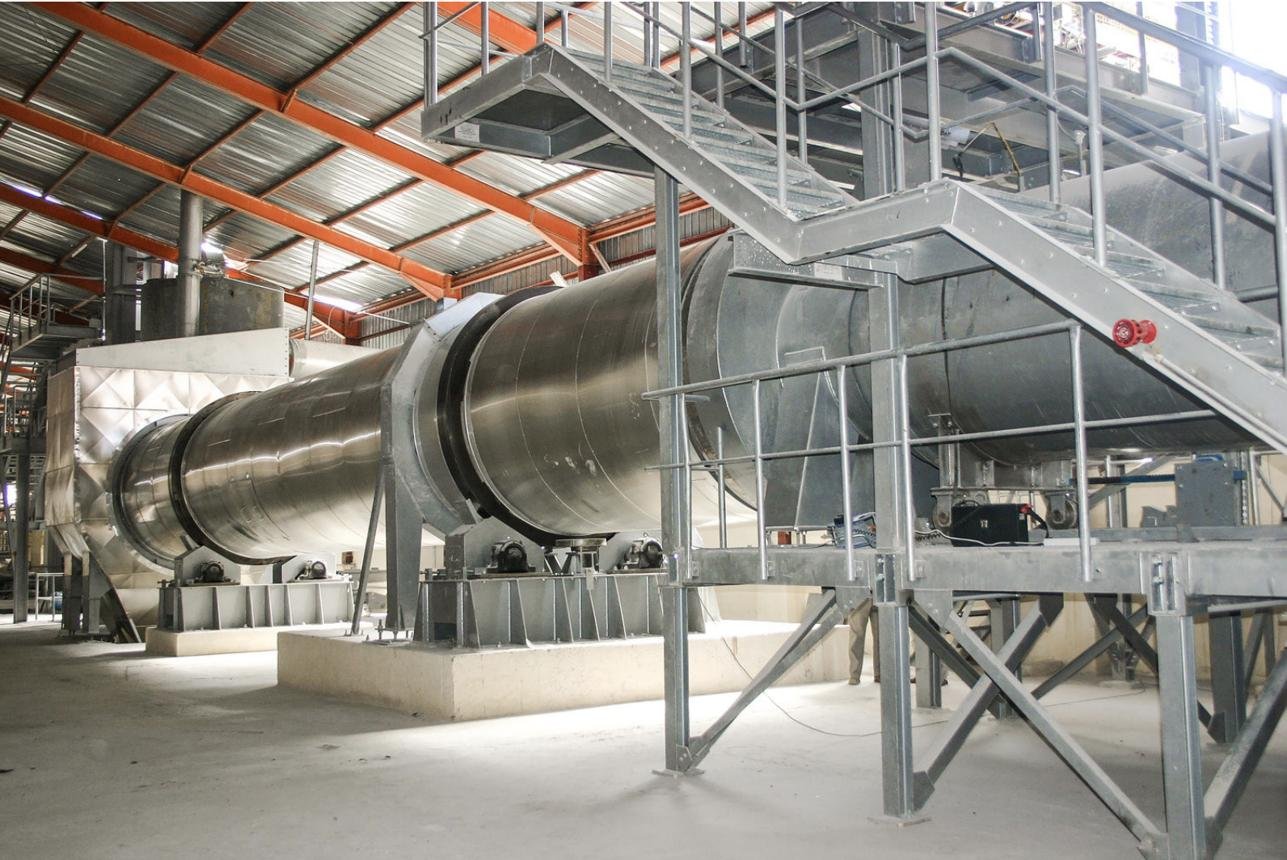
A rotary drum dryer is an industrial drying machine that removes moisture from bulk materials inside a rotating cylindrical drum. It uses controlled heat transfer and continuous material movement to reduce moisture content as the material travels from the feed end to the discharge end.
Rotary drum dryers are widely used in industries such as mining, mineral processing, biomass, agriculture, fertilizer production, chemical manufacturing, and building materials.
But how does a rotary drum dryer actually work? What happens inside the rotating drum? Which materials can it process, and what should buyers consider before purchasing one?
This guide explains the rotary drum dryer’s working principle, main components, drying process, industrial applications, advantages, limitations, and equipment selection considerations.
1. What Is a Rotary Drum Dryer?
A rotary drum dryer is a continuous industrial drying machine designed to remove moisture from wet solid materials through controlled contact with a heated drying medium.
The main structure is a large cylindrical drum that rotates around its axis. The drum is generally installed at a slight downward inclination, allowing material to move gradually from the feeding end toward the discharge end.
Inside the drum, specially designed lifting plates, commonly called flights, raise and distribute the material as the drum rotates. The material then falls through the heated gas stream, increasing contact between the wet solids and the drying medium.
As heat transfers to the material, moisture evaporates and is carried away by the exhaust gas. The dried material is discharged at the opposite end of the drum.
How Is a Rotary Drum Dryer Different From Other Industrial Dryers?
The main distinction is its method of material movement.
Unlike tray dryers, which process materials in stationary batches, a rotary drum dryer continuously moves material through a rotating chamber.
Compared with fluidized bed dryers, which suspend particles in an upward-flowing gas stream, rotary drum dryers rely primarily on drum rotation and internal flights to move and distribute the material.
This operating principle makes rotary drum dryers particularly relevant to many bulk-material applications.
However, the best drying technology depends on material properties, required moisture reduction, production capacity, product quality, and energy requirements.
Main Types of Rotary Drum Dryers
Rotary drum dryers can be classified according to their heating and heat-transfer arrangements.
Direct rotary drum dryer
In a direct rotary drum dryer, heated air or combustion gas flows through the drum and directly contacts the material.
Heat is transferred mainly through convection, although other heat-transfer mechanisms may also contribute.
Direct rotary dryers are commonly considered for materials such as sand, minerals, aggregates, biomass, and other bulk solids that can tolerate direct contact with the drying gas.
Indirect rotary drum dryer
An indirect rotary drum dryer transfers heat through a heated surface, such as the drum wall or another internal heating structure.
The material is heated without direct contact with the combustion gas or primary heating medium.
This arrangement may be suitable when direct gas contact is undesirable because of contamination concerns, product characteristics, or process requirements.
Steam-heated rotary drum dryer
Some rotary drying systems use steam as their heating source. Depending on the design, steam transfers heat through heated surfaces rather than directly contacting the material.
This arrangement may be considered in facilities with an available steam supply and suitable process conditions.
The selection of a direct, indirect, or steam-heated configuration depends on the material, heating requirements, contamination considerations, and overall process design.
2. How Does a Rotary Drum Dryer Work?
The rotary drum dryer working principle combines three essential processes:
Mechanical movement of wet material.
Heat transfer from the drying medium to the material.
Mass transfer as moisture evaporates and leaves the material.
The following steps explain how a typical direct-contact rotary drum dryer operates.
Step 1: Wet Material Feeding
Wet material enters the drum through a feeding chute, hopper, conveyor, or other feeding arrangement.
The feeding system must deliver material at a relatively consistent rate to maintain stable drying conditions.
Feed characteristics that influence operation include:
Initial moisture content
Particle size and distribution
Bulk density
Material temperature
Flowability
Stickiness
Material composition
For example, if the incoming material contains substantially more moisture than the normal operating range, the dryer may not be able to achieve the required final moisture content at the existing feed rate.
A stable feeding system helps prevent overloading, uneven drying, and fluctuations in product quality.
Step 2: Material Movement Through the Rotating Drum
Once inside the drum, the material moves gradually toward the discharge end.
The drum rotates at a controlled speed and is typically inclined slightly to support material movement.
Internal flights play an important role in this process.
As the drum rotates, the flights lift material from the lower section of the drum. The material then falls through the heated gas stream.
This repeated lifting and falling action helps distribute the material and expose more of its surface to the drying medium.
The effectiveness of this process depends on:
Drum rotation speed
Drum inclination
Flight design
Material particle size
Material flow characteristics
Drum dimensions
Material loading
An unsuitable flight arrangement can cause poor material distribution, material buildup, excessive dust generation, or insufficient heat transfer.
Step 3: Heat Transfer to the Wet Material
The heating system supplies the energy needed to evaporate moisture.
In a direct rotary drum dryer, heated gas flows through the drum and contacts the wet material.
The temperature difference between the drying gas and the material provides the driving force for heat transfer.
Heat moves into the material, raising its temperature and providing the energy required for moisture evaporation.
The drying rate is affected by several operating conditions:
Inlet gas temperature
Gas flow rate
Material temperature
Material moisture content
Particle size
Available surface area
Material porosity
Relative humidity of the drying gas
Residence time
A higher inlet temperature does not always mean better drying performance. Excessive heat may damage sensitive materials, affect product quality, or increase energy losses.
The operating conditions must therefore be matched to the material’s thermal characteristics and final product requirements.
Step 4: Moisture Evaporation and Exhaust
As the wet material absorbs heat, moisture moves from within the material toward its surface and evaporates.
The drying gas carries the resulting water vapor away from the drum.
This process involves two connected mechanisms:
Internal moisture movement: Water moves from the interior of the material toward its surface.
External mass transfer: Moisture evaporates from the material surface into the surrounding gas.
The relative importance of these mechanisms depends on the material’s structure and drying conditions.
For some materials, surface moisture evaporates relatively quickly, while internal moisture takes longer to move toward the surface. This is one reason why simply increasing the gas temperature may not solve every slow-drying problem.
The exhaust system removes humid gas and may also collect dust generated during processing.
Depending on the application, it may include:
Exhaust fans
Cyclone separators
Baghouse filters
Dust collectors
Ductwork
Other gas-treatment equipment
The appropriate exhaust arrangement depends on the material, dust characteristics, emissions requirements, and process conditions.
Step 5: Dried Material Discharge
After moving through the drying zone, the material reaches the discharge end.
The dried product is discharged through an outlet and transferred to the next production stage.
Depending on the process, downstream equipment may include:
Belt conveyors
Bucket elevators
Cooling systems
Screening machines
Storage silos
Packaging equipment
The target final moisture content must be consistent with the requirements of the next production stage.
For example, a mineral-processing operation may require a particular moisture level before screening or further treatment, while a biomass producer may need moisture control for storage and fuel preparation.
3. What Are the Main Components of a Rotary Drum Dryer?
A rotary drum dryer consists of mechanical, thermal, material-handling, and exhaust components. Each contributes to the overall drying process.
1. Rotary Drum
The rotary drum is the main drying chamber.
It is typically manufactured from steel, with the construction selected according to operating temperature, mechanical loads, abrasion, corrosion, and material characteristics.
Drum diameter and length are determined by the required drying duty, throughput, material behavior, and residence time.
2. Internal Lifting Flights
Flights are installed along the inside of the drum.
Their function is to lift and distribute the material as the drum rotates, allowing it to fall through the drying gas.
Flight design must match the material’s physical characteristics.
For example, a free-flowing granular material may require a different internal arrangement from a fibrous or sticky material.
3. Feeding System
The feeding system delivers wet material into the dryer.
Common feeding equipment includes hoppers, belt conveyors, screw conveyors, and feed chutes.
The system should support consistent material flow and minimize blockages or uneven loading.
4. Drive System
The drive system provides the rotational force required to operate the drum.
Depending on the equipment design, it may include:
Electric motor
Gearbox
Gears or friction drive
Couplings
Speed-control components
The drive must be suitable for the drum load and operating conditions.
5. Support Rollers and Riding Rings
Support rollers carry the rotating drum through its riding rings, also known as tires.
These components help maintain mechanical stability and drum alignment.
Their condition should be inspected regularly because misalignment, wear, or inadequate lubrication can affect operation.
6. Heating System
The heating system provides the energy needed to evaporate water.
Depending on the process, potential heat sources include:
Natural gas
Diesel or other suitable liquid fuels
Biomass-derived fuels
Steam
Electricity
Waste heat, where technically appropriate
The choice should consider local energy prices, availability, emissions requirements, and operating conditions.
7. Exhaust and Dust Collection System
The exhaust system removes humid gas from the dryer.
It may also collect dust and recover material particles from the exhaust stream.
A properly designed system supports stable gas movement and helps control emissions and workplace dust.
8. Control and Safety System
The control system may monitor and regulate:
Drum rotation speed
Feed rate
Heating temperature
Gas flow
Exhaust temperature
Burner operation
Motor status
Safety interlocks
Instrumentation and automation requirements should be determined by the production process and applicable safety standards.
4. What Materials Can a Rotary Drum Dryer Process?
Rotary drum dryers are used in many industries because they can handle a wide range of bulk solid materials.
However, suitability must be evaluated for each application. Particle size, moisture content, heat sensitivity, abrasiveness, stickiness, and product quality all influence the design.

Mineral Processing and Mining
Rotary drum dryers may be used to process:
Silica sand
Limestone
Clay
Gypsum
Mineral concentrates
Aggregates
Other mineral materials
Drying may be required before screening, grinding, storage, transportation, or additional processing.
Abrasiveness, particle-size distribution, initial moisture content, and final moisture requirements are important design factors.
Biomass and Renewable Energy
Biomass materials may contain substantial moisture, which can affect storage, handling, and combustion characteristics.
Potential applications include drying:
Wood chips
Sawdust
Agricultural residues
Certain organic biomass materials
Biomass fuel feedstocks
Biomass drying requires attention to variable feed characteristics, dust generation, fire risks, and temperature control.
Fibrous or lightweight materials may behave differently from granular materials, so the internal drum design and material-handling arrangement must be evaluated accordingly.
Agriculture and Fertilizer Production
Rotary dryers may be used for certain agricultural and fertilizer products, including:
Organic fertilizers
Mineral fertilizers
Fertilizer intermediates
Agricultural byproducts
Selected grain-processing residues
Product sensitivity and required final moisture content should be considered when determining the drying conditions.
Chemical Manufacturing
Certain inorganic chemicals, chemical intermediates, and granular chemical products can be processed in rotary drying systems.
Important considerations include:
Chemical compatibility
Corrosion resistance
Thermal stability
Contamination control
Dust characteristics
Required process atmosphere
The chemical properties of the material should be reviewed before selecting construction materials and heating arrangements.
Building Materials
Rotary drum dryers are also used in the preparation of construction materials and industrial minerals.
Common examples include sand, aggregates, clay, and other mineral-based raw materials.
Moisture reduction can support consistent batching, mixing, screening, and downstream manufacturing.
5. What Are the Advantages and Limitations of a Rotary Drum Dryer?
A rotary drum dryer offers several advantages for industrial bulk-material processing, but it also has limitations that buyers should understand.
Advantages
Continuous operation
Rotary drum dryers are designed to move material continuously through the drying chamber. This makes them suitable for production lines that require ongoing bulk-material processing.
Broad material compatibility
Depending on the design, rotary dryers can handle granular, particulate, and certain lumpy materials.
Their suitability must still be confirmed against the specific material’s physical and thermal characteristics.
Adaptable heating arrangements
Rotary drying systems can be designed around different heating methods, allowing manufacturers to consider available fuels, steam, electricity, or suitable waste-heat sources.
Integration with production equipment
A rotary drum dryer can be connected with feeding systems, conveyors, dust collectors, cooling equipment, screening machines, and storage systems.
This makes it possible to integrate drying into a larger production line.
Potential for high-volume processing
Rotary dryers are commonly used in industrial processes that require continuous handling of bulk solids.
Actual capacity depends on the drying duty, material characteristics, drum configuration, heat-transfer conditions, and supporting equipment.
Limitations
Large installation space
A rotary drying system may require significant floor space for the drum, heating system, exhaust equipment, conveyors, and maintenance access.
Thermal energy requirements
Water evaporation requires energy. Poor insulation, excessive exhaust losses, and unsuitable operating conditions can increase fuel or electricity consumption.
Potential material degradation
Some products are sensitive to heat, abrasion, impact, or long residence times. These factors must be evaluated before selecting a rotary dryer.
Dust generation
The movement of solids and drying gas can generate dust, especially when processing fine or fragile materials.
Dust collection and appropriate safety measures may therefore be necessary.
Mechanical maintenance
Drums, support rollers, drive systems, seals, flights, and exhaust equipment require regular inspection and maintenance.
When Might Another Drying Technology Be More Suitable?
A rotary drum dryer may not be the best option for every material.
Alternative drying technologies may be worth evaluating when:
The product is highly heat-sensitive.
The material requires precise temperature control.
The material is extremely sticky and prone to buildup.
A specialized process atmosphere is required.
The installation space is restricted.
The product requires a specific particle structure or surface condition.
Depending on the application, alternatives may include fluidized bed dryers, belt dryers, spray dryers, vacuum dryers, or tray dryers.
The comparison should be based on the actual material and process requirements rather than equipment names alone.
6. How to Select the Right Rotary Drum Dryer
Choosing a rotary drum dryer based only on its advertised capacity can result in poor drying performance or unnecessary operating costs.
The equipment must be selected according to the actual drying duty.
1. Identify the Material Characteristics
Start by describing the material that needs to be dried.
Important information includes:
Material name and composition
Particle size and distribution
Bulk density
Initial moisture content
Physical form
Flowability
Stickiness
Abrasiveness
Heat sensitivity
Corrosive properties, if any
A free-flowing mineral material and fibrous biomass may require different drum configurations, flight arrangements, and operating conditions.
2. Define Initial and Final Moisture Content
The initial and target final moisture contents determine how much water the dryer must remove.
Consider the following illustrative example.
A production line processes 1,000 kg/h of wet material with an initial moisture content of 20% on a wet basis. The target final moisture content is 5% on a wet basis.
Initial dry solids:
Final product mass:
Water remaining in the final product:
Initial water content:
Water to be evaporated:
Illustrative drying calculation
Wet feed rate
1,000 kg/h
Water removal
157.9 kg/h
Initial moisture
20%
Final moisture
5%
This calculation estimates the water evaporation duty. It does not establish the required drum dimensions, heating capacity, or energy consumption.
Those require further evaluation of material behavior, gas conditions, heat losses, residence time, and drying characteristics.
3. Confirm the Required Production Capacity
Clarify whether the required capacity refers to wet feed or dried product.
These are not interchangeable.
A supplier should understand:
Wet material feed rate
Required dry product output
Operating hours per day
Daily production target
Continuous or batch operating requirements
Expected variations in feed conditions
Capacity should be evaluated alongside the required moisture reduction.
4. Establish Temperature and Product Quality Requirements
Some materials can tolerate relatively high drying temperatures, while others may be damaged by excessive heat.
Potential quality concerns include:
Color changes
Chemical degradation
Loss of active ingredients
Changes in physical structure
Reduced product performance
Buyers should define the maximum allowable material temperature and any critical product-quality requirements.
Where necessary, material testing should be conducted to confirm suitable drying conditions.
5. Evaluate the Available Heat Source
The heating method affects both equipment configuration and operating costs.
Compare available energy sources based on:
Local fuel or electricity prices
Energy availability
Required thermal input
Heating-system efficiency
Environmental regulations
Fuel storage and handling
Maintenance requirements
A low-cost fuel does not necessarily result in the lowest overall operating cost if it requires additional emissions treatment or more maintenance.
6. Review the Complete System Configuration
A rotary drum dryer should be evaluated as part of a complete production system.
The quotation may include:
Feeding equipment
Rotary drum
Burner or heating system
Exhaust fan
Dust collection system
Conveyors
Cooling equipment
Electrical control system
Supporting structures
Installation and auxiliary equipment
Buyers should clarify exactly what is included in the supplier’s scope of supply.
A quotation for a standalone drum cannot be directly compared with one covering a complete drying line.
Common Rotary Drum Dryer Problems and How to Prevent Them
Understanding common operating problems can help manufacturers evaluate equipment design and plan for stable production.
Uneven Drying
Possible causes:
Inconsistent feed moisture
Fluctuating feed rate
Poor material distribution
Insufficient residence time
Uneven gas temperature or flow
Practical measures:
Maintain stable feeding conditions, inspect the internal flights, and evaluate gas distribution.
If incoming moisture varies significantly, upstream material blending or conditioning may be necessary.
High Energy Consumption
Possible causes:
Excessive exhaust heat losses
Poor insulation
Incorrect operating temperature
Inappropriate airflow
High incoming moisture
Poor heat transfer
Practical measures:
Review the heat balance, inspect insulation, monitor inlet and exhaust conditions, and verify that the system is operating within its intended design range.
Waste-heat recovery may be evaluated when technically and economically appropriate.
Material Buildup Inside the Drum
Possible causes:
Sticky material characteristics
Excessive feed moisture
Unsuitable internal flight design
Inappropriate operating conditions
Poor material flow
Practical measures:
Review material behavior, evaluate the feed moisture range, and confirm that the drum’s internal structure is suitable for the application.
Some materials may require pretreatment or a different drying technology.
Excessive Dust Generation
Possible causes:
Fine or fragile material
Excessive gas velocity
High material drop impact
Unsuitable flight arrangement
Excessive material loading
Practical measures:
Review the airflow and internal material movement, and select appropriate exhaust and dust collection equipment.
Where relevant, assess dust fire and explosion hazards before finalizing the system design.
Frequently Asked Questions
1. What is a rotary drum dryer used for?
A rotary drum dryer is used to remove moisture from bulk solid materials in continuous industrial processes. Typical applications include drying sand, minerals, aggregates, biomass, fertilizers, agricultural byproducts, and certain chemical materials.
2. How does a rotary drum dryer work?
Wet material enters a rotating cylindrical drum and moves gradually toward the discharge end. Internal flights lift and distribute the material through the heated drying medium. Heat causes moisture to evaporate, and the exhaust system removes the resulting water vapor. The dried material exits through the discharge section.
3. What is the difference between a rotary dryer and a rotary drum dryer?
The terms are often used interchangeably in industrial equipment descriptions. A rotary drum dryer specifically refers to a dryer that uses a rotating cylindrical drum to move material through the drying process. The exact configuration may differ according to the heating method and application.
4. What materials can be processed in a rotary drum dryer?
Rotary drum dryers can process many granular, particulate, and certain lumpy materials, including sand, minerals, biomass, aggregates, fertilizers, and selected chemical products. Suitability depends on moisture content, particle size, flowability, abrasiveness, stickiness, and heat sensitivity.
5. How do I calculate the capacity of a rotary drum dryer?
Begin with the wet feed rate, initial moisture content, and target final moisture content. Use a mass balance to calculate the amount of water that must be evaporated. The final equipment capacity and dimensions require further evaluation of drying behavior, heat-transfer conditions, gas flow, residence time, and material properties.
6. What information is needed to request a rotary drum dryer quotation?
Provide the material name, initial and target moisture content, wet feed rate, particle size, material characteristics, available heat source, operating schedule, installation location, and any special product-quality or environmental requirements. A representative material sample may also help with technical evaluation.
Conclusion: Understanding the Process Is the First Step to Selecting the Right Dryer
A rotary drum dryer removes moisture by combining continuous material movement with controlled heat and mass transfer. Its rotating drum, internal flights, heating system, and exhaust equipment work together to process wet bulk materials.
This operating principle makes rotary drum dryers relevant to many industrial applications, including mineral processing, biomass production, fertilizer manufacturing, chemical processing, and building materials.
However, reliable performance depends on more than drum size or heating temperature. The material’s physical properties, initial moisture, target final moisture, production rate, heat sensitivity, and available energy source all influence equipment selection.
Before purchasing, evaluate the complete drying duty and confirm that the proposed system matches your actual production requirements.
Need a rotary drum dryer for your production process?
Contact our team to discuss your material characteristics, moisture requirements, processing capacity, available heat source, and operating conditions.
Share your application details to begin evaluating a suitable rotary drum drying system for your project.