Fresh fruit contains a high proportion of water, which makes it vulnerable to spoilage during storage and transportation. Drying reduces moisture content, extends shelf life when combined with appropriate packaging and storage, and creates value-added products such as dried mango, apple chips, banana slices, raisins, and dried berries.
For commercial food processors, selecting the right fruit drying machine involves more than choosing equipment that removes moisture. Different fruits have different structures, sugar contents, heat sensitivities, and drying characteristics. A drying system that works well for apple slices may not deliver the same results with whole berries, mango strips, or banana pieces.
An unsuitable dryer can cause uneven moisture distribution, excessive shrinkage, discoloration, hardening, long processing times, and unnecessary energy consumption.
This guide explains the main types of industrial fruit drying machines, their working principles, common applications, and the technical factors buyers should evaluate before purchasing fruit dehydration equipment.
1. What Is an Industrial Fruit Drying Machine?
An industrial fruit drying machine is a piece of food processing equipment designed to remove moisture from fresh or pretreated fruit under controlled conditions.
The objective is to reduce the fruit’s moisture content to a specified target while maintaining the required product characteristics, such as:
Color and appearance
Flavor and aroma
Texture and chewiness
Shape and physical integrity
Rehydration properties, where required
Microbiological stability under the intended packaging and storage conditions
Most industrial fruit dryers use heated air to transfer heat to the product and carry evaporated moisture away. Other systems use vacuum, low-temperature conditions, or specialized heat-transfer methods for products requiring different quality characteristics.
A typical fruit drying process includes several stages:
Fruit preparation: Washing, sorting, peeling, pitting, cutting, or slicing.
Pretreatment: Depending on the fruit, this may include blanching, antioxidant treatment, or other methods to control browning and improve product quality.
Loading: Placing the prepared fruit onto trays, belts, or another suitable conveying system.
Drying: Applying controlled heat and airflow to remove moisture.
Cooling: Allowing the dried product to reach a suitable temperature before packaging.
Packaging: Using appropriate moisture-resistant packaging to protect the finished product.
The exact process depends on the fruit variety, cut size, initial moisture content, desired final moisture, and product quality requirements.
A critical distinction: Moisture content and water activity are not the same. Moisture content measures the amount of water in a product, while water activity indicates how much water is available for microbial growth and chemical reactions. Both may need to be evaluated when establishing a commercial dried-fruit specification.
2. Main Types of Fruit Drying Machines
Different drying technologies provide different advantages in terms of production capacity, temperature control, product handling, equipment investment, and final product quality.
The most suitable system depends on the physical characteristics of the fruit and the required production process.
2.1 Hot Air Tray Dryer
A hot air tray dryer uses heated air circulated through a drying chamber containing multiple trays of fruit.
The fruit is spread across trays, and hot air passes around the product to transfer heat and remove moisture. Depending on the equipment design, airflow may be horizontal, vertical, or arranged through a controlled circulation system.
Key features:
Batch-based operation
Relatively straightforward loading and unloading
Flexible for different fruit varieties and batch sizes
Suitable for small and medium-scale processing operations
Can accommodate different tray arrangements and drying conditions
Typical applications:
Apple slices
Mango pieces
Banana chips
Pineapple pieces
Dried citrus products
Small batches of specialty dried fruit
One limitation is that tray position and loading conditions can affect drying uniformity. Poor airflow distribution, excessive loading, or inconsistent slice thickness may result in some trays drying faster than others.
For commercial use, buyers should ask about airflow distribution, tray spacing, temperature control, and the method used to maintain consistent drying conditions throughout the chamber.
2.2 Industrial Belt Dryer
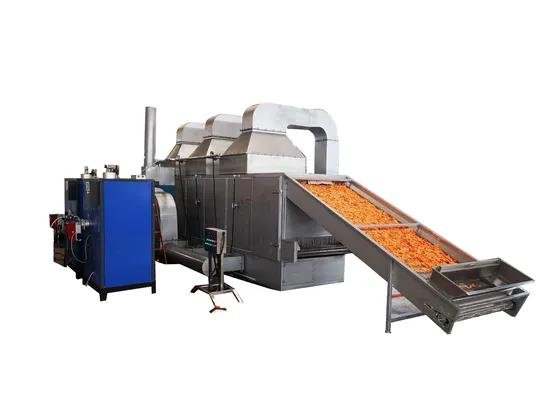
An industrial belt dryer is designed for continuous production. Prepared fruit is distributed across a moving conveyor belt and passes through one or more drying zones.
Heated air moves through or across the product layer, depending on the dryer configuration. Temperature, airflow, belt speed, and drying-zone conditions can be adjusted to suit the material and target moisture level.
Key features:
Continuous material feeding and discharge
Suitable for larger and more consistent production volumes
Can be configured with multiple drying zones
Supports integration with upstream and downstream processing equipment
Reduces the need for repeated manual tray handling
Typical applications:
Apple slices
Mango strips
Pineapple pieces
Banana slices
Diced fruit
Other prepared fruit products with suitable particle size and handling characteristics
A belt dryer is not automatically suitable for every fruit. Sticky materials, irregular pieces, delicate products, and fruit with high sugar content may require special attention to belt selection, product distribution, cleaning, and material handling.
Before selecting a continuous fruit dryer, confirm the required hourly output, product loading depth, residence time, and acceptable variation in final moisture content.
2.3 Multi-Layer Belt Dryer
A multi-layer belt dryer uses several conveyor levels arranged vertically. Fruit moves through different drying stages as it travels along the conveyor system.
This arrangement can increase the effective drying area while reducing the floor space required compared with a single-level system of similar conveying length.
Key features:
Multiple drying layers
Continuous operation
More effective use of available floor space
Potential for different drying conditions across stages
Suitable for integration into automated processing lines
The number of layers, belt dimensions, airflow arrangement, and conveying speed must be determined according to the product and required throughput.
Buyers should also consider maintenance access, cleaning procedures, belt replacement, and the risk of product accumulation at transfer points.
2.4 Heat Pump Fruit Dryer
A heat pump fruit dryer uses a refrigeration-based system to provide controlled heating and dehumidification.
In a typical configuration, the system removes moisture from the circulating air and recovers or transfers heat within the drying process. This can help maintain controlled temperature and humidity conditions.
Key features:
Controlled drying temperature
Integrated air dehumidification in suitable designs
Potentially useful for heat-sensitive fruit
Can reduce dependence on direct fuel-fired heating
Suitable for batch or specially designed continuous configurations
Heat pump systems should be evaluated using the actual operating conditions, including ambient temperature, humidity, target drying temperature, moisture removal rate, and electricity costs.
Their economic performance cannot be judged from the equipment purchase price alone. Buyers should request energy-consumption estimates based on a clearly defined production condition.
2.5 Vacuum Fruit Dryer

A vacuum fruit dryer removes moisture under reduced pressure. Lower operating pressure allows water to evaporate at a lower temperature than under normal atmospheric conditions.
This can be useful for certain fruit products that are sensitive to high temperatures or require specialized texture and quality characteristics.
Key features:
Reduced-pressure drying environment
Lower water boiling temperature under vacuum
Suitable for selected heat-sensitive products
Requires vacuum equipment and pressure-control components
Vacuum drying is generally more specialized than conventional hot air drying. Equipment investment, batch size, vacuum-system design, loading arrangements, and process cycle time should all be considered.
It is particularly important to test the actual fruit product because its structure, sugar content, and physical behavior can affect drying performance.
2.6 Freeze Dryer for Premium Dried Fruit
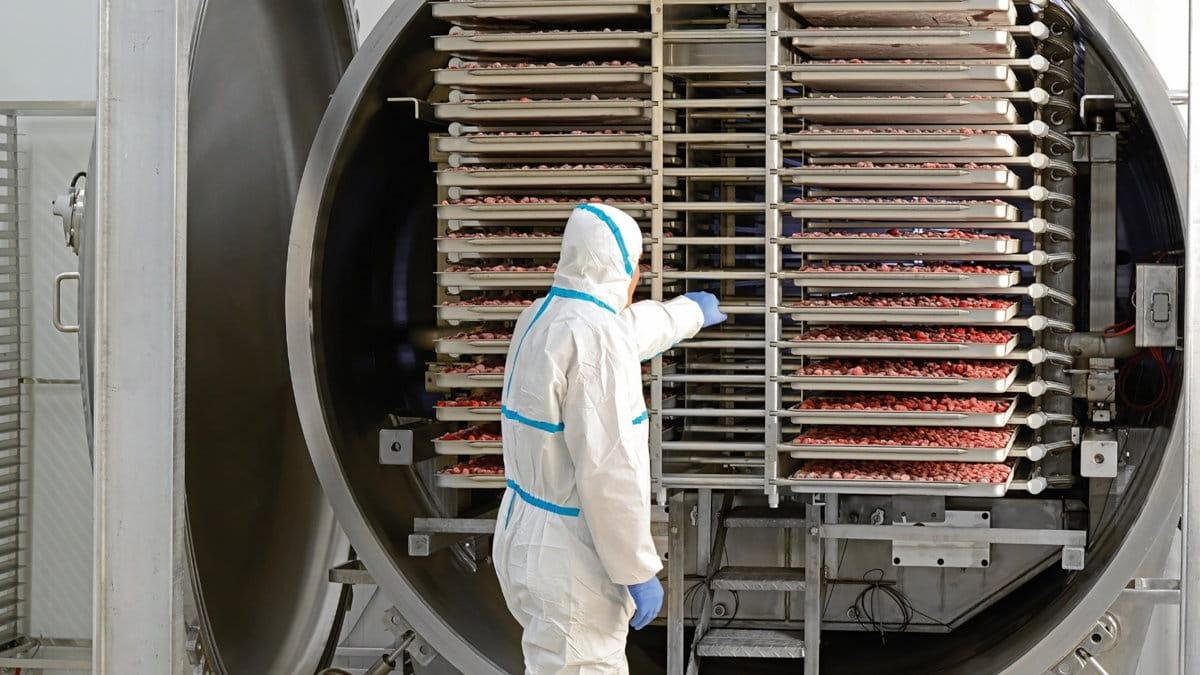
Freeze drying, also known as lyophilization, is a specialized dehydration process.
The fruit is first frozen. Under vacuum, ice is removed mainly through sublimation, meaning it changes directly from solid ice into vapor. A subsequent drying stage removes remaining unfrozen water.
Freeze drying can preserve a porous structure and produce lightweight fruit with distinctive texture and rehydration characteristics.
Typical applications:
Freeze-dried strawberries
Freeze-dried blueberries
Freeze-dried raspberries
Freeze-dried mango
Fruit ingredients for cereals and snacks
Premium fruit powders and specialty food products
Freeze dryers generally involve more complex equipment and longer processing cycles than conventional hot air systems. They are therefore more appropriate when the target product quality and selling price justify the additional investment.
3. Fruit Drying Machine Applications by Fruit Type
Fruit characteristics strongly influence equipment selection and drying conditions. The same dryer may process several fruits, but its operating parameters and product handling arrangements may need to change.
Fruit | Common dried product | Important processing considerations |
|---|---|---|
Apples | Apple rings, slices, chips | Browning control, slice thickness, color |
Mangoes | Mango strips, dried mango pieces | High sugar content, stickiness, texture |
Bananas | Banana chips, dried banana slices | Browning, softness, slice uniformity |
Pineapples | Pineapple rings, chunks | High moisture, sugar content, shrinkage |
Strawberries | Dried or freeze-dried berries | Delicate structure, color, shape |
Blueberries | Whole dried or freeze-dried berries | Skin structure, moisture removal |
Grapes | Raisins | Variety, skin characteristics, drying time |
Citrus fruits | Citrus slices, peel, segments | Thickness, peel properties, flavor |
3.1 Apple Drying
Apple slices are commonly dried into snacks, ingredients, or products for further food processing.
The main challenges include enzymatic browning, inconsistent slice thickness, and moisture variation.
Pretreatment may be required to control browning, depending on the product specification. Slice thickness and loading density should be controlled to support consistent drying.
3.2 Mango Drying
Mango contains considerable natural sugar, and its texture can become sticky during drying.
The preparation process, strip thickness, surface characteristics, and drying conditions all influence the finished product.
A suitable system should provide controlled airflow and temperature while allowing practical cleaning and handling of sticky material.
3.3 Banana Drying
Banana products may be processed into chewy dried slices or crisp products, depending on the formulation and drying method.
The target texture must be established before equipment selection because different product styles require different processing conditions.
Pretreatment may also be considered to manage discoloration.
3.4 Strawberry and Berry Drying
Berries often have delicate structures and may require careful control of temperature, airflow, and handling.
Conventional hot air drying and freeze drying produce different textures and appearances. Buyers should determine whether their market requires a chewy dried product or a lightweight, porous product with a crisp texture.
4. How to Choose the Right Fruit Drying Machine
Choosing equipment based only on the fruit name or advertised production capacity can lead to incorrect purchasing decisions.
A reliable equipment selection process starts with the product specification and works backward to the required drying technology.
4.1 Define the Initial and Final Moisture Content
The amount of water that must be removed is one of the most important factors in drying equipment design.
Buyers should provide:
Initial moisture content
Target final moisture content
Moisture measurement basis
Expected variation in incoming material
Moisture content is commonly expressed on a wet basis or dry basis. These values are not interchangeable.
For example, consider a simplified process handling 1,000 kg of prepared fruit per hour:
Initial moisture content: 85% wet basis
Target final moisture content: 15% wet basis
Dry solids: 150 kg/h
Final product mass: approximately 176.5 kg/h
Water to be removed: approximately 823.5 kg/h
This calculation assumes no loss of dry solids during processing.
It illustrates why equipment capacity should not be judged only by the incoming fruit weight. The required evaporation rate is a key part of dryer sizing.
4.2 Determine the Required Production Capacity
Clarify whether the required capacity refers to:
Fresh fruit input per hour
Prepared fruit input per batch
Dried product output per hour
Total daily production
These are different measurements.
For batch equipment, the calculation should include loading time, drying time, cooling time, and unloading time.
For continuous equipment, buyers should evaluate the actual hourly feed rate, residence time, belt loading, and discharge conditions.
4.3 Evaluate Fruit Characteristics
Different fruits behave differently during drying.
Important characteristics include:
Natural sugar content
Fiber structure
Skin thickness
Slice or piece dimensions
Surface stickiness
Heat sensitivity
Tendency to brown or shrink
Initial moisture distribution
A supplier should understand the actual product rather than relying solely on a general description such as “mango” or “apple.”
Providing representative samples and a detailed product specification can improve the accuracy of equipment evaluation.
4.4 Select the Appropriate Drying Temperature and Airflow
Drying temperature affects moisture evaporation, product quality, and processing time.
Higher temperatures may accelerate drying under some conditions, but excessive heat can damage color, flavor, texture, or nutritional quality.
Airflow is equally important. It transfers heat to the fruit and carries moisture away from the product surface.
If airflow is uneven, some sections may dry faster than others. Excessive airflow may also cause problems such as product movement or surface changes, depending on the material and dryer design.
The correct temperature and airflow should be established through process evaluation and, where necessary, drying tests.
4.5 Compare Energy Sources and Operating Costs
Industrial fruit dryers may use different heating arrangements, including:
Electric heating
Gas-fired heating
Steam-based heating
Heat pump systems
Other site-specific thermal energy sources
The best option depends on local energy prices, utility availability, production schedules, and required drying conditions.
When comparing equipment, evaluate more than the initial purchase price.
Consider:
Electricity or fuel consumption
Labor requirements
Maintenance costs
Cleaning time
Spare parts availability
Expected operating hours
Product yield and quality consistency
A lower-priced dryer may have higher operating costs or create greater product losses. Total cost of ownership is a more useful comparison than purchase price alone.
4.6 Consider Food Safety, Cleaning, and Automation
Fruit processing equipment must be suitable for the intended food production environment.
Buyers should review:
Product-contact material specifications
Cleaning access and procedures
Drainage and moisture management
Belt or tray cleaning requirements
Temperature monitoring and control
Protection against contamination
Integration with upstream and downstream equipment
Automation may help maintain consistent operating conditions and reduce manual handling, but its value depends on the production process and labor requirements.
Do not assume that a particular machine is certified for a specific market. Confirm applicable food-contact requirements, electrical standards, and local regulatory obligations before purchase.
5. Common Problems in Industrial Fruit Drying
Even when the selected machine is generally suitable, poor process conditions can result in inconsistent products and unnecessary costs.
5.1 Uneven Drying
Possible causes:
Uneven fruit slice thickness
Excessive loading density
Poor airflow distribution
Inconsistent raw material moisture
Incorrect belt speed or tray arrangement
Practical solutions:
Standardize cutting dimensions
Control product loading depth
Evaluate airflow across different drying zones
Monitor moisture at multiple product locations
Adjust residence time based on actual drying results
5.2 Discoloration and Loss of Product Quality
Possible causes:
Enzymatic browning
Excessive drying temperature
Long exposure to unfavorable processing conditions
Inadequate pretreatment
Poor storage after drying
Practical solutions:
Evaluate suitable pretreatment methods
Control temperature and drying time
Standardize raw material preparation
Cool products appropriately before packaging
Use packaging suitable for the target shelf life
5.3 Excessive Drying Time
Possible causes:
Thick fruit slices
High initial moisture
Insufficient airflow
Low effective heat transfer
Excessive loading
Inappropriate drying conditions
Practical solutions:
Standardize product dimensions
Review airflow and heat distribution
Evaluate staged drying conditions
Reduce unnecessary loading variation
Conduct controlled drying trials before changing equipment capacity
5.4 High Energy Consumption
Possible causes:
Excessive exhaust-air losses
Poor insulation
Inappropriate temperature settings
Long drying cycles
Unnecessary equipment operation
Poor matching between dryer capacity and production demand
Practical solutions:
Review heat recovery options where technically suitable
Improve insulation and sealing
Optimize operating schedules
Monitor energy consumption per unit of water removed
Compare actual production data with the equipment design basis
6. What Affects Fruit Drying Machine Price?
The price of an industrial fruit drying machine varies according to the process requirements and equipment configuration.
Key price factors include:
Drying technology: Tray, belt, heat pump, vacuum, and freeze-drying systems have different equipment structures and costs.
Processing capacity: Larger production requirements generally require more drying area, heating capacity, and material-handling equipment.
Fruit characteristics: Sticky, delicate, or irregular materials may require specialized handling arrangements.
Heating system: The selected energy source and thermal system influence equipment configuration.
Automation level: Sensors, controls, automatic feeding, and discharge systems affect the overall design.
Construction materials: Product-contact materials and corrosion-resistance requirements influence manufacturing costs.
Additional equipment: Washing, cutting, pretreatment, cooling, and packaging systems may be included in a complete processing line.
When requesting a quotation, buyers should avoid asking only for the price of a machine with a general capacity description.
A more useful inquiry provides the fruit type, initial and target moisture content, required input capacity, product dimensions, and desired finished-product characteristics.
This allows suppliers to evaluate the process and propose a more relevant equipment configuration.
7. What Information Should You Prepare Before Requesting a Quotation?
To help an equipment supplier assess your project, prepare the following information:
Information | Details to provide |
|---|---|
Fruit type | Apple, mango, banana, pineapple, berries, or other fruit |
Raw material condition | Fresh, frozen, peeled, sliced, diced, or pretreated |
Initial moisture | Measured moisture content and basis |
Target final moisture | Required moisture specification |
Product dimensions | Slice thickness, strip size, or piece dimensions |
Input capacity | Required fresh fruit processing rate |
Product quality | Desired color, texture, flavor, and appearance |
Heat source | Electricity, gas, steam, or other available energy |
Production schedule | Operating hours per day and days per year |
Site conditions | Available floor space, utilities, and installation environment |
For products with unusual physical characteristics or strict quality requirements, representative samples and laboratory or pilot-scale testing may be necessary before final equipment selection.
Frequently Asked Questions
1. What is the best fruit drying machine for commercial production?
There is no single best machine for every fruit. Hot air tray dryers may suit batch production, while continuous belt dryers can be appropriate for larger, consistent production volumes. Heat pump, vacuum, and freeze-drying systems may be considered when specific temperature-control or product-quality requirements justify them.
2. How long does it take to dry fruit in an industrial dryer?
Drying time depends on fruit variety, initial moisture, slice thickness, loading density, temperature, airflow, and target final moisture.
Thin apple slices and thick mango pieces, for example, should not be expected to have the same drying cycle. Actual drying time should be established through process testing.
3. Can one industrial fruit dryer process different types of fruit?
Some dryers can process multiple fruit varieties, but the operating conditions and product-handling arrangements may need adjustment.
Different fruits may require different temperatures, airflow, residence times, loading methods, and cleaning procedures. Confirm multi-product requirements before purchasing the machine.
4. What is the difference between a hot air fruit dryer and a freeze dryer?
A hot air dryer removes moisture through evaporation using heated air. A freeze dryer freezes the product and removes ice mainly through sublimation under vacuum.
Hot air drying is commonly used for conventional dried-fruit products. Freeze drying is used for specialized products where a lightweight, porous structure and particular quality characteristics are required.
5. How do I calculate the capacity of a fruit drying machine?
Start with the fresh fruit input rate, initial moisture content, target final moisture content, and expected dry-solids losses.
Then calculate the required water removal rate. The dryer must also be evaluated according to heat-transfer requirements, airflow, residence time, and the desired final product quality.
6. How much does an industrial fruit drying machine cost?
Pricing depends on drying technology, capacity, construction materials, heating system, automation, and additional processing equipment.
A meaningful quotation requires product information and process requirements. Comparing suppliers only by their advertised machine capacity or initial price may result in an unsuitable selection.
Find the Right Fruit Drying Solution for Your Production Line
Choosing a fruit drying machine requires a clear understanding of the raw material, moisture removal requirements, production capacity, and finished-product quality.
Whether you are processing apple slices, dried mango, banana products, pineapple pieces, or berries, the right equipment configuration should be based on the actual material and operating conditions.
Looking for an industrial fruit drying solution? Contact our team to discuss your fruit type, initial and target moisture content, processing capacity, product dimensions, and available energy sources. Providing these details will help us evaluate a suitable drying system and prepare a more relevant equipment proposal for your application.