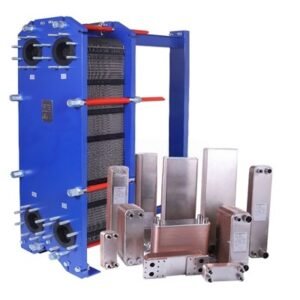
Plate heat exchangers can be molded free of charge
| Equipment Brand: | Zhongzhen |
| Equipment Models: | PER |
| Equipment Type: | Heat exchange units |
Distinctive features of brazed plate heat exchangers
Ensuring
that users can save investment and shipping costs: 1. Compact structure, easy installation, uses thin plates for high thermal insulation and low liquid retention.
2. Low water consumption, and brazed plate heat exchangers have high heat exchange efficiency.
3. Low fouling coefficient; high turbulence reduces the fouling coefficient, thereby decreasing the number of cleaning cycles.
4. Lightweight, only 20%~30% of that of shell-and-tube heat exchangers.
5. Durable and able to withstand high temperatures (250°C) and high pressure (45bar), eliminating corrosion issues and eliminating gaskets.
6. High-quality experience in the field of heat transfer over many years and precise computer-aided design make Baode plate heat exchangers
It meets industry-leading standards in China. Our products are widely used in fields such as metallurgy, food, light industry, chemicals, refrigeration, and HVAC
A plate heat exchanger consists of a set of metal corrugated plates with holes on the plates for the medium to pass through. The metal plates are installed within a frame and clamped with clamping studs. When installing the plates, they are inverted 180 degrees to form a runner. Sealing gaskets are installed on the plates to completely remove the liquid channel and guide the liquid to flow through each channel, preventing mixing of different media. The plate group is positioned by pressing with a fixing plate and pressure plate, and clamped with a clamping stud. To achieve better heat exchange performance, the hot and cold media inside the heat exchanger are usually designed to be counterflow.
Total Heat Transfer (Unit: kW)
Inlet and outlet temperatures on the primary and secondary sides
Allowable pressure drop on the primary and secondary sides