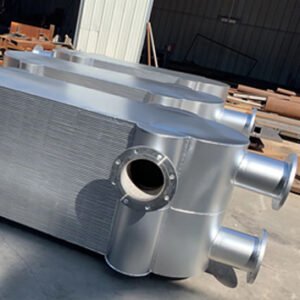
Welded plate heat exchanger
| Equipment Models: | PES |
(1) Semi-welded plate heat exchanger
The structure of a semi-welded plate heat exchanger consists of welding two corrugated plates together, then combining them and sealing each other with gaskets.
The inter-plate channels welded together carry fluids with higher pressure, while those sealed with gaskets carry fluids with lower pressure. Therefore, this type of plate heat exchanger
Increased working pressure on one side. A channel for a medium is formed inside the cavity of the plate pair; Sealants between plate pairs are sealed with corrosion-resistant, high-temperature, and high-pressure sealant gaskets,
Forming another medium channel; The two media flow evenly in opposite directions within adjacent channels, thus completing a full heat exchange process. This structure allows each pair of plates to be easily maintained,
At the same time, it ensures the stability of the welded plate pairs. It features high safety, high heat transfer efficiency, long service life, and ease of maintenance. It is suitable for cooling and chemical treatment, serving as an alternative to shell-and-tube types and complete equipment
The ideal choice for welded plate heat exchangers, especially suitable for the evaporation and condensation of ammonia-based coolants, as well as in the ammonia refrigeration industry, sulfuric acid industry, caustic soda industry, petrochemical industry, metallurgy industry, machinery industry,
Pharmaceutical industry, food industry, etc.
Advantages of Laser Semi-Welded Plate Heat Exchangers Laser semi-welded plate heat exchangers have many advantages, which can be summarized as follows:
(1) No need for spare parts, resulting in low operating costs. Since laser welding is used on the process fluid side (such as electrolyte, sulfuric acid, alkali, etc.) without rubber gasket sealing, strictly speaking, there is no need to purchase spare parts later on that side.
As a result, the operating costs of this equipment are greatly reduced compared to ordinary plate heat exchangers.
(2) Modular design. The entire plate heat exchanger consists of many modules of 2 pieces per group, ensuring the flexibility of the equipment. That is, by increasing or decreasing the number of modules, the heat exchange capacity of the equipment can be conveniently adjusted.
(3) High anti-scaling properties. Generally, the plates of modular laser semi-welded plate heat exchangers are polished during manufacturing. This was originally intended to facilitate welding, improve welding power, or improve power.
However, it also greatly improves the anti-fouling performance of laser semi-welded plate heat exchangers.
(4) It possesses all the advantages of other ordinary plate heat exchangers. For example, it occupies a small footprint, has a high heat transfer coefficient and efficiency, is easy to maintain, and economical to operate.
Application of Laser Semi-Welded Plate Heat Exchangers in the Chemical Industry The maximum operating pressure of laser semi-welded plate heat exchangers can reach 32 bar, with a typical operating temperature range of 40°C~170°C.
Therefore, it has wide applications in the chemical industry, such as: various gas or gas-liquid condensers (such as tower top condensers); Oil cooler; Acid-alkali cooling active heater; Other chemical fluid heat exchange devices;
Condenser subcooler; Evaporators (including gravity circulation evaporators, such as chemical liquids for evaporation and concentration); Gas cooling and heaters, etc.
Welded plate heat exchangers are a new plate exchange technology introduced in the early 1980s to make plate heat exchangers suitable for refrigerant evaporation and condensation. Because semi-welded plate heat exchangers can be applied modularly and offer multiple advantages, they are widely used in cooling and quick-freezing.
1. It has the original advantages of ordinary plate heat exchangers: small footprint, detachable inspection and cleaning, variable number and form of plates, and low refrigerant consumption.
2. Low refrigerant charge, plate materials can be used in various fluids including sanitary and corrosive grades, resistant to freezing, strong fatigue resistance (caused by temperature and pressure changes), high thermal efficiency, and can meet the increasingly rising energy costs and environmental requirements in the current market.
3. Low refrigerant charge allows for low fluid inertia, responsiveness, and facilitates automatic control.
4. The sealing trench of the semi-welded plate heat exchanger not only supports the sealing ring (ring) under very high test pressure, but also has elastic bottoms, allowing additional pressure to be buffered to prevent excessive pressure during assembly. To prevent corrosion and facilitate maintenance, sealing rings (rings) are installed using a buckle method instead of glue. Therefore, it has the advantage of being suitable for more extreme temperatures and having lower permeability.
5. As an evaporator, semi-welded plate heat exchangers can produce ice crystals in fluids (such as water, alcohol-aqueous solutions, etc.) similar to frost and stabilize them in this state. This can increase the capacity of the community’s cooling network without increasing the size of existing pipes.