Choosing a commercial food dehydrator is not simply about finding a machine that can heat food and remove moisture. For food manufacturers, the equipment must deliver consistent drying results, meet production requirements, protect product quality, and operate at a reasonable cost.
A small commercial dehydrator designed for restaurants or specialty food businesses may not be suitable for a factory processing hundreds or thousands of kilograms of raw material. Industrial production requires careful consideration of moisture removal capacity, airflow distribution, temperature control, material handling, automation, and cleaning requirements.
The challenge is that different foods behave differently during dehydration. Fruit slices, vegetables, herbs, meat, seafood, and granular ingredients have different moisture characteristics, heat sensitivities, and processing requirements.
This guide explains how commercial food dehydrators work, compares common machine types, and outlines the key factors to evaluate before purchasing equipment for your business.
1. What Is a Commercial Food Dehydrator?
A commercial food dehydrator is a machine designed to remove moisture from food products using controlled drying conditions. It is used by food businesses and manufacturers to produce dried ingredients, snacks, preserved foods, and other dehydrated products.
Unlike household dehydrators, commercial and industrial systems are designed around higher production requirements, more consistent process control, and integration with food manufacturing operations.
The equipment may use heated air, controlled airflow, conveyor systems, trays, or specialized drying technologies depending on the material and production process.
How Does a Commercial Food Dehydrator Work?
Most conventional commercial food dehydrators use heated air to transfer energy to the food material.
The process generally involves four stages:
Loading: Fresh food is placed on trays, conveyor belts, or another feeding system.
Heating: The equipment supplies controlled heat to the drying chamber.
Moisture evaporation: Water inside the food moves toward the surface and evaporates.
Moisture removal: Airflow carries water vapor away from the product and out of the drying system.
The drying process depends on several interacting variables:
Air temperature
Relative humidity
Air velocity
Material thickness
Initial moisture content
Target final moisture content
Product loading density
Residence time
For example, thin apple slices generally dry faster than whole apples because moisture has a shorter distance to travel from the interior to the surface.
However, increasing temperature does not always improve the process. Excessive heat can damage color, flavor, texture, and other quality characteristics. The correct drying conditions depend on the food material and the desired finished product.
Commercial vs. Industrial Food Dehydrators
The terms commercial food dehydrator and industrial food dehydrator are sometimes used interchangeably in equipment catalogs. However, buyers should distinguish between equipment designed for small commercial operations and systems intended for factory production.
Evaluation factor | Small commercial dehydrator | Industrial food dehydrator |
|---|---|---|
Production scale | Small batches | Larger-scale production |
Feeding method | Usually manual | Manual, semi-automatic, or automated |
Drying configuration | Often tray-based | Tray, belt, or specialized systems |
Process control | Basic or moderate | Can include integrated process monitoring |
Production integration | Usually standalone | Can connect with production lines |
Application | Restaurants, small businesses, specialty products | Food factories and manufacturers |
These are general distinctions rather than fixed technical definitions. Actual equipment capabilities must be confirmed with the supplier.
2. Main Types of Commercial Food Dehydrators
The best commercial food dehydrator depends on the material, production volume, and required product quality.
Different machine configurations offer different advantages. Understanding these differences helps buyers avoid purchasing equipment that is unsuitable for their production process.
2.1 Commercial Tray Food Dehydrator

A tray dehydrator uses multiple trays arranged inside an insulated drying chamber. Food is spread across the trays, and heated air circulates around the material to remove moisture.
Typical applications:
Fruit slices
Vegetable pieces
Herbs and spices
Mushrooms
Specialty dried foods
Small-batch food ingredients
Advantages:
Relatively simple operating principle.
Suitable for batch production.
Flexible for different food materials.
Can be useful when production volumes vary.
Limitations:
Tray loading and airflow distribution strongly affect drying consistency. If trays are overloaded or materials are distributed unevenly, some products may dry faster than others.
Operators may also need to load and unload trays manually, depending on the machine configuration.
A tray dehydrator is worth considering when batch flexibility is more important than continuous high-volume production.
2.2 Commercial Belt Food Dehydrator
A belt dehydrator uses a conveyor system to move food through a heated drying chamber. Heated air passes through or across the product layer, depending on the machine’s airflow design.
Some systems use multiple conveyor levels to increase the available drying area.
Typical applications:
Fruit and vegetable slices
Dehydrated mushrooms
Herbs
Agricultural products
Selected food ingredients
Advantages:
Suitable for continuous production.
Can reduce repeated manual loading and unloading.
Drying conditions can be adjusted through temperature, airflow, and belt speed.
Can integrate with upstream preparation and downstream packaging equipment.
Limitations:
Material must be distributed consistently across the conveyor. Uneven product thickness, excessive loading, or poor airflow distribution can result in inconsistent final moisture content.
A belt dryer is generally worth evaluating when a manufacturer requires continuous processing and has a relatively consistent material feed.
2.3 Multi-Layer Food Dehydrator
A multi-layer food dehydrator uses several conveyor levels or drying layers within one equipment structure. Material moves through different drying zones as it travels through the system.
Typical applications:
Fruit and vegetable processing
Selected agricultural materials
Food ingredients
Products requiring continuous drying
Advantages:
Makes use of vertical equipment space.
Can provide a longer material path within a compact footprint.
Supports continuous material handling.
May allow different drying conditions across zones, depending on design.
Limitations:
The design must provide suitable airflow and temperature distribution across every layer. Uneven loading or differences between zones can affect drying consistency.
Buyers should ask suppliers how material transfers between layers and how airflow is distributed throughout the machine.
2.4 Specialized Industrial Food Drying Systems
Not every food product is suitable for conventional hot-air dehydration. Some applications require a different drying principle.

Spray dryer
Used to convert suitable liquid feeds, such as food solutions or emulsions, into powders through atomization and rapid moisture evaporation.
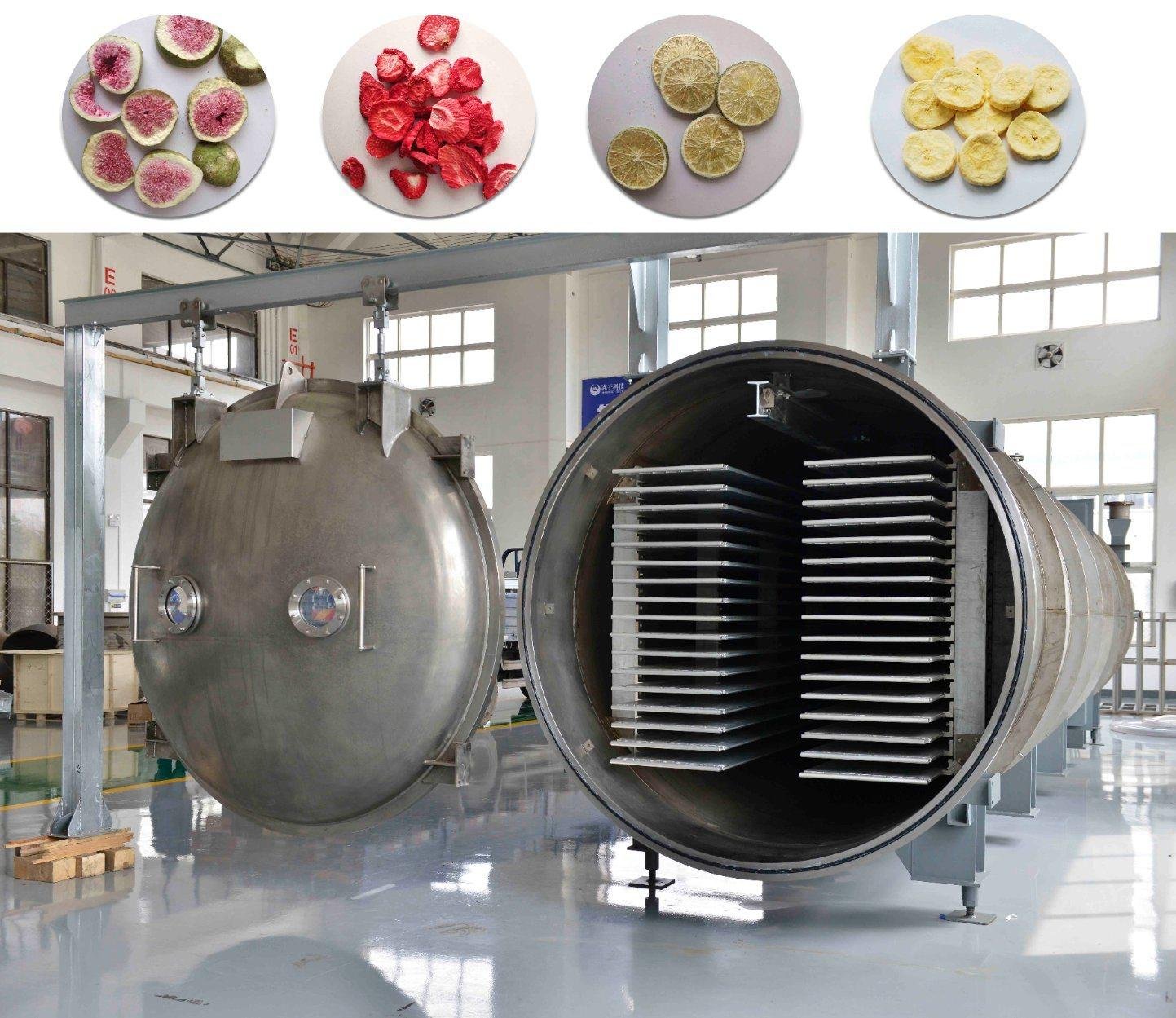
Freeze dryer
Removes moisture from frozen products through sublimation under reduced pressure. It is used for selected premium and heat-sensitive food products.
These technologies should not be treated as direct replacements for ordinary commercial food dehydrators. Each has specific feed requirements, operating conditions, and cost implications.
3. How to Choose the Right Commercial Food Dehydrator
Selecting the right machine starts with the product and production process, not the equipment’s advertised capacity.
The following factors should be evaluated before requesting a quotation.
3.1 Identify the Food Material
Different food materials have different drying characteristics.
Before selecting equipment, identify:
Food type and composition.
Physical form: whole, sliced, diced, paste, powder, or granule.
Product dimensions and thickness.
Initial moisture content.
Bulk density, where relevant.
Stickiness or tendency to agglomerate.
Heat sensitivity.
Desired finished-product characteristics.
For example, drying sliced bananas is different from drying leafy herbs. Bananas may have high sugar content and become sticky during processing, while herbs may require careful control to preserve aroma and color.
The material’s physical condition can influence the choice of dryer, feeding method, and airflow arrangement.
3.2 Determine Initial and Final Moisture Content
Moisture removal is one of the most important factors in determining the required drying system.
Buyers should provide:
Initial moisture content.
Target final moisture content.
Whether values are measured on a wet basis or dry basis.
Acceptable moisture variation.
Water activity requirements, where relevant.
Moisture content and water activity are different measurements. Moisture content describes the amount of water in a product, while water activity indicates how available that water is for chemical and microbial processes.
For many food products, both measurements may be relevant to product quality and storage stability.
Example: Calculating water removal
Suppose a food processor needs to dry 500 kg/h of fruit with an initial moisture content of 80% to a final moisture content of 15%, both on a wet basis.
Assuming no loss of dry solids:
Initial wet feed: 500 kg/h
Initial water: 400 kg/h
Dry solids: 100 kg/h
Final product mass: approximately 117.6 kg/h
Water remaining in final product: approximately 17.6 kg/h
Water to be removed: approximately 382.4 kg/h
This calculation provides an estimate of the water evaporation load. It does not establish the machine’s required size, heating capacity, drying time, or energy consumption. Those require further process evaluation.
3.3 Match Equipment Capacity to Production Requirements
A common purchasing mistake is comparing machines using capacity figures without checking what those figures represent.
Capacity may refer to:
Wet raw material input per hour.
Finished dried product output per hour.
Water evaporation capacity per hour.
Total material processed per batch.
These measurements are not interchangeable.
For example, a dryer processing 500 kg/h of high-moisture fruit may produce a much smaller quantity of finished dried product.
Buyers should also consider:
Daily production targets.
Operating hours per shift.
Number of shifts.
Seasonal production changes.
Expected future capacity expansion.
Upstream and downstream equipment capacity.
The entire production line should be considered, not just the dehydrator itself.
3.4 Evaluate Temperature and Airflow Control
Temperature and airflow influence both drying speed and final product quality.
Important questions include:
Can the temperature be adjusted for different products?
Is airflow distributed evenly across the drying area?
Can air velocity be controlled?
Is humidity monitored or controlled?
Can the drying process use multiple temperature zones?
How is the final moisture content checked?
A higher temperature may increase the drying rate under suitable conditions, but it can also damage heat-sensitive food.
Similarly, insufficient airflow can slow moisture removal, while uneven airflow can create differences in drying results across the product.
The appropriate operating conditions should be determined through material testing and process validation.
3.5 Choose the Right Heat Source
Commercial and industrial food dehydrators may use different heat sources, depending on their design and the production facility.
Common options include:
Electric heating.
Natural gas.
LPG.
Steam.
Hot water.
Recovered waste heat, where technically suitable.
When comparing options, evaluate local energy prices, energy availability, installation costs, temperature control requirements, and maintenance.
The supplier should clarify whether the quotation includes the heating system or only the main drying chamber.
For example, a machine may require a separate boiler, burner, heat exchanger, or other auxiliary equipment. These components can significantly affect the overall project cost.
3.6 Consider Hygiene and Cleaning Requirements
Food processing equipment must be suitable for the hygiene requirements of the product and facility.
Buyers should ask about:
Product-contact material specifications.
Cleaning access.
Internal surface finish.
Drainage and moisture management.
Cleaning procedures.
Maintenance access.
Prevention of cross-contamination.
Compatibility with the facility’s sanitation procedures.
Stainless steel is commonly used in food-processing equipment, but the required grade and surface finish should be determined according to the food material, cleaning chemicals, and applicable regulations.
A machine should not be considered hygienically suitable simply because its exterior is stainless steel.
3.7 Evaluate Automation and Labor Requirements
The right level of automation depends on production volume, labor availability, product consistency requirements, and investment budget.
Potential features to evaluate include:
Automatic feeding.
Conveyor speed control.
Temperature monitoring.
Automated process control.
Alarm functions.
Data recording.
Automatic discharge.
Integration with upstream and downstream production lines.
Automation can reduce manual handling and improve process consistency, but the benefits should be evaluated against equipment cost, maintenance complexity, and operator training requirements.
4. Common Problems When Using a Commercial Food Dehydrator
Even suitable equipment can produce poor results if the operating conditions are not properly controlled.
4.1 Uneven Drying Results
Possible causes:
Different product thicknesses.
Uneven material loading.
Poor airflow distribution.
Blocked air passages.
Incorrect drying time.
Inconsistent raw material moisture.
Practical solutions:
Standardize cutting and preparation procedures.
Maintain consistent loading density.
Inspect airflow distribution.
Check tray positions or conveyor loading.
Measure moisture at different points in the finished product.
4.2 Excessive Drying Time
Possible causes:
Low heat-transfer performance.
Insufficient airflow.
High inlet-air humidity.
Excessive product thickness.
Material characteristics that slow internal moisture movement.
Overloading.
Practical solutions:
Review material preparation and dimensions.
Check temperature and humidity conditions.
Improve airflow where the equipment allows.
Reduce excessive loading.
Evaluate whether the selected drying technology is appropriate.
Simply increasing the temperature may cause product damage without solving the underlying problem.
4.3 High Energy Consumption
Possible causes:
Poor insulation.
Excessive exhaust-air losses.
Inappropriate operating temperatures.
Low equipment utilization.
Inefficient loading arrangements.
Insufficient heat recovery.
Practical solutions:
Inspect insulation and air leakage.
Optimize loading and production scheduling.
Evaluate heat recovery opportunities.
Adjust operating conditions based on measured results.
Compare energy consumption with the actual mass of water removed.
Energy performance should be evaluated using operating data under clearly defined production conditions.
4.4 Food Quality Deterioration
Possible causes:
Excessive product temperature.
Long exposure to unsuitable conditions.
Oxidation.
Uneven moisture removal.
Excessive mechanical handling.
Practical solutions:
Establish product-specific process conditions.
Monitor product temperature where relevant.
Review airflow and residence time.
Reduce unnecessary handling.
Conduct representative drying trials before full-scale production.
Food dehydration must also be considered within the broader food safety process. Drying alone does not automatically eliminate all pathogens or make a product safe for long-term storage.
5. Commercial Food Dehydrator Price and Purchasing Considerations
The price of a commercial food dehydrator varies according to its design, production capacity, heating system, materials, automation, and auxiliary equipment.
A small batch dehydrator and a continuous industrial drying line are fundamentally different investments.
What Factors Affect the Price?
Pricing factor | How it affects the quotation |
|---|---|
Equipment type | Tray, belt, multi-layer, spray, and freeze dryers have different structures |
Processing capacity | Influences equipment dimensions and system requirements |
Water evaporation load | Affects heating and moisture-removal requirements |
Material characteristics | May require specialized feeding, handling, or construction |
Construction materials | Product-contact material and surface requirements affect cost |
Heat source | Heating equipment and auxiliary systems influence the total price |
Automation | Controls, sensors, and integrated feeding systems add configuration requirements |
Installation scope | Electrical work, foundations, commissioning, and site conditions affect project cost |
What Should Buyers Ask Food Dehydrator Suppliers?
Before purchasing, ask suppliers:
What types of food materials is the machine designed to process?
Is the quoted capacity based on wet feed, dried product, or water evaporation?
What initial and final moisture conditions were used for the capacity estimate?
How is temperature and airflow controlled?
How is drying uniformity evaluated?
What product-contact materials are used?
What cleaning and maintenance procedures are required?
Which heating and auxiliary systems are included?
What utilities and installation conditions are required?
Can the proposed configuration be evaluated using representative material samples?
These questions help buyers compare suppliers on a consistent technical basis rather than relying on price alone.
What Information Should You Prepare for a Quotation?
To help a supplier evaluate your application, prepare the following details:
Required information | Details to provide |
|---|---|
Food material | Fruit, vegetable, herb, meat, seafood, or other product |
Material form | Whole, sliced, diced, paste, powder, or granule |
Initial moisture | Percentage and measurement basis |
Target final moisture | Required finished-product moisture |
Production capacity | Wet feed rate or finished product output |
Product dimensions | Thickness, particle size, or average dimensions |
Quality requirements | Color, flavor, texture, water activity, or rehydration |
Heat source | Electricity, gas, steam, hot water, or other source |
Operating schedule | Hours per day and shifts |
Installation location | Country, factory conditions, and available space |
Automation | Manual, semi-automatic, or automatic operation |
If some information is unavailable, explain the intended product and provide representative samples if possible. Testing may be necessary to establish suitable drying conditions.
Frequently Asked Questions
1. What is the difference between a commercial food dehydrator and an industrial food dehydrator?
The terms often overlap, but commercial dehydrators may refer to equipment for restaurants, small businesses, or specialty food production. Industrial food dehydrators are generally designed for larger production volumes, more demanding operating schedules, and integration with manufacturing lines.
Buyers should compare actual processing capacity, feeding methods, controls, construction, and operating requirements rather than relying on product labels.
2. What is the best commercial food dehydrator for fruit?
The best option depends on the fruit type, product dimensions, initial moisture, target final moisture, and required production volume.
Tray dehydrators may suit batch production, while belt dehydrators are worth evaluating for continuous processing of suitable sliced fruit. Freeze drying may be considered for premium products where maintaining structure and other quality characteristics is important.
Representative material testing is recommended before final selection.
3. How much does a commercial food dehydrator cost?
The price depends on equipment type, production capacity, moisture evaporation requirements, heating method, materials, automation, and included auxiliary equipment.
For an accurate quotation, provide the material type, initial and final moisture content, production rate, heat source, and finished-product requirements.
4. How long does it take to dehydrate food commercially?
Drying time depends on material composition, thickness, initial moisture, target final moisture, temperature, airflow, relative humidity, and equipment configuration.
Thin fruit slices may require very different drying conditions from whole vegetables or thick pieces of meat. The actual cycle time should be established through process testing.
5. Can one commercial food dehydrator dry different types of food?
Some machines can process different food materials, but operating conditions and handling arrangements may need to change between products.
Differences in moisture, thickness, stickiness, heat sensitivity, and aroma can affect drying performance. Buyers should confirm the intended product range with the equipment supplier before purchasing.
6. How can I reduce energy consumption in commercial food dehydration?
Start by measuring energy use and the actual amount of water removed. Then evaluate insulation, exhaust-air losses, airflow distribution, loading density, heat recovery, and operating conditions.
The objective is to remove the required moisture while maintaining product quality. Increasing temperature alone does not necessarily reduce total energy consumption.
Conclusion: Choose a Food Dehydrator That Matches Your Production Needs
The right commercial food dehydrator should be selected according to the food material, moisture-removal requirements, production capacity, product quality targets, and operating conditions.
Tray dehydrators can provide batch flexibility, while belt and multi-layer systems may be suitable for continuous production. Spray dryers, fluidized bed dryers, and freeze dryers serve more specialized applications.
Before purchasing, define your raw material characteristics, initial and final moisture content, production targets, and energy requirements. Compare suppliers based on the complete equipment configuration, not just the advertised machine price.
Looking for a commercial food dehydrator for your production facility?
Contact our team to discuss your food material, moisture requirements, processing capacity, heat source, and finished-product specifications. Share your application details so that a suitable drying technology and equipment configuration can be evaluated for your production needs.