Custom plate heat exchangers are used in HVAC systems, industrial process cooling, food processing, chemical production, power generation, and other applications that require efficient heat transfer between two fluids. When a standard model does not meet the required thermal performance, pressure rating, material compatibility, or installation dimensions, a customized design may be necessary.
However, specifying a custom plate heat exchanger involves more than providing a required capacity or choosing a connection size. The design depends on the properties of both fluids, their inlet and outlet temperatures, operating pressures, allowable pressure drops, fouling conditions, and the available installation space.
Incomplete or inaccurate information can result in insufficient heat transfer, excessive pressure drop, unsuitable materials, unnecessary equipment costs, or difficulties during installation.
This guide explains what information engineers, purchasing managers, OEM buyers, and project contractors should prepare before requesting a custom plate heat exchanger design or quotation. It also covers the main design considerations, common specification mistakes, and the information a qualified supplier needs to coordinate an appropriate solution with its manufacturing partners.
Quick Answer: What Information Is Needed for Custom Plate Heat Exchanger Design?
To design or select a custom plate heat exchanger, provide the following information for both fluid circuits:
- Application: What process, system, or equipment will the heat exchanger serve?
- Fluids: What fluid flows through each side, including its concentration and relevant properties?
- Flow rates: What are the normal, minimum, and maximum flow rates?
- Temperatures: What are the inlet temperatures and required outlet temperatures?
- Heat duty: How much heat must be transferred, in kW or BTU/h, if known?
- Operating pressure: What are the normal and maximum operating pressures?
- Allowable pressure drop: What pressure loss can the system accommodate on each side?
- Materials: What plate, gasket, and connection materials are compatible with the fluids and operating conditions?
- Operating conditions: Are there temperature fluctuations, fouling risks, frequent starts and stops, or unusual operating environments?
- Installation requirements: What connection types, dimensions, orientation, and maintenance clearances are required?
- Compliance requirements: Which design codes, testing requirements, and documentation apply to the project?
The most important starting point is a reliable set of thermal operating conditions for both fluids. A supplier can use these details to evaluate heat transfer requirements, pressure drop, plate configuration, materials, and the suitability of a gasketed, brazed, or other plate heat exchanger design.
If some data are unavailable, identify the unknowns clearly rather than substituting unsupported assumptions. Final selection requires appropriate thermal and mechanical design verification.
1. Define the Application and Heat Transfer Requirements
Before discussing plate materials, plate patterns, or connection dimensions, establish what the heat exchanger must accomplish.
The application determines the operating conditions, potential contamination risks, required reliability, cleaning method, and acceptable design limitations.
What Problem Does Application Definition Solve?
A heat exchanger selected only by nominal capacity may perform poorly if its actual operating conditions differ from the assumptions used during selection.
For example, a heat exchanger for chilled water in an HVAC system has different requirements from one used for hot oil cooling or a food-processing application.
Even when two applications require the same heat duty, they may need different plate materials, gasket compounds, pressure ratings, flow arrangements, or cleaning provisions.
What Information Should You Provide?
Describe the following:
| Information | Questions to Answer | Why It Matters |
|---|---|---|
| Application | Heating, cooling, heat recovery, or temperature control? | Establishes the required thermal function |
| Industry | HVAC, chemical processing, food production, marine, or another sector? | Identifies relevant operating and compliance requirements |
| Heat source | What fluid supplies the heat? | Defines hot-side conditions |
| Heat sink | What fluid receives the heat? | Defines cold-side conditions |
| Operating schedule | Continuous, intermittent, seasonal, or variable-load operation? | Influences the design operating range |
| Installation environment | Indoor, outdoor, marine, corrosive, or restricted space? | Affects materials, protection, and mechanical arrangements |
| Existing equipment | New installation or replacement of an existing unit? | Determines compatibility and dimensional constraints |
Example: Industrial Cooling
Consider a manufacturing facility that needs to cool a circulating process fluid using cooling water.
The initial requirement may simply state that the process fluid must be cooled from 65°C to 40°C.
That is not enough to complete the design. The supplier also needs the process fluid’s identity, flow rate, inlet temperature under different operating conditions, cooling-water temperature, available cooling-water flow, operating pressure, and allowable pressure drop.
If the process fluid contains suspended solids or tends to form deposits, the design may also require special attention to channel geometry, cleaning access, or alternative heat exchanger technology.
What to Provide to the Supplier
Prepare a short application description covering:
- The purpose of the heat exchanger.
- The equipment or process it will connect to.
- The required heating or cooling result.
- Expected operating hours and load variations.
- Any existing equipment or installation restrictions.
- Special hygiene, corrosion, cleaning, or safety requirements.
Clear application information helps prevent technically unsuitable products from entering the quotation stage.
2. Provide Accurate Fluid Data for Both Sides
Fluid properties directly influence heat transfer, pressure drop, material compatibility, and the risk of fouling.
A custom plate heat exchanger supplier must understand what flows through each circuit, not just whether the fluid is generally described as water, oil, or glycol.
Which Fluid Properties Matter Most?
At minimum, identify both fluids and provide their operating concentrations where applicable.
| Fluid Information | Why It Matters | Examples |
|---|---|---|
| Fluid identity | Establishes the basic design conditions | Water, glycol solution, thermal oil |
| Composition | Determines compatibility and physical properties | Ethylene glycol and water mixture |
| Concentration | Influences viscosity, heat capacity, and freezing point | 30% or 40% glycol solution |
| Density | Affects mass-flow calculations | kg/m³ |
| Specific heat capacity | Determines the energy carried by the fluid | kJ/(kg·K) |
| Viscosity | Influences flow distribution and pressure drop | mPa·s |
| Thermal conductivity | Contributes to heat transfer performance | W/(m·K) |
| Corrosiveness | Helps determine suitable materials | Chloride-containing water |
| Fouling tendency | Affects long-term performance | Hard water or process fluids containing deposits |
| Suspended solids | May cause blockage or erosion | Particulate-laden process water |
For preliminary selection, some properties can be obtained from reliable reference data. For mixtures, proprietary process fluids, or fluids operating at unusual temperatures, provide a technical data sheet whenever possible.
Why Fluid Identification Alone May Not Be Enough
Problem: A buyer specifies only “glycol” or “industrial oil.”
Why it happens: Different glycol concentrations and oil formulations can have substantially different physical properties. Viscosity, in particular, may change significantly with temperature.
How to solve it: Provide the fluid type, concentration, expected temperature range, and a technical data sheet where available. If the composition is proprietary, ask whether sufficient non-confidential physical-property data can be provided for design purposes.
What to provide to the supplier:
- Fluid name and composition.
- Concentration or mixture ratio.
- Density and specific heat capacity, if available.
- Viscosity at relevant operating temperatures.
- Thermal conductivity, if available.
- Corrosion or compatibility concerns.
- Suspended solids, deposits, or crystallization risks.
Pay Special Attention to Chlorides and Corrosion
Stainless steel is commonly used for plate heat exchangers, but stainless steel grades are not interchangeable in every environment.
Chloride concentration, temperature, pH, oxidizing conditions, and other chemical constituents can influence corrosion risk. Stainless steel 316L may be suitable for many applications, but it is not universally resistant to chloride-induced pitting or stress corrosion cracking.
Titanium may be an appropriate alternative for some aggressive aqueous environments, although suitability must be evaluated against the complete fluid composition and operating conditions.
Material selection should therefore be based on documented fluid chemistry and the proposed design conditions, not simply on the general fluid name.
3. Specify Flow Rates, Inlet Temperatures, and Required Outlet Temperatures
Flow rate and temperature data form the foundation of thermal design.
A supplier uses these parameters to estimate the required heat duty, evaluate the temperature driving force, and determine a suitable heat transfer area and plate arrangement.
What Temperature Data Should You Provide?
For each fluid, specify:
- Inlet temperature.
- Required outlet temperature.
- Normal operating temperature.
- Minimum and maximum expected temperature.
- Any startup, shutdown, or seasonal variations.
For flow rate, provide the normal value and the minimum and maximum values where the system operates under variable conditions.
Use consistent units, such as °C and m³/h, or include clearly identified alternatives such as °F and US gallons per minute.
How Is Heat Duty Calculated?
For a fluid undergoing sensible heating or cooling, the heat duty can be estimated using:
[
Q = \dot{m} c_p \Delta T
]
Where:
- (Q) = heat transfer rate, in kW when the units are consistent.
- (\dot{m}) = mass flow rate, in kg/s.
- (c_p) = specific heat capacity, in kJ/(kg·K).
- (\Delta T) = absolute temperature change, in K or °C.
For this unit combination, the resulting heat duty is in kW.
For example, consider water flowing at 2 kg/s and cooling from 60°C to 40°C. Using an approximate specific heat capacity of 4.18 kJ/(kg·K):
[
Q = 2 \times 4.18 \times (60-40)
]
[
Q = 167.2 \text{ kW}
]
This is an illustrative energy-balance calculation, not a complete plate heat exchanger design. It assumes the stated water flow and temperature change are achieved and does not establish the required plate area, pressure drop, or mechanical configuration.
For fluids undergoing phase changes, such as condensing steam or evaporating refrigerant, additional calculations are required.
What If the Heat Duty Is Unknown?
A buyer does not always need to calculate the heat duty independently.
If reliable flow rates and inlet and outlet temperatures are available for both sides, a supplier can calculate the required duty and check the energy balance.
If the process data are incomplete, the supplier may need additional information before confirming capacity.
The heat removed from one stream should be consistent with the heat received by the other stream, allowing for applicable heat losses and measurement uncertainty.
How Does Flow Rate Affect Plate Heat Exchanger Design?
Increasing flow rate generally increases fluid velocity and may improve convective heat transfer. However, it can also increase pressure drop and pumping requirements.
Reducing flow rate may lower pressure drop, but it can also reduce heat transfer performance and increase the risk of uneven distribution or fouling under certain conditions.
The relationship depends on fluid properties, channel geometry, plate pattern, flow arrangement, and operating conditions. A larger flow rate does not automatically mean that a larger heat exchanger is required, nor does a smaller flow rate guarantee lower overall operating costs.
Practical Information Checklist
| Parameter | Hot Side | Cold Side |
|---|---|---|
| Fluid name | Required | Required |
| Normal flow rate | Required | Required |
| Minimum and maximum flow | If variable | If variable |
| Inlet temperature | Required | Required |
| Required outlet temperature | Required | Required |
| Operating pressure | Required | Required |
| Allowable pressure drop | Required | Required |
| Fluid properties | As applicable | As applicable |
Providing these values in a single table makes technical review and quotation preparation more efficient.
4. Define Operating Pressure, Allowable Pressure Drop, and Temperature Limits
Thermal performance is only one part of custom plate heat exchanger design. The selected unit must also withstand the expected mechanical loads and operate within acceptable hydraulic limits.
Operating Pressure vs. Design Pressure
Operating pressure is the pressure expected during normal service. Design pressure is the pressure basis used for mechanical design under the applicable requirements.
The two values should not be assumed to be identical.
The supplier needs to understand normal operating pressure, maximum expected pressure, possible pressure surges, and the applicable design requirements.
For a heat exchanger separating two fluid circuits, the pressure difference between the sides also matters. Depending on the construction, an excessive differential pressure may affect the plates, gaskets, joints, or brazed structure.
The specified maximum allowable pressure must be appropriate for the actual operating temperature and selected construction.
Why Allowable Pressure Drop Matters
Pressure drop is the reduction in fluid pressure as it passes through the heat exchanger.
A design with higher flow velocity may provide favorable heat transfer performance but require more pumping energy. A design with very low pressure drop may need additional heat transfer area or a different plate arrangement, depending on the application.
Both sides should have a specified allowable pressure drop.
For example, a heat exchanger connected to an existing pump may have a strict hydraulic limit because the pump must also overcome resistance elsewhere in the system.
The allowable pressure drop should therefore reflect the complete system rather than an arbitrary target selected in isolation.
Temperature Limits and Operating Transients
Provide both normal and maximum expected fluid temperatures. Also identify startup conditions, shutdown conditions, temperature cycling, and any possibility of thermal shock.
Temperature affects fluid viscosity, heat transfer, gasket performance, corrosion behavior, and mechanical stresses.
For gasketed plate heat exchangers, the permissible operating range depends on the selected gasket compound, fluid compatibility, pressure, and manufacturer-specific limits. Brazed units have different construction constraints and require their own verified operating envelope.
What to Provide to the Supplier
- Normal and maximum operating pressure on each side.
- Required design pressure.
- Allowable pressure drop on each side.
- Normal and maximum fluid temperatures.
- Expected pressure fluctuations or surges.
- Startup and shutdown conditions.
- Applicable pressure equipment regulations or design codes.
- Any specified inspection or pressure-testing requirements.
The final pressure and temperature ratings must be confirmed for the actual model and construction. Generic ratings should not be used as substitutes for product-specific design verification.
5. Select Suitable Plate, Gasket, and Connection Materials
Material selection influences corrosion resistance, thermal performance, mechanical reliability, maintenance requirements, and purchase price.
For a custom plate heat exchanger, the correct material depends on the fluids on both sides, the operating environment, and the selected construction.
Common Plate Materials
| Material | Typical Considerations | Important Limitations |
|---|---|---|
| Stainless steel 304 | Used in many general-purpose water and industrial applications | May be unsuitable for some chloride-containing or aggressive fluids |
| Stainless steel 316L | Offers improved resistance to many corrosive environments compared with 304 | Not universally resistant to chlorides or all chemical conditions |
| Titanium | Used in selected applications requiring strong corrosion resistance, including certain seawater services | Higher material cost; compatibility still requires verification |
| Other specialty alloys | May be considered for demanding chemical or high-corrosion environments | Availability, cost, fabrication, and suitability depend on the application |
These are general guidelines, not universal compatibility recommendations. The correct choice requires a review of the complete fluid chemistry and operating conditions.
Why Gasket Selection Matters
Gasketed plate heat exchangers rely on elastomeric gaskets to seal the fluid channels.
Common gasket materials include EPDM, NBR, and FKM, but no single compound is suitable for every combination of temperature, pressure, and fluid chemistry.
For example:
- EPDM is used in many water and selected aqueous applications but is generally unsuitable for petroleum-based oils.
- NBR is commonly considered for many oil-related applications, subject to the specific formulation, temperature, and fluid.
- FKM can be suitable for selected oils, fuels, and chemical services, but compatibility and temperature limits must be verified for the actual compound.
The exact material designation and manufacturer-specific operating limits should be confirmed before ordering.
Brazed plate heat exchangers do not use the same gasketed plate-pack arrangement. Their brazing material, commonly copper or another specified alloy, must be compatible with the fluid chemistry and operating conditions.
Connection Materials and Dimensions
The connections must match the piping system and the mechanical requirements of the application.
Specify:
- Connection type, such as threaded, flanged, or another required configuration.
- Nominal connection size.
- Applicable flange standard and pressure class, where relevant.
- Required orientation.
- Pipe material and connection compatibility.
- Any space limitations around the connections.
Do not assume that two connections with the same nominal diameter are interchangeable. Flange standards, dimensions, pressure classes, and sealing arrangements may differ.
What to Provide to the Supplier
Provide the complete fluid composition, operating temperature and pressure, preferred plate and gasket materials if known, connection specifications, and any project-specific material requirements.
For demanding applications, ask for written confirmation of material compatibility and identify whether material certificates or traceability documentation are required.
6. Choose the Appropriate Plate Heat Exchanger Construction
The term “custom plate heat exchanger” can refer to several different constructions. The appropriate option depends on thermal requirements, pressure and temperature limits, fluid cleanliness, maintenance expectations, and available space.
Gasketed Plate Heat Exchanger
A gasketed plate heat exchanger consists of corrugated plates assembled in a frame, with gaskets directing the fluids through alternating channels.
Advantages:
- Can provide high heat transfer performance in a compact arrangement.
- Plate packs can often be opened for inspection and cleaning.
- Capacity can sometimes be adjusted by changing the plate configuration, subject to the frame and design limits.
- Gaskets and plates may be replaceable.
Limitations:
- Gaskets require material compatibility and periodic inspection.
- External leakage may occur if seals deteriorate or the unit is incorrectly assembled.
- The frame, plates, gaskets, and design conditions limit allowable pressure and temperature.
This construction is often considered for HVAC, industrial water systems, and process applications where maintenance access is valuable.
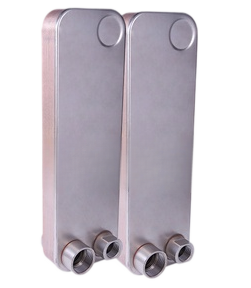
Brazed Plate Heat Exchanger
A brazed plate heat exchanger uses a brazed joint structure to hold the plates together without a conventional removable gasketed plate pack.
Advantages:
- Compact construction.
- No conventional plate-pack gaskets to replace.
- Suitable for many refrigeration, heat pump, and liquid-cooling applications.
Limitations:
- Generally cannot be opened for routine mechanical cleaning.
- Fouling or blockage can be difficult to address.
- The brazing material and construction must be compatible with the fluids.
- Operating pressure and temperature limits depend on the specific design.
Brazed units are commonly considered for clean fluids and applications with space constraints, provided the required operating conditions are within the verified design envelope.
Welded and Other Specialized Plate Designs
Some applications require welded or semi-welded plate constructions because of fluid compatibility, leakage-control considerations, or particular operating conditions.
These designs may be suitable for selected aggressive fluids or demanding industrial processes, but their construction, maintenance requirements, and cost differ from standard gasketed or brazed units.
Comparison: Which Plate Heat Exchanger Is Appropriate?
| Selection Factor | Gasketed | Brazed | Welded or Specialized |
|---|---|---|---|
| Compactness | High | Very high in many applications | Design-dependent |
| Routine internal access | Generally possible after isolation and opening | Generally not possible | Depends on construction |
| Gasket replacement | Applicable | No conventional plate-pack gaskets | Design-dependent |
| Fouling tolerance | Depends on channel design and maintenance access | Often limited where deposits require mechanical cleaning | Application-dependent |
| Customization | Often flexible within the product range | Available within the manufacturer’s design range | Highly design-dependent |
| Purchase cost | Depends on size and configuration | Often economical for compact applications | May be higher |
| Best selection basis | Maintainability and process requirements | Compactness and suitable clean-fluid service | Specific chemical or mechanical requirements |
There is no universally best construction. The selection should balance thermal performance, mechanical suitability, maintenance, and total cost of ownership.
7. Determine Customization, Installation, and Documentation Requirements
A thermally suitable heat exchanger can still be unsuitable for a project if its connections, dimensions, mounting arrangement, or documentation do not meet the installation requirements.
These details should be addressed before finalizing the design and quotation.
What Can Be Customized?
Depending on the selected product and manufacturing partner’s capabilities, customization may include:
- Heat transfer capacity and plate configuration.
- Plate and gasket materials.
- Connection sizes and types.
- Connection orientation.
- Frame dimensions and mounting arrangements.
- Design pressure and temperature within the available product range.
- Special surface treatments or materials where technically appropriate.
- Instrument connections or accessories, if supported by the design.
- OEM labeling, packaging, and documentation.
Not every feature is available for every product. Some changes may require a different model or construction rather than a simple modification to a standard unit.
Installation Requirements
Provide the available installation space, piping arrangement, support requirements, and maintenance clearance.
For a replacement project, useful information includes:
- Existing heat exchanger model and nameplate data.
- Overall dimensions.
- Connection center distances.
- Connection sizes and orientations.
- Available maintenance space.
- Photographs of the existing installation.
- Existing performance problems, if any.
A replacement unit should not be selected based on dimensions alone. Its thermal duty, pressure drop, operating limits, and materials must also be checked.
What Documentation Should Buyers Request?
Depending on the project, the required documents may include:
- Technical datasheet.
- General arrangement drawing.
- Connection and dimensional drawings.
- Thermal performance information.
- Pressure drop data.
- Material specifications.
- Applicable material certificates.
- Inspection and pressure-test documentation.
- Operation and maintenance instructions.
- Packing list and export documents.
- Applicable conformity or regulatory documentation.
The exact documents depend on the product, destination market, project specification, and applicable regulations.
For projects subject to pressure equipment legislation or other mandatory requirements, establish the applicable conformity and documentation requirements before ordering. Do not assume that a supplier’s standard documentation package satisfies every destination country’s regulations.
 8. What Factors Affect Custom Plate Heat Exchanger Cost?
 8. What Factors Affect Custom Plate Heat Exchanger Cost?
The cost of a custom plate heat exchanger depends on its thermal requirements, mechanical design, materials, construction, customization level, and order quantity.
A meaningful quotation requires enough information to establish a technically comparable specification.
Main Cost Factors
| Cost Factor | How It Affects Price |
|---|---|
| Heat duty | Influences required heat transfer area and product size |
| Fluid properties | May require different plate patterns, configurations, or construction |
| Plate material | Specialty corrosion-resistant materials may increase cost |
| Gasket material | Compatible compounds may have different prices and availability |
| Design pressure | May require a different mechanical construction |
| Operating temperature | Can affect material selection and allowable operating conditions |
| Pressure drop limits | May influence plate arrangement, channel configuration, and equipment size |
| Connections | Special sizes, flange standards, or orientations may increase customization costs |
| Construction type | Gasketed, brazed, and specialized designs have different cost structures |
| Testing and inspection | Additional requirements may increase cost |
| Documentation | Material traceability, drawings, and project-specific records may affect the quotation |
| Quantity | Repeat orders and volume may affect unit pricing |
| Packaging and transport | Export packing, freight, insurance, and destination requirements affect delivered cost |
Should You Choose the Lowest-Priced Heat Exchanger?
Not without checking whether the quotations are technically equivalent.
Two suppliers may quote different prices because they have assumed different heat duties, materials, pressure drops, fouling allowances, or testing requirements.
A lower-priced unit may also have higher operating costs if its pressure drop requires more pumping energy or if its design does not meet the application’s maintenance needs.
A more useful comparison includes:
- Purchase price.
- Required pumping energy.
- Expected cleaning and maintenance costs.
- Replacement parts and service requirements.
- Expected operating life under the specified conditions.
- Freight, packaging, and applicable import costs.
- Compliance and documentation requirements.
For long-running industrial systems, the total cost of ownership can be more important than the initial purchase price.
How to Request a Comparable Quotation
Send the same technical specification to each supplier.
Ask each supplier to identify:
- Proposed construction and model.
- Confirmed design conditions.
- Calculated heat duty.
- Pressure drop on both sides.
- Proposed materials.
- Connection details.
- Applicable ratings and standards.
- Included testing and documentation.
- Delivery terms and exclusions.
If a supplier makes assumptions because information is missing, request that those assumptions be stated explicitly in the quotation.
9. Common Custom Plate Heat Exchanger Design Mistakes
Avoid these mistakes when preparing a specification or comparing supplier proposals.
Mistake 1: Providing Only the Required Heat Duty
What buyers do: Request a 100 kW heat exchanger without providing fluid temperatures or flow rates.
Why it causes problems: Heat duty alone does not define the temperature driving force, hydraulic conditions, or required heat transfer area.
What to do instead: Provide flow rates, inlet temperatures, required outlet temperatures, and available pressure-drop limits for both sides.
Mistake 2: Using Incorrect Fluid Properties
What buyers do: Describe a fluid as water, glycol, or oil without specifying its concentration or operating temperature.
Why it causes problems: Incorrect viscosity, specific heat capacity, or density assumptions can lead to inaccurate performance calculations.
What to do instead: Provide the fluid composition and a reliable technical datasheet where available.
Mistake 3: Ignoring Pressure Drop
What buyers do: Focus entirely on heat transfer capacity.
Why it causes problems: Excessive pressure drop can increase pumping energy or prevent the existing system from delivering the required flow.
What to do instead: State the allowable pressure drop for each circuit and confirm that the proposed unit fits the system’s hydraulic limits.
Mistake 4: Choosing Materials Based on Fluid Name Alone
What buyers do: Specify stainless steel without considering the detailed chemical composition.
Why it causes problems: Certain chlorides, chemicals, and operating conditions can cause corrosion even in commonly used stainless steel grades.
What to do instead: Provide fluid chemistry, concentrations, and operating temperatures, and obtain a documented compatibility review.
Mistake 5: Selecting a Brazed Unit for a Difficult-to-Clean Fluid
What buyers do: Choose a compact brazed heat exchanger for a fluid containing deposits or suspended solids without checking cleaning requirements.
Why it causes problems: Internal blockage may be difficult or impractical to remove.
What to do instead: Evaluate fluid cleanliness, filtration, fouling tendency, and cleaning access before selecting the construction.
Mistake 6: Specifying Operating Pressure Instead of Design Requirements
What buyers do: Provide only the normal operating pressure.
Why it causes problems: The mechanical design may need to account for higher pressures, temperature effects, pressure surges, and applicable codes.
What to do instead: Distinguish normal operating pressure, maximum expected pressure, design pressure, and differential pressure requirements.
Mistake 7: Ignoring Replacement Dimensions
What buyers do: Order a replacement based only on the old unit’s nominal capacity.
Why it causes problems: Connection positions, flange standards, mounting arrangements, or maintenance clearances may not match.
What to do instead: Provide the existing nameplate, drawings, dimensions, connection details, and operating data.
Mistake 8: Comparing Quotations With Different Assumptions
What buyers do: Select the cheapest proposal without reviewing the technical specification.
Why it causes problems: Suppliers may have quoted different materials, thermal margins, pressure drops, or testing requirements.
What to do instead: Compare confirmed performance and construction against a common specification.
Mistake 9: Treating a Preliminary Selection as a Final Design
What buyers do: Place an order based on a rough online calculation or a nominal capacity estimate.
Why it causes problems: Preliminary calculations cannot establish every thermal, hydraulic, mechanical, and regulatory requirement.
What to do instead: Obtain a final, documented selection based on the actual operating conditions before releasing the order.
10. Custom Plate Heat Exchanger Design Checklist
Use this checklist when preparing an RFQ for a custom plate heat exchanger supplier or export partner.
| Category | Information to Prepare | Priority |
|---|---|---|
| Application | Process description and heating or cooling objective | Essential |
| Hot-side fluid | Fluid name, composition, and concentration | Essential |
| Cold-side fluid | Fluid name, composition, and concentration | Essential |
| Hot-side flow | Normal flow rate and operating range | Essential |
| Cold-side flow | Normal flow rate and operating range | Essential |
| Hot-side temperatures | Inlet and required outlet temperatures | Essential |
| Cold-side temperatures | Inlet and required outlet temperatures | Essential |
| Heat duty | Required kW or BTU/h, if known | Preferred |
| Operating pressure | Normal and maximum pressure on each side | Essential |
| Design pressure | Required mechanical design basis | Essential for final design |
| Pressure drop | Maximum allowable pressure drop on each side | Essential |
| Fluid properties | Density, specific heat, viscosity, and relevant chemistry | Essential where applicable |
| Fouling conditions | Deposits, suspended solids, scaling, or filtration | Essential |
| Materials | Plate, gasket, brazing material, and connection requirements | Essential |
| Construction | Gasketed, brazed, welded, or another suitable design | Preferred if already specified |
| Connections | Size, type, standard, and orientation | Essential for installation |
| Dimensions | Available space and maintenance clearance | Essential |
| Standards | Applicable design codes and destination-market requirements | Project-dependent |
| Testing | Required inspection and test documentation | Project-dependent |
| Quantity | Number of units and expected repeat orders | Essential for quotation |
| Delivery | Required delivery date and destination | Essential for quotation |
| Packaging | Export packaging and handling requirements | Project-dependent |
| Documentation | Datasheets, drawings, certificates, and manuals | Project-dependent |
Practical recommendation: If you cannot provide every parameter, submit the information you have and identify the missing values. A qualified technical team can determine which additional data are essential before confirming a design.
11. Frequently Asked Questions About Custom Plate Heat Exchanger Design
1. What information is required to design a custom plate heat exchanger?
The essential information includes the application, both fluids, flow rates, inlet and outlet temperatures, operating pressures, allowable pressure drops, fluid properties, and material requirements. Installation dimensions, connections, cleaning requirements, and applicable standards are also needed to finalize the specification.
2. Can I order a custom plate heat exchanger if I only know the required capacity?
A preliminary discussion is possible, but capacity alone is insufficient for a reliable final selection. The supplier will normally need flow rates and inlet and outlet temperatures for both fluids, along with pressure-drop limits, fluid properties, and operating pressure.
3. How is the required heat transfer area calculated?
The required area depends on heat duty, the overall heat transfer coefficient, and the effective temperature difference. For a suitable countercurrent arrangement, a common preliminary relationship is:
[
Q = U A \Delta T_{lm}
]
Where (Q) is heat duty, (U) is the overall heat transfer coefficient, (A) is the heat transfer area, and (\Delta T_{lm}) is the logarithmic mean temperature difference (LMTD).
The actual design must account for the selected heat exchanger’s flow arrangement, fluid properties, fouling assumptions, and performance characteristics.
4. What is the difference between heat duty and heat transfer area?
Heat duty is the rate at which heat must be transferred, normally expressed in kW. Heat transfer area is the effective surface available for transferring that heat, normally expressed in m². The required area depends on the heat duty, temperature driving force, overall heat transfer coefficient, and design conditions.
5. Which plate material is best for a custom plate heat exchanger?
There is no universally best material. Stainless steel 304, stainless steel 316L, titanium, and specialty alloys are used in different applications. The correct selection depends on fluid chemistry, chloride concentration, temperature, pressure, corrosion risks, and cost.
6. How do I choose between a gasketed and brazed plate heat exchanger?
A gasketed unit is often preferable when opening the plate pack for inspection or cleaning is important. A brazed unit is often attractive when compactness and a sealed construction are priorities. The choice depends on fluid cleanliness, operating limits, maintenance requirements, and the specific manufacturer’s design.
7. Can a custom plate heat exchanger handle glycol?
Yes. Plate heat exchangers are used with many water-glycol mixtures, provided the materials and operating conditions are suitable. The supplier needs the glycol type, concentration, flow rate, and operating temperatures because viscosity and thermal properties influence heat transfer and pressure drop.
8. Can a plate heat exchanger be used with seawater?
Yes, but seawater service requires careful material selection and consideration of corrosion, fouling, temperature, and operating conditions. Titanium plates are used in many seawater applications, although the complete construction and other wetted components must also be checked for compatibility.
9. What causes excessive pressure drop in a plate heat exchanger?
Excessive pressure drop can result from high flow rates, unsuitable channel configurations, viscous fluids, fouling, blockage, or an incorrect design assumption. A technical review should compare actual flow conditions with the original design data and assess whether cleaning, operating adjustments, or equipment changes are appropriate.
10. Can a custom plate heat exchanger replace an existing unit?
Yes, provided the replacement meets the required thermal duty, pressure-drop limits, mechanical ratings, material compatibility, and installation constraints. The existing nameplate, performance data, drawings, connection dimensions, and details of any operating problems help establish a suitable replacement.
11. What affects the price of a custom plate heat exchanger?
Price depends on heat duty, materials, construction, pressure and temperature ratings, connections, customization, testing, documentation, order quantity, and delivery requirements. Quotations should be compared using the same technical specification rather than purchase price alone.
12. How long does custom plate heat exchanger production take?
Lead time depends on the selected model, material availability, design approval, manufacturing partner’s schedule, customization, inspection requirements, and shipping arrangements. A reliable delivery estimate should be confirmed against the actual specification and order conditions.
13. What documents should accompany a custom plate heat exchanger?
Depending on the application and project requirements, documents may include a technical datasheet, general arrangement drawing, connection drawing, operating instructions, material certificates, inspection records, test documentation, and export documents. Applicable regulatory or conformity documentation should be agreed before ordering.
14. Can a supplier in China provide OEM plate heat exchangers?
Yes. Chinese manufacturing partners may offer OEM and customized plate heat exchanger solutions, depending on their product range and engineering capabilities. Buyers should verify the actual manufacturer’s relevant experience, available construction options, quality-control arrangements, documentation, and ability to meet the required technical specification.
15. What should I send to a supplier to receive an accurate quotation?
Send the application description, fluid data, flow rates, inlet and outlet temperatures, operating and design pressures, allowable pressure drops, material requirements, connection details, quantity, destination, and delivery requirements. Include drawings or photographs for replacement projects. If some information is unavailable, identify it so the supplier can clarify the requirements before quoting.
12. How to Choose a Reliable Custom Plate Heat Exchanger Supplier
A reliable supplier should do more than offer a product that appears to match the requested capacity. The supplier should be able to coordinate the technical specification, clarify missing information, identify design limitations, and provide documentation appropriate to the application.
For international B2B buyers, the distinction between a manufacturer and a trading or export company is also important.
A manufacturer is responsible for the manufacturing activities within its agreed scope. A trading or export company can coordinate sourcing, technical communication, customization requests, quality-control arrangements, documentation, packaging, and international logistics through qualified manufacturing partners.
The scope of responsibility should be clear before an order is placed.
What Should Buyers Verify?
Technical communication
The supplier should understand the application and ask relevant questions about fluids, temperatures, flow rates, pressure drop, and materials rather than recommending a model based only on nominal capacity.
Manufacturing capability
Confirm that the proposed manufacturing partner can supply the required construction, materials, ratings, connections, and customization. Review relevant product documentation and technical capabilities for the specific application.
Quality control and traceability
Clarify what inspections are performed, what records are available, and whether material traceability is required. Ask how nonconforming products are handled and which inspection activities are included in the quotation.
Testing and documentation
Agree on the required performance information, pressure testing, inspection records, certificates, drawings, and operating instructions. Confirm which documents are available for the specific product rather than assuming every document is included as standard.
Customization and engineering coordination
Determine how the supplier handles design clarifications, drawing approval, changes to the specification, and communication with the manufacturing partner.
Export and delivery arrangements
Confirm packaging, shipping terms, delivery schedule, required export documents, and the division of responsibilities between the supplier, buyer, carrier, and other parties.
After-sales support
Ask how technical questions, spare parts, warranty claims, and product issues will be handled after delivery. The agreed support process should be documented in the commercial terms.
Working With a China-Based Heat Exchanger Export Partner
For overseas buyers, a China-based international sourcing and export partner can help coordinate communication between the buyer and qualified heat exchanger manufacturing partners.
A professional export partner should help clarify technical requirements, coordinate customization, communicate manufacturing specifications, arrange agreed quality-control activities, and support international delivery documentation.
The key is transparency: the buyer should understand who manufactures the equipment, what has been verified, which documents will be supplied, and which party is responsible for each stage of the order.
Need Help With a Custom Plate Heat Exchanger Design?
Providing complete operating data is the most effective way to start a custom plate heat exchanger project. Even when the final design is not yet defined, your application details can help establish a realistic technical specification and identify suitable product options.
Need help selecting a custom plate heat exchanger for your application?
Click here to schedule a consultation or send us your operating conditions, including fluid types, flow rates, inlet and outlet temperatures, operating pressure, allowable pressure drop, and installation requirements.
We work closely with qualified manufacturing partners and engineering teams to coordinate product sourcing, customization, technical clarification, quality-control arrangements, and international export support.
If you are replacing an existing unit, you can also provide its nameplate, technical datasheet, connection dimensions, and installation photographs.
Our team can review the information available, clarify outstanding requirements, and coordinate with manufacturing partners to identify suitable options for your project.