A district heating substation transfers heat from a central district heating network to a building or local heating system. It separates, controls, and regulates the primary district heating circuit from the building’s secondary heating circuit.
For engineers, building owners, EPC contractors, and purchasing teams, selecting a district heating substation is more than choosing a heat exchanger. The complete system must match the district heating supply conditions, building heat demand, pressure requirements, domestic hot water requirements, control strategy, available installation space, and local regulations.
An incorrectly selected substation can cause insufficient heating capacity, excessive pressure drop, unstable temperatures, high pumping costs, poor domestic hot water performance, noise, or difficult maintenance.
This guide explains the main components of a district heating substation, how the system works, which specifications matter most, and what buyers should provide to a supplier before requesting a quotation.
What Is a District Heating Substation?
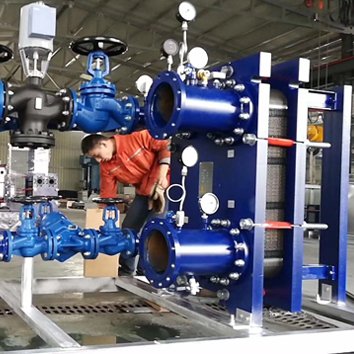
A district heating substation is a packaged or assembled heat-transfer system that connects a district heating network to a building’s heating and/or domestic hot water system. It normally transfers heat through one or more heat exchangers rather than mixing the primary and secondary fluids.
A typical substation may include:
- Primary-side isolation and control valves
- Strainers or filters
- Plate heat exchangers
- Secondary circulation pumps
- Temperature and pressure sensors
- Control valves and actuators
- Differential pressure control equipment
- Expansion and pressure-maintenance equipment where required
- Heat meters
- Control panels and controllers
- Safety devices
- Secondary-side distribution connections
- Domestic hot water heating equipment where required
The exact configuration depends on the application. A small residential building may require a relatively compact heating-only unit, while a large commercial building, hospital, hotel, or industrial facility may require separate circuits for space heating, ventilation, domestic hot water, and other loads.
How Does a District Heating Substation Work?
A district heating substation receives hot water from the district heating network and transfers its thermal energy to one or more secondary circuits.
The primary district heating water normally remains within the district heating network. A plate heat exchanger transfers heat across metal plates without directly mixing the primary and secondary fluids.
A simplified arrangement is:
District heating network → primary isolation/control → heat exchanger → secondary heating circuit → building
The heat exchanger transfers thermal energy according to the required heat duty:
Q = m × Cp × ΔT
Where:
- Q = heat transfer rate, typically kW
- m = mass flow rate, kg/s
- Cp = specific heat capacity, kJ/kg·K
- ΔT = temperature difference, K
The control system adjusts the primary flow according to the building’s actual heating demand. If the building requires less heat, the control valve reduces primary flow. If demand increases, the valve opens further.
This arrangement provides several important advantages:
- Hydraulic separation between district and building circuits
- Easier pressure management
- Controlled heat delivery
- Reduced risk of contaminating the district heating network
- Flexible secondary-side operating conditions
- Easier maintenance and replacement of individual components
What Are the Main Components of a District Heating Substation?
The main components are the heat exchanger, valves, pumps, control system, sensors, safety equipment, filtration equipment, and metering devices. Their exact configuration depends on the building load and district heating network conditions.
1. Plate Heat Exchanger
The plate heat exchanger is usually the central heat-transfer component in a modern district heating substation.
Hot primary water flows through alternate channels while cooler secondary water flows through the remaining channels. Heat passes through the plates from the primary fluid to the secondary fluid.
Gasketed plate heat exchangers are commonly used where capacity, maintainability, and flexibility are important. Brazed plate heat exchangers can be attractive for compact applications with suitable pressure, temperature, fluid, and maintenance requirements.
Important heat exchanger specifications include:
- Thermal duty
- Primary flow rate
- Secondary flow rate
- Primary inlet/outlet temperature
- Secondary inlet/outlet temperature
- Operating pressure
- Design pressure
- Allowable pressure drop
- Fluid quality
- Fouling conditions
- Plate material
- Gasket material
- Connection size
- Required heat transfer area
The heat exchanger should not be selected only by nominal heating capacity. Thermal and hydraulic calculations should be performed using the actual operating conditions.
Problem
A buyer selects a heat exchanger based only on the building’s peak heating load.
Why It Happens
Two heat exchangers with the same nominal heat duty can have significantly different pressure drops, approach temperatures, dimensions, and operating characteristics.
How to Solve It
Specify the complete operating conditions and define acceptable pressure-drop limits before selecting the unit.
What to Provide to the Supplier
Provide:
- Required heat duty in kW
- Primary temperatures
- Secondary temperatures
- Flow rates
- Operating and design pressures
- Fluid composition
- Maximum allowable pressure drop
- Connection requirements
2. Primary-Side Control Valve
The primary control valve regulates how much district heating water enters the heat exchanger.
The valve should be selected according to the actual flow range, differential pressure, temperature, pressure rating, and control requirements.
An oversized valve can make control unstable because a small movement produces a disproportionately large change in flow. An undersized valve may restrict the required peak flow and prevent the substation from achieving full heating capacity.
Valve selection should therefore consider both maximum load and part-load operation.
3. Secondary Circulation Pump
The secondary pump circulates heated water through the building’s heating system.
Pump selection depends mainly on:
- Required flow rate
- Total system pressure loss
- Required differential pressure
- Operating temperature
- Control strategy
- Operating hours
- System configuration
Variable-speed pumps are commonly considered where building demand changes substantially during operation.
Pump energy consumption can become a significant part of long-term operating cost. A pump that is substantially oversized may operate at unnecessary pressure and flow, increasing electricity consumption and potentially causing control or noise problems.
4. Temperature and Pressure Sensors
Sensors provide the control system with information about operating conditions.
Typical measurement points include:
- Primary supply temperature
- Primary return temperature
- Secondary supply temperature
- Secondary return temperature
- Primary pressure
- Secondary pressure
- Differential pressure
- Domestic hot water temperature where applicable
Accurate temperature measurement is particularly important because district heating substations frequently control heat delivery based on supply or return temperature.
Sensor placement also matters. A temperature sensor positioned too close to a mixing point or an unstable flow region may not accurately represent the temperature that the controller is supposed to regulate.
5. Control System
The controller coordinates valves, pumps, sensors, and other equipment.
A heating control strategy may adjust the primary control valve according to:
- Outdoor temperature
- Secondary supply temperature
- Building heat demand
- Time schedule
- Domestic hot water demand
- Differential pressure
- Return-temperature requirements
Weather-compensated control can reduce secondary supply temperature during periods of lower outdoor heating demand.
For larger installations, the control system may also communicate with a building management system (BMS).
6. Strainers and Filtration
Strainers help protect valves, heat exchangers, pumps, and other components from particles in the water.
Poor water quality can contribute to fouling and blockage. The appropriate filtration arrangement depends on the district heating network and building-side water quality.
A strainer is not a substitute for proper water treatment. The buyer should understand the expected water chemistry, cleanliness, and maintenance requirements of both circuits.
7. Heat Meter
A heat meter measures the thermal energy transferred to the building.
A typical heat-metering system uses:
- Flow measurement
- Supply temperature measurement
- Return temperature measurement
- A calculator or energy-processing unit
The measured thermal energy can be used for billing, energy monitoring, system management, and performance analysis.
Metering requirements vary by country, utility, and application, so the buyer should identify applicable local requirements before specifying the substation.
8. Safety and Pressure-Management Equipment
Depending on the hydraulic arrangement, a substation may require:
- Safety valves
- Pressure gauges
- Expansion vessels
- Air separators
- Pressure-maintenance equipment
- Drain and vent connections
- Isolation valves
The required components depend on whether the secondary circuit is hydraulically independent, how the building system is configured, and the applicable design rules.
How Do You Select a District Heating Substation?
The correct selection starts with the building’s thermal load and the district heating network’s actual operating conditions. The substation should then be designed around heat duty, temperatures, flow rates, pressure, pressure drop, fluid quality, control requirements, and installation constraints.
Step 1: Determine the Required Heat Duty
The first requirement is the building’s maximum heating demand.
Heat duty may include:
- Space heating
- Ventilation heating
- Domestic hot water
- Process heating
- Other building loads
For example, a commercial building might require separate heat-transfer circuits for space heating and domestic hot water because the two loads have different temperature and control requirements.
Do not automatically add every theoretical load together without considering diversity and the actual design basis.
The supplier should receive the design heat load in kW or another clearly defined unit.
Step 2: Confirm District Heating Supply Conditions
The district heating network determines the conditions available on the primary side.
Important information includes:
- Primary supply temperature
- Primary return temperature or required return temperature
- Minimum and maximum temperatures
- Operating pressure
- Design pressure
- Available differential pressure
- Flow limitations
- Seasonal operating conditions
These parameters directly affect heat exchanger sizing and control valve selection.
A substation designed around assumed primary conditions may perform poorly if the actual network operates at significantly different temperatures or differential pressures.
Step 3: Determine Secondary-Side Requirements
The secondary system may supply:
- Radiators
- Fan coil units
- Underfloor heating
- Air-handling units
- Domestic hot water systems
- Industrial heating equipment
The secondary supply and return temperatures are critical.
For example, a low-temperature underfloor heating circuit may operate at substantially lower temperatures than a conventional radiator system. The heat exchanger and control arrangement should therefore be designed for the actual secondary circuit rather than a generic building-heating temperature.
What Temperature Difference Does a District Heating Substation Need?
The required temperature difference depends on the district heating network, building system, heat exchanger design, and control strategy. There is no single temperature pair that applies to every substation.
A larger temperature difference can allow a given heat duty to be transferred with a lower mass flow rate, while the actual heat exchanger size also depends on the temperature approach and heat-transfer characteristics.
For counter-current heat exchange, the logarithmic mean temperature difference (LMTD) can be expressed as:
LMTD = (ΔT₁ − ΔT₂) / ln(ΔT₁ / ΔT₂)
where ΔT₁ and ΔT₂ are the temperature differences between the hot and cold streams at the two ends of the heat exchanger.
A smaller temperature approach generally requires more heat-transfer area and may increase equipment cost.
This is why a supplier needs actual inlet and outlet temperatures rather than only a required heating capacity.
How Does Pressure Drop Affect District Heating Substation Selection?
Pressure drop is one of the most important hydraulic considerations because every component in the substation consumes part of the available differential pressure.
Pressure loss can occur across:
- Heat exchangers
- Control valves
- Strainers
- Pipes
- Meters
- Check valves
- Other fittings
If the heat exchanger is selected with unnecessarily high pressure drop, the available network differential pressure may not be sufficient at peak conditions.
On the other hand, designing every component for extremely low pressure drop can increase equipment size and purchase cost.
The objective is to achieve a practical balance between:
Heat-transfer performance + hydraulic performance + equipment cost + operating cost
The allowable pressure drop should therefore be specified before final equipment selection.
Which Heat Exchanger Is Best for a District Heating Substation?
For many water-to-water district heating applications, a plate heat exchanger is an effective choice because it provides high heat-transfer efficiency in a relatively compact package. However, the best heat exchanger depends on pressure, temperature, fluid quality, capacity, maintenance requirements, and the application.
Gasketed Plate Heat Exchanger
A gasketed plate heat exchanger can be suitable when:
- Capacity is moderate to large
- Cleaning access is important
- The unit may need future capacity adjustment
- Maintenance flexibility is valuable
- Operating conditions are compatible with gasket materials
The plate pack can generally be opened for inspection and cleaning.
Brazed Plate Heat Exchanger
A brazed plate heat exchanger can be attractive for:
- Compact heating systems
- Smaller substations
- Limited installation space
- Applications where opening the heat exchanger for mechanical cleaning is not required
Its compact construction can reduce physical size, but the absence of removable gaskets and plates changes the maintenance strategy.
Shell-and-Tube Heat Exchanger
Shell-and-tube heat exchangers may be considered when:
- High mechanical robustness is required
- Fluid characteristics favor a shell-and-tube design
- Larger channels are desirable
- Specific pressure or temperature requirements make the configuration appropriate
- Existing plant standards require shell-and-tube equipment
They generally occupy more space than comparable plate heat exchangers for many water-to-water applications, but application-specific engineering determines the appropriate choice.
Plate vs Shell-and-Tube for District Heating
| Factor | Plate Heat Exchanger | Shell-and-Tube Heat Exchanger |
|---|---|---|
| Compactness | Usually excellent | Usually larger |
| Heat transfer efficiency | High for many liquid applications | Good, application-dependent |
| Cleaning | Gasketed type can be opened | Depends on construction |
| Capacity adjustment | Often flexible with gasketed design | Configuration-dependent |
| Pressure/temperature suitability | Application-dependent | Often suitable for demanding conditions |
| Installation footprint | Generally smaller | Generally larger |
| Typical building heating use | Very common | Used for specific requirements |
The decision should be based on engineering conditions rather than the assumption that one technology is universally superior.
How Do You Choose Materials for a District Heating Substation?
Material selection depends primarily on fluid chemistry, temperature, pressure, corrosion risk, and service conditions.
For plate heat exchangers, common material considerations include:
- Stainless steel plates
- Titanium plates for specific corrosive water applications
- Elastomeric gaskets selected for the operating conditions
- Carbon steel or stainless steel piping depending on system requirements
316L stainless steel may be considered where improved corrosion resistance compared with common stainless steel grades is required, but material selection should be based on the actual water chemistry.
Titanium may be appropriate for certain aggressive water environments, but its higher material cost means it should not be specified without a reason.
Problem
A buyer selects the cheapest standard material without checking water chemistry.
Why It Happens
The purchase specification focuses on initial price while overlooking corrosion mechanisms and long-term operating conditions.
How to Solve It
Review chloride concentration, pH, conductivity, dissolved gases, contaminants, temperature, and other relevant water-quality parameters where applicable.
What to Provide to the Supplier
Provide available water-analysis data and identify whether the primary or secondary circuit contains treated water, glycol, additives, or other chemicals.
How Does Fouling Affect a District Heating Substation?
Fouling reduces heat-transfer performance by adding thermal resistance to the heat-transfer surface. It can also reduce flow area and increase pressure drop.
Common sources include:
- Suspended particles
- Scale
- Corrosion products
- Biological deposits
- Poorly maintained water systems
A fouled heat exchanger may gradually show:
- Higher approach temperature
- Lower heating capacity
- Higher pressure drop
- Increased energy consumption
- Reduced control stability
The correct response is not simply to oversize the heat exchanger significantly. Oversizing can create unnecessary cost and may alter flow velocity and control characteristics.
Instead, the design should consider expected fouling conditions, water treatment, filtration, cleaning access, and an appropriate fouling allowance.
District Heating Substation for Domestic Hot Water
Domestic hot water (DHW) can require a different design approach from space heating because the load is variable and hot water demand can change rapidly.
The design should consider:
- Cold-water inlet temperature
- Required DHW outlet temperature
- Peak flow
- Average demand
- Storage arrangement
- Required recovery time
- Primary supply temperature
- Anti-legionella strategy where applicable
- Local health and building requirements
A DHW heat exchanger should not be sized solely from the average daily consumption if the system must handle short-duration peak demand.
For a building such as a hotel, apartment block, hospital, or sports facility, the peak DHW profile can strongly influence the heat exchanger and control system.
Packaged District Heating Substation vs Individual Components
A packaged substation integrates multiple components into a coordinated assembly. This can simplify installation and commissioning, but it also means the entire system should be reviewed as one hydraulic and control system.
| Approach | Advantages | Considerations |
|---|---|---|
| Packaged substation | Compact, coordinated components, easier installation | Requires clear specification of the complete package |
| Individual components | More flexibility in component selection | More engineering and installation coordination |
| Custom packaged system | Can match specific site requirements | Requires more technical coordination |
A packaged unit is particularly useful where installation space is limited or where the project requires a pre-engineered interface between the district network and building system.
District Heating Substation Selection Decision Table
| Selection Factor | Why It Matters | Buyer Should Provide |
|---|---|---|
| Heat duty | Determines thermal capacity | kW or BTU/h |
| Primary supply temperature | Determines heat-transfer conditions | °C / °F |
| Primary return temperature | Influences network performance and sizing | °C / °F |
| Secondary supply temperature | Defines building heating requirement | °C / °F |
| Secondary return temperature | Determines required temperature lift | °C / °F |
| Primary flow | Affects heat exchanger and valve sizing | m³/h or GPM |
| Secondary flow | Determines secondary hydraulic requirements | m³/h or GPM |
| Operating pressure | Determines component requirements | bar / psi |
| Design pressure | Establishes mechanical design basis | bar / psi |
| Differential pressure | Critical for control and hydraulic balance | bar / psi |
| Allowable pressure drop | Prevents excessive hydraulic losses | bar / kPa |
| Fluid quality | Influences fouling and corrosion | Water analysis where available |
| Heat exchanger material | Affects durability | SS304/316L, titanium, etc. |
| Installation space | Determines equipment configuration | Dimensions / drawings |
| Control requirements | Determines valves, sensors, and controller | BMS / local control |
| Metering | May be required for energy billing | Metering specification |
| Maintenance access | Affects lifecycle cost | Site layout |
 Common District Heating Substation Selection Mistakes
 Common District Heating Substation Selection Mistakes
1. Selecting Only by Heat Capacity
A 1,000 kW heat exchanger is not defined by capacity alone. Temperature conditions, flow rate, pressure drop, materials, and mechanical requirements also matter.
Better approach: provide complete thermal and hydraulic conditions.
2. Ignoring Available Differential Pressure
A heat exchanger and control valve may work correctly in laboratory conditions but fail to provide the expected flow when installed in a network with limited differential pressure.
Better approach: obtain minimum, normal, and maximum differential pressure data from the district heating operator where available.
3. Oversizing the Heat Exchanger Excessively
Large oversizing may increase capital cost and can affect flow velocity and control behavior.
Better approach: use the actual design duty and apply an engineering margin appropriate to the project rather than an arbitrary large factor.
4. Ignoring Return Temperature
District heating systems may place significant importance on return temperature. A substation that transfers heat effectively but returns water at an unnecessarily high temperature can reduce network efficiency.
Better approach: identify the required return-temperature target during design.
5. Choosing Materials Without Checking Water Chemistry
Stainless steel is not automatically suitable for every water chemistry.
Better approach: review the fluid composition and corrosion risk before finalizing plate and gasket materials.
6. Treating the Pump as an Independent Component
The pump, heat exchanger, control valve, and building distribution system interact hydraulically.
Better approach: evaluate the complete pressure-loss and control system.
7. Forgetting Maintenance Access
A technically correct unit can still be difficult to service if valves, strainers, pumps, or heat exchangers cannot be accessed.
Better approach: review the equipment layout and maintenance clearances before installation.
8. Providing Incomplete RFQ Information
A supplier cannot reliably select equipment from a request that only says “500 kW district heating substation.”
Better approach: provide thermal, hydraulic, mechanical, control, dimensional, and documentation requirements.
What Affects District Heating Substation Cost?
District heating substation pricing depends on the complete system configuration rather than a single component.
Major cost factors include:
- Required heat duty
- Heat exchanger type and size
- Heat-transfer area
- Plate and gasket materials
- Operating and design pressure
- Temperature rating
- Primary and secondary connections
- Control valves
- Pumps
- Sensors
- Heat meter
- Control panel
- Automation requirements
- BMS communication
- Safety equipment
- Piping configuration
- Frame and skid construction
- Factory testing requirements
- Documentation
- Customization
- Quantity
- Packaging
- Shipping destination
A lower purchase price is not necessarily the lowest lifecycle cost.
For example, a substation with a more efficient pump, better control strategy, accessible heat exchanger, and appropriate filtration may have a higher initial cost but lower operating and maintenance costs.
For international purchasing, buyers should also consider packaging, export documentation, shipping dimensions, spare parts availability, and installation requirements.
How Should You Specify a District Heating Substation for International Purchase?
A professional RFQ should contain enough information for the supplier and manufacturing partner to evaluate the system without making major assumptions.
A useful specification package should include:
- Application — residential, commercial, industrial, hotel, hospital, etc.
- Required heat duty — kW or BTU/h.
- Primary fluid — normally district heating water, with water-quality information where available.
- Secondary fluid — water, glycol mixture, or another specified fluid.
- Primary inlet/outlet temperatures
- Secondary inlet/outlet temperatures
- Primary and secondary flow rates
- Operating and design pressure
- Available differential pressure
- Maximum allowable pressure drop
- Required heat exchanger type
- Material requirements
- Connection type and size
- Control requirements
- BMS communication requirements
- Heat metering requirements
- Installation dimensions
- Applicable local or project standards
- Quantity
- Delivery destination
- Required documentation
- Commissioning or technical-support requirements
If some information is unavailable, identify it clearly rather than estimating it without a technical basis.
District Heating Substation Buyer Checklist
Before requesting a quotation, confirm the following:
Thermal Data
Heat duty
Primary supply temperature
Primary return temperature
Secondary supply temperature
Secondary return temperature
Peak and normal loads
Domestic hot water load, if applicable
Hydraulic Data
Primary flow rate
Secondary flow rate
Operating pressure
Design pressure
Minimum/normal/maximum differential pressure
Allowable pressure drop
Fluid Data
Fluid on each side
Glycol concentration if applicable
Water-quality information
Corrosion concerns
Fouling concerns
Equipment
Heat exchanger type
Pump requirements
Control valve requirements
Sensors
Heat meter
Strainers
Safety equipment
Control panel
Mechanical
Connection sizes
Connection standards
Equipment dimensions
Installation orientation
Maintenance clearance
Weight limitations
Commercial
Quantity
Destination country
Delivery terms
Required documentation
Packaging requirements
Spare parts requirements
Delivery schedule
Frequently Asked Questions
What is the purpose of a district heating substation?
A district heating substation transfers heat from the district heating network to a building’s heating or hot-water system while controlling temperature, flow, pressure, and energy delivery.
What is the main component of a district heating substation?
The plate heat exchanger is often the main heat-transfer component, but a complete substation also requires valves, pumps, sensors, controls, filtration, safety devices, and potentially heat metering.
Why are plate heat exchangers commonly used in district heating?
Plate heat exchangers offer high heat-transfer performance in a compact footprint and can provide efficient water-to-water heat transfer. Gasketed designs also allow inspection and cleaning.
What information is needed to size a district heating heat exchanger?
The minimum practical information normally includes heat duty, primary and secondary inlet/outlet temperatures, flow rates, operating pressures, allowable pressure drops, fluid characteristics, and material requirements.
How is district heating heat exchanger capacity calculated?
Heat duty can be calculated using Q = m × Cp × ΔT. Final heat exchanger selection additionally requires heat-transfer and hydraulic calculations using the actual operating conditions.
What pressure rating should a district heating substation have?
The pressure rating should be based on the maximum operating and design pressure of the connected circuits, including applicable safety and design margins. It should not be selected from heat duty alone.
Is a gasketed plate heat exchanger better than a brazed plate heat exchanger?
Neither is universally better. Gasketed plate heat exchangers provide greater maintenance and configuration flexibility, while brazed units can offer a compact solution for suitable applications.
Can a district heating substation provide domestic hot water?
Yes. A substation can include a dedicated heat exchanger and control arrangement for domestic hot water, but the design must account for peak demand, recovery requirements, temperatures, and applicable hygiene regulations.
How does fouling affect a district heating heat exchanger?
Fouling adds thermal resistance and can reduce heat-transfer capacity while increasing pressure drop. Proper water quality, filtration, operating conditions, and maintenance planning help control the problem.
Should the heat exchanger be oversized?
A reasonable engineering margin may be appropriate, but excessive oversizing can increase cost and affect hydraulic and control performance. The final margin should be based on project requirements.
Can a district heating substation be customized?
Yes. A substation can be configured around specific heat loads, temperatures, pressures, connections, controls, dimensions, metering, and building requirements.
What is the difference between the primary and secondary circuits?
The primary circuit connects to the district heating network, while the secondary circuit distributes heat within the building. A heat exchanger can separate the two circuits hydraulically.
What causes a district heating substation to provide insufficient heat?
Common causes include undersized heat exchangers, insufficient primary flow, inadequate differential pressure, incorrect temperature assumptions, fouling, control-valve problems, pump limitations, or incorrect system commissioning.
How often should a district heating heat exchanger be cleaned?
There is no universal cleaning interval. Cleaning frequency depends on fluid quality, fouling tendency, operating conditions, and measured changes in heat-transfer performance or pressure drop. Condition-based maintenance is often more appropriate than an arbitrary schedule.
What should I ask a district heating substation supplier?
Ask how the supplier determines heat exchanger size, pressure drop, material compatibility, control-valve sizing, pump duty, documentation, testing, spare parts, maintenance access, and coordination with the actual manufacturing partner.
How to Choose a District Heating Substation Supplier
The supplier should be evaluated on more than equipment price.
A professional international sourcing and export partner should be able to coordinate the technical information required to turn a project specification into a manufacturable system.
Important evaluation criteria include:
Technical Communication
The supplier should understand heat duty, temperatures, flow rates, pressure drop, fluid properties, materials, and control requirements.
Manufacturing Coordination
If the supplier is a trading or export company rather than the direct manufacturer, it should clearly identify how it coordinates with qualified manufacturing partners and engineering teams.
Quality Control
The purchasing process should define applicable inspections, testing, documentation, material requirements, and acceptance criteria before production.
Documentation
Depending on the project, documentation may include:
- Technical datasheets
- General arrangement drawings
- P&IDs
- Component lists
- Material information
- Test documentation
- Installation instructions
- Operation and maintenance documentation
- Spare-parts information
- Export documentation
Customization
The supplier should be able to coordinate modifications to heat exchanger configuration, connections, controls, dimensions, materials, and other project-specific requirements where technically feasible.
International Export Support
For international projects, packaging, shipping dimensions, documentation, destination requirements, and communication between the buyer and manufacturing partner can be as important as the equipment itself.
We work closely with qualified manufacturing partners and engineering teams to provide product sourcing, technical coordination, customization, quality control, and international export support. The final equipment selection should always be confirmed against the project’s thermal, hydraulic, mechanical, and regulatory requirements.
Need Help Selecting a District Heating Substation?
A district heating substation should be selected as a complete thermal and hydraulic system rather than as a collection of individual components.
The most important information is usually the heat duty, primary and secondary temperatures, flow rates, operating and design pressures, available differential pressure, allowable pressure drop, fluid characteristics, material requirements, control strategy, and installation constraints.
If you are sourcing a district heating substation for a residential, commercial, industrial, HVAC, or building-services application, provide your operating conditions and project requirements.