Low flow and high pressure is one of the hardest heat transfer duties to specify.
A shell and tube exchanger can be overbuilt. A plate heat exchanger cannot handle the pressure. A brazed unit may plug or fail. In many cases, the best answer is a double pipe heat exchanger—also called a tube-in-tube or hairpin heat exchanger.
It is simple, strong, and true countercurrent. But it is not automatic. The wrong selection will give you laminar flow, poor heat transfer, high pressure drop, or a shell wall so thick it costs more than a shell and tube unit.
Here is how to choose a double pipe heat exchanger for low flow, high pressure service.
What Is a Double Pipe Heat Exchanger?
A double pipe heat exchanger has one pipe inside another. One fluid flows through the inner tube. The other flows through the annulus between the inner tube and the outer pipe.
A hairpin heat exchanger is a double pipe with a U-bend. The inner tube returns through a second outer pipe. This gives true countercurrent flow in a compact, modular unit.
Common configurations:
Single double pipe
Hairpin with U-tube
Multi-tube hairpin
Jacketed pipe
Finned inner tube for gas cooling
Advantages for low flow, high pressure:
High pressure stays in a small-diameter inner tube
No gaskets in the high-pressure path
True countercurrent flow
Easy to add or remove sections
Simple to clean the inner tube
Good for small duty and pilot plants
Limits:
Large floor space per unit of area
Harder to clean the annulus
Lower heat transfer if flow is laminar
Many units needed for large duty
Step 1: Define the Duty Before You Select
You cannot size a double pipe exchanger from flow rate alone. Start with the full data set.
You need:
Heat load: kW or BTU/hr
Hot side flow, inlet and outlet temperature
Cold side flow, inlet and outlet temperature
Design pressure and design temperature
Allowable pressure drop on each side
Fluid phase: liquid, gas, two-phase, supercritical
Fluid properties: density, viscosity, specific heat, thermal conductivity
Fouling tendency and cleaning method
Corrosion risk
Code requirements: ASME, PED, CRN, ATEX
Available space and connection sizes
Do not ignore pressure drop. A double pipe unit that meets the heat duty but exceeds the allowed pressure drop is not a valid selection.
Step 2: Put the High-Pressure Fluid in the Inner Tube
This is the first rule of high-pressure selection.
The inner tube is small. Hoop stress is lower for a given wall thickness. A high-pressure inner tube is cheaper and easier to seal than a high-pressure outer shell.
If the high-pressure fluid is in the annulus, the outer pipe becomes a pressure vessel. Wall thickness increases fast. Flanges, fittings, and welds become larger and more expensive. The unit may no longer be practical.
Exceptions:
If the high-pressure fluid is very dirty, it may need to go in the inner tube for cleaning access. This is usually still the inner tube.
If both fluids are high pressure, consider a multi-tube hairpin or a welded block design.
If the high-pressure fluid is viscous and needs a larger flow area, check whether the annulus can be designed for pressure without excessive cost.
For most low flow, high pressure duty, the high-pressure fluid goes inside the tube.
Step 3: Check the Flow Regime
Low flow often means laminar flow. That changes everything.
Calculate the Reynolds number for both sides. If the flow is laminar, heat transfer is poor. You may need much more area than a turbulent-flow estimate suggests.
Options to improve heat transfer:
Use a smaller inner tube to raise velocity
Use multiple tubes in parallel
Use twisted tape or static mixers
Use a finned inner tube
Use multiple hairpins in series
Accept a larger unit and lower U-value
Each option has a cost. Smaller tubes increase pressure drop. Inserts can foul or vibrate. Finned tubes help the gas side but add cost. Multiple hairpins increase footprint and piping.
Do not assume turbulent flow because the fluid is a liquid. Low flow in a large annulus can be laminar.
Step 4: Balance Pressure Drop and Heat Transfer
Pressure drop and heat transfer fight each other.
Higher velocity improves heat transfer. It also raises pressure drop. In low flow service, the annulus is often the problem. The equivalent diameter is small. The flow area can be irregular. Pressure drop can be higher than expected.
Check both sides:
Inner tube pressure drop
Annulus pressure drop
Connection and nozzle losses
Return bend losses
Fouling allowance
Set a realistic allowable pressure drop. Then select the tube size, annulus gap, and number of hairpins to meet it. If the pressure drop is too high, use parallel units. If the heat transfer is too low, use series units or inserts.
Step 5: Choose Materials for Pressure and Corrosion
Material selection is not just about corrosion. It affects wall thickness, weight, and cost.
Common materials:
Carbon steel: low cost, non-corrosive service
Stainless steel 304/316: general chemical and utility duty
Duplex and super duplex: high strength, chloride resistance
Inconel, Hastelloy, Monel: aggressive or high-temperature service
Titanium: seawater and high chloride
Copper alloys: clean water and some marine duty
Check:
Chloride stress corrosion cracking
Hydrogen service
Sour service
Low-temperature brittleness
Thermal conductivity
Compatibility with cleaning chemicals
High-strength materials can reduce wall thickness. That saves weight and improves heat transfer through the tube wall. But they cost more and may have long lead times.
Step 6: Design for Thermal Expansion
A double pipe exchanger can see large temperature differences between the inner tube and outer pipe. The inner tube may expand more than the shell.
For straight double pipe units, use:
Expansion joints
Sliding supports
Flexible connections
Correct cold spring if required
A hairpin U-bend allows the inner tube to expand freely. This is one reason hairpin units are popular in high-temperature service.
Do not ignore differential expansion. It can bow tubes, crack welds, or damage supports.
Step 7: Plan for Fouling and Cleaning
The inner tube is easy to clean. It can be rodded, pigged, hydrojetted, or chemically cleaned.
The annulus is harder. It has no straight access. Deposits can build up on the outer surface of the inner tube and the inside of the outer pipe.
Rules:
Put the dirty fluid in the inner tube if possible.
Put the clean fluid in the annulus.
Provide cleaning connections on both sides.
Use chemical cleaning for the annulus when mechanical cleaning is not possible.
Consider removable inner tube or removable bundle designs.
Avoid dead zones and low-velocity pockets.
If both fluids are dirty, a double pipe exchanger may not be the best choice. A shell and tube with removable bundle may be easier to clean.
Step 8: Choose the Right Configuration
For low flow, high pressure, you have several choices:
| Configuration | Best For | Watch |
|---|---|---|
| Single double pipe | Small duty, simple service | Limited area; many units for large duty |
| Hairpin U-tube | True countercurrent, thermal expansion | Larger footprint |
| Multi-tube hairpin | More area in one shell | More complex flow distribution |
| Finned inner tube | Gas cooling, low gas-side coefficient | Fouling between fins |
| Jacketed pipe | Viscous or crystallizing fluids | Poor annulus heat transfer |
Use series arrangement for more heat transfer. Use parallel arrangement for lower pressure drop. In many low flow, high pressure duties, several hairpins in series give the best balance.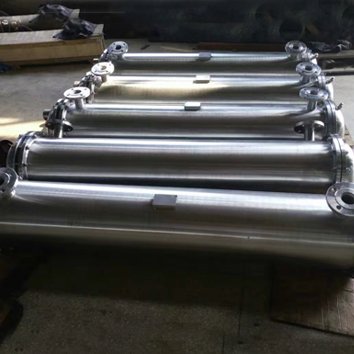
Step 9: Confirm Code, Testing, and Connections
High-pressure service demands strict compliance.
Check:
ASME Section VIII Div 1, Div 2, or Div 3 for very high pressure
PED 2014/68/EU and CE marking for Europe
CRN for Canada
ATEX or IECEx for hazardous areas
NACE MR0175 for sour service
Hydrostatic test pressure
Helium leak test for critical service
NDT: RT, UT, PT, or MT as required
Connections matter. Use welded, flanged, Grayloc, cone-and-thread, or autoclave fittings as needed. Avoid gaskets in the high-pressure path if thermal cycling is severe. Make sure the connection size does not create unnecessary pressure drop.
Step 10: Compare Lifecycle Cost
A double pipe exchanger may have a higher initial cost per unit area than a shell and tube unit. But for low flow, high pressure, it can be cheaper overall.
Compare:
Capital cost
Pressure drop and pumping energy
Cleaning cost and downtime
Replacement parts
Footprint and structural support
Lead time
Inspection and testing cost
A simple double pipe unit with easy cleaning can beat a complex high-pressure shell and tube exchanger over 10 years.
Common Selection Mistakes
Avoid these:
Putting high pressure in the annulus without checking cost
Ignoring laminar flow
Using a plate exchanger for high pressure
Sizing only for heat duty and ignoring pressure drop
Forgetting annulus cleaning
Using incompatible materials
Ignoring thermal expansion
Specifying too few hairpins for the duty
Choosing a brazed unit that cannot be cleaned
Quick Selection Checklist
Before you request a quote, confirm:
Heat load and design temperatures
Flow rates and allowable pressure drop
High-pressure side location
Reynolds number and flow regime
Tube size and annulus gap
Number of hairpins and arrangement
Material and wall thickness
Fouling and cleaning method
Thermal expansion design
Code and testing requirements
Connection type and size
When a Double Pipe Exchanger Is the Right Choice
Choose a double pipe or hairpin exchanger when:
Flow is low
Pressure is high
Duty is small to medium
True countercurrent flow is needed
The high-pressure fluid can go in the inner tube
One side is dirty and needs cleaning access
The process is pilot scale or modular
Do not choose it when:
Duty is very large
Floor space is tight
Both sides are heavily fouling
A close temperature approach is required with low pressure drop
A plate or shell and tube unit is clearly more economical