Finding replacement plates for a plate heat exchanger is more complicated than matching the outside dimensions of an old plate. A replacement must fit the frame, gasket system, port arrangement, plate pack, and thermal design while remaining compatible with the process fluids.
An incorrect plate can cause leakage, excessive pressure drop, insufficient heat transfer, corrosion, or installation problems. Even a plate that appears physically similar may have a different corrugation pattern, port arrangement, thickness, or pressing depth.
For maintenance teams, procurement managers, distributors, and industrial equipment buyers, the objective is therefore not simply to find a plate that “looks the same.” The objective is to identify a dimensionally, mechanically, thermally, and chemically suitable replacement plate.
This guide explains what information to collect, how to identify a replacement plate, when OEM and compatible plates can be considered, and what to provide to a supplier before requesting a quotation.
Direct Answer: How Do You Find the Right Replacement Plate?
The most reliable way to find a replacement plate is to identify the exact plate heat exchanger model and plate type, then verify the plate dimensions, port arrangement, corrugation pattern, material, thickness, gasket configuration, and thermal design requirements.
Before ordering, provide the supplier with:
- Heat exchanger manufacturer
- Heat exchanger model
- Serial number, if available
- Plate model or part number
- Plate length and width
- Port diameter and location
- Plate material
- Plate thickness, if known
- Corrugation or pressing pattern
- Gasket type and attachment method
- Existing plate photographs
- Fluid and operating conditions
- Required quantity
- OEM or compatible-replacement requirements
For critical applications, the replacement should be checked against the original thermal and mechanical design rather than selected solely by physical dimensions.
Why Is Finding a Replacement Plate Difficult?
A gasketed plate heat exchanger consists of many thin metal plates assembled into a plate pack. Each plate contributes to heat transfer while also creating separate flow channels for the two fluids.
A replacement plate must therefore satisfy several interfaces simultaneously:
- Mechanical fit — it must fit the frame and plate-hanging system.
- Sealing compatibility — the gasket must fit its groove correctly.
- Port compatibility — inlet and outlet openings must match the flow arrangement.
- Flow geometry — corrugation determines channel characteristics.
- Thermal performance — the plate pattern affects heat transfer and pressure drop.
- Material compatibility — the plate must resist corrosion from the process fluid.
- Pressure capability — the plate design must withstand the specified operating conditions.
Two plates can have the same approximate length and width while producing different hydraulic and thermal performance.
Problem
A buyer measures the old plate and finds a replacement online with the same length and width.
Why It Happens
Plate heat exchanger manufacturers use different plate patterns, pressing depths, port configurations, gasket grooves, and hanging arrangements.
How to Solve It
Use the dimensions as identification information, not as the only acceptance criterion. Compare the plate against the original model, drawings, photographs, gasket pattern, and operating requirements.
What to Provide to the Supplier
Send:
- Front and rear photos
- Plate dimensions
- Port dimensions
- Gasket photos
- Heat exchanger nameplate
- Original part number
- Plate model if available
Example
A replacement plate may fit onto the carrying bar but still have a different corrugation depth. The result can be a different pressure drop and heat-transfer coefficient even though the plate appears physically compatible.
What Information Do You Need to Identify a Replacement Plate?
The more precise the identification data, the less risk there is of receiving an incompatible part.
1. Heat Exchanger Manufacturer and Model
This is usually the best starting point.
Look for the nameplate or equipment documentation.
Typical information includes:
- Manufacturer
- Model
- Serial number
- Design pressure
- Design temperature
- Year of manufacture
- Product code
The serial number can be particularly useful when the manufacturer maintains equipment-specific records.
2. Original Plate Part Number
If the plate has a stamped, engraved, printed, or documented part number, provide it to the supplier.
A part number is generally more useful than a generic description such as:
“Need a stainless steel plate for a 100 kW heat exchanger.”
The part number can help distinguish between plates with similar dimensions but different designs.
3. Plate Dimensions
If the original model or part number is unavailable, measure the plate carefully.
Potential measurements include:
- Overall length
- Overall width
- Port-to-port dimensions
- Port diameter
- Hanging hole dimensions
- Plate thickness
- Pressing depth
- Gasket groove dimensions
Measurements should be taken from an undamaged plate whenever possible.
A severely corroded or deformed plate can produce misleading dimensions.
How Do You Measure a Plate Heat Exchanger Plate?
Measure the plate’s overall dimensions, ports, hanging arrangement, gasket groove, and pressing geometry, but do not rely on these measurements alone for replacement selection.
A practical identification process is:
Step 1: Photograph the Plate
Take clear photos of:
- Full plate
- Front side
- Back side
- Gasket
- Ports
- Hanging holes
- Corrugation
- Manufacturer markings
Place a ruler or scale beside the plate if possible.
Step 2: Measure Overall Dimensions
Measure the maximum:
- Height
- Width
Do not assume the frame dimensions are the same as the actual plate dimensions.
Step 3: Measure Port Configuration
Record:
- Number of ports
- Port diameter
- Port position
- Port shape
- Port-to-port spacing
Step 4: Examine the Gasket
Check:
- Gasket profile
- Gasket groove
- Gasket material
- Gasket attachment
- Clip positions
- Bonded sections, if applicable
Step 5: Examine the Corrugation
Record:
- Corrugation pattern
- Approximate pressing depth
- Chevron/herringbone appearance
- Plate pattern or designation if marked
A photograph can be extremely useful when the original technical drawing is unavailable.
Which Plate Specifications Matter Most?
Not all specifications have equal importance. The following should be treated as core identification and selection parameters.
| Specification | Why It Matters | What to Check |
|---|---|---|
| Plate model | Identifies the basic design | Original model/part number |
| Overall dimensions | Determines physical fit | Length and width |
| Port arrangement | Determines flow connection | Position and diameter |
| Gasket groove | Determines sealing compatibility | Profile and dimensions |
| Gasket attachment | Determines installation | Clip-on/glued/etc. |
| Corrugation pattern | Affects heat transfer and pressure drop | Pattern and pressing depth |
| Plate thickness | Affects mechanical strength and durability | Original specification |
| Plate material | Determines corrosion resistance | 316L, titanium, etc. |
| Heat transfer area | Influences thermal duty | Effective area |
| Plate arrangement | Determines flow configuration | Passes and channel arrangement |
| Surface condition | Affects sealing and service life | Pitting, cracks, deformation |
How Does Plate Material Affect Replacement Selection?
The replacement plate material must be compatible with the process fluid, temperature, concentration, and corrosion environment.
Common materials include:
- Stainless steel
- 316L stainless steel
- Titanium
- Nickel alloys
- Other specialty alloys for demanding chemical services
The correct material depends on the application.
316L Stainless Steel
316L is commonly used for many water-based and process applications where corrosion resistance is adequate.
It is frequently considered for:
- HVAC water
- Chilled water
- Heating water
- Many industrial water services
- Selected food and process applications
However, 316L is not automatically suitable for every chloride-containing or chemically aggressive fluid.
Titanium
Titanium is often considered when resistance to certain chloride-containing or seawater-related environments is required.
Typical applications may include:
- Seawater cooling
- Desalination-related systems
- Marine applications
- Selected aggressive water services
The choice should still be based on the actual chemistry and operating conditions.
Specialty Alloys
More demanding chemical applications may require higher-alloy materials.
The material should be selected according to:
- Chloride concentration
- pH
- Temperature
- Chemical composition
- Flow conditions
- Corrosion mechanism
- Required service life
Problem
A buyer replaces a corroded plate with the same material without determining why the original plate failed.
Why It Happens
The original material is often assumed to be automatically correct.
How to Solve It
Determine whether corrosion resulted from an unexpected fluid condition, concentration change, temperature increase, contamination, or material limitation.
What to Provide to the Supplier
Provide:
- Fluid composition
- Concentration
- Temperature
- pH where relevant
- Chloride concentration where relevant
- Existing plate material
- Failure photographs
Example
If a plate failed through localized corrosion, simply installing another plate of the same alloy may repeat the problem if the underlying water chemistry has not changed.
Does the Corrugation Pattern Matter?
Yes. The plate corrugation pattern strongly affects heat transfer, pressure drop, turbulence, mechanical strength, and the resulting channel geometry.
Plate heat exchanger plates are not flat sheets with holes cut into them. The pressed pattern creates flow channels and increases turbulence.
The corrugation influences:
- Heat transfer coefficient
- Pressure drop
- Flow distribution
- Effective heat transfer area
- Mechanical rigidity
- Fouling behavior
- Channel velocity
A replacement plate with a different pressing geometry may physically fit but deliver different performance.
This is one of the most important reasons not to purchase replacement plates solely by length and width.
Problem
A buyer finds a cheaper “same-size” plate from another supplier.
Why It Happens
The dimensions appear identical.
How to Solve It
Ask for technical confirmation that the replacement has equivalent or intentionally compatible:
- Corrugation pattern
- Pressing depth
- Effective area
- Port geometry
- Gasket arrangement
- Material
- Design pressure
What to Provide to the Supplier
The original plate designation, technical drawing, photographs, or sample plate.
How Does the Replacement Plate Affect Heat Transfer?
A plate replacement can affect thermal performance if its geometry differs from the original design.
For a heat exchanger, the thermal duty can be expressed as:
Q = U × A × ΔTₗₘ
Where:
- Q = heat-transfer duty
- U = overall heat-transfer coefficient
- A = effective heat-transfer area
- ΔTₗₘ = log mean temperature difference
The actual design is more complex because the overall heat-transfer coefficient depends on the fluid properties, flow regime, fouling, plate material, channel geometry, and other factors.
Corrugation affects the hydraulic and thermal behavior of the channel.
A different plate pattern can therefore change:
- Heat-transfer coefficient
- Pressure drop
- Required number of plates
- Flow velocity
- Thermal margin
For a simple one-for-one replacement, the safest approach is to match the original plate design.
For a modified plate design or partial redesign, the complete thermal calculation should be reviewed.
What Is the Difference Between OEM and Compatible Replacement Plates?
There are two broad sourcing approaches.
OEM Replacement Plates
OEM plates are supplied according to the original equipment manufacturer’s specification.
Advantages can include:
- Direct equipment compatibility
- Known plate geometry
- Original part identification
- Easier documentation matching
- Reduced identification uncertainty
Potential disadvantages include:
- Higher purchase price
- Longer lead time in some cases
- Limited sourcing flexibility
Compatible Replacement Plates
Compatible plates are produced to match an existing heat exchanger design.
Potential advantages include:
- Alternative sourcing
- Competitive pricing
- Availability of discontinued or difficult-to-source parts
- Potential customization
However, compatibility must be demonstrated rather than assumed.
A compatible plate should be checked for:
- Dimensions
- Port arrangement
- Gasket groove
- Corrugation
- Material
- Thickness
- Pressure rating
- Thermal characteristics
- Manufacturing quality
| Factor | OEM Plate | Compatible Replacement |
|---|---|---|
| Original design match | Usually straightforward | Must be verified |
| Sourcing options | More limited | Potentially broader |
| Price | May be higher | May be competitive |
| Documentation | Usually tied to OEM | Depends on supplier |
| Discontinued equipment | May be difficult | Alternative may be possible |
| Technical verification | Usually simpler | More important |
Neither option is automatically better for every application.
Can You Replace Only One Plate?
Sometimes, but the decision depends on the condition of the remaining plates and the extent to which the replacement matches the original design.
A single plate may be replaced when:
- One plate is damaged
- The remaining plates are in good condition
- The replacement has the same design
- The material is compatible
- The gasket system remains suitable
However, replacing only one plate may not be economical or technically appropriate if the entire plate pack has significant corrosion, erosion, deformation, or aging.
Problem
Only one plate is visibly damaged, so the buyer assumes that replacing one plate will always restore the heat exchanger.
Why It Happens
Visible damage is easier to identify than gradual deterioration elsewhere in the plate pack.
How to Solve It
Inspect the remaining plates for:
- Pitting
- Cracks
- Deformation
- Thinning
- Corrosion
- Gasket-groove damage
If several plates are approaching the end of their useful service life, replacing a larger portion of the plate pack may make more economic sense.
 Can a Different Plate Material Be Used as a Replacement?
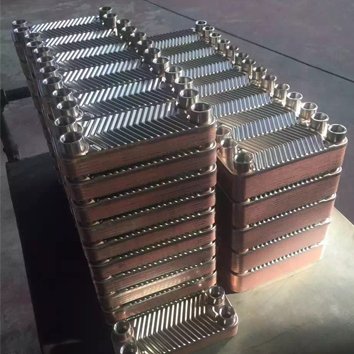 Can a Different Plate Material Be Used as a Replacement?
A different material should only be used after checking corrosion resistance, mechanical requirements, thermal design, cost, and compatibility with the existing plate pack.
For example, upgrading from stainless steel to titanium may improve corrosion resistance in a suitable application, but it does not automatically mean the plate is a drop-in replacement.
Consider:
- Plate thickness
- Material mechanical properties
- Forming characteristics
- Pressure rating
- Gasket compatibility
- Thermal conductivity
- Corrosion resistance
- Existing plate arrangement
Material substitution should therefore be treated as an engineering change rather than a simple spare-part replacement.
Common Problems When Sourcing Replacement Plates
Problem 1: The Plate Fits but the Gasket Does Not
Cause: Different gasket groove or plate profile.
Solution: Match the gasket groove and gasket profile, not just external dimensions.
Problem 2: The Replacement Causes Higher Pressure Drop
Cause: Different corrugation pattern, pressing depth, or channel geometry.
Solution: Verify the hydraulic characteristics and original plate pattern.
Problem 3: Heat Transfer Capacity Changes
Cause: Different effective area or heat-transfer characteristics.
Solution: Confirm thermal equivalence before changing plate geometry or pattern.
Problem 4: Premature Corrosion
Cause: Inappropriate plate material or changed process conditions.
Solution: Review the fluid chemistry and corrosion mechanism.
Problem 5: Plates Cannot Be Properly Compressed
Cause: Incorrect plate thickness, gasket dimensions, or plate count.
Solution: Confirm plate thickness, gasket design, plate pack dimensions, and manufacturer’s tightening requirements.
Problem 6: Port Connections Do Not Match
Cause: Different port arrangement or plate orientation.
Solution: Verify all port locations before ordering.
What Information Should You Give a Replacement Plate Supplier?
A supplier can identify a replacement much more accurately when the RFQ contains technical information rather than only a product description.
Minimum Identification Information
Provide:
- Heat exchanger manufacturer
- Model
- Serial number
- Plate part number
- Plate model
- Required quantity
- Photos
Physical Information
Where available:
- Plate length
- Plate width
- Port diameter
- Port arrangement
- Plate thickness
- Gasket profile
- Corrugation pattern
Operating Information
Provide:
- Fluid on side A
- Fluid on side B
- Flow rate
- Inlet temperature
- Outlet temperature
- Operating pressure
- Maximum pressure
- Heat duty
- Fouling conditions
Material Information
Provide:
- Existing plate material
- Required material
- Fluid chemistry
- Chloride concentration where relevant
- pH where relevant
- Cleaning chemicals
This information allows the supplier to distinguish a simple dimensional replacement from a technically sensitive application.
Replacement Plate Decision Framework
| Factor | Why It Matters | What the Buyer Should Check |
|---|---|---|
| Heat exchanger model | Identifies equipment family | Nameplate/model |
| Plate part number | Provides direct identification | Original marking |
| Plate dimensions | Determines physical fit | Length/width |
| Port configuration | Determines flow connections | Diameter/location |
| Gasket groove | Determines sealing | Profile and dimensions |
| Corrugation | Affects heat transfer and pressure drop | Pattern/pressing depth |
| Plate material | Determines corrosion resistance | 316L, titanium, etc. |
| Plate thickness | Affects mechanical performance | Original specification |
| Heat duty | Confirms thermal requirement | kW / BTU/h |
| Flow rate | Affects channel velocity | m³/h / GPM |
| Pressure | Affects mechanical requirements | bar / psi |
| Temperature | Affects thermal and material selection | °C / °F |
| Fluid chemistry | Determines corrosion risk | Composition/concentration |
| Gasket | Must match plate groove | Material/profile |
| Quantity | Affects sourcing and economics | Number required |
Common Mistakes When Buying Replacement Plates
1. Buying by Size Alone
Mistake: Matching only length and width.
Why it fails: Corrugation, ports, gasket grooves, and thickness may differ.
Better approach: Match the complete plate design.
2. Ignoring the Heat Exchanger Model
Mistake: Sending only a plate photograph.
Why it fails: Similar-looking plates can belong to different models.
Better approach: Provide the nameplate and model whenever possible.
3. Replacing Stainless Steel Without Checking Corrosion
Mistake: Assuming the original material is always adequate.
Why it fails: The original failure may have resulted from corrosion.
Better approach: Identify the failure mechanism before specifying the replacement material.
4. Assuming Compatible Means Identical
Mistake: Treating any aftermarket plate advertised as compatible as an exact equivalent.
Why it fails: Compatibility claims can refer only to physical fit.
Better approach: Ask which specifications have been matched.
5. Ignoring the Gasket
Mistake: Buying plates first and figuring out the gasket later.
Why it fails: The gasket groove and plate design are interconnected.
Better approach: Source the plate and gasket as a matched system.
6. Replacing Plates Without Checking Plate Count
Mistake: Assuming the original number of plates can be changed arbitrarily.
Why it fails: Plate count affects heat-transfer area, pressure drop, and channel arrangement.
Better approach: Keep the original configuration unless the heat exchanger is being intentionally redesigned.
7. Focusing Only on Purchase Price
Mistake: Selecting the cheapest replacement plate.
Why it fails: Incorrect or low-quality plates can create leakage, downtime, and repeat maintenance.
Better approach: Compare total cost, technical compatibility, documentation, and expected service life.
How Much Do Replacement Plate Heat Exchanger Plates Cost?
There is no reliable universal price for a replacement plate because cost depends heavily on plate size, material, geometry, quantity, gasket configuration, manufacturing requirements, and sourcing route.
Major cost factors include:
- Plate material
- Plate dimensions
- Corrugation pattern
- Plate thickness
- Effective heat-transfer area
- Gasket groove
- Gasket material
- OEM vs compatible design
- Quantity
- Custom tooling or production requirements
- Inspection and documentation
- Packaging
- Shipping
Titanium or specialty-alloy plates generally cost more than common stainless-steel alternatives, but the actual quotation depends on the specific plate design.
International buyers should also consider:
- Freight
- Export packaging
- Import duties and taxes
- Lead time
- Replacement downtime
- Technical verification
- Spare-parts inventory
A lower unit price is not necessarily a lower total procurement cost if the plate requires modification or causes operational problems.
Should You Replace Plates or the Entire Plate Heat Exchanger?
Replace individual plates or part of the plate pack when the frame and remaining plates are serviceable and the required replacement parts are available and technically compatible. Consider replacing the entire heat exchanger when the frame, plates, sealing system, or thermal design are no longer economical to maintain.
A replacement analysis should consider:
Individual plate replacement may make sense when:
- Damage is localized
- Most plates remain in good condition
- The frame is sound
- Original or compatible plates are available
- Thermal performance remains adequate
A complete replacement may make sense when:
- Many plates are corroded
- The heat exchanger is significantly undersized
- Replacement plates are difficult to source
- The frame is damaged
- Gasket and plate replacement costs approach a new unit
- The process requirements have changed substantially
The economic comparison should include downtime and installation costs, not just equipment purchase price.
Replacement Plate Buyer Checklist
Before contacting a supplier, prepare:
Manufacturer
Heat exchanger model
Serial number
Original plate part number
Plate model
Required quantity
Plate length
Plate width
Plate thickness, if known
Port diameter
Port arrangement
Port orientation
Corrugation pattern
Pressing depth, if known
Gasket profile
Gasket material
Gasket attachment method
Plate material
Fluid on each side
Flow rate
Inlet temperature
Outlet temperature
Operating pressure
Maximum pressure
Heat duty
Cleaning conditions
Corrosion history
Photos of the plate
Photos of the nameplate
Photos of the gasket
Delivery destination
For an unfamiliar or discontinued heat exchanger, providing a physical sample, dimensional drawing, or detailed photographs can substantially reduce identification uncertainty.
Frequently Asked Questions
Can I buy replacement plates directly from a heat exchanger supplier?
Yes, replacement plates can often be sourced through the original manufacturer, specialist spare-parts suppliers, or qualified compatible-part manufacturers. The supplier should verify the plate design before confirming compatibility.
How do I know which plate fits my heat exchanger?
Start with the heat exchanger model, plate part number, and manufacturer information. Then verify dimensions, port configuration, gasket groove, corrugation, material, and thickness.
Can I replace a plate with one from another manufacturer?
Potentially, but the alternative plate must be technically compatible rather than simply similar in size. Mechanical, sealing, hydraulic, thermal, and material characteristics should be checked.
Can I use a thicker or thinner replacement plate?
Do not change plate thickness without verifying the mechanical and thermal design. Plate thickness affects pressure capability, plate pack dimensions, forming geometry, and potentially the overall heat exchanger configuration.
Does the plate corrugation affect heat transfer?
Yes. Corrugation strongly affects turbulence, heat-transfer coefficient, pressure drop, channel geometry, and effective heat-transfer behavior. A different pattern should therefore not be treated as a simple dimensional substitution.
Can I replace only one damaged plate?
Yes, in some cases, if the remaining plates are serviceable and the replacement matches the original design. The entire plate pack should be inspected before deciding.
What is the most common replacement plate material?
Stainless steel is widely used, including 316L in many applications, but the correct material depends on the fluid chemistry and corrosion conditions. Titanium and specialty alloys may be required for more demanding environments.
Are OEM replacement plates better than aftermarket plates?
OEM plates provide a straightforward route to the original design, while qualified compatible plates can provide alternative sourcing options. The key issue is verified technical equivalence, not simply the supplier’s label.
How can I identify a plate if I do not know the model?
Provide clear photographs, measurements, plate markings, gasket details, and the heat exchanger nameplate. A supplier can use these details to narrow down the plate design and request additional information where necessary.
Can I change the plate material from stainless steel to titanium?
Possibly, but a material change should be treated as an engineering modification. Corrosion resistance, thickness, pressure capability, gasket compatibility, thermal performance, and plate geometry all need to be checked.
Do replacement plates come with gaskets?
It depends on the supplier and product configuration. Some replacement plates are supplied with gaskets, while others are quoted as bare plates, so the RFQ should clearly specify whether gaskets are required.
What causes replacement plates to fail prematurely?
Common causes include unsuitable material, incorrect geometry, corrosion, excessive pressure, poor installation, fouling, and incompatible cleaning conditions. The failure mechanism should be investigated before ordering a second replacement.
How many spare plates should an industrial plant keep?
There is no universal quantity. The appropriate spare inventory depends on the number of heat exchangers, operating criticality, plate availability, lead time, failure history, and the consequences of downtime.
What should I send when requesting a replacement plate quotation?
Send the heat exchanger model, original plate information, quantity, photos, dimensions, fluid conditions, and material requirements. If the model is unknown, detailed photographs and measurements are especially valuable.
What Should You Look for in a Replacement Plate Supplier?
A replacement-part supplier should do more than match a photograph to a product catalogue.
Look for a supplier or export partner that can coordinate:
- Plate identification
- Technical specification review
- Material selection
- Gasket matching
- Dimensional verification
- Communication with the manufacturing partner
- Quality-control requirements
- Product documentation
- Export packaging
- International shipping coordination
- Custom or discontinued-part sourcing
For technically sensitive replacement projects, ask the supplier what specifications were used to establish compatibility.
A useful quotation should ideally identify the proposed:
- Plate model
- Material
- Thickness
- Corrugation or plate pattern
- Gasket configuration
- Quantity
- Applicable technical documentation
We work closely with qualified manufacturing partners and engineering teams to provide product sourcing, technical coordination, customization, quality control, and international export support. For replacement plates, we can coordinate the information needed to distinguish a simple spare-part purchase from a technically significant plate-pack modification.
Need Help Finding Replacement Plates for Your Plate Heat Exchanger?
If you are replacing damaged, corroded, discontinued, or difficult-to-source plates, send us the heat exchanger nameplate, model or serial number, plate photographs, dimensions, gasket information, required quantity, and operating conditions.