Free cooling in data centers is a cooling strategy that uses favorable outdoor environmental conditions to reduce or eliminate the need for mechanical refrigeration. Instead of relying entirely on compressors to produce chilled air or water, the system uses cooler outdoor air or ambient heat-rejection equipment to remove heat from the facility.
For data center operators, the main objective is to reduce cooling energy consumption while maintaining stable conditions for IT equipment. Depending on the climate, cooling architecture, and operating temperatures, free cooling can reduce compressor operating hours and, in suitable conditions, allow cooling systems to operate without mechanical refrigeration.
However, free cooling does not mean that cooling is completely free of energy costs. Fans, pumps, controls, filtration, and other equipment still consume electricity. The actual benefits depend on outdoor conditions, system design, and operating requirements.
This guide explains how data center free cooling works, the differences between air-side and water-side economizers, when each approach is suitable, and what engineers should evaluate before selecting a system.
1. What Is Free Cooling in a Data Center?
Free cooling is a method of using naturally available environmental conditions to reject heat from a data center without relying entirely on mechanical refrigeration.
Traditional mechanical cooling systems typically use compressors, refrigerant circuits, and heat exchangers to transfer heat from indoor spaces to the outdoor environment.
A free cooling system reduces this mechanical refrigeration requirement by taking advantage of a favorable temperature difference between the data center and its surroundings.
There are two main approaches:
Air-side free cooling: Outdoor air is introduced into the data center, directly or through an air-handling arrangement, to remove heat.
Water-side free cooling: Outdoor air cools a circulating water or coolant loop through equipment such as dry coolers or cooling towers, reducing or replacing the need for chiller operation.
Both approaches use outdoor conditions, but their equipment configurations and operational requirements are different.
How does free cooling reduce energy consumption?
In a conventional chilled-water cooling system, chillers use compressors to lower the temperature of circulating water. This requires substantial electrical energy.
When outdoor conditions are sufficiently cool, a water-side economizer can transfer heat from the data center’s cooling-water circuit to the outdoor environment through a heat exchanger.
The chiller may then operate at reduced capacity or shut down, depending on the system design and operating conditions.
The main energy savings generally come from:
Reduced compressor operating hours.
Lower mechanical refrigeration demand.
Optimized pump and fan operation.
Improved use of outdoor temperature conditions.
The savings are not determined by outdoor temperature alone. Water temperatures, heat exchanger performance, approach temperature, airflow, humidity, and control settings all affect whether free cooling is practical.
2. How Does Free Cooling Work in Data Centers?
The operating principle is based on transferring heat from a warmer environment or fluid to a cooler outdoor environment.
A data center continuously generates heat from servers, networking equipment, power systems, lighting, and other electrical infrastructure. The cooling system must remove this heat and reject it outside the building.
Free cooling uses outdoor conditions to perform part or all of this heat-rejection process.
A. Air-Side Free Cooling
Air-side free cooling uses outdoor air as part of the cooling process.
When the outdoor air is suitable, the system introduces it into the data center through dampers, filters, and air-handling equipment. Warm air from the IT space is exhausted or partially recirculated, depending on the system configuration.
A typical operating sequence includes:
Outdoor sensors measure temperature and humidity.
The control system determines whether outdoor air is suitable for cooling.
Dampers adjust to introduce the required amount of outdoor air.
Air passes through filtration and, where necessary, conditioning equipment.
The incoming air absorbs heat from IT equipment.
Warm air is exhausted outside or managed through a controlled return-air arrangement.
Main advantages:
Can reduce or eliminate compressor-based cooling during suitable conditions.
May simplify the heat-rejection process in appropriate climates.
Can provide substantial cooling-energy benefits where outdoor air is suitable for extended periods.
Main limitations:
Outdoor air quality must be carefully managed.
Humidity and condensation risks require attention.
Dust, pollutants, salt, and corrosive contaminants can affect IT equipment.
Filtration and air-handling equipment require maintenance.
Temperature and humidity conditions must remain within the IT equipment’s environmental requirements.
Air-side economizers are therefore not automatically suitable for every data center. Locations with high humidity, heavy industrial pollution, dust, or corrosive outdoor air may require additional treatment or a different cooling approach.
B. Water-Side Free Cooling
Water-side free cooling uses outdoor equipment to cool a circulating fluid rather than introducing outdoor air directly into the IT space.
A typical system includes:
Cooling coils or chilled-water distribution.
A plate heat exchanger or another suitable heat-transfer arrangement.
A dry cooler or cooling tower.
Pumps and control valves.
Temperature and flow sensors.
A chiller for mechanical cooling when outdoor conditions are insufficient.
The operating sequence is generally as follows:
Warm return water comes back from the data center cooling equipment.
The control system compares outdoor conditions with the required fluid temperatures.
The dry cooler or cooling tower rejects heat to the outdoor environment.
The cooled fluid passes through a heat exchanger or an appropriately designed cooling circuit.
The cooled water returns to the data center cooling system.
If outdoor conditions cannot provide sufficient cooling, the chiller supplements the process.
The exact arrangement depends on whether the system uses a separate economizer loop, integrated chiller economizer, or another configuration.
Main advantages:
Outdoor air does not need to enter the IT space.
Can integrate with existing chilled-water infrastructure.
Reduces compressor operating hours when conditions permit.
Can be suitable for facilities with centralized chilled-water systems.
Main limitations:
Requires additional heat-rejection equipment and piping.
Pump and fan energy remains necessary.
Heat exchanger approach temperatures affect performance.
Water treatment and water consumption must be considered for cooling-tower systems.
Low outdoor temperatures may require freeze protection.
Air-Side vs. Water-Side Free Cooling
Comparison | Air-side free cooling | Water-side free cooling |
|---|---|---|
Cooling medium | Outdoor air | Water or another circulating fluid |
Main equipment | Dampers, filters, fans, air-handling equipment | Dry coolers or cooling towers, heat exchangers, pumps |
Outdoor air enters IT space | Yes, in direct systems | No |
Water treatment | Usually not central to the air-side process | May be required, depending on the system |
Main concerns | Air quality, humidity, filtration | Fluid temperature, flow, heat transfer, freeze protection |
Typical application | Suitable climates and air-quality conditions | Chilled-water data centers and facilities with external heat rejection |
The best option depends on the site’s climate, existing cooling infrastructure, environmental conditions, and operational requirements.
3. What Equipment Is Used in a Data Center Free Cooling System?
Free cooling is not a single piece of equipment. It is a system configuration involving heat rejection, heat transfer, air movement, and automatic control.
The following equipment is commonly involved.
A. Dry Coolers

A dry cooler rejects heat from a circulating fluid to outdoor air through a heat exchanger.
Fans move outdoor air across the coil, allowing heat to transfer from the warmer fluid to the cooler ambient air.
Dry coolers are commonly used in water-side free cooling systems because they can reject heat without evaporative water consumption.
Their performance depends on:
Outdoor dry-bulb temperature.
Required fluid supply temperature.
Heat exchanger surface area.
Fluid flow rate.
Airflow and fan performance.
Coil cleanliness and maintenance.
A dry cooler cannot always replace a chiller. If the required fluid temperature is below what outdoor air can achieve after accounting for the heat exchanger approach, mechanical cooling may still be necessary.
B. Industrial and Data Center Chillers
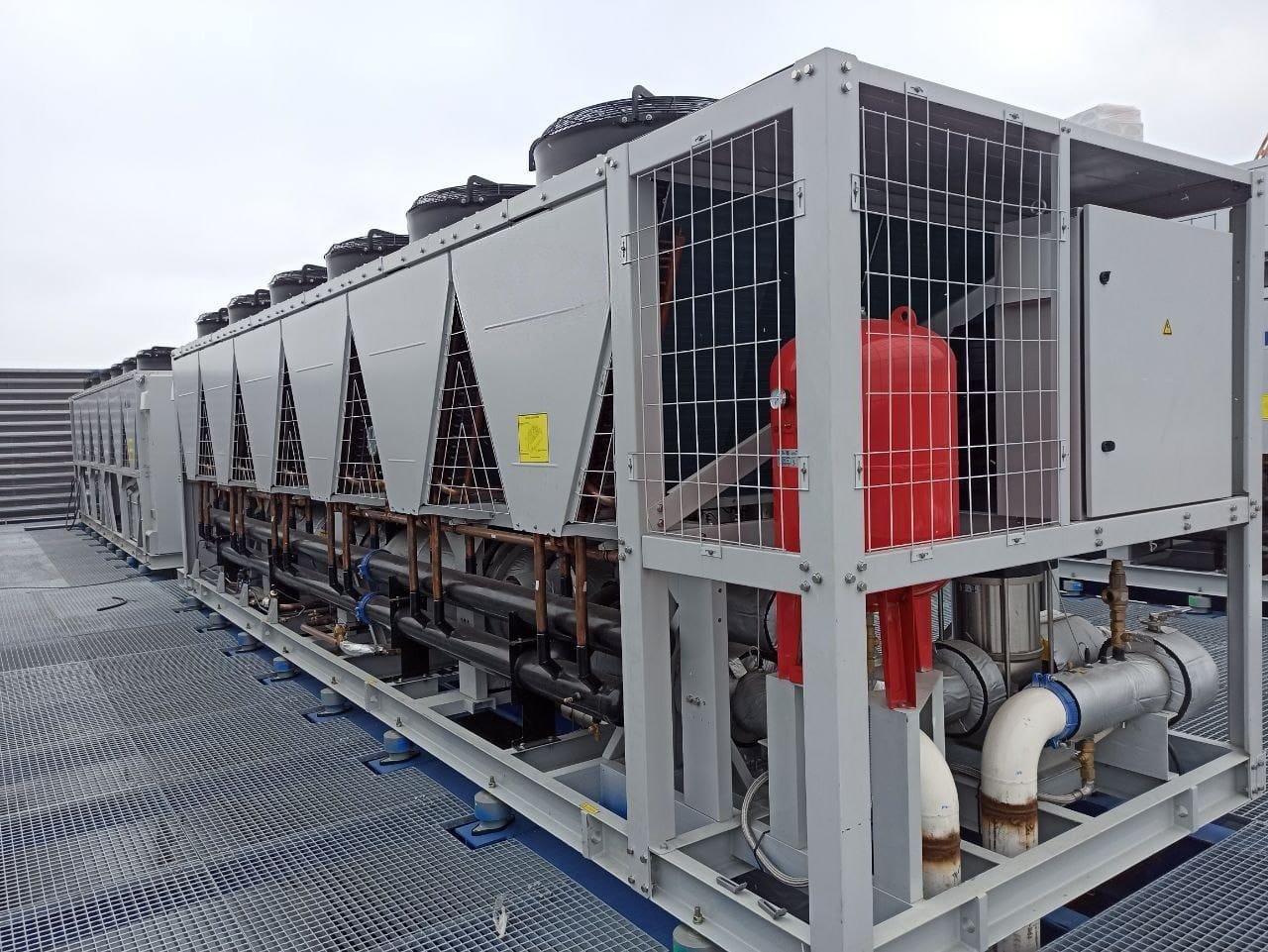
Chillers provide mechanical cooling when ambient conditions are unsuitable for free cooling or when the cooling load exceeds the available free-cooling capacity.
In a hybrid system, a chiller and economizer operate together.
Depending on the system configuration, the operating modes may include:
Mechanical cooling: The chiller provides the required cooling.
Partial free cooling: Outdoor conditions provide part of the cooling, while the chiller supplies the remaining capacity.
Full free cooling: The economizer provides the required cooling without compressor-based refrigeration.
The transition between operating modes should be controlled automatically to maintain stable supply temperatures and avoid unnecessary energy consumption.
C. Plate Heat Exchangers

A plate heat exchanger transfers heat between two fluid circuits without mixing the fluids.
In a water-side economizer, it can separate the data center’s internal cooling-water loop from the external heat-rejection loop.
This arrangement can help manage water quality, pressure, and fluid compatibility.
Engineers should evaluate:
Heat-transfer capacity.
Design flow rates.
Inlet and outlet temperatures.
Pressure drop.
Fouling potential.
Materials compatibility.
Maintenance access.
The heat exchanger’s approach temperature is particularly important. A larger temperature difference between the two circuits may reduce the amount of time the system can operate in full free-cooling mode.
D. Precision Air Conditioners and CRAH Systems

Precision air conditioners and Computer Room Air Handlers (CRAHs) distribute cooling to IT equipment.
A CRAH typically uses chilled water supplied by an external cooling plant. This makes it a common component in water-side free-cooling architectures.
A direct-expansion precision air conditioner generally uses a refrigerant circuit and compressor-based refrigeration. Some configurations can incorporate economizer functionality, but the actual arrangement depends on the equipment design.
When integrating free cooling with room-level cooling equipment, engineers should verify:
Required chilled-water supply temperature.
Coil capacity at actual operating conditions.
Airflow and sensible cooling requirements.
Control valve operation.
Condensation management.
Compatibility with the central cooling plant.
Free cooling at the heat-rejection level does not eliminate the need for suitable room-level air distribution.
4. When Is Free Cooling Suitable for a Data Center?
Free cooling is most effective when outdoor conditions allow the system to reject heat at the temperatures required by the data center.
However, there is no universal outdoor temperature at which every data center can activate free cooling.
The operating threshold depends on the cooling architecture and the required supply-air or supply-fluid temperature.
A. Climate and Outdoor Temperature
Climate is one of the most important factors.
Facilities in cooler climates may have more opportunities to operate in full free-cooling mode. Facilities in hot climates may have fewer hours when outdoor conditions can provide sufficient cooling.
However, climate alone does not determine suitability.
For example, a water-side system serving a facility with relatively high chilled-water temperatures may use free cooling under conditions where a system requiring colder water cannot.
This is because the temperature difference between the outdoor environment and the required cooling-fluid temperature determines whether sufficient heat transfer is possible.
B. Humidity and Air Quality
For air-side free cooling, outdoor air must be evaluated for more than temperature.
Important factors include:
Relative humidity and dew point.
Dust and particulate concentration.
Industrial pollutants.
Salt and corrosive contaminants.
Seasonal air-quality variations.
Filtration requirements.
High humidity does not automatically make air-side economizer operation impossible, but moisture conditions must remain compatible with IT equipment requirements and condensation prevention.
For water-side systems, outdoor air quality is generally less directly relevant to the IT environment, although it can still affect outdoor heat-exchanger maintenance and corrosion.
C. IT Load and Rack Density
The data center’s heat load also affects free-cooling system design.
A facility with high-density GPU racks may require different cooling-water temperatures, flow rates, and heat-rejection capacity from a traditional enterprise data center.
If direct-to-chip liquid cooling is used, the system may be designed around a separate coolant distribution loop and a specific heat-rejection temperature range.
Free cooling may be possible for these applications, but engineers must verify the required coolant supply temperature, outdoor design conditions, and heat-exchanger performance.
D. Operating Hours and Seasonal Conditions
Free cooling should be evaluated over the full year rather than against one outdoor design temperature.
A useful engineering assessment includes:
Hourly outdoor temperature data.
Outdoor humidity and dew point.
Required chilled-water or coolant supply temperatures.
IT load profile throughout the year.
Heat-rejection equipment performance.
Partial-load efficiency.
Mechanical cooling operating requirements.
This helps determine how often the system can operate in full or partial free-cooling mode.
5. How Much Energy Can Data Center Free Cooling Save?
Free cooling can reduce cooling energy consumption by lowering the demand for mechanical refrigeration. However, the actual savings vary significantly between projects.
It is important to distinguish between cooling-system energy savings and whole-facility energy savings.
For example, reducing chiller compressor energy does not mean the same percentage reduction in total data center electricity consumption. IT equipment, UPS systems, power distribution, lighting, and other infrastructure continue to consume energy.
Key Factors Affecting Energy Savings
1. Outdoor climate
Cooler outdoor conditions generally create more opportunities for economizer operation, although the actual benefit depends on the required cooling temperatures.
2. Cooling-water temperature
Higher permissible supply-water temperatures may increase the number of hours when free cooling is available, provided they remain compatible with the cooling coils, IT equipment, and system design.
3. Heat exchanger performance
Insufficient heat-transfer capacity or excessive approach temperature can reduce free-cooling availability.
4. Fan and pump efficiency
Free cooling still requires electricity for air movement and fluid circulation. Poorly selected fans, pumps, or control settings can reduce the overall benefit.
5. Control strategy
Incorrect switching between mechanical and free-cooling modes can cause unnecessary compressor operation or unstable temperatures.
How to Evaluate the Energy Benefit
A practical comparison should examine annual cooling-system electricity consumption under two operating scenarios:
Baseline operation using the conventional mechanical cooling system.
Proposed operation using the hybrid or free-cooling system.
The annual energy difference can be expressed as:
Where:
\(E_{\text{saved}}\) = annual electricity saved.
\(E_{\text{baseline}}\) = annual cooling-system electricity consumption without the proposed free-cooling strategy.
\(E_{\text{free cooling}}\) = annual cooling-system electricity consumption with free cooling.
The calculation should include chillers, pumps, dry cooler fans, cooling-tower equipment where applicable, and other relevant auxiliary loads.
For a whole-facility assessment, the effect on PUE can also be evaluated:
PUE is a facility-level metric. It should not be used alone to claim that a particular dry cooler, chiller, or economizer has achieved a specific energy-saving percentage.
A reliable assessment requires an hourly or otherwise appropriately resolved energy model using local weather data, equipment performance curves, and the expected IT load profile.
6. Common Free Cooling Problems and How to Solve Them
Free cooling systems can improve energy efficiency, but they introduce additional design and operating considerations.
The following problems should be considered during engineering, commissioning, and maintenance.
Common problem | Possible cause | Practical solution |
|---|---|---|
Free cooling cannot reach the required water temperature | Outdoor temperature is too high or heat exchanger approach is insufficient | Review design temperatures, heat exchanger capacity, and hybrid chiller operation |
High fan or pump energy | Poor equipment selection, excessive pressure drop, or inefficient control | Review fan and pump sizing, variable-speed control, and hydraulic design |
Unstable supply-water temperature | Incorrect control sequence or sensor placement | Check control logic, sensor calibration, and valve response |
Air-side system introduces contaminants | Inadequate filtration or unsuitable outdoor air quality | Review filtration, sealing, air-quality monitoring, and operating limits |
Condensation occurs | Fluid or surface temperature falls below the surrounding air’s dew point | Review insulation, dew-point monitoring, and coolant temperature control |
Dry cooler performance deteriorates | Dirty coils, restricted airflow, or fan problems | Inspect coils, fans, airflow paths, and maintenance records |
Cooling capacity is insufficient during hot weather | Free cooling was treated as the only cooling source | Provide appropriately sized mechanical backup or hybrid cooling |
Control System Optimization
Automatic control is essential for reliable free cooling.
A properly designed control strategy should consider:
Outdoor temperature and humidity.
Supply and return water temperatures.
Required cooling capacity.
Heat exchanger performance.
Pump and fan operating conditions.
Chiller operating limits.
Equipment alarms and failure conditions.
The control system should transition between full free cooling, partial free cooling, and mechanical cooling without causing sudden temperature changes or unnecessary equipment cycling.
Maintenance Requirements
Maintenance depends on the equipment configuration.
For dry coolers, inspect coils, fans, electrical connections, and airflow paths.
For water-side systems, inspect heat exchangers, pumps, valves, strainers, fluid quality, and freeze-protection arrangements.
For air-side economizers, inspect filters, dampers, actuators, seals, sensors, and outdoor air intake conditions.
Maintenance plans should also include functional testing of operating modes and backup cooling equipment.
7. How to Select a Free Cooling System for a Data Center
Choosing a free cooling system requires a project-specific assessment. The best configuration depends on climate, IT load, existing infrastructure, environmental conditions, and reliability requirements.
Before selecting equipment, engineers should evaluate the following factors.
1. Define the Cooling Load
Determine the total heat load that the cooling system must remove.
This should include:
IT equipment heat load.
Electrical losses within the conditioned space.
Lighting and occupancy loads.
Building envelope and ventilation heat gains, where applicable.
For high-density facilities, assess rack-level heat distribution rather than relying only on the total IT load.
2. Confirm Required Supply Temperatures
Identify the required supply-air, chilled-water, or coolant temperatures.
These requirements determine whether outdoor conditions can provide sufficient cooling and how the economizer should integrate with the existing cooling system.
3. Evaluate the Local Climate
Use local hourly weather data rather than annual average temperatures.
The assessment should include temperature, humidity, and other environmental conditions relevant to the selected free-cooling technology.
4. Choose the Appropriate Heat-Rejection Configuration
Evaluate whether the project is better suited to:
Air-side economizer cooling.
Water-side economizer cooling.
Dry cooler-based free cooling.
Cooling-tower-based heat rejection.
Integrated chiller and economizer systems.
The decision should account for water availability, maintenance requirements, environmental regulations, and operating conditions.
5. Check Redundancy and Reliability
Free cooling should be integrated into the overall cooling reliability strategy.
Consider whether the facility requires N, N+1, or 2N redundancy and verify that the entire cooling path supports the intended level of resilience.
This includes heat-rejection equipment, pumps, electrical supplies, controls, valves, and distribution infrastructure.
6. Evaluate Lifecycle Cost
Initial equipment cost is only one part of the decision.
Compare:
Equipment purchase and installation costs.
Annual electricity consumption.
Water consumption, if applicable.
Maintenance requirements.
Replacement parts and service access.
Expected operating life.
The impact of reduced or increased chiller operation.
A system with a higher initial cost may be economically justified if its verified lifecycle performance is better. However, the conclusion should be based on project-specific calculations rather than assumed savings.
8. Frequently Asked Questions About Data Center Free Cooling
1. What is free cooling in a data center?
Free cooling is a cooling strategy that uses favorable outdoor conditions to remove heat from a data center while reducing or eliminating compressor-based refrigeration. It commonly uses air-side or water-side economizers.
2. What is the difference between air-side and water-side free cooling?
Air-side free cooling introduces outdoor air into the data center or its air-handling system to remove heat. Water-side free cooling uses outdoor equipment, such as dry coolers or cooling towers, to cool a circulating fluid without introducing outdoor air into the IT space.
3. Does free cooling completely eliminate the need for chillers?
Not necessarily. In many systems, free cooling operates alongside a chiller. When outdoor conditions are suitable, the economizer reduces or replaces mechanical cooling. When conditions become less favorable, the chiller provides additional cooling.
4. Is free cooling suitable for AI data centers?
It can be, but suitability depends on rack power density, coolant temperature requirements, heat-rejection design, and local climate. AI data centers using direct-to-chip liquid cooling may be able to use water-side free cooling if the outdoor conditions and heat exchanger design support the required coolant temperatures.
5. Are dry coolers better than cooling towers for free cooling?
Neither is universally better. Dry coolers reject heat without evaporative water consumption, while cooling towers use evaporation and can provide different heat-rejection performance. The choice depends on climate, required fluid temperatures, water availability, regulations, maintenance, and total operating cost.
6. What information is needed to request a free cooling system quotation?
A preliminary technical assessment should include:
Data center location and outdoor design conditions.
Total IT load and rack power density.
Required cooling capacity.
Required chilled-water or coolant supply and return temperatures.
Existing chiller and cooling equipment information.
Available installation space.
Electrical supply.
Redundancy requirements.
Water availability and quality, if relevant.
Project drawings and piping information.
These details help determine the appropriate free-cooling configuration and equipment capacity.