Heat exchangers gradually lose performance when scale, sediment, biological growth, oil deposits, corrosion products, or other contaminants accumulate on heat transfer surfaces. A unit that previously delivered the required heating or cooling capacity may begin to show higher outlet temperatures, reduced flow, increased pressure drop, or greater energy consumption.
For plant operators, maintenance engineers, HVAC contractors, procurement managers, and industrial equipment buyers, the challenge is identifying the right cleaning method without damaging plates, tubes, gaskets, brazed joints, or protective surfaces. Cleaning too aggressively can create leaks or shorten service life, while cleaning too infrequently can increase operating costs and cause unplanned downtime.
A suitable heat exchanger cleaning and maintenance service combines performance assessment, deposit identification, cleaning-method selection, inspection, and post-cleaning verification. The correct approach depends on the exchanger design, materials, fluid chemistry, type of fouling, operating conditions, and maintenance history.
This guide explains when heat exchangers need cleaning, which methods suit different equipment types, how to establish a maintenance schedule, what affects service costs, and what information to provide when requesting a quotation.
Quick Answer: How Should a Heat Exchanger Be Cleaned and Maintained?
A heat exchanger should be cleaned using a method that removes the actual deposits without damaging its heat transfer surfaces, seals, joints, or pressure-containing components. The recommended process is to assess performance, identify the likely fouling mechanism, isolate the equipment safely, select a compatible cleaning method, inspect the unit, and verify its performance before returning it to service.
The main maintenance principles are:
- Monitor heat transfer performance and pressure drop.
- Identify the type of deposit before choosing a cleaning chemical or mechanical method.
- Follow the equipment manufacturer’s cleaning instructions and material-compatibility requirements.
- Use chemical cleaning, mechanical cleaning, backflushing, or a combination only where suitable for the equipment.
- Inspect plates, tubes, gaskets, brazed joints, and connections where accessible.
- Record pre-cleaning and post-cleaning operating data.
- Investigate recurring fouling rather than relying on increasingly frequent cleaning alone.
Not every heat exchanger should be disassembled for cleaning. Some can be cleaned in place using a compatible cleaning solution, while others require mechanical access to the heat transfer surfaces.
1. What Is Heat Exchanger Cleaning and Maintenance Service?
Heat exchanger cleaning and maintenance service involves assessing equipment condition, removing unwanted deposits, inspecting relevant components, and checking whether the unit can continue operating safely and effectively.
The service scope varies according to exchanger type, process fluid, fouling severity, accessibility, and the customer’s maintenance requirements.
What does a typical cleaning service include?
A professional service scope may include:
- Initial condition assessment: Review operating symptoms, maintenance records, fluid conditions, and available performance data.
- Fouling identification: Determine whether deposits are likely to be scale, sediment, biological growth, oil, process residue, or corrosion products.
- Cleaning-method selection: Evaluate whether chemical cleaning, mechanical cleaning, flushing, or disassembly is appropriate.
- Isolation and preparation: Establish safe isolation, depressurization, draining, and other required precautions.
- Cleaning: Remove deposits using a method compatible with the equipment and contaminants.
- Inspection: Examine accessible heat transfer surfaces, seals, joints, connections, and other relevant components.
- Reassembly and testing: Where the unit has been opened, restore it according to the applicable assembly procedures and perform the required checks.
- Performance verification: Compare operating data before and after cleaning where reliable measurements are available.
- Maintenance reporting: Document the work performed, observations, replaced components, and recommendations.
The exact activities should be agreed before the service begins. Chemical analysis, replacement parts, specialized inspection, pressure testing, on-site labor, and transportation may be separate items.
Problem: The heat exchanger is losing performance, but the cause is unknown
Why it happens: Reduced heat transfer can result from fouling, insufficient flow, incorrect operating conditions, gas accumulation where relevant, control-valve problems, sensor errors, or equipment damage. Cleaning is not automatically the correct solution.
How to solve it: Compare current operating data with the original design conditions and previous normal operation. Review inlet and outlet temperatures, flow rates, pressure drop, fluid properties, and control-system behavior before deciding whether cleaning is required.
What to provide to the service provider:
- Equipment type and model, if known.
- Process fluid on each side.
- Current inlet and outlet temperatures.
- Flow rates and pressure-drop readings, if available.
- Description of the performance problem.
- Previous cleaning dates and methods.
- Known deposit types or fluid-quality issues.
- Photographs, drawings, or maintenance records where available.
Example: A chilled-water plate heat exchanger may provide insufficient cooling because of mineral scale, but a malfunctioning control valve could produce a similar symptom. Checking flow and control conditions before arranging cleaning helps avoid unnecessary maintenance.
2. What Are the Signs That a Heat Exchanger Needs Cleaning?
The most useful cleaning indicators are changes in thermal performance, hydraulic resistance, operating energy, and maintenance history. No single symptom proves that fouling is present, so several indicators should be considered together.
Common warning signs
| Symptom | Possible cause | Recommended investigation |
|---|---|---|
| Reduced heating or cooling capacity | Fouling, insufficient flow, changed process conditions | Compare actual duty with the design basis |
| Higher outlet temperature than expected | Reduced heat transfer, incorrect flow, control problems | Check both-side temperatures and flow rates |
| Increasing pressure drop | Blocked passages, deposits, solids accumulation | Compare pressure drop at comparable flow conditions |
| Reduced flow rate | Restricted passages, upstream filter blockage, pump issues | Check filters, valves, pumps, and exchanger passages |
| Higher pumping energy | Increased hydraulic resistance or changed operating demand | Review pump operation and exchanger pressure drop |
| Uneven temperature distribution | Flow maldistribution, blockage, or instrumentation issues | Inspect operating data and accessible internal surfaces |
| Repeated alarms or process instability | Changing heat transfer performance or control issues | Review trends, controls, and process conditions |
| Visible deposits or corrosion | Contamination, scaling, chemical attack, or material deterioration | Identify the deposit and inspect affected surfaces |
Why do temperature readings alone provide an incomplete diagnosis?
Heat transfer depends on both the exchanger’s condition and the operating conditions. A lower cooling-water flow rate, higher inlet temperature, or change in fluid concentration can reduce performance even when the heat transfer surfaces are clean.
For a single-phase fluid, the approximate heat transfer rate is:
[
Q=\dot m c_p \Delta T
]
Where:
- (Q) is the heat transfer rate, in kW when the units are consistent.
- (\dot m) is mass flow rate, in kg/s.
- (c_p) is specific heat capacity, in kJ/(kg·K).
- (\Delta T) is the fluid temperature change, in K or °C.
Comparing calculated heat duty before and after cleaning can help evaluate the result, provided flow rates, fluid properties, inlet conditions, and measurement quality are considered.
For fluids undergoing boiling or condensation, a calculation based on enthalpy change may be required instead of the simple sensible-heat equation.
Problem: Pressure drop is increasing
Why it happens: Deposits or solids may restrict flow passages. However, a blocked upstream filter, partially closed valve, or change in flow rate can also explain the pressure-drop change.
How to solve it: Compare pressure drop at similar flow conditions, inspect associated filters and valves, and establish whether the restriction is inside the exchanger.
What to provide to the service provider: Original and current pressure-drop readings, flow rates, fluid composition, filter-maintenance records, and any available inspection findings.
Practical point: Pressure drop should be compared under comparable operating conditions. An increase caused by a higher flow rate should not automatically be attributed to fouling.
3. Which Heat Exchanger Cleaning Method Should You Choose?
The correct cleaning method depends on the type of deposit, equipment construction, material compatibility, and access to the heat transfer surfaces.
Common methods include chemical cleaning, mechanical cleaning, flushing, and backflushing. Some applications require a combination of methods.
Chemical cleaning
Chemical cleaning uses a compatible solution to dissolve or loosen deposits. It may be performed through a circulation system or by another controlled method suitable for the equipment.
It can be useful for certain mineral scales, oxide deposits, and process residues, but the chemistry must be matched to the contaminant and equipment materials.
Before using a cleaning chemical, confirm:
- Compatibility with plate or tube materials.
- Compatibility with gaskets, seals, brazing materials, and coatings.
- Suitable concentration, temperature, and contact time.
- Required flow conditions and circulation arrangements.
- Neutralization, rinsing, and waste-disposal requirements.
- Any restrictions specified by the equipment manufacturer.
An acidic solution may remove some mineral scales but can damage susceptible metals or components. Stronger chemicals are not necessarily more effective and can create serious equipment and safety risks.
Problem: A deposit remains after flushing with water.
Why it happens: Mineral scale or certain chemical deposits may not dissolve sufficiently in water.
How to solve it: Identify the deposit and obtain a compatible cleaning procedure from the equipment manufacturer or a qualified cleaning specialist. Chemical selection should be based on both deposit chemistry and material compatibility.
Mechanical cleaning
Mechanical cleaning physically removes deposits from accessible surfaces using suitable tools and procedures.
It is commonly considered for shell-and-tube heat exchangers where tube access is available and for other equipment designed to permit mechanical cleaning.
The cleaning tool must suit the tube material, diameter, geometry, and deposit type. Excessive force or unsuitable tools can damage tube walls, coatings, or surface finishes.
Mechanical methods may be unsuitable for narrow plate channels, inaccessible passages, or equipment that cannot be disassembled.
Flushing and backflushing
Flushing uses fluid flow to remove loose particles and residues. Backflushing reverses the flow direction where the equipment and system arrangement permit it.
These methods can help remove loose sediment or some accumulated solids, but they may not remove firmly bonded scale, polymerized deposits, or heavy oil residues.
Before reversing flow, confirm that the exchanger, piping, valves, seals, and connected equipment can tolerate the procedure. Follow the manufacturer’s instructions and avoid introducing excessive differential pressure.
Cleaning-method comparison
| Method | Best suited to | Main advantages | Main limitations |
|---|---|---|---|
| Chemical cleaning | Deposits that respond to a compatible chemical solution | Can reach internal surfaces without full disassembly in suitable systems | Chemical compatibility, waste handling, and rinsing must be controlled |
| Mechanical cleaning | Deposits on accessible surfaces, including suitable tube-side applications | Direct deposit removal and visual inspection may be possible | Access is required; unsuitable tools can damage surfaces |
| Flushing | Loose sediment and removable contaminants | Relatively simple where suitable connections and flow paths exist | Limited effectiveness against firmly bonded deposits |
| Backflushing | Some loose deposits in equipment designed for reverse flow | Can help dislodge accumulated material | Not suitable for every configuration or deposit |
| Disassembly and manual cleaning | Equipment designed to be opened for maintenance | Provides direct access to internal surfaces and components | Requires labor, correct reassembly, and appropriate inspection |
| Combined cleaning | Mixed deposits or severe fouling | Allows different methods to address different contaminants | Requires a coordinated procedure and compatibility review |
No cleaning method is universally suitable. The service provider should explain why the selected method is appropriate for the particular equipment and deposit.
4. How Should Different Heat Exchanger Types Be Cleaned?
Cleaning procedures must reflect the exchanger’s construction. A method that works for an accessible tube bundle may damage a brazed plate unit or a gasketed plate pack.
Plate heat exchangers
Gasketed plate heat exchangers contain plates held together in a frame, with gaskets directing the two fluids through alternating channels.
Depending on the design and deposit, maintenance may involve cleaning in place (CIP), opening the plate pack for inspection, or removing plates for more extensive cleaning.
Important considerations include:
- Plate material and surface condition.
- Gasket material and compatibility with the cleaning solution.
- Deposit type and severity.
- Plate alignment and correct assembly.
- Tightening dimensions or assembly instructions specified by the manufacturer.
- Inspection for cracks, deformation, erosion, or other damage.
Opening a plate heat exchanger without following the manufacturer’s procedure can cause sealing problems. Plates must be reassembled in the correct sequence and orientation, where applicable.
Problem: A gasketed plate heat exchanger leaks after cleaning.
Why it happens: Possible causes include damaged or displaced gaskets, incorrect plate arrangement, contaminated sealing surfaces, or incorrect tightening.
How to solve it: Follow the equipment-specific disassembly and assembly instructions, inspect relevant sealing surfaces and components, and perform the required post-maintenance checks.
Brazed plate heat exchangers
Brazed plate heat exchangers contain permanently joined plates and generally cannot be opened for routine internal cleaning.
Where the manufacturer permits it, cleaning in place may be an option. The cleaning solution, concentration, temperature, circulation rate, and duration must be compatible with the plate material, brazing material, and design limits.
Severe blockage or internal damage may be difficult to address because the plate pack is not normally accessible for mechanical cleaning. Replacement may be more practical than repeated unsuccessful cleaning, depending on the unit’s condition and repair options.
Buyer requirement: Provide the exact model, fluid composition, symptoms, operating history, and any manufacturer cleaning instructions before selecting a cleaning method.
Shell-and-tube heat exchangers
Shell-and-tube heat exchangers may allow access to tubes, tube sheets, baffles, and other internal components, depending on their construction.
Cleaning options may include suitable mechanical tube cleaning, chemical circulation, or other approved procedures.
The method depends on whether deposits occur on the tube side, shell side, or both. Access, tube geometry, material, deposit hardness, and the presence of coatings must be considered.
Inspection may identify tube blockage, corrosion, erosion, damaged baffles, or other conditions that cleaning alone cannot correct.
Air-cooled heat exchangers
Air-cooled units may accumulate dust, fibers, oil, or other contaminants on finned surfaces. Restricted airflow can reduce heat rejection and increase fan energy or operating temperatures.
Maintenance may include inspection and cleaning of accessible finned surfaces, fan assemblies, air inlets, guards, and associated components.
Cleaning pressure and tools must be appropriate for the fin geometry. Excessive pressure can bend fins and reduce airflow.
Maintenance planning should also consider ambient temperature, fan condition, airflow obstruction, vibration, and safe access.
Liquid cooling heat exchangers
Liquid cooling systems may serve power electronics, batteries, industrial equipment, and other heat-generating systems.
Cleaning requirements depend on the coolant, internal channel design, and contamination risk. Narrow passages may be sensitive to particles, deposits, and incompatible cleaning chemicals.
Before cleaning, review coolant compatibility, electrical or equipment isolation requirements, leak risks, and the manufacturer’s approved procedure. After maintenance, the system may require controlled filling, venting where applicable, leak checks, and verification of flow and thermal performance.
Heat exchanger type and maintenance comparison
| Heat exchanger type | Common maintenance focus | Key risk to avoid |
|---|---|---|
| Gasketed plate | Plate channels, gaskets, sealing surfaces, assembly | Gasket damage or incorrect plate assembly |
| Brazed plate | Approved CIP, internal restriction, coolant or process-fluid cleanliness | Chemical damage to plates or brazed joints |
| Shell-and-tube | Tube-side and shell-side deposits, tubes, tube sheets, baffles | Tube damage from unsuitable tools or cleaning pressure |
| Air-cooled | Fins, fans, airflow paths, guards | Bent fins, unsafe access, or fan damage |
| Liquid cooling | Internal channels, coolant quality, leaks, flow distribution | Blockage, chemical incompatibility, or leakage |
5. How Often Should a Heat Exchanger Be Cleaned?
There is no universal cleaning interval for every heat exchanger. The appropriate schedule depends on fouling rate, fluid quality, operating hours, thermal performance, pressure-drop trends, and the consequences of an unexpected shutdown.
A clean cooling-water system with stable fluid quality may need a different maintenance interval from a process handling suspended solids, viscous oil, or scaling-prone water.
Establish a condition-based maintenance schedule
A practical maintenance program combines routine monitoring with planned inspections and cleaning triggered by defined conditions.
| Maintenance activity | Suggested approach | Purpose |
|---|---|---|
| Temperature monitoring | Record at a consistent frequency appropriate to the process | Detect changes in thermal performance |
| Pressure-drop monitoring | Compare readings at comparable flow rates | Identify possible restrictions |
| Flow verification | Check when performance changes or according to the maintenance plan | Separate flow problems from fouling |
| External inspection | Inspect accessible connections, supports, insulation, and visible leakage | Identify external damage or leaks |
| Fluid-quality review | Follow the process-specific water or coolant management plan | Reduce deposit formation and corrosion risk |
| Planned internal inspection | Base timing on equipment design, service severity, and manufacturer guidance | Evaluate internal condition |
| Cleaning | Trigger according to condition, performance limits, or an approved maintenance schedule | Restore suitable operating performance |
| Post-cleaning verification | Compare performance and leak checks with agreed criteria | Confirm maintenance effectiveness |
The inspection and cleaning frequency should be adjusted as operating experience develops.
Problem: The exchanger needs cleaning more frequently than expected
Why it happens: The root cause may be poor fluid quality, upstream filtration problems, chemical dosing issues, unsuitable operating conditions, corrosion, or an incorrect initial design basis.
How to solve it: Investigate deposit composition, review water or coolant treatment, inspect filtration, and compare actual operating conditions with the design specification. Consider whether the equipment configuration or cleaning access is appropriate for the service.
What to provide to the service provider:
- Cleaning frequency and dates.
- Deposit photographs or laboratory analysis, if available.
- Fluid-quality and filtration records.
- Operating temperatures and flow rates.
- Pressure-drop trends.
- Previous cleaning methods and results.
Repeated cleaning without addressing the cause may increase maintenance costs without producing a lasting improvement.
6. How Can You Verify That Cleaning Has Restored Performance?
Cleaning effectiveness should be assessed against a defined baseline or an agreed acceptance criterion. A visually clean surface does not necessarily prove that the exchanger has recovered its required heat transfer capacity.
Useful checks include:
- Heat duty under comparable operating conditions.
- Inlet and outlet temperatures on both sides.
- Flow rate on both sides.
- Pressure drop at comparable flow conditions.
- Evidence of external leakage.
- Correct operation of associated pumps, valves, and controls.
- Inspection findings, where the equipment has been opened.
Compare performance under equivalent conditions
Operating conditions strongly influence the measured result. If cooling-water inlet temperature decreases after cleaning, the exchanger may deliver a different outlet temperature even if the cleaning has made little difference to its underlying thermal resistance.
For a meaningful comparison, record relevant conditions before and after maintenance. Account for differences in flow, inlet temperatures, fluid properties, and measurement uncertainty.
Where the application uses phase change or properties that vary significantly with temperature, the performance calculation may need a more detailed engineering method.
What if cleaning does not restore the required performance?
If performance remains poor, investigate causes beyond removable deposits.
Potential explanations include:
- Insufficient flow or incorrect flow distribution.
- Damaged plates, tubes, gaskets, or joints.
- Corrosion or erosion.
- Changes in fluid composition.
- Incorrect control-valve operation.
- Instrumentation errors.
- Operating conditions outside the design envelope.
- An exchanger that is undersized for the actual duty.
- Internal blockage that the selected cleaning method could not remove.
A technical assessment may determine whether further cleaning, component replacement, repair, redesign, or complete replacement is the more appropriate option.
7. What Affects Heat Exchanger Cleaning Service Cost?
Heat exchanger cleaning costs depend on the work required, the equipment’s condition, the chosen method, and the site or logistics arrangements. A reliable quotation should define the scope instead of presenting an unexplained lump-sum price.
Main cost factors
| Factor | How it affects cost |
|---|---|
| Heat exchanger type | Construction determines access, disassembly requirements, and cleaning options |
| Equipment size | Larger equipment may require more labor, cleaning solution, handling, or access equipment |
| Fouling severity | Heavy deposits can increase cleaning time and complexity |
| Deposit chemistry | Specialized cleaning solutions or additional analysis may be required |
| Material compatibility | Some materials require more restrictive cleaning procedures |
| Disassembly and reassembly | Opening the unit adds labor and requires correct assembly checks |
| Replacement components | Gaskets, seals, or other damaged components may need replacement |
| Inspection requirements | Additional inspection or testing may increase the service scope |
| Site conditions | Access, isolation, drainage, permits, and operating restrictions affect labor |
| Waste handling | Contaminated cleaning solutions and removed deposits may require controlled disposal |
| Transportation | Moving equipment or arranging off-site cleaning adds logistics costs |
| Documentation | Inspection reports, records, and other deliverables may require additional work |
Should you clean or replace the heat exchanger?
Cleaning is often worth considering when the equipment is structurally sound and performance loss is caused by removable deposits. Replacement may be more appropriate when the unit has serious corrosion, irreparable damage, inaccessible internal blockage, unavailable critical parts, or a design that no longer meets process requirements.
The decision should compare the cost and risk of cleaning, repairs, replacement, downtime, and future maintenance.
| Decision factor | Cleaning may be appropriate when | Replacement may be appropriate when |
|---|---|---|
| Internal condition | Deposits are removable and components remain serviceable | Structural damage or severe corrosion is present |
| Thermal performance | Fouling is the main cause of reduced duty | The design cannot meet the actual duty even when clean |
| Parts availability | Required seals or components are available | Critical components are unavailable or repair is impractical |
| Maintenance access | Effective cleaning can be performed | Repeated cleaning cannot restore acceptable performance |
| Lifecycle cost | Cleaning restores reliable operation at reasonable cost | Repair and downtime costs approach or exceed replacement value |
The decision should not be based on purchase price alone. A new exchanger may offer improved maintainability or a better fit for revised operating conditions, but replacement also involves installation, integration, and commissioning costs.
 8. Common Heat Exchanger Cleaning and Maintenance Mistakes
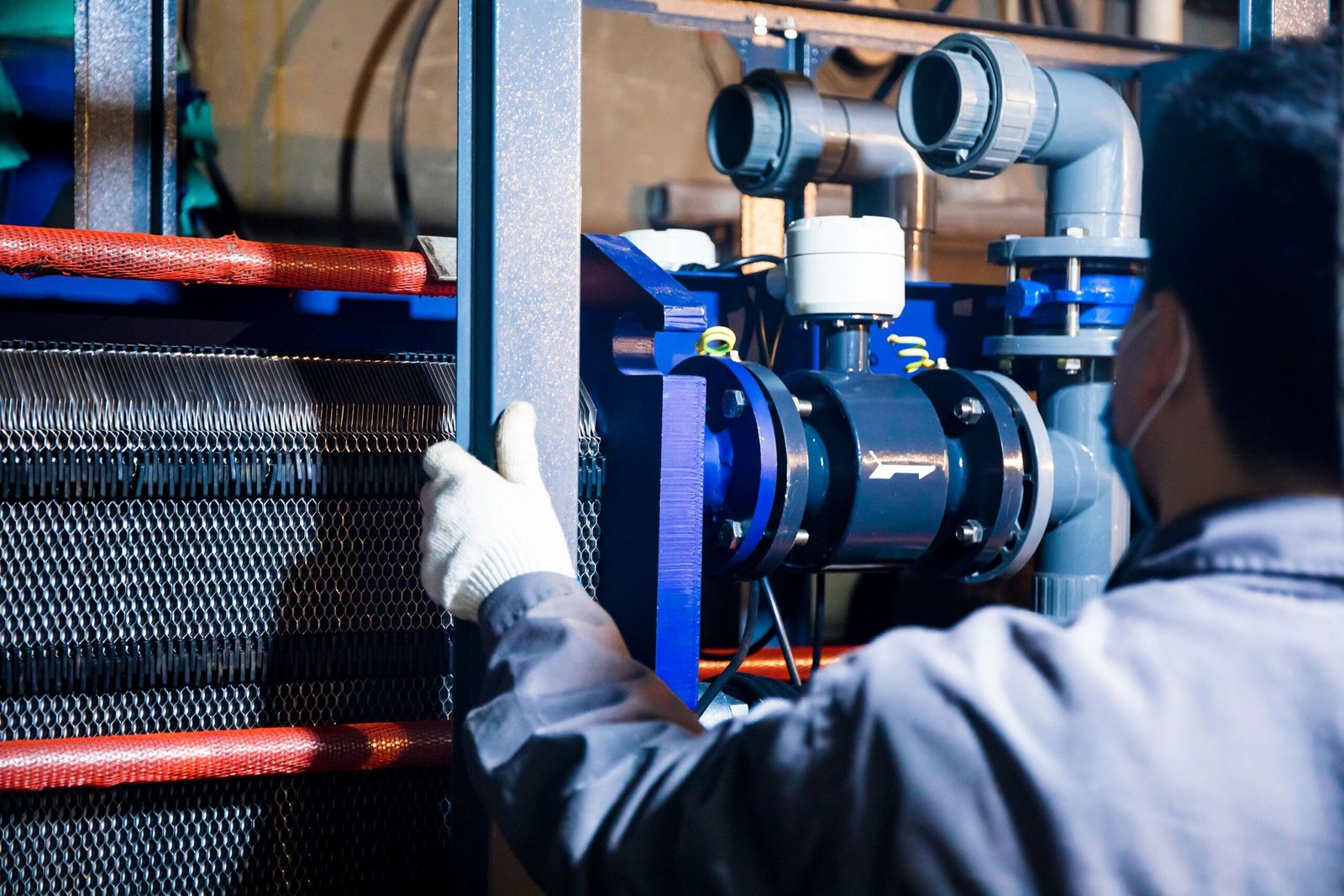 8. Common Heat Exchanger Cleaning and Maintenance Mistakes
Poor cleaning practices can turn a routine maintenance activity into a source of leakage, corrosion, damage, or unnecessary downtime.
Mistake 1: Choosing chemicals before identifying the deposit
What buyers do: Use a familiar acid or alkaline cleaner without confirming the deposit type.
Why it fails: The chemical may be ineffective against the deposit or incompatible with the exchanger materials.
What to do instead: Identify the likely contaminant and verify chemical compatibility with all relevant wetted materials.
Mistake 2: Using excessive pressure or unsuitable mechanical tools
What buyers do: Apply high-pressure water jets or aggressive tools to remove stubborn deposits.
Why it fails: Plates, tubes, fins, coatings, and seals may be damaged.
What to do instead: Follow equipment-specific cleaning instructions and use tools suited to the material and geometry.
Mistake 3: Ignoring gasket and seal compatibility
What buyers do: Use a cleaning solution without checking gasket or seal material.
Why it fails: Certain chemicals, concentrations, temperatures, or exposure times can degrade elastomers.
What to do instead: Confirm compatibility for the complete wetted system, including seals and other non-metallic components.
Mistake 4: Cleaning without checking the root cause
What buyers do: Schedule repeated cleaning whenever capacity falls.
Why it fails: The actual cause may be poor filtration, unsuitable water chemistry, insufficient flow, or a control-system problem.
What to do instead: Track operating data, investigate deposit formation, and address the source of recurring fouling.
Mistake 5: Reassembling a plate heat exchanger incorrectly
What buyers do: Open a gasketed plate pack without following the specified plate arrangement or assembly procedure.
Why it fails: Incorrect plate orientation, damaged gaskets, or incorrect tightening can cause leakage or poor flow distribution.
What to do instead: Follow the manufacturer’s instructions, verify component condition, and perform the required checks after assembly.
Mistake 6: Returning equipment to service without verification
What buyers do: Restart the system immediately after cleaning without checking for leaks or confirming performance.
Why it fails: Assembly errors, trapped air where relevant, residual chemicals, or unresolved restrictions may remain.
What to do instead: Follow the approved commissioning procedure and verify leak integrity, flow, pressure drop, and thermal performance as applicable.
Mistake 7: Using the same maintenance interval for every application
What buyers do: Apply a fixed annual cleaning schedule to all heat exchangers.
Why it fails: Fouling rates vary with fluid quality, temperature, operating hours, and process conditions.
What to do instead: Combine manufacturer guidance with condition monitoring and operating history to establish an appropriate interval.
Mistake 8: Comparing service quotations without checking exclusions
What buyers do: Select the lowest quotation without confirming the scope.
Why it fails: One quotation may include disassembly, gaskets, inspection, testing, and documentation, while another may cover cleaning only.
What to do instead: Compare the cleaning method, labor, replacement parts, testing, waste handling, transportation, and deliverables on an equivalent basis.
Heat Exchanger Cleaning and Maintenance Checklist
Use this checklist when planning a cleaning service or requesting a quotation.
Equipment information
Heat exchanger type: plate, brazed plate, shell-and-tube, air-cooled, or liquid cooling.
Manufacturer and model, if available.
Equipment nameplate or datasheet.
Serial number, if available.
Heat transfer surface materials.
Gasket, seal, or brazing material, where applicable.
Dimensions and connection details.
Existing maintenance and cleaning instructions.
Operating conditions
Fluid on each side.
Fluid composition and concentration.
Normal flow rates.
Inlet and outlet temperatures.
Operating pressure.
Pressure-drop readings.
Required heat duty or known performance target.
Operating hours and load variation.
Water, coolant, or process-fluid quality information.
Cleaning requirements
Description of the performance problem.
Suspected deposit type.
Previous cleaning dates and methods.
Available photographs or inspection findings.
Preferred cleaning method, if specified.
Chemical compatibility restrictions.
Required inspection and testing.
Parts that may require replacement.
Waste collection and disposal requirements.
Service and delivery requirements
On-site or off-site service preference.
Site access and equipment-isolation requirements.
Required maintenance window.
Shutdown and restart coordination.
Required service report.
Destination and transportation requirements, if equipment will be moved.
Spare parts or replacement-equipment requirements.
Budget and schedule constraints.
Providing this information helps the service provider determine whether the job requires cleaning, inspection, repair, replacement parts, or a broader engineering review.
Frequently Asked Questions About Heat Exchanger Cleaning and Maintenance
1. How often should a heat exchanger be cleaned?
A heat exchanger should be cleaned when its condition, performance trends, or approved maintenance plan indicate that cleaning is necessary. The interval depends on fluid quality, fouling rate, operating conditions, and equipment design. Monitoring heat duty and pressure drop can help establish an appropriate schedule rather than relying on an arbitrary calendar interval.
2. What is the best method for cleaning a heat exchanger?
The best method is the one that removes the actual deposits while remaining compatible with the exchanger’s materials and construction. Chemical cleaning, mechanical cleaning, flushing, backflushing, and disassembly may be suitable in different situations. The method should be selected after considering deposit chemistry, equipment access, and manufacturer instructions.
3. Can a plate heat exchanger be cleaned without disassembly?
Yes, many suitable plate heat exchangers can be cleaned in place using an approved cleaning-in-place procedure. CIP can reduce disassembly requirements, but its effectiveness depends on the deposit, cleaning solution, flow conditions, and equipment design. Some severe or inaccessible deposits may require opening the unit for inspection and cleaning.
4. Can a brazed plate heat exchanger be cleaned?
Yes, some brazed plate heat exchangers can be cleaned using a manufacturer-approved circulation procedure. The chemical and operating conditions must be compatible with the plates and brazing material. Because the plate pack is generally not designed for routine disassembly, severe internal blockage may require specialist assessment or replacement.
5. What causes heat exchanger fouling?
Heat exchanger fouling occurs when unwanted material accumulates on heat transfer surfaces. Common causes include mineral scale, suspended solids, biological growth, oil deposits, process residues, and corrosion products. The rate of fouling depends on fluid composition, temperature, surface conditions, flow behavior, and the effectiveness of upstream treatment or filtration.
6. Does fouling increase heat exchanger pressure drop?
Fouling can increase pressure drop by restricting flow passages or changing the effective flow geometry. However, a pressure-drop increase can also result from higher flow rates, blocked filters, valve problems, or other system changes. Pressure readings should therefore be compared at similar operating conditions before fouling is diagnosed.
7. Can chemical cleaning damage a heat exchanger?
Yes, an incompatible cleaning chemical or an unsuitable concentration, temperature, or exposure time can damage metals, gaskets, brazing materials, coatings, or seals. Cleaning chemistry should be selected based on the deposit and all relevant wetted materials. The equipment manufacturer’s approved procedure should take precedence over a generic cleaning recommendation.
8. How can I tell whether a heat exchanger needs cleaning or replacement?
Cleaning is generally worth evaluating when removable deposits are the main problem and the equipment remains structurally sound. Replacement may be preferable when there is severe corrosion, irreparable damage, inaccessible blockage, unavailable critical parts, or inadequate capacity under actual process conditions. A condition assessment and lifecycle-cost comparison can support the decision.
9. What is cleaning in place (CIP)?
Cleaning in place is a procedure that circulates a suitable cleaning solution through equipment without requiring full disassembly. It is used for compatible systems where the cleaning solution can reach the surfaces and remove the deposits effectively. CIP procedures must account for chemical compatibility, flow conditions, temperature, rinsing, waste handling, and equipment-specific restrictions.
10. Does cleaning restore the original heat transfer capacity?
Cleaning can restore performance when removable fouling is the main cause of reduced heat transfer. It cannot necessarily correct undersizing, damaged surfaces, poor flow distribution, control problems, or changes in process requirements. Performance should be assessed under comparable operating conditions before and after cleaning.
11. What information is needed for a heat exchanger cleaning quotation?
A cleaning quotation normally requires the exchanger type, model, dimensions, fluid composition, suspected deposit, symptoms, operating conditions, and maintenance history. The provider may also need photographs, cleaning instructions, site details, access restrictions, required inspection, and information about replacement parts. More complete information helps clarify the method, scope, schedule, and cost.
12. Should a heat exchanger be inspected after cleaning?
Yes, appropriate post-cleaning checks help confirm that the equipment is ready for service. Depending on the design and work performed, these may include visual inspection, component checks, assembly verification, leak testing, and performance monitoring. The exact checks should follow the manufacturer’s procedures and the agreed maintenance scope.
13. Can poor water quality shorten heat exchanger service life?
Yes, unsuitable water quality can contribute to scaling, corrosion, sediment accumulation, or biological fouling. The specific risk depends on water chemistry, temperature, materials, treatment, and operating conditions. Water treatment, filtration, and routine monitoring should be selected for the actual system rather than applied as a universal solution.
14. What should be included in a heat exchanger maintenance report?
A useful report records the equipment identification, initial symptoms, cleaning method, work performed, deposits observed, component condition, replacement parts, inspections, testing, and recommendations. Where reliable data are available, it should also document relevant operating conditions before and after cleaning so that performance changes can be evaluated.
15. Can a heat exchanger supplier help with cleaning and spare parts?
A supplier may help identify compatible spare parts, obtain manufacturer instructions, coordinate technical assessment, and arrange suitable service or replacement options. The available support depends on the supplier’s role and its manufacturing and service partners. Buyers should confirm whether cleaning is performed directly, coordinated through a service provider, or referred to a qualified specialist.
Choosing a Heat Exchanger Cleaning and Maintenance Partner
A reliable cleaning and maintenance arrangement should begin with a clear understanding of the equipment, deposits, operating conditions, and required result. The service provider should explain the proposed method, identify material-compatibility concerns, define the scope, and specify the checks that will be performed before the exchanger returns to service.
Before approving a quotation, confirm:
- Technical assessment: How will the cause of reduced performance be evaluated?
- Cleaning procedure: Why is the selected method appropriate for the equipment and deposits?
- Material compatibility: Have plates, tubes, gaskets, brazing materials, and other relevant components been considered?
- Inspection and testing: Which checks are included, and how will results be documented?
- Replacement parts: Are gaskets, seals, or other components included or quoted separately?
- Safety and waste handling: How will isolation, chemical handling, rinsing, and disposal be addressed?
- Documentation: Will the service provider issue a maintenance report?
- Follow-up: Can recurring fouling, spare parts, or replacement-equipment requirements be reviewed?
How an International Heat Exchanger Export Partner Can Help
For international buyers, coordinating equipment information, compatible spare parts, technical documentation, and replacement options can be as important as arranging the initial purchase.
As a China-based trading and export company, we work closely with qualified manufacturing partners and engineering teams to coordinate product sourcing, technical communication, customization, quality-control arrangements, documentation, and international export support.
Depending on the equipment and agreed scope, we can help buyers organize product information, communicate maintenance requirements, identify suitable spare parts, and evaluate replacement heat exchangers when cleaning or repair may not be the most practical option. Specialized cleaning work should be arranged with a qualified service provider using procedures appropriate to the equipment.
Our role is to help make technical and commercial coordination clearer while ensuring that product selection and service recommendations are based on the actual application requirements.