Choosing the right heat exchanger is not simply a matter of comparing prices.
A plate heat exchanger, shell and tube heat exchanger, and plate fin heat exchanger use different heat-transfer structures and are designed for different operating conditions.
The right choice depends on:
- Heat duty
- Fluid type
- Flow rate
- Operating temperature
- Operating pressure
- Allowable pressure drop
- Fouling tendency
- Required temperature approach
- Materials
- Installation space
- Maintenance requirements
- Initial cost
- Long-term operating cost
This guide compares the three technologies from a practical engineering perspective and explains when each type is a better choice.
Plate vs Shell and Tube vs Plate Fin Heat Exchanger: Quick Comparison
| Factor | Plate Heat Exchanger | Shell and Tube | Plate Fin |
|---|---|---|---|
| Compactness | Excellent | Moderate to low | Excellent |
| Heat-transfer area per volume | High | Moderate | Very high |
| Liquid-to-liquid | Excellent | Excellent | Possible |
| Gas-to-gas | Limited | Possible | Excellent |
| Gas-to-liquid | Application dependent | Good | Excellent |
| High temperature | Depends on design | Excellent | Excellent for suitable designs |
| High pressure | Depends on design | Excellent | Depends on construction |
| Maintenance access | Excellent for gasketed designs | Moderate | Usually limited |
| Fouling tolerance | Application dependent | Good for some duties | Application dependent |
| Temperature approach | Very good | Usually larger | Very good |
| Footprint | Small | Larger | Very small |
| Customization | High | Very high | High |
| Best use | Liquid heating/cooling | Heavy-duty industrial service | Compact gas or mixed duties |
There is no universal winner.
The best heat exchanger is the one that satisfies the thermal, hydraulic, mechanical and maintenance requirements of the application.
1. What Is a Plate Heat Exchanger?
A plate heat exchanger transfers heat through a series of thin plates.
The hot and cold fluids flow through alternating channels.
Corrugated plates create turbulence and provide a large heat-transfer surface in a compact volume.
Gasketed plate-and-frame heat exchangers can also be opened for inspection, cleaning and plate replacement. Their capacity can often be modified by adding or removing plates.
Common plate heat exchanger types include:
- Gasketed plate heat exchangers
- Brazed plate heat exchangers
- Welded plate heat exchangers
- Semi-welded plate heat exchangers
- Plate-and-shell heat exchangers
They are widely used for heating and cooling applications involving liquids.
2. What Is a Shell and Tube Heat Exchanger?
A shell and tube heat exchanger consists of a tube bundle installed inside a shell.
One fluid flows through the tubes while the other flows around the tubes inside the shell.
Baffles or other internal structures can direct the shell-side flow and improve heat transfer.
Shell and tube heat exchangers can be designed for a wide range of:
- Temperatures
- Pressures
- Flow rates
- Fluid types
- Single-phase applications
- Condensing applications
- Boiling applications
They remain a common choice in chemical processing, refineries, power generation, marine systems and other demanding industrial applications.
 3. What Is a Plate Fin Heat Exchanger?
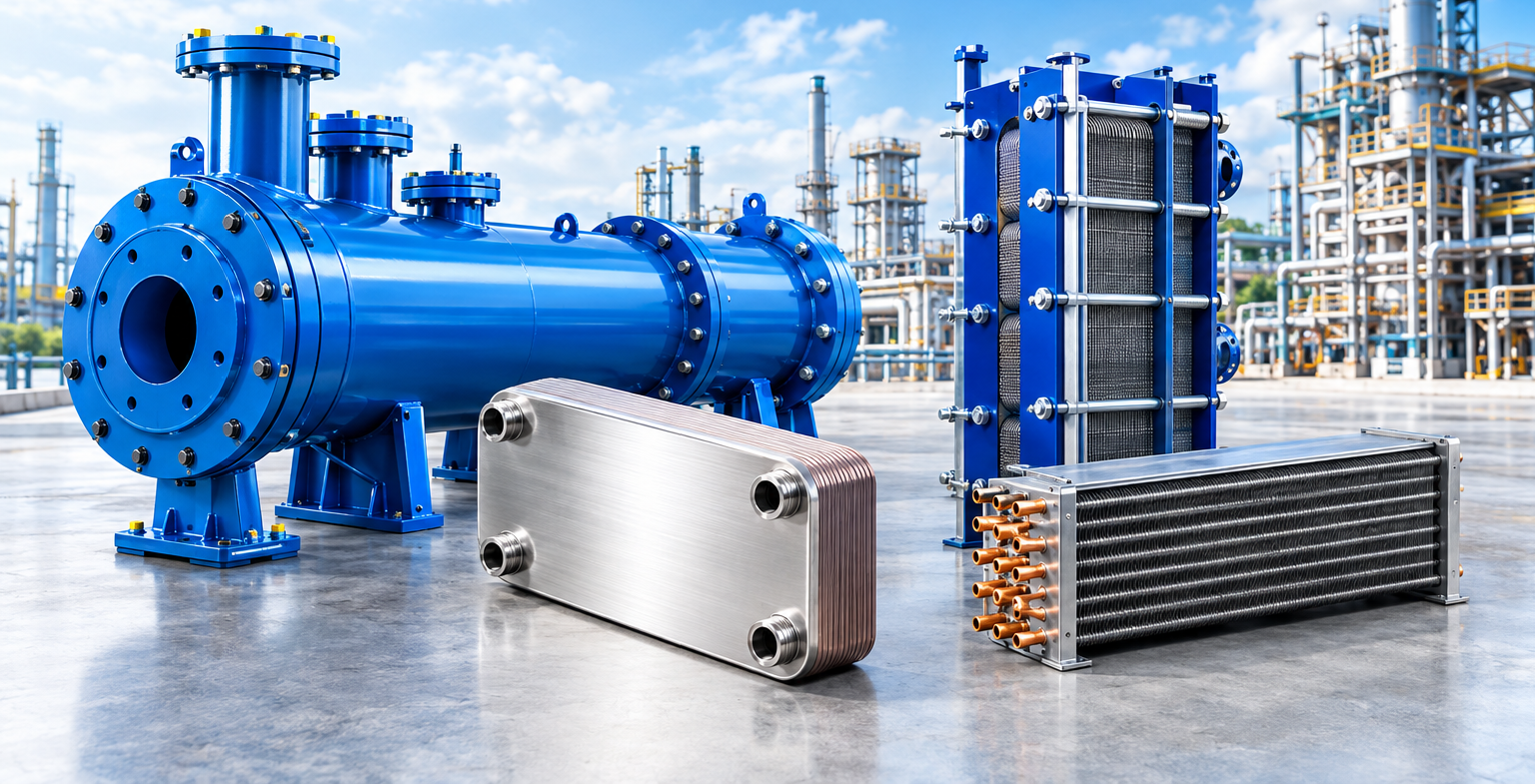 3. What Is a Plate Fin Heat Exchanger?
A plate fin heat exchanger uses plates and fins to create many small flow channels.
The fins dramatically increase the available heat-transfer surface.
This gives plate fin heat exchangers a very high surface-area-to-volume ratio.
They are particularly attractive when the application requires:
- High heat-transfer performance
- Compact dimensions
- Low pressure drop
- Gas-to-gas heat transfer
- Gas-to-liquid heat transfer
- Large flow imbalance between two streams
Modern plate-fin designs are used in applications such as gas processing, compressor cooling, industrial heat pumps, refrigeration and energy systems.
4. Plate Heat Exchanger vs Shell and Tube Heat Exchanger
This is one of the most common heat exchanger selection questions.
Neither technology is automatically better.
The correct choice depends on the operating conditions.
Plate Heat Exchanger Advantages
A plate heat exchanger can offer:
- Compact footprint
- High heat-transfer efficiency
- Close temperature approaches
- High turbulence
- Lower hold-up volume
- Easy access for cleaning in gasketed designs
- Flexible capacity
- Relatively low material volume
Corrugated plates promote turbulence and allow high heat-transfer performance from a relatively compact heat-transfer surface.
This makes plate heat exchangers particularly attractive for liquid-to-liquid heating and cooling.
5. Shell and Tube Heat Exchanger Advantages
Shell and tube technology remains attractive when the application requires:
- High operating temperature
- High operating pressure
- Large flow capacity
- Robust mechanical construction
- Wide material selection
- Difficult process fluids
- Condensation
- Evaporation
- Heavy industrial service
A shell and tube exchanger can also be customized extensively through:
- Tube material
- Tube diameter
- Tube length
- Number of tube passes
- Shell diameter
- Baffle configuration
- Tube arrangement
- Corrosion-resistant alloys
For demanding industrial duties, this flexibility can be more important than achieving the smallest possible footprint.
6. Plate Heat Exchanger vs Shell and Tube: Footprint
If installation space is limited, the plate heat exchanger often has a major advantage.
Its thin plates provide a large heat-transfer surface in a relatively small package.
For an equivalent duty, plate technology can require substantially less floor space than conventional shell-and-tube equipment.
This matters when:
- Retrofitting existing equipment
- Expanding a plant
- Adding capacity
- Installing equipment inside mechanical rooms
- Reducing pipework
- Transporting equipment through restricted access areas
However, the actual footprint must be calculated from the required duty rather than assumed from the exchanger type alone.
7. Plate Heat Exchanger vs Shell and Tube: Temperature Approach
Temperature approach is critical when designing an efficient heat recovery system.
A smaller temperature approach generally means that the heat exchanger can transfer heat effectively even when the temperature difference between the two streams is relatively small.
Counter-current plate heat exchangers can achieve very close temperature approaches in suitable applications.
This can be valuable for:
- Heat recovery
- District heating
- HVAC heating
- Industrial process heating
- Waste heat recovery
- Heat pump systems
However, the required approach temperature must be evaluated together with flow rate, pressure drop and heat-transfer area.
8. Plate Heat Exchanger vs Shell and Tube: Pressure Drop
A common mistake is to focus only on heat-transfer efficiency.
Pressure drop is equally important.
If a heat exchanger creates excessive pressure loss, the system may require more pumping energy.
The design should therefore balance:
Heat-transfer coefficient
with
Pressure drop
A plate heat exchanger can achieve high heat-transfer coefficients through turbulent flow, but the channel configuration still needs to be selected according to the allowable pressure drop.
Shell-and-tube designs can also be optimized for pressure drop using tube diameter, tube length, tube passes and baffle configuration.
The correct design is not necessarily the exchanger with the highest heat-transfer coefficient.
It is the exchanger that achieves the required duty within the system’s pressure-drop limit.
9. Which Heat Exchanger Is Easier to Clean?
For gasketed plate heat exchangers, maintenance can be relatively straightforward because the plate pack can be opened.
Plates can be:
- Removed
- Inspected
- Cleaned
- Re-gasketed
- Replaced
CIP cleaning can also be used for suitable applications.
This can be an advantage when the process has a high fouling tendency.
Shell-and-tube heat exchangers can also be cleaned using:
- Mechanical tube cleaning
- Chemical cleaning
- Hydroblasting
- Tube-side cleaning systems
The best cleaning method depends on the tube design, fouling type and accessibility.
Plate-fin heat exchangers generally have a different maintenance philosophy because their compact internal passages are not normally accessed in the same way as a gasketed plate heat exchanger.
10. Which Heat Exchanger Is Better for Fouling?
There is no universal answer.
Fouling depends on:
- Fluid chemistry
- Velocity
- Temperature
- Surface condition
- Suspended solids
- Water quality
- Process contaminants
- Channel geometry
A well-designed plate heat exchanger can provide high turbulence and reduce certain types of fouling, but narrow channels may be unsuitable for fluids containing large amounts of suspended solids.
Shell-and-tube heat exchangers can be advantageous when larger flow passages and mechanical tube cleaning are important.
Therefore, the question should not simply be:
“Which heat exchanger has less fouling?”
The better question is:
“Which heat exchanger can handle the actual fouling mechanism in this application?”
11. Which Heat Exchanger Is Better for High Pressure?
For high-pressure service, the exchanger construction becomes critical.
Traditional shell-and-tube technology has long been used for high-pressure industrial applications because the shell, tubes and tube sheets can be designed as pressure-containing components.
However, fully welded plate technologies can also be engineered for demanding pressure applications.
Some welded plate-and-shell designs are specifically developed for high-pressure and high-temperature process duties.
Do not select an exchanger based only on its name.
Check:
- Design pressure
- Operating pressure
- Differential pressure
- Design temperature
- Thermal cycling
- Material strength
- Applicable pressure-vessel requirements
12. Which Heat Exchanger Is Better for High Temperature?
Shell-and-tube heat exchangers are often a strong choice for high-temperature process applications.
They can use metal construction without gaskets that limit the temperature range.
However, welded plate and plate-fin technologies can also be suitable for high-temperature duties when the specific design and materials are appropriate.
For example, diffusion-welded plate-fin technology is available for demanding high-pressure and high-temperature gas applications.
The limiting factor is therefore not simply “plate versus tube.”
It is:
Material + construction + pressure + temperature + thermal cycling + fluid compatibility.
13. Which Heat Exchanger Is Better for Liquid-to-Liquid Applications?
For many liquid-to-liquid heating and cooling applications, a plate heat exchanger is an excellent starting point.
Typical applications include:
- Water heating
- Water cooling
- HVAC
- District heating
- Chilled water
- Heat pumps
- Process cooling
- Process heating
- Oil cooling
- Food processing
The compact design and high heat-transfer performance make plate heat exchangers particularly attractive for these duties.
However, heavily contaminated fluids, extreme pressures or temperatures may shift the decision toward shell-and-tube or another welded design.
14. Which Heat Exchanger Is Better for Gas-to-Gas?
For gas-to-gas applications, plate-fin technology can be particularly attractive.
Gas has a much lower heat-transfer coefficient than many liquids.
Therefore, a large heat-transfer surface is often required.
Plate-fin construction provides a very high surface-area-to-volume ratio and can create many small flow passages.
This allows high thermal performance in a compact package.
Typical applications include:
- Gas processing
- Air separation
- Compressor cooling
- Cryogenic systems
- Energy recovery
- Industrial heat pumps
- Refrigeration
The actual selection still depends on pressure, temperature, gas composition and allowable pressure drop.
15. Which Heat Exchanger Is Better for Gas-to-Liquid?
Gas-to-liquid service can be more difficult than liquid-to-liquid service because gas-side heat transfer is often weaker.
Plate-fin technology can be useful where high surface area and low pressure drop are required.
Shell-and-tube designs can also be used successfully, especially where high pressure, high temperature or robust construction is required.
A plate heat exchanger may be suitable for certain gas-to-liquid applications, but it should not be selected automatically.
The gas-side pressure drop and flow distribution must be checked carefully.
16. Which Heat Exchanger Has the Lowest Pressure Drop?
There is no fixed answer.
Pressure drop depends on:
- Flow rate
- Channel geometry
- Number of passes
- Heat-transfer area
- Fluid density
- Fluid viscosity
- Port size
- Flow distribution
Plate-fin heat exchangers can be designed for very low pressure drop while maintaining high thermal performance in suitable gas applications.
Plate and shell-and-tube designs can also be optimized for low pressure drop.
Always compare actual calculated pressure drop rather than comparing technologies using generic claims.
17. Which Heat Exchanger Is the Most Compact?
If compactness is the main requirement, plate and plate-fin technologies are usually strong candidates.
Plate heat exchangers provide a large heat-transfer surface within a small footprint.
Plate-fin designs go further by using fins to increase the surface area inside each channel.
This is particularly useful for gas applications where conventional designs can become physically large.
Shell-and-tube equipment generally requires more physical volume for the same type of compact-duty application, although optimized shell-and-tube designs can still be highly compact.
18. Which Heat Exchanger Is Cheapest?
The cheapest heat exchanger to purchase is not necessarily the cheapest heat exchanger to operate.
Consider:
Initial equipment cost
Installation cost
Piping cost
Pump or fan energy
Cleaning cost
Maintenance cost
Replacement parts
Downtime
Expected service life
A shell-and-tube heat exchanger may have an attractive purchase price for certain applications.
A plate heat exchanger may reduce equipment size and installation cost.
A plate-fin heat exchanger may justify a higher initial cost where compactness and thermal performance are critical.
The correct comparison is total cost of ownership, not purchase price alone.
19. Plate Heat Exchanger vs Shell and Tube: Maintenance Cost
Maintenance depends heavily on the design.
For gasketed plate heat exchangers, opening the plate pack can provide direct access to the heat-transfer surfaces.
Plates can be cleaned or replaced individually.
Capacity can also be modified by changing the number of plates in many designs.
Shell-and-tube maintenance may involve:
- Tube cleaning
- Tube inspection
- Tube plugging
- Tube replacement
- Tube-sheet inspection
- Shell-side cleaning
For large industrial systems, maintenance access and downtime should be included in the initial equipment selection.
20. What About Corrosive Fluids?
Material selection becomes critical when corrosive fluids are involved.
Possible materials include:
- Stainless steel
- Titanium
- Nickel alloys
- Hastelloy
- Carbon steel
- Copper alloys
- Aluminum
The correct material depends on:
- Fluid chemistry
- Chloride concentration
- Temperature
- Pressure
- Oxygen content
- Contaminants
- Required service life
Do not choose the cheapest material simply because it works under normal conditions.
Corrosion rates can change significantly with temperature and fluid composition.
For expensive corrosion-resistant materials, compact heat exchanger designs can also reduce the total amount of material required for a given duty.
21. Which Heat Exchanger Is Better for Dirty Fluids?
Dirty fluids require special attention.
Consider:
- Channel size
- Tube diameter
- Flow velocity
- Filtration
- Cleaning method
- Drainage
- Inspection access
A plate heat exchanger with narrow channels may not be appropriate for fluids containing large particles.
A shell-and-tube exchanger with larger tube passages may be easier to operate and clean in some dirty-fluid applications.
However, the final selection depends on the actual contaminant and required cleaning method.
Ask:
What is in the fluid?
What particle size is present?
How frequently will it foul?
How will it be cleaned?
These questions are more useful than simply asking which technology is “better.”
 22. Plate vs Shell and Tube vs Plate Fin: Application Examples
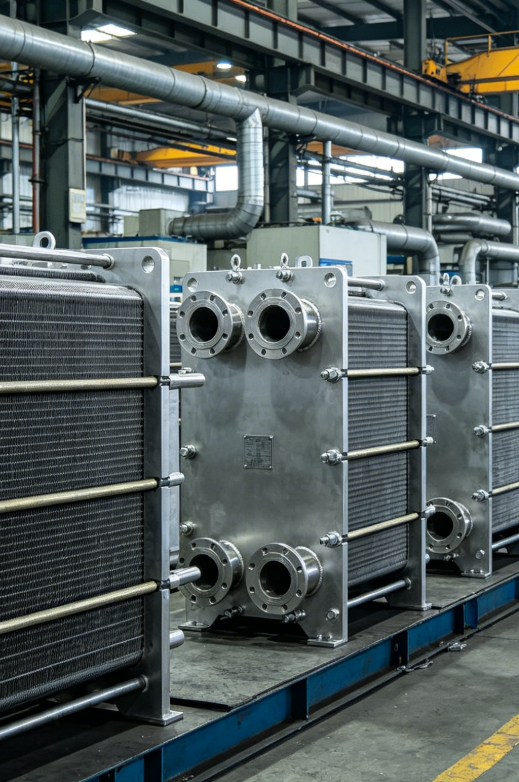 22. Plate vs Shell and Tube vs Plate Fin: Application Examples
HVAC Water Heating
Preferred starting point: Plate heat exchanger
Why:
- Compact
- Efficient
- Close temperature approach
- Easy maintenance for gasketed designs
District Heating
Preferred starting point: Plate heat exchanger
Why:
- Compact installation
- High heat-transfer performance
- Suitable for water-to-water duties
Chemical Process Heating
Possible choices: Plate, shell and tube, or welded plate
Selection depends on:
- Temperature
- Pressure
- Fluid chemistry
- Fouling
- Corrosion
Refinery High-Temperature Service
Preferred starting point: Shell and tube or suitable welded compact technology
The selection depends heavily on pressure, temperature, process chemistry and mechanical requirements.
Gas Processing
Preferred starting point: Plate-fin or specialized shell-and-tube design
Plate-fin becomes particularly attractive when high surface density and low pressure drop are required.
Compressor Cooling
Possible choices: Plate, shell and tube, or plate-fin
The correct design depends on whether the duty involves liquid cooling, gas cooling or refrigerant service.
Industrial Heat Pump
Possible choices: Plate or plate-fin
Liquid-to-liquid systems often favor plate technology, while gas or refrigerant duties may require a different configuration.
23. How to Choose the Right Heat Exchanger
Do not start with:
“Which heat exchanger is cheapest?”
Start with the process requirements.
Step 1: Define the Heat Duty
How much heat must be transferred?
Usually expressed as:
kW, MW, BTU/h or refrigeration tons
Step 2: Define the Fluids
Identify:
- Fluid type
- Concentration
- Density
- Viscosity
- Corrosiveness
- Solid content
- Phase
Step 3: Define Temperatures
Provide:
- Hot-side inlet temperature
- Hot-side outlet temperature
- Cold-side inlet temperature
- Cold-side outlet temperature
Step 4: Define Flow Rates
Provide the flow rate for each side.
Typical units include:
- m³/h
- kg/h
- kg/s
- GPM
- lb/h
Step 5: Define Pressure
Provide:
- Operating pressure
- Design pressure
- Maximum allowable pressure drop
Step 6: Define Installation Limits
Tell the manufacturer:
- Maximum length
- Maximum width
- Maximum height
- Connection position
- Available maintenance space
Step 7: Define Maintenance Requirements
Consider:
- CIP
- Manual cleaning
- Tube cleaning
- Inspection frequency
- Spare parts
- Gasket replacement
Step 8: Compare Total Cost
Compare:
CAPEX + OPEX + Maintenance + Energy + Downtime
rather than equipment price alone.
24. Heat Exchanger Selection Decision Guide
A practical starting point is:
Choose a Plate Heat Exchanger When:
- The duty is mainly liquid-to-liquid
- Compact size is important
- Close temperature approach is required
- Easy cleaning is valuable
- Flexible capacity is needed
- Operating conditions are within the plate/gasket limits
Choose a Shell and Tube Heat Exchanger When:
- High pressure is required
- High temperature is required
- Heavy industrial service is involved
- Large or complex process duties are involved
- Robust mechanical construction is important
- Tube-side mechanical cleaning is advantageous
Choose a Plate Fin Heat Exchanger When:
- Gas-to-gas heat transfer is required
- Gas-to-liquid heat transfer is required
- Compactness is critical
- Very high surface-area density is useful
- Low pressure drop is important
- The process involves demanding gas-side heat transfer
These are starting points, not substitutes for thermal design calculations.
25. Do Not Select a Heat Exchanger From Heat Duty Alone
Two projects can both require:
1 MW of heat transfer
but need completely different heat exchangers.
For example:
Project A
Water → Water
80°C → 60°C
20°C → 50°C
Moderate pressure
Clean fluid
Limited installation space
A plate heat exchanger may be an excellent solution.
Project B
High-pressure process gas
450°C
High differential pressure
Cyclic operation
Low allowable pressure drop
This requires a completely different engineering approach.
Heat duty alone cannot determine the heat exchanger type.
26. The Five Most Important Selection Factors
If you are comparing plate, shell-and-tube and plate-fin heat exchangers, start with these five questions:
1. What are the fluids?
Water and clean glycol are very different from corrosive process chemicals or contaminated gas.
2. What are the temperatures?
Temperature affects materials, gaskets, thermal expansion and equipment construction.
3. What are the pressures?
Pressure determines mechanical design requirements.
4. What pressure drop is acceptable?
A thermally efficient heat exchanger is not useful if it creates excessive system pressure loss.
5. How will it be maintained?
Cleaning and maintenance requirements should be considered before purchase.
27. The Best Heat Exchanger Is Application-Specific
There is no single heat exchanger technology that is best for every application.
A plate heat exchanger can be an excellent solution for compact liquid-to-liquid heat transfer.
A shell-and-tube heat exchanger can be the better choice for demanding high-pressure, high-temperature or heavy industrial service.
A plate-fin heat exchanger can be highly effective when gas-side heat transfer, compactness and low pressure drop are critical.
The correct selection comes from matching the equipment to the process.
28. Need Help Selecting a Heat Exchanger?
If you are comparing:
Plate heat exchanger vs shell and tube
Plate heat exchanger vs plate fin
Shell and tube vs plate fin
or you are not sure which technology is suitable for your project, provide the operating data to the manufacturer.
Useful information includes:
Heat duty
Hot-side fluid
Cold-side fluid
Hot-side flow rate
Cold-side flow rate
Hot-side inlet/outlet temperatures
Cold-side inlet/outlet temperatures
Operating pressure
Maximum allowable pressure drop
Fluid concentration
Material requirements
Maximum equipment dimensions
Cleaning requirements
Existing heat exchanger model or drawing
With this information, a manufacturer can evaluate the thermal and hydraulic requirements and recommend an appropriate configuration.
Request a Heat Exchanger Comparison and Quote
Instead of asking only for the lowest price, ask the supplier to compare the available technologies based on:
Heat-transfer performance
Pressure drop
Materials
Footprint
Maintenance
Expected service life
Energy consumption
Initial cost
Total cost of ownership
That gives you a much more useful basis for purchasing.
Plate vs shell and tube vs plate fin is not a question of which technology is universally better. It is a question of which technology best matches your fluids, temperatures, pressures, flow rates, space limitations and maintenance requirements.