For most clean water and HVAC applications, 316L stainless steel with EPDM or NBR gaskets is the standard material selection. For seawater or chloride-rich fluids, titanium or SMO 254 is required. For high-temperature or high-pressure duties, carbon steel or chrome-moly may be used. Material selection determines corrosion resistance, service life, maintenance cost, and safety.
This guide explains exactly how to choose the right materials for plate heat exchangers (PHE), shell and tube heat exchangers (STHE), and their components. You will learn:
The key factors that drive material selection: corrosion, temperature, pressure, fouling, and cost
How to select plate, tube, shell, and gasket materials for specific fluids
Corrosion mechanisms and how to resist them
Step-by-step selection logic and decision criteria
Common mistakes that cause premature failure
Cost, lead time, and certification factors for export projects
Quick Answer
| Fluid / Application | Recommended Plate / Tube Material | Recommended Gasket |
|---|---|---|
| Clean water, HVAC | 316L stainless steel | EPDM or NBR |
| Cooling tower water | 316L, titanium | EPDM |
| Seawater, chloride-rich | Titanium, SMO 254, duplex | EPDM, FKM |
| Ammonia (R717) | Carbon steel (STHE), 316L (PHE) | Nickel braze (BPHE) |
| Food and beverage | 316L, FDA-compliant | EPDM, NBR, PTFE |
| Acids, aggressive chemicals | Nickel alloys, titanium, PTFE-lined | PTFE-encapsulated, FKM |
| High-temperature steam | Carbon steel, chrome-moly | Graphite, spiral wound |
| Refrigerants | Copper, 316L, aluminum | HNBR, nickel braze |
| Hydrogen | 316L, low-temperature carbon steel | PTFE, FKM |
Table of Contents
What Is Heat Exchanger Material Selection?
How to Select Material for Plate Heat Exchangers
How to Select Material for Shell and Tube Heat Exchangers
Material Selection by Fluid and Application
Corrosion Mechanisms and Material Resistance
Temperature, Pressure, and Fouling Considerations
Step-by-Step Material Selection Guide
Comparison Tables
Material Selection Checklist
Common Mistakes and How to Avoid Them
Cost, Lead Time, and Certification Factors
FAQ
Key Takeaways
What Is Heat Exchanger Material Selection?
Heat exchanger material selection is the process of choosing wetted materials, gaskets, and construction materials that can resist corrosion, temperature, pressure, and fouling over the expected service life. It is a critical engineering decision that affects safety, reliability, and total cost of ownership.
H3: Why Material Selection Matters
Corrosion resistance: Wrong material leads to pitting, cracking, or wall thinning.
Service life: Correct material can last 15–20 years; wrong material may fail in months.
Maintenance cost: Resistant materials reduce cleaning and repair frequency.
Safety: Material failure can cause leaks, cross-contamination, or hazardous releases.
Compliance: Food, pharmaceutical, and marine applications have strict material requirements.
H3: Key Factors in Material Selection
| Factor | What to Evaluate |
|---|---|
| Fluid chemistry | pH, chlorides, oxygen, acids, solvents |
| Temperature | Operating and design temperature |
| Pressure | Design pressure and cycling |
| Fouling | Scaling, particulate, biological growth |
| Flow velocity | Erosion risk at high velocity |
| Cleaning method | Chemical compatibility with CIP agents |
| Certification | PED, ASME, FDA, marine class |
| Cost | Material cost, availability, lead time |
How to Select Material for Plate Heat Exchangers
For plate heat exchangers, plates are usually 316L stainless steel, titanium, or SMO 254; gaskets are NBR, EPDM, HNBR, FKM, or PTFE-encapsulated. Selection depends on fluid corrosivity, temperature, and cleaning requirements.
H3: Plate Material Selection Table
| Material | Typical Application | Temperature Limit | Chloride Resistance | Relative Cost |
|---|---|---|---|---|
| 304 stainless steel | Clean water, low chloride | 200 °C | Low | Low |
| 316L stainless steel | HVAC, food, general water | 200 °C | Moderate | Low–moderate |
| Titanium | Seawater, chloride-rich | 200 °C | Excellent | High |
| SMO 254 | High chloride, acidic | 200 °C | Excellent | Very high |
| Duplex 2205 | Seawater, high strength | 200 °C | Very good | High |
| Nickel alloys (C276, 625) | Aggressive acids | 200 °C | Excellent | Very high |
H3: Gasket Material Selection Table
| Gasket | Temperature Range | Chemical Resistance | Best For |
|---|---|---|---|
| NBR | −20 to 110 °C | Good for water, oils | Chilled water, HVAC |
| EPDM | −35 to 150 °C | Excellent for water, steam | Hot water, steam, glycol |
| HNBR | −20 to 160 °C | Good for oils, refrigerants | Refrigeration, oil cooling |
| FKM (Viton-compatible) | −20 to 200 °C | Excellent for chemicals | Aggressive fluids, high temp |
| PTFE-encapsulated | −20 to 180 °C | Exceptional | Highly corrosive fluids |
H3: When to Use Titanium vs 316L vs SMO 254
316L: Clean water, HVAC, food, general industrial water with low chlorides.
Titanium: Seawater, brackish water, high-chloride fluids, marine HVAC.
SMO 254: High-chloride and acidic environments where titanium may corrode.
Duplex: High-strength, seawater, and stress-corrosion-resistant applications.
How to Select Material for Shell and Tube Heat Exchangers
For shell and tube heat exchangers, tubes and shells can be carbon steel, stainless steel, copper alloys, titanium, or duplex; selection depends on fluid corrosivity, temperature, and pressure.
H3: Tube Material Selection Table
| Material | Typical Application | Temperature Limit | Corrosion Resistance | Relative Cost |
|---|---|---|---|---|
| Carbon steel | Steam, oil, high temp | 600 °C+ | Low (needs treatment) | Low |
| 304/316 stainless | General water, chemicals | 400 °C | Moderate | Moderate |
| Copper alloys | Clean water, marine | 200 °C | Good (no ammonia) | Moderate |
| Titanium | Seawater, chlorides | 300 °C | Excellent | High |
| Duplex 2205 | Seawater, high strength | 300 °C | Very good | High |
| Nickel alloys | Aggressive acids | 600 °C | Excellent | Very high |
H3: Shell Material Selection
Carbon steel: Most common for steam, oil, and high-temperature duties; requires corrosion allowance.
Stainless steel: For corrosive fluids and clean service.
Duplex: For seawater and high-strength applications.
Clad materials: Carbon steel with stainless or alloy cladding for cost-effective corrosion resistance.
H3: Tube Sheet and Baffle Materials
Tube sheets: carbon steel, stainless steel, or clad; must match tube and shell to avoid galvanic corrosion.
Baffles: carbon steel or stainless steel; must resist shell-side fluid.
Fasteners: must be compatible with flanges and shell to avoid galvanic couples.
Material Selection by Fluid and Application
Match material to fluid: clean water → 316L; seawater → titanium; ammonia → carbon steel; food → 316L; acids → nickel alloys or PTFE.
H3: HVAC and Refrigeration
| Fluid | Recommended Material | Gasket |
|---|---|---|
| Chilled water | 316L | NBR |
| Condenser water | 316L, titanium | EPDM |
| Glycol | 316L | EPDM |
| Refrigerant (HFC) | Copper, 316L | HNBR |
| Ammonia | Carbon steel, 316L | Nickel braze |
| CO₂ | Stainless steel | Nickel braze |
H3: Chemical and Petrochemical
| Fluid | Recommended Material |
|---|---|
| Acids (sulfuric, hydrochloric) | Nickel alloys, PTFE-lined |
| Caustic solutions | Nickel, 316L (dilute) |
| Organic solvents | Stainless steel, PTFE |
| High-temperature oils | Carbon steel, chrome-moly |
| Hydrogen | 316L, low-temperature carbon steel |
H3: Marine and Offshore
| Fluid | Recommended Material |
|---|---|
| Seawater | Titanium, SMO 254, duplex |
| Marine diesel | Carbon steel, stainless steel |
| Brine | Titanium, SMO 254 |
| Marine HVAC | Titanium, 316L |
H3: Food and Beverage
| Fluid | Recommended Material | Gasket |
|---|---|---|
| Milk, juice | 316L, FDA-compliant | EPDM, NBR |
| Beer, wine | 316L | EPDM, NBR |
| CIP chemicals | 316L, PTFE | FKM, PTFE |
| Steam | 316L | EPDM |
H3: Data Center and Energy Storage
| Fluid | Recommended Material |
|---|---|
| Water/glycol | 316L, copper |
| Refrigerant | Copper, 316L |
| Dielectric fluids | Stainless steel, PTFE |
| Battery cooling | 316L, aluminum |
H3: Hydrogen
| Fluid | Recommended Material |
|---|---|
| Gaseous hydrogen | 316L, low-temperature carbon steel |
| Liquid hydrogen | Austenitic stainless steel |
| Hydrogen embrittlement risk | Avoid high-strength steels |
Corrosion Mechanisms and Material Resistance
Common corrosion types are uniform, pitting, crevice, galvanic, erosion-corrosion, and stress corrosion cracking (SCC); material selection must address the dominant mechanism.
H3: Pitting and Chloride Resistance (PREN)
Pitting resistance equivalent number (PREN) predicts chloride resistance:
PREN = Cr + 3.3 × Mo + 16 × N
| Material | PREN | Chloride Resistance |
|---|---|---|
| 304 | ~18 | Low |
| 316L | ~24 | Moderate |
| Duplex 2205 | ~35 | Very good |
| SMO 254 | ~43 | Excellent |
| Titanium | N/A | Excellent |
H3: Galvanic Corrosion and Dissimilar Metals
Avoid coupling dissimilar metals in conductive fluids.
Use isolation gaskets or sleeves between flanges.
Choose materials close in galvanic series.
Common risk: carbon steel shell with stainless tubes.
H3: Stress Corrosion Cracking (SCC)
Chlorides + tensile stress + temperature > 60 °C can crack 304/316.
Use duplex, SMO 254, or titanium for chloride SCC resistance.
Avoid high-stress designs in chloride environments.
H3: Erosion-Corrosion
High velocity and particles remove protective oxide layers.
Reduce velocity, filter particles, or use harder materials.
Titanium and duplex resist erosion better than copper.
 Temperature, Pressure, and Fouling Considerations
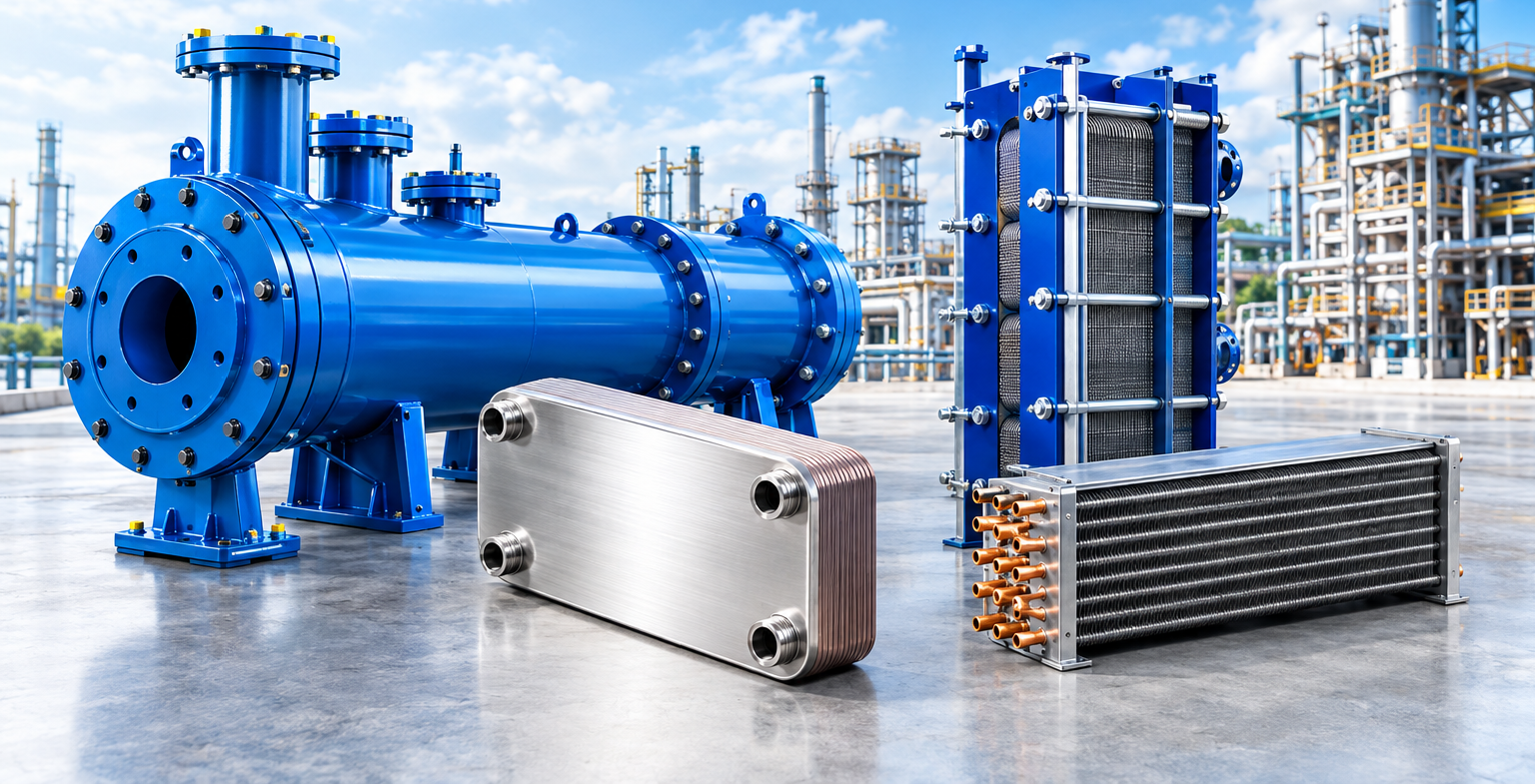 Temperature, Pressure, and Fouling Considerations
High temperature limits gasket choice; high pressure requires thicker plates/tubes; fouling may require smooth surfaces or coatings.
H3: Temperature Limits by Material
| Material | Max Temperature (Continuous) |
|---|---|
| NBR gasket | 110 °C |
| EPDM gasket | 150 °C |
| HNBR gasket | 160 °C |
| FKM gasket | 200 °C |
| PTFE gasket | 180 °C |
| 316L plate | 200 °C (gasket limited) |
| Carbon steel tube | 600 °C+ |
| Stainless steel tube | 400–600 °C |
H3: Pressure Effects on Material Thickness
Higher pressure requires thicker plates or tubes.
BPHE can handle 30–45 bar; gasketed PHE up to 25 bar.
STHE can handle 100+ bar with thicker tubes and shell.
Always verify design pressure with vendor.
H3: Fouling and Surface Finish
Smooth surfaces reduce deposit adhesion.
Electropolished plates improve cleanability.
Coatings (PTFE, epoxy) resist fouling but may reduce U.
Wide-gap plates handle particulate fouling better.
Step-by-Step Material Selection Guide
Follow these steps to select the right materials for your heat exchanger.
Step 1 — Define fluid chemistry.
List pH, chlorides, oxygen, acids, solvents, and contaminants.
Step 2 — Determine temperature and pressure.
Identify operating and design conditions for both sides.
Step 3 — Identify corrosion risks.
Assess pitting, crevice, galvanic, SCC, and erosion potential.
Step 4 — Select candidate materials.
Use tables above to shortlist 316L, titanium, SMO 254, carbon steel, etc.
Step 5 — Check gasket compatibility.
Match gasket material to fluid and temperature.
Step 6 — Verify cost and availability.
Compare material cost and lead time.
Step 7 — Confirm certifications.
Check PED, ASME, FDA, marine class requirements.
Step 8 — Validate with vendor.
Request material certificates and corrosion data.
Step 9 — Consider maintenance.
Ensure cleaning chemicals are compatible with materials.
Step 10 — Finalize and document.
Record material selection rationale for future reference.
Comparison Tables
Table 1: Common Heat Exchanger Materials Comparison
| Material | Corrosion Resistance | Temperature Limit | Relative Cost | Best For |
|---|---|---|---|---|
| 304 SS | Low–moderate | 400 °C | Low | Clean water, low chloride |
| 316L SS | Moderate | 400 °C | Moderate | HVAC, food, general water |
| Titanium | Excellent | 300 °C | High | Seawater, chlorides |
| SMO 254 | Excellent | 300 °C | Very high | High chloride, acidic |
| Duplex 2205 | Very good | 300 °C | High | Seawater, high strength |
| Carbon steel | Low | 600 °C+ | Low | Steam, oil, high temp |
| Copper alloys | Good | 200 °C | Moderate | Clean water, marine |
| Nickel alloys | Excellent | 600 °C | Very high | Aggressive acids |
Table 2: Gasket Material Selection Guide
| Gasket | Temp Range | Water | Steam | Oil | Refrigerant | Chemicals |
|---|---|---|---|---|---|---|
| NBR | −20 to 110 °C | Excellent | Fair | Good | Good | Fair |
| EPDM | −35 to 150 °C | Excellent | Excellent | Poor | Fair | Good |
| HNBR | −20 to 160 °C | Good | Good | Excellent | Excellent | Good |
| FKM | −20 to 200 °C | Good | Good | Excellent | Good | Excellent |
| PTFE | −20 to 180 °C | Excellent | Good | Excellent | Good | Excellent |
Material Selection Checklist
- □
Fluid chemistry defined (pH, chlorides, oxygen, contaminants)
- □
Operating and design temperature confirmed
- □
Operating and design pressure confirmed
- □
Corrosion mechanisms identified
- □
Candidate materials shortlisted
- □
Gasket material matched to fluid and temperature
- □
Material compatibility with cleaning chemicals verified
- □
Certification requirements identified (PED, ASME, FDA, marine)
- □
Cost and availability checked
- □
Lead time confirmed
- □
Material certificates requested from supplier
- □
Maintenance and cleaning method planned
- □
Spare parts strategy defined
- □
Vendor thermal calculation and drawing requested
Common Mistakes and How to Avoid Them
1. Using 316L in high-chloride seawater.
316L pits in seawater. Use titanium, SMO 254, or duplex.
2. Using copper with ammonia.
Ammonia attacks copper. Use carbon steel or stainless steel.
3. Ignoring galvanic corrosion.
Dissimilar metals cause accelerated corrosion. Use isolation or compatible materials.
4. Selecting gasket only by temperature.
Chemical compatibility is equally important. Match gasket to fluid.
5. Forgetting cleaning chemical compatibility.
CIP chemicals can attack materials. Verify compatibility.
6. Overlooking stress corrosion cracking.
Chlorides + stress + temperature crack 304/316. Use duplex or titanium.
7. Choosing material on price alone.
Cheapest material may fail early. Evaluate lifecycle cost.
8. Skipping certification requirements.
PED, ASME, FDA, or marine approvals affect material choice. Plan early.
9. Not requesting material certificates.
Traceability is essential for quality and compliance. Always request certificates.
10. Ignoring fouling and cleaning.
Material affects cleanability. Smooth surfaces and compatible materials reduce maintenance.
Cost, Lead Time, and Certification Factors
Material cost, lead time, and certification requirements vary significantly by material and market. Titanium and nickel alloys cost more but last longer in aggressive fluids.
H3: Cost Factors
| Material | Relative Cost | Lead Time Impact |
|---|---|---|
| Carbon steel | Low | Short |
| 304 SS | Low | Short |
| 316L SS | Moderate | Short |
| Titanium | High | Moderate |
| SMO 254 | Very high | Long |
| Duplex | High | Moderate |
| Nickel alloys | Very high | Long |
H3: Lead Time Factors
| Material | Typical Lead Time |
|---|---|
| 316L plates/tubes | 2–6 weeks |
| Titanium plates/tubes | 4–10 weeks |
| SMO 254 | 8–16 weeks |
| Nickel alloys | 10–20 weeks |
| Carbon steel | 2–8 weeks |
H3: Certification Requirements by Market
| Market | Requirement |
|---|---|
| Europe | PED 2014/68/EU, CE marking, EN 13445 |
| North America | ASME Section VIII, U-stamp, CRN |
| Middle East | ASME, PED, local authority |
| Southeast Asia | ASME, PED, national standards |
| Marine | ABS, DNV, Lloyd’s Register |
| Food / pharma | FDA, 3-A, EHEDG |
FAQ
1. What is the best material for a heat exchanger?
The best material depends on the fluid. 316L stainless steel is standard for clean water and HVAC. Titanium or SMO 254 is best for seawater and chlorides. Carbon steel is used for high-temperature steam and oil.
2. When should I use titanium instead of 316L?
Use titanium when the fluid contains chlorides above 200 ppm, or in seawater, brackish water, or marine environments. 316L pits in these conditions.
3. What gasket material is best for hot water?
EPDM is best for hot water up to 150 °C. For higher temperatures, use FKM or PTFE-encapsulated gaskets.
4. Can I use stainless steel with ammonia?
Yes, 316L stainless steel is compatible with ammonia. However, copper and copper alloys must never be used with ammonia.
5. What is PREN and why does it matter?
PREN (Pitting Resistance Equivalent Number) predicts chloride resistance. Higher PREN means better resistance. 316L has PREN ~24; SMO 254 has ~43.
6. How do I avoid galvanic corrosion?
Avoid coupling dissimilar metals in conductive fluids. Use isolation gaskets, sleeves, or compatible materials. Choose materials close in the galvanic series.
7. What material is best for food and beverage heat exchangers?
316L stainless steel with FDA-compliant EPDM or NBR gaskets. Avoid carbon steel and copper.
8. What is the maximum temperature for EPDM gaskets?
EPDM gaskets are typically rated to 150 °C. Above this, use FKM or PTFE-encapsulated gaskets.
9. How does pressure affect material selection?
Higher pressure requires thicker plates or tubes. Gasketed PHE is limited to ~25 bar; BPHE can reach 30–45 bar; STHE can exceed 100 bar.
10. What certifications affect material selection?
PED, ASME, FDA, and marine class approvals may require specific materials, traceability, and testing. Plan early.
11. How do I select material for hydrogen service?
Use 316L or low-temperature carbon steel. Avoid high-strength steels due to hydrogen embrittlement. Austenitic stainless steels are preferred for liquid hydrogen.
12. What is the lead time for titanium heat exchangers?
Titanium plates or tubes typically have a lead time of 4–10 weeks, depending on size and certification.
Key Takeaways
Material selection determines corrosion resistance, service life, and total cost of ownership.
316L stainless steel is standard for clean water and HVAC; titanium or SMO 254 for seawater and chlorides.
Gasket material must match both temperature and chemical compatibility.
Avoid copper with ammonia and dissimilar metal couples that cause galvanic corrosion.
PREN predicts chloride resistance; higher PREN means better performance in seawater.
Temperature limits gasket choice; pressure affects plate and tube thickness.
Certification (PED, ASME, FDA, marine) affects material selection, cost, and lead time.
Always request material certificates and validate with vendor calculations.