A fouled heat exchanger costs money every day it runs. Efficiency drops, pressure drop rises, and eventually the unit forces a shutdown. But shutting down production to clean it is often more expensive than the fouling itself.
Online cleaning keeps the exchanger in service while deposits are removed. It is not a universal fix, but when applied correctly, it can extend run times from months to years and eliminate most unplanned downtime.
This guide covers the practical methods, design requirements, and limits of online heat exchanger cleaning.
Why online cleaning matters
Offline cleaning requires isolation, drainage, disassembly, manual or chemical cleaning, reassembly, and restart. For a continuous process, that can mean 8–24 hours of lost production.
Online cleaning avoids most of that. It works best when:
Fouling is predictable and moderate
The duty is critical and cannot be interrupted
Cleaning can be done with the process fluid or a compatible cleaning agent
The exchanger is designed for it
If fouling is severe or hard scale has already formed, online cleaning may not be enough. But for many cooling water, process, and utility services, it is the most cost-effective option.
Online cleaning methods
1. Clean-in-place (CIP)
CIP circulates a cleaning solution through the exchanger without disassembly. It is standard in food, dairy, beverage, and pharmaceutical plants, but works in any application where the chemistry is compatible.
How it works:
Isolate the exchanger from the process
Circulate hot caustic, acid, or a proprietary cleaner
Soak, rinse, and return to service
Best for: Organic fouling, biofilm, moderate scaling.
Limitations: Requires chemical compatibility, waste treatment, and time. Not effective for hard scale or large solids.
2. Reverse flow cleaning
Flow is reversed periodically to scour deposits off tube or plate surfaces. This is common in cooling water and seawater systems.
How it works:
Valves switch flow direction
Higher velocity in reverse dislodges loose deposits
Deposits flush out through a drain
Best for: Particulate fouling, silt, and loose scale.
Limitations: Only removes soft deposits. Hard scale requires chemicals or mechanical action.
3. Chemical injection online
A small dose of antifoulant, dispersant, or biocide is injected continuously or intermittently into the process stream.
Best for: Preventing scaling, organic fouling, and biofouling before it starts.
Limitations: Ongoing chemical cost. Not a cure for existing heavy deposits.
4. Mechanical online cleaning systems
These use moving parts inside the exchanger to keep surfaces clean during operation.
Examples:
Brush and sponge ball systems — soft balls circulate through tubes and wipe the walls
Tube inserts — static mixers or wire matrix inserts increase turbulence and reduce fouling
Rotating scraper systems — mechanically driven scrapers on the heat transfer surface
Best for: High-fouling duties where chemical cleaning is impractical.
Limitations: Higher capital cost. Inserts can increase pressure drop. Not suitable for all geometries.
5. Thermal shock cleaning
Alternating hot and cold flow causes deposits to crack and spall off. This is sometimes used in seawater or cooling water systems.
Best for: Crystalline scale that responds to thermal cycling.
Limitations: Can stress materials. Not suitable for all heat exchanger types.
Design features that enable online cleaning
An exchanger must be designed for online cleaning from the start. Retrofitting is possible but more expensive.
Key features:
Isolation valves and bypass — allow safe online cleaning and quick switchover
Large nozzles — for chemical cleaning and drainage
Proper vent and drain points — for complete cleaning and refill
Velocity control — keep tube-side velocity in the self-cleaning range (typically 1–2 m/s for water)
Square tube pitch — allows mechanical cleaning of the outside of tubes
Wide-gap plate channels — for fibrous or particulate slurries
Removable bundles or floating head — for mechanical cleaning if online methods fail
Corrosion-resistant materials — reduce corrosion fouling and extend cleaning intervals
How to choose the right online cleaning method
Ask these questions:
What is the fouling mechanism? Biological, scaling, particulate, or chemical reaction.
How severe is the fouling? Mild fouling may be handled by chemical injection. Severe fouling needs mechanical cleaning or a spare.
How often does it foul? More than twice a year usually justifies an online system.
What is the downtime cost? If one shutdown costs more than an online cleaning system, install one.
What chemicals are compatible? Cleaning agents must not attack the heat exchanger materials.
Is waste treatment available? Chemical cleaning produces waste that must be handled.
What is the pressure drop limit? Some online systems increase pressure drop.

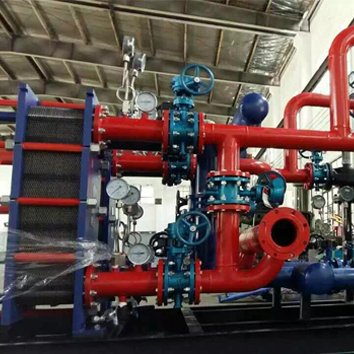
Step-by-step: How to clean a shell-and-tube exchanger online
Confirm the fouling type and location. Use temperature and pressure data to identify which side is fouled.
Isolate the fouled side using valves or blinds. Keep the other side in service if possible.
Connect cleaning equipment to the appropriate nozzles.
Circulate cleaning solution at the recommended concentration, temperature, and flow rate.
Monitor cleaning progress by measuring return solution color, pH, or conductivity.
Rinse thoroughly until the return solution is clean.
Return the exchanger to service and verify performance.
For reverse flow, simply switch the flow direction for a set period, then switch back.
Step-by-step: How to clean a plate heat exchanger online
Isolate the fouled side.
Connect a CIP skid to the inlet and outlet.
Circulate cleaning solution through the plate pack.
Soak if required for heavy organic fouling.
Rinse until clean.
Return to service.
Plate heat exchangers are well suited to CIP because of their narrow gaps and high turbulence. But heavily fouled plates may still need disassembly.
Safety precautions
Never exceed pressure or temperature ratings.
Use proper PPE for chemicals and hot surfaces.
Vent confined spaces before entry.
Follow lockout/tagout procedures.
Neutralize and dispose of cleaning waste properly.
Check material compatibility before using any chemical.
Limitations of online cleaning
Online cleaning is not a cure-all. It will not:
Remove hard scale that has already formed
Clean severely fouled exchangers
Replace the need for periodic offline inspection
Work with incompatible cleaning chemicals
Fix mechanical damage or corrosion
If fouling is severe, consider a spare exchanger or a redesign.
When to use a spare instead
If online cleaning cannot keep up with fouling, a standby or swing exchanger may be the better solution. A spare allows you to switch over and clean offline without stopping production. The choice depends on space, capital, and downtime cost.
FAQ
What is online cleaning of a heat exchanger?
Online cleaning removes fouling while the exchanger remains in service. Methods include CIP, reverse flow, chemical injection, and mechanical systems like brush balls or inserts.
Can I clean a heat exchanger without shutting down production?
Yes, if the exchanger is designed for online cleaning and the fouling is moderate. Severe fouling may still require a shutdown.
How often should I clean my heat exchanger online?
Based on fouling rate. Monitor pressure drop and temperature approach. Clean when performance drops below acceptable limits.
What is the best online cleaning method for cooling water?
Reverse flow, chemical injection, and brush ball systems are common. The best choice depends on fouling type and exchanger design.
Can I use CIP on a shell-and-tube heat exchanger?
Yes, if the materials are compatible and the unit has proper nozzles and drainage. CIP is more common on plate exchangers.
Does online cleaning increase pressure drop?
Some mechanical systems do. Chemical and reverse flow cleaning generally do not.
What chemicals are used for online cleaning?
Caustic, acid, chelants, dispersants, and biocides. The choice depends on the fouling type and material compatibility.