Pressure drop is the hidden tax on your heat exchanger. You pay for it every hour the pump or fan runs.
High ΔP means the pump works harder, flow drops, and energy bills climb. It can also force you to run more pumps in parallel, increase maintenance, and shorten equipment life. In some systems, high pressure drop is the limiting factor that prevents you from reaching design capacity.
This guide explains why heat exchanger pressure drop rises, how to diagnose it, and how to optimize it without sacrificing heat transfer.
Why Pressure Drop Matters
Pressure drop is the energy lost as fluid moves through the heat exchanger. That lost energy must be replaced by the pump or fan.
The relationship is simple:
Pump power ≈ (flow × pressure drop) / efficiency
If pressure drop doubles at the same flow, pump power roughly doubles. That is real money.
High ΔP also causes:
Lower flow rate through the unit
Poor temperature control
Higher pump maintenance
Cavitation risk
Uneven flow distribution
Increased fouling in low-flow zones
But pressure drop is not all bad. Higher velocity improves heat transfer and reduces fouling. The goal is not zero ΔP. The goal is the right ΔP for the duty—enough to keep surfaces clean and heat transfer high, but not more than necessary.
What Causes High Pressure Drop
Pressure drop comes from friction and flow disturbances. In heat exchangers, the main causes are:
1. Fouling and scaling
Deposits narrow the flow channels. Rough surfaces increase friction. A fouled heat exchanger can have two to three times the design pressure drop.
2. Low flow area
Small tubes, narrow plate gaps, or clogged passages. The smaller the flow area, the higher the velocity and the higher the ΔP.
3. High viscosity
Thick fluids resist flow. Cold oil, heavy chemicals, and slurries can have very high pressure drop. Viscosity drops as temperature rises, so cold startup is often the worst case.
4. Excessive velocity
High velocity increases heat transfer but pressure drop rises with the square of velocity. Doubling velocity can quadruple ΔP.
5. Flow path geometry
Sharp bends, sudden expansions, poorly designed inlet and outlet nozzles, and excessive baffles all add pressure loss.
6. Two-phase flow
Boiling or condensing fluids change volume dramatically. Vapor formation increases velocity and pressure drop. Poor distribution makes it worse.
7. Air or gas entrainment
Trapped air reduces effective flow area and creates erratic ΔP.
8. Mechanical damage
Bent tubes, deformed plates, or swollen gaskets can block flow.
How to Diagnose High Pressure Drop
You cannot optimize what you do not measure.
Start with these steps:
Measure actual ΔP
Install pressure gauges or differential pressure transmitters at inlet and outlet. Record at normal flow and temperature.
Compare to design
Check the datasheet. If actual ΔP is more than 20–30% above design, investigate.
Check flow rate
If flow is higher than design, ΔP will be higher. If flow is lower, something is restricting it.
Check temperatures
Cold fluid has higher viscosity and higher ΔP. Compare hot and cold conditions.
Inspect for fouling
Look at trends. A gradual increase in ΔP over weeks or months points to fouling. A sudden increase points to blockage or mechanical damage.
Calculate velocity
For shell and tube, check tube-side and shell-side velocity. For plate heat exchangers, check channel velocity. Compare to recommended ranges.
Check the whole system
Valves, strainers, and piping also create pressure drop. Isolate the heat exchanger to confirm it is the main source.
Design Optimization: Reduce ΔP at the Source
If you are selecting a new heat exchanger or replacing an existing one, design choices decide pressure drop.
1. Increase Flow Area
Larger tubes, wider plate gaps, and more parallel channels reduce velocity and pressure drop.
Shell and tube: Consider larger tube diameter (e.g., 25 mm instead of 19 mm) or more tubes.
Plate heat exchangers: Use wider gap plates or a larger model with more plates in parallel.
Air coolers: Increase fin spacing and face area to reduce air-side ΔP.
The trade-off is size and cost. A larger unit costs more, but the energy savings can pay it back quickly.
2. Reduce Velocity
Pressure drop scales with velocity squared. Small reductions in velocity can give large ΔP savings.
Increase the number of tube passes? Actually, more passes increase velocity. Fewer passes reduce velocity and ΔP.
For plate heat exchangers, use more passes in parallel instead of series.
For shell and tube, consider a single-pass design if thermal performance allows.
But do not go too low. Low velocity promotes fouling and poor heat transfer. Find the minimum velocity that keeps the surface clean.
3. Choose a Low-ΔP Heat Exchanger Type
Different heat exchangers have different pressure drop characteristics.
| Type | Typical ΔP | Best for |
|---|---|---|
| Shell and tube | Moderate to high | High pressure, high temperature |
| Plate and frame | Low to moderate | Clean fluids, close approach |
| Plate and shell | Low to moderate | High pressure, compact |
| Air cooler | High on air side | Where water is unavailable |
| Scraped surface | High | Viscous, fouling fluids |
If ΔP is critical, a plate heat exchanger often has lower pressure drop than a shell and tube for the same duty, because of its high efficiency and close approach. But narrow gaps can foul.
4. Optimize Baffles and Flow Distribution
In shell and tube exchangers, baffles direct flow but add pressure drop.
Reduce baffle count if thermal performance allows.
Use low-ΔP baffle designs (e.g., segmental with larger spacing).
Improve inlet and outlet nozzle design to avoid sudden expansion.
Use distributor plates for two-phase flow.
5. Improve Nozzle and Piping Design
Pressure drop often occurs at connections, not just inside the core.
Use full-size nozzles.
Avoid sharp elbows and reducers.
Keep piping short and straight where possible.
Use gradual expansions and contractions.
Operational Optimization: Reduce ΔP Without Replacing Equipment
If the heat exchanger is already installed, you can still reduce pressure drop.
1. Clean the Heat Exchanger
Fouling is the most common cause of high ΔP. Cleaning restores flow area and reduces friction.
Chemical cleaning for scale and organics.
Mechanical cleaning for hard deposits.
Online cleaning (sponge balls, reverse flow) to extend run time.
Improve filtration upstream to reduce solids.
After cleaning, measure ΔP again. If it drops significantly, fouling was the problem.
2. Reduce Flow Rate
If the process allows, lower the flow rate. Pump power drops, and ΔP falls.
Use variable frequency drives (VFDs) on pumps.
Check if the system can meet duty at lower flow.
Avoid reducing flow too much—low velocity causes fouling.
3. Raise Fluid Temperature
Higher temperature lowers viscosity. Lower viscosity means lower pressure drop.
Preheat viscous fluids before the heat exchanger.
Use waste heat or a small preheater.
Check that higher temperature does not cause fouling or product degradation.
4. Remove Air and Gas
Air pockets reduce flow area and increase ΔP.
Install air vents at high points.
Ensure proper priming and bleeding.
Check for dissolved gas release in hot fluids.
5. Balance Flow Distribution
In parallel heat exchangers or multi-channel units, uneven flow causes high ΔP in some paths.
Use balancing valves.
Check for blocked channels.
Improve inlet headers.
6. Optimize Controls
Avoid unnecessary bypasses.
Tune control valves to reduce throttling losses.
Check that the pump is not oversized for the duty.
Retrofit and Upgrade Options
If cleaning and operation are not enough, consider a retrofit.
Retube with larger tubes
Reduces tube-side velocity and ΔP. Check thermal performance.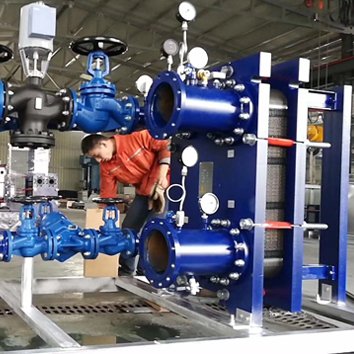
Replace plates with wider gap
For plate heat exchangers, wider gaps reduce ΔP but may reduce heat transfer. Balance with more plates.
Add a parallel heat exchanger
Splits flow, reduces velocity, and lowers ΔP. Good for capacity increase.
Install a low-ΔP bundle
Some manufacturers offer low-pressure-drop tube bundles with optimized baffles.
Switch to a different type
If ΔP is chronically high and energy costs are significant, replacing a shell and tube with a plate heat exchanger can cut ΔP and energy use.
Add online cleaning
Sponge ball or reverse flow systems keep tubes clean and maintain low ΔP.
Economic Analysis: When Does Optimization Pay?
Pressure drop reduction saves energy. Calculate the payback.
Pump power savings:
P (kW) = (Q (m³/s) × ΔP (kPa)) / efficiency
Example: 100 L/s (0.1 m³/s) at 200 kPa ΔP, 70% efficiency.
P = (0.1 × 200) / 0.7 = 28.6 kW
If you reduce ΔP by 30% (to 140 kPa):
P = (0.1 × 140) / 0.7 = 20 kW
Savings = 8.6 kW. At $0.10/kWh, that is $7,500 per year for continuous operation. A cleaning or retrofit that costs $15,000 pays back in two years.
Add reduced maintenance and longer run length, and the case gets stronger.
Common Pain Points and Fixes
High ΔP after cleaning
Check for remaining deposits, damaged tubes, or gasket protrusion. Verify flow rate and temperature.
Gradual ΔP increase
Fouling. Improve filtration, water treatment, or cleaning frequency.
Sudden ΔP increase
Blockage, broken part, or valve issue. Inspect immediately.
High ΔP at cold start
High viscosity. Preheat, use a bypass, or select a larger unit.
High ΔP only at high flow
Unit is undersized for the flow. Reduce flow, add parallel capacity, or replace.
High ΔP on air side
Fouled fins or poor airflow. Clean fins, check fan, and increase face area.
Erratic ΔP
Air entrainment, two-phase instability, or control valve hunting. Check vents and controls.
FAQ
What is a normal pressure drop for a heat exchanger?
It depends on the service. Shell and tube: 10–50 kPa (1.5–7 psi) per side is common. Plate heat exchangers: 20–100 kPa. Air coolers: 50–200 Pa air side. Always compare to design.
Does high pressure drop mean better heat transfer?
Not necessarily. Higher velocity improves heat transfer but increases ΔP. The goal is optimal, not maximum.
How does fouling affect pressure drop?
Fouling narrows flow channels and increases surface roughness. ΔP can double or triple. Cleaning restores it.
Can I reduce pressure drop by lowering flow?
Yes. ΔP drops with flow, roughly with the square. But low flow can cause fouling and poor distribution.
Is a plate heat exchanger lower ΔP than shell and tube?
Often yes, for the same duty, because it achieves high turbulence at lower velocity. But narrow gaps can foul and cause high ΔP if solids are present.
When should I replace a heat exchanger instead of cleaning?
If ΔP remains high after cleaning, if fouling is chronic, or if energy costs are high. A new design with larger flow area or a different type may pay back quickly.
Bottom Line
High heat exchanger pressure drop is an energy problem, a capacity problem, and a maintenance problem. It rarely fixes itself.
Measure ΔP. Compare to design. Find the cause: fouling, velocity, viscosity, or geometry. Clean first. Optimize flow and temperature. If ΔP is still too high, redesign with more flow area, lower velocity, or a different heat exchanger type.
The energy savings often justify the investment. And the production gains from stable flow and temperature are even bigger.
If you are dealing with high pressure drop in a heat exchanger, send your flow rate, fluid properties, inlet and outlet pressures, and current design. We will help you diagnose the cause and recommend a cost-effective optimization.