Choosing a heat exchanger from a catalog is not always enough.
For many projects, the real questions are more specific:
Will the heat exchanger achieve the required heat duty?
Is the pressure drop acceptable?
Is the material suitable for the fluid?
Will the unit fit the existing system?
Can the manufacturer customize the connections or dimensions?
Can the supplier provide reliable production and technical support?
A trade show provides an opportunity to discuss these questions directly with a heat exchanger manufacturer.
Instead of comparing product photos and quotations online, you can see the actual equipment, discuss your application with technical staff, review drawings and evaluate possible solutions face to face.
Why Visit a Heat Exchanger Manufacturer at a Trade Show?
A heat exchanger is a technical product.
Two units can look similar while having very different:
- Heat-transfer performance
- Pressure ratings
- Materials
- Flow-channel configurations
- Pressure drop
- Manufacturing quality
- Service life
- Application limitations
Meeting a manufacturer in person gives buyers a chance to ask technical questions before placing an order.
Industry-specific heat exchanger exhibitions are designed specifically to connect manufacturers, fabricators, EPC companies, end users and technical professionals.
For buyers with an active project, a trade show meeting can therefore be much more useful than a general sales presentation.
What Can You See at a Heat Exchanger Trade Show?
Depending on the manufacturer’s product range, you may be able to inspect different types of heat exchangers, including:
- Plate heat exchangers
- Brazed plate heat exchangers
- Gasketed plate heat exchangers
- Shell and tube heat exchangers
- Welded plate heat exchangers
- Plate-and-shell heat exchangers
- Air-cooled heat exchangers
- Oil coolers
- Industrial heat exchangers
- HVAC heat exchangers
- Refrigeration heat exchangers
- Custom heat exchangers
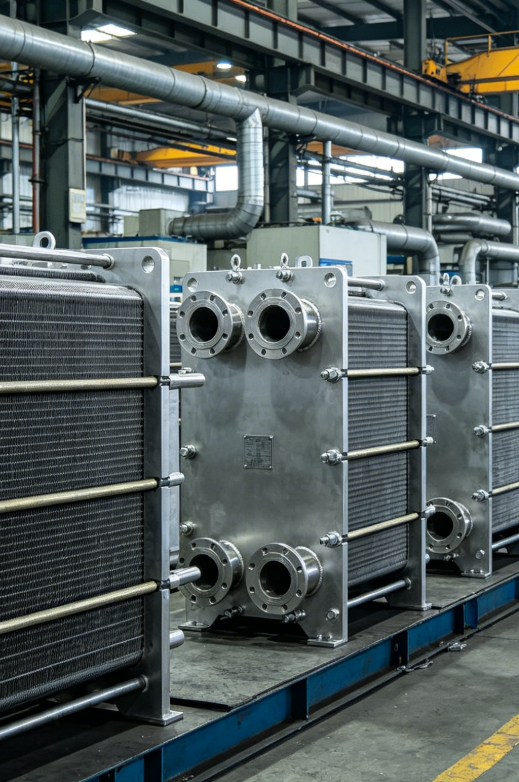
Seeing a physical product allows you to examine details that are difficult to judge from a website.
You can check:
- Overall construction
- Connections
- Frame design
- Plate or tube arrangement
- Welding quality
- Materials
- Nameplate
- Surface finish
- Mounting configuration
- Product dimensions
For custom projects, the physical product can also make technical discussions much easier.
Bring Your Heat Exchanger Project to the Booth
If you already have a project, do not visit the exhibition only to collect a catalog.
Bring the information that engineers actually need.
Thermal Data
- Required heat duty
- Hot-side inlet temperature
- Hot-side outlet temperature
- Cold-side inlet temperature
- Cold-side outlet temperature
Flow Data
- Hot-side flow rate
- Cold-side flow rate
- Minimum flow
- Maximum flow
Fluid Information
- Fluid type
- Concentration
- Density
- Viscosity
- Corrosive components
Pressure Requirements
- Operating pressure
- Design pressure
- Maximum allowable pressure drop
Mechanical Requirements
- Connection size
- Connection type
- Maximum dimensions
- Installation orientation
- Mounting requirements
The more complete the information, the more useful the technical discussion will be.
Bring Your Existing Heat Exchanger Drawing
If you are replacing an existing heat exchanger, bring:
- Original drawing
- CAD file
- Product datasheet
- Nameplate photo
- Product photos
- Connection dimensions
- Existing model number
- Operating data
If possible, bring the actual sample.
This allows the manufacturer to compare the existing unit with potential replacement products.
For replacement projects, dimensions alone are not enough.
The replacement heat exchanger should also be checked against:
- Heat duty
- Flow rate
- Pressure drop
- Operating pressure
- Operating temperature
- Fluid compatibility
- Connection arrangement
A physically similar heat exchanger is not necessarily a technically equivalent replacement.
Discuss Heat Exchanger Selection With an Engineer
One of the biggest advantages of meeting a manufacturer at a trade show is direct technical communication.
Instead of asking:
“Which model is cheapest?”
ask:
“Which heat exchanger configuration is suitable for this application?”
A technical discussion may cover:
Heat Transfer Area
Is the available heat-transfer area sufficient for the required duty?
Temperature Difference
Is the available temperature difference large enough for the required performance?
Flow Rate
Is the selected configuration suitable for the actual operating flow?
Pressure Drop
Can the required heat transfer be achieved without excessive pressure loss?
Materials
Are the plates, tubes, gaskets or other wetted components compatible with the fluid?
Fouling
Will the operating fluid create scaling or fouling problems?
Operating Conditions
Can the heat exchanger safely operate at the required pressure and temperature?
These questions can significantly affect the final product selection.
Discuss Custom Heat Exchanger Solutions
Not every application can use a standard catalog model.
You may need:
- Custom dimensions
- Special connections
- Different connection positions
- Special materials
- Higher pressure rating
- Higher temperature rating
- Special mounting brackets
- Multiple circuits
- Custom plate configurations
- Custom shell dimensions
- Special surface treatment
A face-to-face engineering meeting makes it easier to explain these requirements.
You can show the engineer your existing equipment and explain the limitations directly.
The manufacturer can then determine whether the requirement can be handled through:
Standard Product Selection
or
Custom Heat Exchanger Design
or
Engineering Modification
Discuss Heat Exchanger Replacement Projects
Replacement is a major reason buyers look for alternative heat exchanger suppliers.
A customer may currently use a particular brand but have problems with:
- High replacement cost
- Long lead time
- Limited local supply
- Obsolete models
- Expensive spare parts
- Poor technical support
- Repeated leakage
- Insufficient thermal performance
At the exhibition, bring the existing heat exchanger information and ask the manufacturer:
Can you provide a compatible replacement?
The manufacturer can then evaluate the existing unit instead of simply recommending a standard model.
Compare Materials for Your Application
Material selection can directly affect heat exchanger reliability.
Depending on the application, buyers may need to discuss:
- Stainless steel
- Titanium
- Nickel alloys
- Carbon steel
- Copper
- Aluminum
- Special alloys
The correct material depends on factors such as:
- Fluid chemistry
- Chloride concentration
- Temperature
- Pressure
- Corrosion conditions
- Required service life
Do not select materials based only on the lowest initial cost.
A cheaper material can become expensive if corrosion causes premature failure.
Discuss Energy Efficiency
Heat exchanger efficiency is closely related to operating cost.
At the trade show, ask the manufacturer how the proposed design affects:
- Heat-transfer performance
- Pumping power
- Pressure drop
- Heat-transfer area
- Approach temperature
- Operating temperature
- Fouling resistance
The objective is not simply to purchase a heat exchanger with the highest theoretical heat-transfer coefficient.
The objective is to find a design that provides the required thermal performance while keeping the overall system cost reasonable.
Discuss Pressure Drop Before Ordering
Pressure drop is often overlooked during product selection.
A heat exchanger may achieve the required heat duty but create excessive pressure loss.
That can increase pump or compressor energy consumption.
Ask the manufacturer to provide the expected pressure drop under your actual operating conditions.
Compare:
Required Heat Duty
with
Pressure Drop
rather than evaluating thermal performance alone.
For many industrial applications, the correct heat exchanger is the one that balances both.
Discuss Fouling and Cleaning Requirements
If the fluid contains:
- Suspended solids
- Minerals
- Oil
- Biological contaminants
- High concentrations of dissolved salts
fouling can reduce heat-transfer performance over time.
Discuss:
- Expected fouling tendency
- Channel velocity
- Cleaning method
- Cleaning frequency
- Chemical cleaning compatibility
- Mechanical cleaning requirements
- Maintenance access
A design that performs well when new may perform very differently after months of operation if fouling is not considered.
Discuss Cold-Weather and Freeze Protection
For outdoor installations or systems exposed to low temperatures, freezing can damage a heat exchanger.
Discuss whether the system requires:
- Glycol
- Drainage
- Insulation
- Heat tracing
- Automatic shutdown
- Low-temperature protection
- Freeze alarms
The correct protection method depends on the fluid and operating conditions.
This is particularly important for HVAC, refrigeration, heat pump and outdoor process applications.
 Discuss Manufacturing and Quality Control
 Discuss Manufacturing and Quality Control
A trade show meeting is also an opportunity to understand how the heat exchanger is manufactured.
Ask about:
- Raw material inspection
- Plate or tube forming
- Welding
- Brazing
- Assembly
- Pressure testing
- Leak testing
- Dimensional inspection
- Performance testing
- Final inspection
You can also ask what quality documents are available with production orders.
Depending on the product and project requirements, documentation may include:
- Material certificates
- Pressure-test reports
- Leak-test reports
- Inspection reports
- Performance test data
- Certificate of conformity
The exact requirements should be confirmed before ordering.
Ask About OEM and Custom Manufacturing
If you are a:
- Heat exchanger distributor
- HVAC equipment manufacturer
- Refrigeration company
- Heat pump manufacturer
- Industrial equipment manufacturer
- Engineering company
- System integrator
- Private-label brand
you may need more than a standard product.
Discuss:
- OEM manufacturing
- Private labeling
- Custom drawings
- Custom dimensions
- Custom connections
- Packaging
- Nameplates
- Product development
- Prototype production
- Mass production
A trade show is an efficient place to determine whether a manufacturer is capable of becoming a long-term OEM supplier.
Discuss Your Project Before Asking for a Price
A common mistake is to ask:
“What is your price for a heat exchanger?”
without providing operating conditions.
The manufacturer may then quote a generic product that does not match the actual application.
A better approach is:
Application → Operating Data → Technical Selection → Configuration → Quotation
This produces a more meaningful quotation.
For example, provide:
Heat duty: 500 kW
Fluid: Water / 30% glycol
Hot side: 80°C → 60°C
Cold side: 20°C → 50°C
Flow rate: XXX m³/h
Maximum pressure drop: XXX kPa
Operating pressure: XXX bar
The manufacturer can then evaluate an appropriate configuration.
 Book a One-to-One Meeting Before the Exhibition
 Book a One-to-One Meeting Before the Exhibition
If you have a serious project, do not wait until you arrive at the exhibition.
Contact the manufacturer before the event.
Send:
- Project description
- Technical specifications
- Drawings
- Photos
- Existing model number
- Estimated annual quantity
- Target application
The manufacturer can prepare before the meeting.
This can make a 20-minute booth discussion much more productive.
Business-matching programs at HVAC exhibitions increasingly use pre-registration and scheduled one-to-one meetings to connect buyers with exhibitors.
What Questions Should You Ask at the Booth?
Prepare a short list.
Product
Which heat exchanger type is suitable for my application?
Performance
What heat duty can this configuration achieve?
Pressure Drop
What is the expected pressure drop at my flow rate?
Materials
Are the wetted materials compatible with my fluid?
Design
Can the dimensions and connections be customized?
Testing
What tests are performed before shipment?
Certification
What certificates and documentation are available?
Production
What is the normal lead time?
OEM
Can you manufacture according to our drawings?
Replacement
Can you provide an alternative to our existing heat exchanger?
After-Sales
What spare parts and technical support are available?
These questions quickly reveal whether the supplier understands your application.
See the Product, Then Compare the Solution
A trade show should not become a competition for the largest number of brochures.
Use the opportunity to compare actual solutions.
Evaluate:
Technical suitability
Manufacturing capability
Product quality
Material selection
Energy performance
Delivery capability
Customization
After-sales support
Total cost
A lower initial price does not necessarily mean a lower total cost.
The correct heat exchanger should provide the required performance reliably over its expected service life.
From Trade Show Discussion to Engineering Proposal
After the meeting, a professional supplier should be able to move toward a defined technical proposal.
A typical process is:
Project Discussion
↓
Technical Data Collection
↓
Heat Exchanger Selection
↓
Thermal Calculation
↓
Pressure-Drop Check
↓
Material Confirmation
↓
Drawing
↓
Quotation
↓
Sample / Prototype if Required
↓
Production
This turns a trade show conversation into a real engineering project.
What Buyers Should Bring to the Exhibition
Before visiting the booth, prepare:
☐ Existing heat exchanger photos
☐ Nameplate photo
☐ Product drawing
☐ CAD file
☐ Heat duty
☐ Flow rate
☐ Inlet temperature
☐ Outlet temperature
☐ Fluid information
☐ Operating pressure
☐ Allowable pressure drop
☐ Material requirements
☐ Connection dimensions
☐ Installation limitations
☐ Annual demand
☐ Target delivery time
With this information, the manufacturer can focus on your actual project rather than giving you a general product introduction.
Why Meet a Heat Exchanger Manufacturer in Person?
Online communication is convenient.
But complex engineering projects often require discussion.
At a trade show, you can:
See the physical product
Compare different designs
Ask technical questions
Show your existing equipment
Discuss drawings
Evaluate materials
Discuss customization
Review manufacturing capability
Discuss delivery
Discuss OEM cooperation
Request a project quotation
Most importantly, you can determine whether the supplier understands your problem.
Turn Your Exhibition Visit Into a Real Project
If you are currently:
- Selecting a new heat exchanger
- Replacing an existing unit
- Reducing energy consumption
- Solving excessive pressure drop
- Dealing with repeated leakage
- Experiencing fouling
- Developing new equipment
- Looking for an OEM manufacturer
- Searching for a regional supplier
bring the project to the exhibition.
Do not simply ask for a catalog.
Bring the problem.
Bring the drawings.
Bring the operating data.
Bring the existing heat exchanger if possible.
Then discuss the solution directly with the manufacturer.
Meet Us at the Heat Exchanger Trade Show
We welcome HVAC contractors, refrigeration companies, industrial equipment manufacturers, EPC companies, system integrators, distributors and end users to visit our booth.
You can:
See our heat exchanger samples
Discuss your application
Review technical drawings
Compare heat exchanger configurations
Discuss materials
Evaluate custom designs
Discuss OEM manufacturing
Request a technical quotation
Discuss long-term supply
If you already have a project, send your technical information before the exhibition so our engineering team can prepare for the discussion.
Schedule a Meeting With Our Heat Exchanger Team
To make the meeting more efficient, please provide:
Heat duty + Fluid + Flow rate + Inlet/outlet temperatures + Operating pressure + Allowable pressure drop + Material requirements + Drawing or existing heat exchanger model
We can review the information before the meeting and focus on the most suitable heat exchanger solution when you visit our booth.
Come to the exhibition, see the product, bring your application and talk directly with the people who can solve it.