Vibration and noise in heat exchangers are not just annoyances. They cause tube fatigue, cracked welds, gasket leaks, and eventually catastrophic failure. In severe cases, acoustic noise exceeds occupational limits and triggers complaints from nearby communities.
Most vibration problems trace back to flow-induced excitation. Fixing them requires understanding the mechanism, not just adding supports or insulation. This guide covers how to diagnose and reduce vibration and noise in shell-and-tube and plate heat exchangers.
What causes heat exchanger vibration
Flow across tubes and through shells creates several excitation mechanisms:
Vortex shedding — alternating vortices form behind tubes, creating periodic forces. If the shedding frequency matches a tube natural frequency, resonance occurs.
Turbulent buffeting — random pressure fluctuations from high-velocity flow cause small-amplitude vibration.
Fluid-elastic instability — the most destructive. Above a critical velocity, tube motion couples with flow and grows rapidly, leading to failure in hours or days.
Acoustic resonance — standing waves form in the shell, producing loud noise and high-cycle fatigue.
Mechanical sources — pump pulsation, compressor surges, misalignment, or loose supports.
Two-phase flow (condensers, reboilers) is especially prone to vibration because of slugging and flow regime changes.
Symptoms and risks
Watch for these signs:
Audible humming, whistling, or pounding
Visible tube movement in the bundle
Cracked tubes at tubesheet or support plates
Worn baffles or support plates
Fretting marks on tubes
Gasket leaks at flanges
Unexplained pressure drop increase
If left unchecked, vibration leads to tube rupture, cross-contamination, and unplanned shutdowns.
How to diagnose vibration
Start with operating data:
Flow rates and velocities on both sides
Fluid densities and phase state
Shell diameter, tube pitch, and baffle spacing
Tube natural frequencies (calculated per TEMA or HTRI methods)
Acoustic resonance frequencies
Then measure:
Vibration analysis — accelerometers on shell and piping to identify dominant frequencies
Acoustic measurement — sound pressure levels and frequency spectra
CFD — for complex geometries or two-phase flow
Eddy current testing — to detect tube wall thinning from fretting
A specialist can compare measured frequencies to calculated natural frequencies and identify the excitation mechanism.
Mitigation strategies for shell-and-tube exchangers
Design changes
Reduce baffle spacing — shortens unsupported tube spans, raises natural frequency.
Use “no tubes in window” layout — eliminates the most vibration-prone tubes.
Increase tube wall thickness — raises stiffness and natural frequency.
Change tube pitch — larger pitch reduces velocity between tubes.
Add intermediate supports — support plates or rod baffles reduce span.
Use U-tube or floating head — allows thermal expansion and can reduce shell-side velocity.
Detune acoustic resonance — change shell diameter, add acoustic baffles, or alter baffle cut.
Operational changes
Lower flow rate or velocity where possible.
Reduce pump pulsation with dampeners or variable frequency drives.
Avoid operating at resonant flow rates.
Balance flow across parallel units.
Noise reduction
Insulation and lagging — reduces radiated noise but not vibration.
Acoustic enclosures — effective but costly and can hinder maintenance.
Silencers — for piping noise.
Baffles and absorptive panels — inside enclosures or nearby.
Note: noise reduction does not fix vibration. Address the root cause first.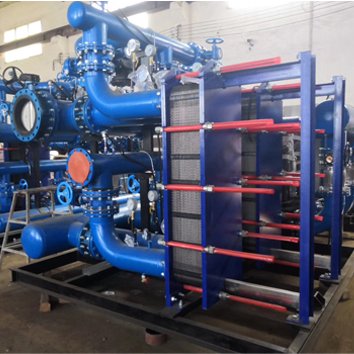
Mitigation strategies for plate heat exchangers
Plate heat exchangers are less prone to flow-induced vibration because of their compact, supported plate pack. But noise can still occur:
High velocity in ports or channels causes whistling.
Cavitation from low pressure or high temperature.
Pump pulsation transmitted through piping.
Solutions:
Reduce flow velocity.
Increase port sizes.
Use thicker plates or reinforced gaskets.
Install pulsation dampeners.
Support piping independently.
Design guidelines to prevent vibration
Follow these best practices:
Keep shell-side cross-flow velocity below critical thresholds (typically 0.5–1.5 m/s for liquids, lower for gases).
Use TEMA or HTRI vibration analysis during design.
Avoid baffle spacing greater than 0.3–0.5 times shell diameter.
Use support plates at calculated intervals.
Specify tube natural frequencies at least 20% away from excitation frequencies.
For two-phase flow, use flow regime maps to avoid slugging.
Consider rod baffles or helical baffles for high-velocity gas service.
When to call a specialist
If you experience any of the following, get expert help:
Repeated tube failures at supports or tubesheet
Acoustic noise above 85 dBA
Vibration that persists after operational changes
Suspected fluid-elastic instability
Two-phase flow with unstable behavior
A specialist can perform vibration analysis, recommend design modifications, or supply a replacement exchanger designed for the duty.
Case example: Condenser tube failure
A power plant condenser with 20,000 tubes developed leaks after 18 months. Vibration analysis showed fluid-elastic instability in the outer tube rows. The fix: install “no tubes in window” baffles, reduce baffle spacing by 30%, and add support plates. Tube failures stopped, and the unit ran for 10+ years without further issues.
FAQ
What causes heat exchanger vibration?
Flow-induced excitation: vortex shedding, turbulent buffeting, fluid-elastic instability, and acoustic resonance. Mechanical sources like pump pulsation can also contribute.
How do I reduce heat exchanger noise?
First fix vibration at the source. Then add insulation, acoustic enclosures, or silencers. Noise reduction alone does not prevent tube fatigue.
What is fluid-elastic instability?
A self-excited vibration where tube motion couples with flow. It grows rapidly and destroys tubes in a short time. It is the most dangerous vibration mechanism.
Can I stop vibration by reducing flow rate?
Sometimes. Lower velocity reduces excitation. But if the root cause is acoustic resonance or mechanical, flow reduction may not help.
What is the maximum allowable noise level for a heat exchanger?
Typically 85 dBA at 1 meter for occupational safety. Community noise limits are often lower (55–65 dBA at property line).
How do I prevent tube vibration in a shell-and-tube exchanger?
Use proper baffle spacing, support plates, no-tubes-in-window layout, and vibration analysis during design. Avoid high cross-flow velocities.
Do plate heat exchangers vibrate?
Less than shell-and-tube, but they can generate noise from high velocity or cavitation. Reduce velocity and support piping.