If you have ever wondered how a heat exchanger transfers heat between two fluids without letting them mix, you are asking the right question — and the answer explains why indirect heat exchangers are the backbone of power plants, chemical processing, HVAC systems, food production, and oil & gas operations worldwide.
In most industrial processes, mixing hot and cold fluids is not an option. Contamination, corrosion, pressure differences, and product purity all demand a physical barrier between the two streams. This is exactly what an indirect (recuperative) heat exchanger does: it transfers thermal energy through a solid wall, keeping the fluids completely separated.
The Working Principle: Conduction Through a Barrier
At its core, indirect heat exchange is simple physics — heat always flows from a hotter medium to a colder one, and it never needs the two media to touch.
Here is what happens inside the unit, step by step:
1. The hot fluid enters one side of the exchanger (for example, the tubes of a shell-and-tube unit or the channels of a plate heat exchanger).
2. Heat conducts through the metal wall — usually stainless steel, carbon steel, titanium, or nickel alloys — separating the two streams.
3. The cold fluid absorbs the heat on the other side of the wall as it flows through its own passage.
4. Both fluids exit at nearly equal mass flow rates, now closer in temperature, but chemically and physically isolated from each other.
No fluid crosses the barrier. The only thing that “moves” is thermal energy. This is why engineers searching for how heat is transferred between two fluids without direct contact almost always land on the concept of indirect heat exchange.
The Fundamental Equation Behind It
The rate of heat transfer in any recuperative exchanger is described by:
Q = U × A × ΔTlm
Where:
• Q = heat duty (kW or BTU/hr)
• U = overall heat transfer coefficient (how efficiently the wall and films transfer heat)
• A = heat transfer surface area
• ΔTlm = log mean temperature difference (the average driving force between the two fluids)
This single equation drives every heat exchanger sizing and selection calculation. If your process needs more heat recovery but the exchanger falls short, engineers look at three levers: increase surface area (A), improve the U-value (better turbulence, cleaner surfaces, higher-conductivity materials), or increase the temperature approach (ΔT).
Main Types of Indirect Heat Exchangers
Not every application suits the same design. Choosing the right type is usually the first real engineering decision — and a common reason buyers search for which type of heat exchanger is best for my application.
1. Shell and Tube Heat Exchangers
The workhorse of heavy industry. One fluid flows inside the tubes; the other flows around them inside the shell. They handle high pressures (up to 400+ bar), high temperatures, and aggressive media.
Typical searches: shell and tube heat exchanger working principle, when to use shell and tube vs plate heat exchanger
Best for: power plants, oil & gas, refinery services, steam condensing, high-pressure duties.
2. Gasketed Plate Heat Exchangers (PHE)
A stack of corrugated plates clamped together, creating thin channels for each fluid. The turbulence created by the plate pattern delivers very high U-values — often 3–5× higher than shell-and-tube in liquid-to-liquid service — in a footprint roughly one-fifth the size.
Typical searches: how does a plate heat exchanger work, plate heat exchanger vs shell and tube efficiency
Best for: HVAC, food & beverage, district heating, cooling water loops, marine applications.
3. Brazed and Welded Plate Heat Exchangers
For applications where gaskets are not acceptable — ammonia refrigeration, aggressive chemicals, high temperatures — plates are brazed (copper or nickel) or laser-welded into cassettes. Compact and leak-free on the fluid side.
Best for: refrigeration, heat pumps, oil cooling, chemical duties.
4. Finned Tube / Air-Cooled Exchangers
When one fluid is a gas (especially air), heat transfer coefficients are naturally low. Extended surfaces — fins — multiply the effective area on the gas side. Air-cooled exchangers eliminate cooling water entirely, which matters more every year as water costs and regulations rise in Europe and North America.
Typical searches: how air cooled heat exchanger works, finned tube heat exchanger heat transfer
Why Keep Fluids Separate? Real Reasons From Real Plants
Understanding the “why” behind indirect design helps you spec the right unit. In practice, customers come to us with four recurring motivations:
Product purity and contamination control. In food, dairy, and pharmaceutical processing, even trace cross-contamination is a batch loss — or a regulatory failure. A physical barrier is non-negotiable.
Pressure and chemistry incompatibility. Boiler feedwater at 120 bar cannot safely share a passage with low-pressure condensate. Different alloys protect each stream from its own corrosion environment.
Leak detection and safety. A double-tube-sheet or double-wall design lets you detect a leak before fluids mix — critical for hazardous services like hydrocarbons or ammonia.
Maintenance isolation. When one side fouls, you can clean or isolate it without shutting down the process stream on the other side.
Common Problems and How to Solve Them
Search data shows engineers and buyers frequently look up symptoms, not products. These are the pain points that drive qualified leads in the heat exchanger industry:
Fouling: The Silent Capacity Killer
Over time, scale, sludge, and biological growth coat the heat transfer surfaces, adding a thermal resistance layer that throttles performance. Symptoms: the outlet temperature drifts away from design, pressure drop climbs.
Solutions:
• Choose the right plate pattern or tube geometry for your fluid (high-shear designs reduce fouling)
• Specify CIP (clean-in-place) connections for plate units
• Schedule mechanical cleaning (bristle blasting, hydro-jetting for tubes)
• Size with a realistic fouling factor — not zero
Thermal Stress and Fatigue
Rapid temperature swings cause differential expansion between tubes, tubesheets, and shells, leading to tube-to-tubesheet joint failure.
Solutions: specify expansion bellows on the shell, choose U-tube designs for large temperature differences, and control startup ramp rates.
Insufficient Heat Recovery (Low Approach Temperature)
If your exchanger leaves a large temperature gap between hot outlet and cold outlet, you are wasting energy — often 5–15% of total plant fuel in steam systems.
Solutions: plate heat exchangers achieve temperature approaches as low as 1–2°C; consider adding surface area or switching technology rather than accepting the loss.
Leakage at Gaskets or Tubesheets
Age, vibration, and wrong gasket material are the usual culprits.
Solutions: match gasket elastomer to the actual fluid chemistry (NBR for oils, EPDM for water/steam, FKM for aggressive chemicals) and inspect tubesheet joints during every turnaround.
How to Select the Right Indirect Heat Exchanger: A Buyer’s Checklist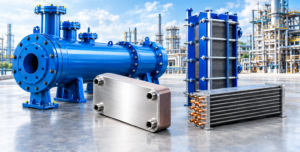
When engineers search how to size a heat exchanger or heat exchanger selection guide, they need answers to these questions before requesting a quote:
1. What are the two fluids? (incl. corrosiveness, viscosity, solids content)
2. Flow rates and inlet/outlet temperatures on both sides
3. Operating pressure and design pressure for each stream
4. Allowable pressure drop — often the forgotten constraint
5. Fouling characteristics of each fluid
6. Space, weight, and maintenance access limits
7. Material requirements — 304/316L stainless, titanium, duplex, nickel alloys
8. Codes and standards — ASME VIII Div.1, PED (2014/68/EU), TEMA class
A supplier who asks you these eight questions before quoting is a supplier who will deliver a unit that actually performs at design conditions — not one that works on paper.
Frequently Asked Questions
How does heat pass through the wall without the fluids mixing?
Heat moves by conduction through the metal. The wall is thin (0.4–1.5 mm in plates, 1–3 mm in tubes) and metal conducts heat well, so thermal energy crosses efficiently while the fluids remain fully isolated.
What is the difference between a direct and indirect heat exchanger?
A direct (contact) exchanger mixes the two streams — common in cooling towers and some scrubbers. An indirect exchanger keeps them separated by a solid wall, which is required whenever contamination, pressure difference, or purity matters.
Can an indirect heat exchanger recover heat from exhaust gas?
Yes — finned tube or plate-fin recuperators recover waste heat from flue gas, drying ovens, and engine exhaust, preheating combustion air or process fluids. Typical fuel savings run 10–30%.
Which is more efficient: plate or shell and tube?
For liquid-to-liquid duties, plate heat exchangers are typically 2–5× more compact with higher U-values and closer temperature approaches. Shell and tube wins for high pressure, high temperature, dirty fluids, and gas services.