Industrial chiller selection should start with the actual cooling load, required supply and return temperatures, flow rate, operating conditions, and heat-transfer fluid—not simply the nominal refrigeration capacity. A properly selected chiller must provide enough cooling under the worst expected operating condition while maintaining acceptable pressure drop, energy consumption, reliability, and maintenance cost.
This guide explains how to select an industrial chiller step by step, including cooling-load calculation, evaporator and condenser selection, plate heat exchanger versus shell-and-tube options, flow rate, temperature approach, materials, fouling, pressure drop, cost, lead time, and replacement considerations.
Table of Contents
- Quick Answer: How Do You Select an Industrial Chiller?
- What Is an Industrial Chiller and How Does It Work?
- How Do You Calculate Industrial Chiller Capacity?
- How Do You Select the Chiller Heat Exchanger?
- How Do Flow Rate, Temperature Approach, and Pressure Drop Affect Selection?
- How Do You Select Materials and Control Fouling?
- Step-by-Step Industrial Chiller Selection Guide
- How Much Does an Industrial Chiller Cost?
- What Are the Common Industrial Chiller Problems and Maintenance Requirements?
- Industrial Chiller Selection Checklist
- Common Mistakes
- FAQ
- Key Takeaways
Quick Answer: How Do You Select an Industrial Chiller?
The correct industrial chiller is selected by matching the required cooling load, fluid flow rate, supply and return temperatures, ambient or cooling-water conditions, pressure drop, heat exchanger type, materials, operating range, and required control accuracy.
For most projects, the basic selection sequence is:
Cooling load → temperatures → flow rate → heat exchanger → refrigeration system → pressure drop → materials → controls → maintenance → total cost.
Industrial Chiller Selection Parameters at a Glance
| Parameter | Typical Selection Question | Why It Matters |
|---|---|---|
| Cooling capacity | How many kW or tons of cooling are required? | Determines chiller size |
| Fluid | Water, glycol, oil, process liquid? | Determines heat transfer and materials |
| Supply temperature | What temperature must the chiller deliver? | Determines evaporating conditions |
| Return temperature | What temperature enters the chiller? | Determines cooling load |
| Flow rate | How much fluid circulates per hour? | Determines heat-transfer requirement |
| Temperature approach | How close must refrigerant and fluid temperatures be? | Affects heat exchanger size |
| Pressure drop | What pressure loss is acceptable? | Affects pump power and process performance |
| Fouling | Does the fluid contain particles, oil, minerals, or chemicals? | Determines heat exchanger design and maintenance |
| Ambient condition | What is the maximum outdoor temperature? | Affects condenser performance |
| Material | Carbon steel, stainless steel, copper alloy, titanium? | Determines corrosion resistance |
| Operating hours | Continuous or intermittent? | Affects efficiency and lifecycle cost |
| Control accuracy | ±0.5°C, ±1°C, or another requirement? | Determines control system design |
What Is an Industrial Chiller and How Does It Work?
An industrial chiller removes heat from process fluid and rejects that heat to air, cooling water, or another heat sink through a refrigeration cycle.
Unlike comfort air-conditioning equipment, industrial chillers are normally selected around a specific process requirement. The cooling load may vary considerably, and the process fluid may be water, glycol solution, oil, chemicals, or another heat-transfer medium.
How Does an Industrial Chiller Work?
A typical vapor-compression industrial chiller contains:
- Compressor
- Condenser
- Expansion device
- Evaporator
- Refrigerant circuit
- Process-fluid circulation system
- Control and protection system
The basic refrigeration cycle is:
Evaporation → Compression → Condensation → Expansion → Evaporation
The evaporator transfers heat from the process fluid to the refrigerant. The condenser then rejects the absorbed heat to ambient air or cooling water.
What Is the Role of the Heat Exchanger?
The heat exchanger is one of the most important components in an industrial chiller because it directly determines how efficiently heat moves between the refrigerant and process fluid.
Common heat exchanger configurations include:
- Brazed plate heat exchanger
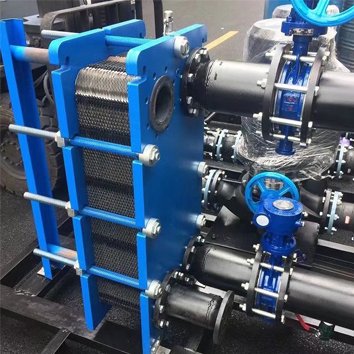
- Gasketed plate heat exchanger
- Welded plate heat exchanger
- Shell-and-tube heat exchanger
- Tube-in-tube heat exchanger
- Custom OEM heat exchanger assemblies
The correct type depends on capacity, fluid cleanliness, pressure, temperature, corrosion, maintenance requirements, and required flexibility.
How Do You Calculate Industrial Chiller Capacity?
Industrial chiller capacity is normally calculated from the fluid flow rate, specific heat, and required temperature difference.
For water or another sensible-cooling liquid:
[
Q = \dot{m} \times C_p \times \Delta T
]
Where:
- Q = cooling capacity, kW
- ṁ = mass flow rate, kg/s
- Cp = specific heat capacity, kJ/kg·K
- ΔT = temperature difference, °C or K
For water, a practical calculation is:
[
Q(kW) \approx 1.163 \times Flow(m^3/h) \times \Delta T(°C)
]
Example: Industrial Chiller Sizing
Suppose a process requires:
- Flow rate: 20 m³/h
- Inlet temperature: 25°C
- Required outlet temperature: 15°C
- Temperature difference: 10°C
Then:
[
Q = 1.163 \times 20 \times 10
]
[
Q \approx 232.6,kW
]
The theoretical cooling load is approximately 233 kW.
The final chiller should not necessarily be selected at exactly 233 kW. A reasonable design margin may be required depending on load uncertainty, ambient conditions, operating fluctuations, startup requirements, and future capacity.
How Much Safety Margin Should Be Used?
A fixed margin should not be applied blindly.
A small, predictable process may require only a modest design margin, while a process with highly variable loads may require more capacity.
Oversizing also creates problems:
- Higher initial cost
- Lower part-load efficiency
- More frequent compressor cycling
- Poor temperature control in some systems
- Larger pumps and heat exchangers than necessary
The objective is adequate capacity under the design condition, not maximum possible capacity.
Cooling Load Calculation for Glycol
For glycol-water mixtures, do not use the water coefficient directly.
The calculation should account for:
- Density
- Specific heat
- Viscosity
- Concentration
- Operating temperature
Higher glycol concentration normally reduces specific heat and increases viscosity. This can increase both required flow rate and pressure drop.
How Do You Select the Chiller Heat Exchanger?
Heat exchanger selection should consider heat-transfer performance, pressure drop, fluid cleanliness, operating pressure, temperature approach, materials, maintenance, and lifecycle cost.
Plate Heat Exchanger vs Shell-and-Tube
| Factor | Plate Heat Exchanger | Shell-and-Tube Heat Exchanger |
|---|---|---|
| Heat-transfer efficiency | Generally high | Moderate to high |
| Compactness | Excellent | Larger footprint |
| Approach temperature | Can be relatively close | Usually requires more area for the same approach |
| Pressure drop | Can be designed low to moderate | Often suitable for moderate pressure drop |
| Cleaning | Gasketed type can be opened | Tube-side cleaning is established |
| Dirty fluid | Requires suitable channel design | Often more tolerant |
| High pressure | Depends on construction | Often suitable |
| Thermal expansion | Good flexibility | Well established |
| Footprint | Small | Larger |
| OEM customization | High | High |
| Typical application | Water/glycol/process cooling | Large industrial or demanding process duties |
When Is a Plate Heat Exchanger Better?
A plate heat exchanger is often attractive when:
- Space is limited
- High heat-transfer efficiency is required
- A compact design is preferred
- The fluid is relatively clean
- Close temperature approach is important
- Easy expansion or plate-area adjustment is valuable
Gasketed plate heat exchangers can also be opened for inspection and cleaning.
When Is Shell-and-Tube Better?
Shell-and-tube construction may be preferred when:
- The process fluid is dirty
- High pressure is required
- High temperature is involved
- Mechanical robustness is a priority
- Tube-side cleaning is important
- The application involves large industrial equipment
The selection should be based on the actual process rather than assuming one heat exchanger type is universally better.
What About Brazed Plate Heat Exchangers?
Brazed plate heat exchangers are widely used where a compact, sealed heat exchanger is required.
Advantages include:
- Compact size
- Low internal volume
- High heat-transfer coefficient
- No external gasket
- Suitable for many refrigeration applications
However, brazed units are less convenient to open for mechanical cleaning. If the process fluid has a high fouling tendency, this limitation should be considered before selection.
How Do Flow Rate, Temperature Approach, and Pressure Drop Affect Selection?
Flow rate, temperature approach, and pressure drop directly affect heat exchanger size, pump power, system efficiency, and operating stability.
Why Is Temperature Approach Important?
The temperature approach is the temperature difference between the two heat-transfer streams at a selected point in the heat exchanger.
A smaller approach generally means:
- Larger heat-transfer area
- Higher heat exchanger cost
- Potentially better temperature recovery
- More demanding design
A larger approach can reduce equipment size and cost but may require different refrigeration operating conditions.
Heat exchanger sizing commonly uses:
[
Q = U A \Delta T_{lm}
]
Where:
- Q = heat-transfer rate
- U = overall heat-transfer coefficient
- A = heat-transfer area
- ΔTlm = logarithmic mean temperature difference
Therefore, reducing the temperature approach generally increases the required heat-transfer area.
Why Does Pressure Drop Matter?
A heat exchanger must transfer enough heat without creating excessive pressure loss.
High pressure drop can result in:
- Higher pump power
- Lower process flow
- Reduced system efficiency
- Unstable process operation
- Increased operating cost
For example, a heat exchanger may provide excellent thermal performance but still be unsuitable if its pressure drop exceeds the available pump head.
Heat Exchanger Selection Trade-Off
| Design Priority | Typical Effect |
|---|---|
| Smaller temperature approach | Larger heat-transfer area |
| Higher flow velocity | Better heat transfer but higher pressure drop |
| Lower pressure drop | Larger channels or more heat-transfer area |
| Smaller heat exchanger | Higher velocity or larger temperature difference may be required |
| More fouling allowance | Larger area and potentially higher cost |
| Higher efficiency | Usually higher initial engineering/equipment cost |
| Lower initial cost | May increase energy or maintenance cost |
The correct design balances thermal performance, hydraulic performance, capital cost, and operating cost.
How Do You Select Materials and Control Fouling?
Material selection should be based on fluid chemistry, temperature, pressure, corrosion risk, water quality, and cleaning method rather than temperature alone.
Common Heat Exchanger Materials
| Material | Typical Consideration |
|---|---|
| Stainless steel | Good general corrosion resistance |
| 316L stainless steel | Common choice for many water and chemical services |
| Titanium | Useful for demanding chloride or seawater environments |
| Copper alloys | Good thermal conductivity but compatibility must be checked |
| Carbon steel | Economical where corrosion conditions permit |
| Nickel-based alloys | Used for more aggressive chemical conditions |
| Special coatings | May be considered for specific corrosion environments |
Material selection must be confirmed against the actual process fluid.
Important factors include:
- Chloride concentration
- pH
- Dissolved oxygen
- Sulfur compounds
- Chemical additives
- Seawater exposure
- Operating temperature
- Cleaning chemicals
- Pressure
- Thermal cycling
What Causes Fouling in Industrial Chillers?
Common fouling sources include:
- Suspended solids
- Scale-forming minerals
- Biological growth
- Oil contamination
- Corrosion products
- Process residues
- Poorly treated cooling water
Fouling adds thermal resistance:
\frac{1}{h_1}
+
R_{f1}
+
R_{wall}
+
R_{f2}
+
\frac{1}{h_2}
]
As fouling resistance increases, overall heat-transfer performance decreases.
How Can Fouling Be Reduced?
Practical measures include:
- Proper water treatment
- Filtration
- Adequate flow velocity
- Correct material selection
- Appropriate channel geometry
- Regular inspection
- Planned cleaning
- Monitoring of approach temperature and pressure drop
A larger heat exchanger can provide additional fouling allowance, but oversizing is not a substitute for proper water treatment.
Step-by-Step Industrial Chiller Selection Guide
A reliable industrial chiller selection process starts with process data and ends with thermal, hydraulic, mechanical, and economic verification.
Step 1: Define the Process Fluid
Record:
- Fluid name
- Concentration
- Density
- Specific heat
- Viscosity
- Corrosiveness
- Suspended solids
- Fouling tendency
- Required cleanliness
Step 2: Define Supply and Return Temperatures
Determine:
- Process inlet temperature
- Required outlet temperature
- Minimum and maximum temperatures
- Normal operating temperature
- Startup conditions
For example:
25°C return → 15°C supply
is much more useful for selection than simply stating “10°C chilled water.”
Step 3: Determine the Required Flow Rate
Record:
- Normal flow
- Minimum flow
- Maximum flow
- Continuous or intermittent operation
- Available pump head
If flow varies significantly, the chiller and heat exchanger should be checked at the complete operating range.
Step 4: Calculate the Cooling Load
Use:
[
Q = \dot{m} C_p \Delta T
]
Then add only an appropriate engineering margin based on the uncertainty of the application.
Step 5: Define the Heat Rejection Condition
For an air-cooled chiller, determine:
- Minimum ambient temperature
- Normal ambient temperature
- Maximum ambient temperature
- Installation altitude
- Ventilation conditions
For a water-cooled chiller, determine:
- Cooling-water inlet temperature
- Cooling-water outlet temperature
- Cooling-water flow
- Fouling conditions
- Cooling tower or cooling-water system limitations
Step 6: Select the Heat Exchanger
Compare:
- Plate heat exchanger
- Brazed plate heat exchanger
- Gasketed plate heat exchanger
- Welded plate heat exchanger
- Shell-and-tube
- Custom OEM design
Check both thermal capacity and pressure drop.
Step 7: Check Refrigeration Operating Conditions
The refrigeration system should be checked for:
- Evaporating temperature
- Condensing temperature
- Refrigerant selection
- Compressor operating range
- Part-load operation
- Control requirements
Step 8: Verify Pressure Drop
Check pressure drop on:
- Process-fluid side
- Refrigerant side
- Condenser side
- Piping
- Filters
- Valves
The total system pressure drop must remain compatible with the pump and process.
Step 9: Verify Materials
Confirm:
- Heat exchanger plates or tubes
- Gaskets
- Brazing materials
- Piping
- Valves
- Seals
- Pump wetted parts
Material compatibility should be reviewed against the actual fluid and cleaning chemicals.
Step 10: Evaluate Maintenance
Determine:
- Cleaning method
- Inspection frequency
- Spare parts
- Gasket replacement
- Tube inspection
- Filter maintenance
- Refrigerant service access
Step 11: Compare Total Cost
Do not compare only the purchase price.
Consider:
Initial equipment cost + installation + electricity + water treatment + maintenance + spare parts + downtime.
Step 12: Verify Documentation and Compliance
Depending on destination and application, documentation may include:
- Technical datasheet
- General arrangement drawing
- Performance calculation
- Pressure test documentation
- Material documentation
- Electrical documentation
- Operating and maintenance manual
- Applicable conformity documentation
- Inspection records where required
The exact certification and documentation package depends on the equipment design, destination, pressure classification, refrigerant, and applicable regulations.
How Much Does an Industrial Chiller Cost?
Industrial chiller cost depends primarily on cooling capacity, temperature requirements, heat exchanger design, compressor configuration, materials, controls, certification, and customization.
Main Industrial Chiller Cost Factors
| Cost Factor | Effect on Cost |
|---|---|
| Cooling capacity | Larger capacity generally increases equipment cost |
| Low leaving-water temperature | May require more demanding refrigeration design |
| Temperature approach | Smaller approach can increase heat exchanger size |
| Heat exchanger type | Brazed, gasketed, welded, and shell-and-tube designs have different costs |
| Stainless steel or titanium | Can significantly increase material cost |
| High pressure | Requires stronger components and testing |
| Corrosive fluid | May require premium materials |
| Fouling allowance | Can increase heat-transfer area |
| Controls | Advanced monitoring and control increase system cost |
| Custom OEM design | Engineering and validation increase project cost |
| Certification | Testing, documentation, and inspection can add cost |
| Packaging | Export packaging and special transport requirements affect landed cost |
What About Lead Time?
Typical lead time depends on whether the chiller is:
- Standard or customized
- Stocked or built to order
- Using standard or special heat exchangers
- Using standard or special materials
- Requiring pressure-vessel inspection
- Requiring third-party testing
- Requiring OEM documentation
Long-lead components can include:
- Compressors
- Custom heat exchangers
- Stainless steel or titanium components
- Control systems
- Pumps
- Special valves
- Pressure vessels
For project procurement, lead time should be confirmed against the actual bill of materials rather than relying on a generic delivery estimate.
What Are the Common Industrial Chiller Problems and Maintenance Requirements?
Most industrial chiller problems are related to fouling, insufficient flow, incorrect operating conditions, refrigerant-side problems, poor water quality, or inadequate maintenance.
Common Problems and Causes
| Problem | Possible Cause | Recommended Check |
|---|---|---|
| Outlet temperature too high | Insufficient capacity or heat-transfer degradation | Check load, flow, approach temperature |
| High pressure drop | Fouling, undersized channels, excessive flow | Check differential pressure |
| Reduced cooling capacity | Fouling or refrigeration problem | Compare historical performance |
| Compressor overload | High condensing pressure or abnormal operating condition | Check condenser and refrigerant circuit |
| Corrosion | Incompatible material or poor water chemistry | Check fluid chemistry and materials |
| Frequent shutdown | Incorrect control settings or unstable load | Check operating range |
| High pump energy | Excessive heat exchanger pressure drop | Review hydraulic design |
| Scaling | Poor water treatment | Inspect and clean heat-transfer surfaces |
What Should Be Monitored?
Useful operating parameters include:
- Process-fluid inlet temperature
- Process-fluid outlet temperature
- Flow rate
- Heat exchanger pressure drop
- Condenser temperature
- Refrigerant pressures
- Compressor current
- Ambient temperature
- Cooling-water temperature
- Pump differential pressure
A gradual increase in pressure drop combined with a reduction in heat-transfer performance can indicate fouling.
Industrial Chiller Maintenance
A practical maintenance program may include:
Daily or continuous monitoring
- Temperatures
- Pressures
- Flow
- Alarms
- Compressor operating status
Periodic inspection
- Filters and strainers
- Heat exchanger pressure drop
- Electrical connections
- Pumps and valves
- Refrigeration circuit
Planned maintenance
- Heat exchanger cleaning
- Gasket inspection or replacement
- Water-quality testing
- Tube inspection where applicable
- Refrigeration-system service
- Calibration of sensors
Maintenance intervals should be based on operating conditions and manufacturer recommendations rather than using one fixed interval for every application.
 Industrial Chiller Selection Checklist
 Industrial Chiller Selection Checklist
Use the following checklist before requesting a quotation or approving a chiller selection.
Process Data
Process fluid identified
Fluid concentration confirmed
Normal flow rate available
Minimum and maximum flow known
Inlet temperature known
Required outlet temperature known
Cooling load calculated
Operating hours defined
Heat Exchanger
Plate or shell-and-tube type evaluated
Heat-transfer area checked
Temperature approach checked
Pressure drop checked
Fouling allowance considered
Cleaning method defined
Gasket or tube material verified
Refrigeration System
Refrigerant selected for the application
Evaporating condition checked
Condensing condition checked
Compressor operating range checked
Part-load performance considered
Safety and protection functions defined
Mechanical and Materials
Wetted materials compatible
Pressure rating verified
Maximum operating temperature verified
Thermal cycling considered
Corrosion risk assessed
Procurement
Technical datasheet approved
Drawings reviewed
Documentation requirements confirmed
Certification requirements confirmed
Spare parts identified
Lead time confirmed
Export packaging considered
Installation and maintenance requirements reviewed
Common Mistakes
The most expensive chiller selection mistakes usually come from incomplete process data rather than from the refrigeration equipment itself.
1. Selecting by Cooling Capacity Alone
A 300 kW chiller is not automatically suitable for every 300 kW process.
The required temperatures, fluid, flow rate, ambient condition, and pressure drop also matter.
Avoid it: Specify the complete operating point, not only nominal capacity.
2. Using Water Properties for Glycol
Glycol changes density, specific heat, viscosity, and pressure drop.
Avoid it: Calculate the system using the actual glycol concentration and operating temperature.
3. Ignoring Pressure Drop
A highly efficient heat exchanger may create excessive pressure loss.
Avoid it: Review thermal and hydraulic performance together.
4. Choosing Material Only by Temperature
Temperature alone does not determine corrosion resistance.
Avoid it: Check pH, chlorides, chemicals, dissolved gases, cleaning fluids, and operating temperature.
5. Oversizing the Chiller Excessively
An oversized system can cost more and perform poorly at low load.
Avoid it: Use actual process data and realistic design margins.
6. Ignoring Fouling
Clean-water laboratory performance may not represent real process conditions.
Avoid it: Include realistic fouling resistance and define a cleaning strategy.
7. Selecting a Non-Serviceable Heat Exchanger for a Dirty Process
A brazed plate heat exchanger may be unsuitable if frequent mechanical cleaning is necessary.
Avoid it: Consider gasketed plate or shell-and-tube construction where service access is important.
8. Comparing Quotations Only by Price
Two chillers with the same nominal capacity may have very different heat exchanger areas, pump power, materials, controls, and maintenance requirements.
Avoid it: Compare the complete technical and lifecycle cost.
9. Ignoring Worst-Case Ambient Conditions
An air-cooled chiller selected at moderate ambient temperature may lose capacity at high ambient temperature.
Avoid it: Confirm performance at the actual design ambient condition.
10. Treating the Heat Exchanger as an Isolated Component
The heat exchanger affects pump power, process temperature stability, refrigeration efficiency, and maintenance.
Avoid it: Evaluate the complete chilled-water or process-cooling system.
FAQ
1. What is industrial chiller selection?
Industrial chiller selection is the process of matching a chiller’s cooling capacity, temperatures, flow rate, heat exchanger, refrigeration system, materials, pressure drop, controls, and maintenance requirements to a specific industrial process.
2. How do I calculate industrial chiller capacity?
For water, a practical calculation is:
[
Q(kW) \approx 1.163 \times Flow(m^3/h) \times \Delta T(°C)
]
For other fluids, use their actual density and specific heat.
3. What information is needed to select an industrial chiller?
The key data includes fluid type, concentration, flow rate, inlet temperature, required outlet temperature, cooling load, ambient or cooling-water conditions, pressure limits, fouling characteristics, material requirements, and operating hours.
4. Which is better for an industrial chiller: plate heat exchanger or shell-and-tube?
Neither is universally better. Plate heat exchangers are often attractive for compact, efficient heat transfer, while shell-and-tube heat exchangers can be advantageous for dirty fluids, high-pressure service, demanding temperatures, and applications requiring established tube-side cleaning methods.
5. How does glycol affect industrial chiller sizing?
Glycol generally has lower specific heat and higher viscosity than water. This can increase required flow rate and pressure drop for the same cooling duty, so the actual glycol concentration must be included in the selection calculation.
6. What is temperature approach in a chiller heat exchanger?
Temperature approach is the temperature difference between the heat-transfer streams at a relevant point in the heat exchanger. A smaller approach generally requires more heat-transfer area and can increase equipment cost.
7. Why is heat exchanger pressure drop important?
Excessive pressure drop increases pump energy consumption and can reduce process flow. The heat exchanger must provide sufficient heat transfer while staying within the available pump head.
8. What materials are commonly used in industrial chiller heat exchangers?
Common materials include stainless steel, carbon steel, copper alloys, titanium, and specialized corrosion-resistant alloys. The correct choice depends on the process fluid, chlorides, pH, temperature, pressure, and cleaning chemicals.
9. How do I select an industrial chiller for a dirty process fluid?
First determine the type and amount of fouling. Then consider channel size, filtration, cleaning access, fouling resistance, and heat exchanger construction. Gasketed plate or shell-and-tube designs may be more suitable than non-serviceable brazed units for some dirty services.
10. How much safety margin should an industrial chiller have?
There is no universal percentage. The margin should reflect uncertainty in the cooling load, process variation, ambient conditions, startup requirements, and future demand. Excessive oversizing can reduce part-load performance and increase cost.
11. What causes an industrial chiller to lose cooling capacity?
Common causes include fouled heat-transfer surfaces, insufficient process flow, high ambient temperature, poor condenser performance, incorrect refrigerant conditions, scaling, and changes in the actual process load.
12. Can an industrial chiller heat exchanger be customized or replaced?
Yes. Heat exchangers can be designed or selected as OEM components based on cooling capacity, fluid, flow rate, temperature, pressure, material, connection size, installation dimensions, and pressure-drop requirements. A replacement should match both thermal and mechanical requirements rather than dimensions alone.
Key Takeaways
- Industrial chiller selection starts with the actual process cooling load, not nominal equipment capacity.
- Flow rate, inlet temperature, outlet temperature, and fluid properties are essential sizing data.
- Plate and shell-and-tube heat exchangers should be compared based on thermal performance, pressure drop, fouling, cleaning, materials, and lifecycle cost.
- A smaller temperature approach generally requires more heat-transfer area and can increase equipment cost.
- Pressure drop must be checked together with heat-transfer performance because excessive pressure loss increases pump energy and can restrict process flow.
- Material selection must consider fluid chemistry, corrosion, temperature, pressure, and cleaning conditions.
- Fouling allowance and maintenance access are critical for real industrial operating conditions.
- The lowest purchase price is not necessarily the lowest total cost; energy consumption, maintenance, spare parts, downtime, and serviceability should also be evaluated.