Moisture control is a critical part of food manufacturing. Too much residual moisture can shorten shelf life, create storage problems, and increase the risk of microbial growth. Excessive drying, however, can damage texture, color, flavor, and nutritional quality while increasing energy consumption and production costs.
For food manufacturers, selecting the right industrial food dryer is not simply a matter of choosing a machine with sufficient heating capacity. The equipment must match the raw material, moisture removal requirements, production volume, product quality standards, and available energy sources.
Industrial food dryers are available in several configurations, including belt dryers, tray dryers, fluidized bed dryers, rotary dryers, spray dryers, and freeze dryers. Each technology works differently and is suited to particular food materials and production processes.
This guide explains the main types of industrial food drying equipment, their applications, and the technical factors buyers should evaluate before purchasing.
1. What Is an Industrial Food Dryer?
An industrial food dryer is a processing machine designed to remove moisture from food materials under controlled conditions. Depending on the technology, moisture is removed through heated air, direct or indirect heat transfer, atomization, reduced pressure, or other drying mechanisms.
Industrial food drying is used to:
Reduce moisture content for improved storage stability.
Extend product shelf life when combined with appropriate packaging and preservation controls.
Reduce product weight and transportation costs.
Prepare ingredients for further processing, such as milling, blending, or packaging.
Achieve consistent product moisture across production batches.
Improve the handling and storage characteristics of food products.
How Does Industrial Food Drying Work?
Most conventional industrial food dryers use heat to transfer energy to the product. This energy helps moisture evaporate from the material. The resulting water vapor must then be removed from the drying environment to maintain the moisture transfer process.
A typical hot-air drying process involves four stages:
Material feeding: Fresh or preprocessed food enters the dryer through a conveyor, tray, hopper, or feeding system.
Heat transfer: Heated air or another heat-transfer medium supplies energy to the material.
Moisture evaporation: Water moves from inside the food toward its surface and evaporates.
Moisture removal and discharge: Moist air is exhausted or treated, while the dried product leaves the equipment.
The actual drying behavior depends on material thickness, surface area, initial moisture content, internal moisture movement, air temperature, relative humidity, airflow, and residence time.
For example, thinly sliced fruit generally dries differently from whole fruit because the distance moisture must travel from the interior to the surface is shorter. Similarly, a powder, a granular ingredient, and a high-moisture vegetable require different handling and heat-transfer conditions.
The objective is not simply to remove water as quickly as possible. It is to reach the required final moisture level without compromising the product’s quality.
2. Main Types of Industrial Food Dryers
Different food materials require different drying technologies. The following equipment types are commonly considered in industrial food processing.
2.1 Industrial Belt Dryer

An industrial belt dryer uses a conveyor belt to transport food materials through a drying chamber. Heated air passes through or across the product layer, transferring heat and carrying away evaporated moisture.
Depending on the design, the machine may use a single belt or multiple conveyor levels. Airflow direction and circulation can also vary.
Typical applications include:
Fruit and vegetable slices
Dehydrated herbs
Mushrooms
Selected root crops
Food ingredients and agricultural products
Key advantages:
Suitable for continuous production.
Can handle relatively large quantities of material.
Drying conditions can be adjusted by controlling temperature, airflow, and belt speed.
Suitable for products that benefit from relatively gentle, consistent handling.
Selection considerations:
Product loading must be reasonably uniform. If the material layer is too thick or uneven, airflow may not distribute moisture removal consistently across the belt. Different sections of the product may therefore reach different final moisture levels.
A belt dryer is worth evaluating when production requires continuous feeding and the material can be distributed in a controlled layer.
2.2 Industrial Tray Dryer
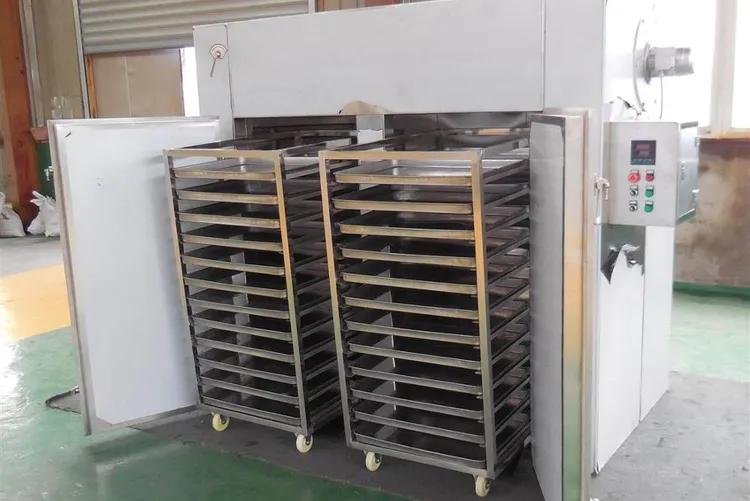
A tray dryer uses multiple trays arranged inside an insulated chamber. Food materials are spread across the trays, and heated air circulates around them to remove moisture.
Depending on the equipment design, air may circulate horizontally, vertically, or through a controlled airflow arrangement.
Typical applications include:
Herbs and spices
Fruit slices
Vegetable pieces
Small-batch specialty foods
Food ingredients requiring batch processing
Key advantages:
Relatively straightforward operating principle.
Flexible for different product types and batch sizes.
Suitable for operations that do not require continuous feeding.
Can be useful for product development and smaller production runs.
Selection considerations:
Air distribution and tray loading are critical. Overloading trays or placing materials unevenly can restrict airflow and create inconsistent drying.
Operators may also need to rotate trays or adjust loading arrangements, depending on the equipment’s airflow design.
Tray dryers are often considered by manufacturers that prioritize batch flexibility over continuous throughput.
2.3 Fluidized Bed Dryer
A fluidized bed dryer uses an upward flow of heated air to suspend and agitate suitable particles. When the airflow and particle properties are appropriate, the material behaves like a fluidized bed, allowing effective contact between the drying air and the particles.
Typical applications include:
Food powders
Granulated food ingredients
Selected starch products
Granular additives
Certain instant food ingredients
Key advantages:
Good contact between drying air and particles.
Can provide relatively uniform drying for suitable particle sizes.
Suitable for continuous or batch configurations, depending on the design.
Can integrate with upstream and downstream processing equipment.
Selection considerations:
Not every food material can be fluidized effectively. Particle size distribution, density, shape, moisture, and tendency to agglomerate all influence performance.
Very sticky materials, irregular large pieces, and products that are easily damaged may require another drying method or additional preprocessing.
Fluidized bed drying is most appropriate when the material has suitable particle characteristics and can be handled without excessive attrition or agglomeration.
2.4 Industrial Rotary Dryer
A rotary dryer consists of a rotating cylindrical drum, usually installed at an incline. Internal lifting flights raise and redistribute the material as the drum rotates, exposing it to the drying medium.
Depending on the configuration, heat may be supplied directly by hot gases or indirectly through heated surfaces.
Potential applications in food-related processing include:
Selected agricultural materials
Certain grains and granular products
Food-processing by-products
Some bulk food ingredients where product characteristics permit
Key advantages:
Suitable for continuous bulk-material handling.
Can process certain granular and particulate materials.
Designed for integration into larger production lines.
Selection considerations:
Rotary drying involves mechanical movement and material contact with internal components. Fragile food products may suffer breakage, abrasion, or changes in particle size.
The design must also account for material retention time, drum speed, inclination, filling level, and heat-transfer conditions.
A rotary dryer should not be selected solely because it can process large quantities. The material must tolerate the mechanical handling involved.
2.5 Spray Dryer

A spray dryer converts a liquid feed, such as a solution, suspension, or emulsion, into fine droplets. These droplets contact hot drying air inside a chamber, and moisture evaporates rapidly. The resulting powder is collected through an appropriate separation system.
Typical applications include:
Milk powder
Whey powder
Instant beverage ingredients
Food flavoring powders
Certain plant-based ingredient powders
Other liquid-derived food powders
Key advantages:
Converts liquid feeds directly into powders.
Suitable for continuous industrial production.
Powder characteristics can be influenced by feed properties and atomization conditions.
Can integrate with powder collection and downstream handling systems.
Selection considerations:
Spray dryer performance depends on feed solids content, viscosity, atomization method, droplet size, inlet and outlet air conditions, and powder collection requirements.
The product’s heat sensitivity and desired powder properties must be considered during process development.
Spray drying is not interchangeable with conventional hot-air drying. It is specifically suited to materials that can be prepared and atomized as a suitable liquid feed.
2.6 Freeze Dryer

Freeze drying, also known as lyophilization, removes moisture from frozen products through sublimation under reduced pressure. Ice changes directly into water vapor without passing through the normal liquid phase.
Typical applications include:
Premium freeze-dried fruit
Instant coffee
Specialty vegetables
Certain ready-to-eat food ingredients
Heat-sensitive food products
Key advantages:
Can help preserve product structure.
Suitable for certain heat-sensitive materials.
Can produce lightweight, porous products that rehydrate effectively when properly processed.
Selection considerations:
Freeze drying generally involves more complex equipment and process control than conventional hot-air drying. Freezing, vacuum conditions, heat input, and product thickness all influence cycle time and final quality.
The equipment’s capital and operating costs should be evaluated against the product’s selling price, quality requirements, and production volume.
3. Industrial Food Dryer Applications by Product Type
The best industrial food drying machine depends heavily on the physical and chemical properties of the material.
A machine suitable for thin fruit slices may not be appropriate for meat, powders, or liquid food products. Buyers should therefore begin with the material and the required final product rather than selecting equipment based only on machine capacity.
Food material | Drying technologies to evaluate | Important considerations |
|---|---|---|
Fruits | Belt dryer, tray dryer, freeze dryer | Color, texture, slice thickness, sugar content |
Vegetables | Belt dryer, tray dryer | Initial moisture, loading uniformity, shrinkage |
Herbs and spices | Tray dryer, belt dryer | Aroma retention, temperature sensitivity |
Mushrooms | Belt dryer, tray dryer, freeze dryer | Shape, thickness, color, rehydration |
Grains and seeds | Specialized grain dryer, selected rotary or fluidized systems | Moisture uniformity, grain integrity, airflow |
Meat and seafood | Application-specific hot-air or specialized drying systems | Food safety, product thickness, humidity, process validation |
Food powders | Spray dryer, fluidized bed dryer | Feed properties, particle size, powder handling |
Liquid food ingredients | Spray dryer | Viscosity, solids content, atomization |
Premium specialty foods | Freeze dryer | Product structure, quality targets, cycle time |
These are preliminary technology options, not universal recommendations. Actual suitability must be confirmed by evaluating the material, process conditions, and food safety requirements.
3.1 Fruit and Vegetable Drying
Fruit and vegetable drying requires careful control of temperature, airflow, and moisture removal.
Different materials behave differently. High-sugar fruit, for example, may become sticky during drying, while some vegetables shrink significantly as water is removed.
Common factors to evaluate include:
Initial moisture content.
Desired final moisture content.
Slice thickness and product dimensions.
Sensitivity to heat and oxidation.
Required color and texture.
Target rehydration characteristics.
Loading density and airflow distribution.
For continuous production of sliced materials, a belt dryer may be appropriate. Tray dryers may be more suitable for smaller batches or varied product runs.
3.2 Meat and Seafood Drying
Meat and seafood require particular attention to hygiene, temperature, humidity, and validated food safety controls.
Drying alone does not automatically make a product microbiologically safe. The process must be designed and validated according to the product type, formulation, water activity target, applicable regulations, and intended storage conditions.
Buyers should evaluate:
Raw material characteristics.
Product thickness and loading pattern.
Required temperature and humidity profile.
Air circulation and moisture removal.
Cleaning and sanitation requirements.
Cross-contamination prevention.
Food safety validation and monitoring.
Equipment selection should involve both process engineering and food safety expertise.
3.3 Grain and Agricultural Product Drying
Grains and agricultural materials often require controlled moisture reduction before storage or further processing.
The main concern is not simply reaching a lower moisture content. Excessive heating or uneven drying may damage the product, reduce quality, or create storage problems.
Important selection factors include:
Grain type and initial moisture.
Required final moisture.
Processing throughput.
Permissible product temperature.
Uniformity of drying.
Dust management and material handling.
Storage requirements after drying.
Specialized grain drying systems may be more suitable than general-purpose food dehydrators for large-scale grain operations.
3.4 Food Powder and Ingredient Drying
Powder production requires different equipment depending on whether the feed enters the dryer as a liquid, wet granules, or an existing solid powder.
Spray dryers are used to convert suitable liquid feeds into powders.
Fluidized bed dryers can dry suitable wet particles or granules.
Other specialized systems may be needed for cohesive, heat-sensitive, or easily agglomerated materials.
The correct choice depends on feed behavior, desired particle size, moisture specification, and downstream handling requirements.
4. How to Choose the Right Industrial Food Dryer
Choosing an industrial food dryer requires a complete understanding of the production process. A machine with a high nominal capacity may still be unsuitable if it cannot meet the product’s moisture, quality, or hygiene requirements.
The following factors should be evaluated before requesting a quotation.
4.1 Identify the Material and Its Characteristics
Start by describing the material in its actual processing condition.
Provide information such as:
Food material name and composition, where relevant.
Physical form: liquid, paste, powder, granule, slice, or whole product.
Particle size or dimensions.
Bulk density, where applicable.
Stickiness and tendency to agglomerate.
Heat sensitivity.
Initial moisture content.
For example, drying thin apple slices is a different process from drying a thick fruit puree. Even when the raw material is similar, its physical form can require a different dryer configuration.
4.2 Define Initial and Final Moisture Content
Moisture removal requirements are among the most important factors in dryer selection.
A buyer should identify:
Initial moisture content.
Target final moisture content.
Whether moisture is expressed on a wet basis or dry basis.
Acceptable moisture variation in the finished product.
Whether water activity must also meet a specific target.
Moisture content and water activity are not interchangeable. Moisture content describes how much water is present, while water activity relates to how available that water is for chemical and microbial processes.
For many food products, water activity is an important quality and food safety consideration.
Example of a basic moisture calculation
Suppose a food processor needs to dry 1,000 kg/h of material with an initial moisture content of 70% to a final moisture content of 10%, both on a wet basis.
Assuming no loss of dry solids:
Initial wet feed: 1,000 kg/h
Initial water: 700 kg/h
Dry solids: 300 kg/h
Final product mass: approximately 333.3 kg/h
Water remaining in final product: approximately 33.3 kg/h
Water to be removed: approximately 666.7 kg/h
This calculation establishes the approximate water evaporation load. It does not determine the required dryer size, heating capacity, energy consumption, or actual production rate. Those require additional process and equipment calculations.
4.3 Determine Required Production Capacity
Capacity should be specified in terms of the actual feed rate and operating conditions.
For example, a supplier needs to know whether the required production rate refers to:
Wet raw material entering the dryer.
Dried product leaving the dryer.
Water evaporation per hour.
Daily or per-batch production.
These values are not equivalent.
A system designed around final product output without considering initial moisture may be incorrectly sized.
Buyers should also explain their expected operating schedule, production peaks, and potential future expansion.
4.4 Evaluate Temperature and Product Quality Requirements
Food quality can be affected by excessive temperature, uneven heating, long exposure times, and oxygen exposure.
Depending on the product, important quality targets may include:
Color retention.
Flavor and aroma.
Texture.
Nutritional characteristics.
Rehydration behavior.
Particle size and appearance.
Final moisture consistency.
A lower drying temperature does not automatically guarantee better product quality. It may increase drying time, while unsuitable airflow or humidity conditions may still cause inconsistent results.
The complete temperature and airflow profile should be evaluated together with the material’s characteristics.
4.5 Choose the Appropriate Heat Source
Industrial food dryers may use different heat sources depending on their design and the production facility.
Potential options include:
Electric heating.
Natural gas.
LPG.
Steam.
Hot water.
Waste heat or other recovered thermal energy, where technically suitable.
The choice affects installation requirements, operating expenses, temperature control, emissions, and maintenance.
Buyers should compare local energy prices and availability rather than focusing only on the initial equipment price.
The supplier should also clarify whether the quoted equipment includes the heat source, burner, boiler, heat exchanger, or other auxiliary systems.
4.6 Consider Hygiene, Cleaning, and Automation
Food processing equipment must be designed around the cleaning and sanitation requirements of the product and facility.
Ask suppliers about:
Product-contact material specifications.
Cleaning access and inspection points.
Drainage and moisture management.
Cleaning procedures and downtime.
Protection against contamination.
Temperature and airflow monitoring.
Automatic control and alarm functions.
Integration with feeding and packaging systems.
Stainless steel construction may be appropriate for many food-contact applications, but the required grade and surface finish should be specified according to the product, cleaning chemicals, and applicable regulations.
Do not assume that a machine is hygienically designed simply because it is described as stainless steel.
4.7 Evaluate Total Cost of Ownership
The purchase price is only one part of the investment.
A practical cost comparison should include:
Cost factor | What to evaluate |
|---|---|
Equipment purchase | Main machine, heating system, controls, and accessories |
Installation | Foundation, electrical work, ventilation, and utilities |
Energy | Electricity, fuel, steam, or other thermal energy |
Labor | Loading, unloading, inspection, and operation |
Maintenance | Replacement parts, cleaning, and servicing |
Production losses | Rejects, inconsistent moisture, and product damage |
Downtime | Cleaning, repairs, and production interruptions |
A lower-priced industrial food drying machine may not provide the lowest long-term cost if it creates excessive energy consumption, requires frequent manual handling, or produces inconsistent product quality.
5. Common Industrial Food Drying Problems and How to Address Them
Even when the correct drying technology is selected, poor operating conditions can reduce product quality and production efficiency.
5.1 Uneven Drying
Possible causes:
Uneven material thickness.
Excessive or inconsistent loading.
Poor airflow distribution.
Blocked air passages.
Incorrect residence time.
Differences in material moisture or size.
Practical solutions:
Standardize product dimensions where possible.
Control the thickness of material layers.
Check airflow distribution across the drying area.
Review conveyor speed or tray loading procedures.
Measure moisture at different positions in the finished product.
5.2 Excessive Drying Time
Possible causes:
Insufficient heat transfer.
Inadequate airflow.
High inlet humidity.
Excessive product thickness.
Poor moisture movement from the material interior.
Incorrect loading or residence time.
Practical solutions:
Review the material preparation process.
Evaluate air temperature and humidity together.
Improve airflow distribution where the equipment allows.
Adjust product dimensions or loading density.
Confirm that the dryer is operating within its intended process range.
Increasing temperature without understanding the cause may damage the product rather than solve the problem.
5.3 High Energy Consumption
Possible causes:
Excessive exhaust-air losses.
Poor insulation.
Inappropriate operating temperature.
Low equipment loading.
Inadequate heat recovery.
Repeated heating and cooling during production.
Practical solutions:
Evaluate heat recovery opportunities.
Check insulation and air leakage.
Match equipment operation to actual production demand.
Optimize loading and production scheduling.
Compare energy use against the actual amount of water removed.
Energy performance should be evaluated using measured operating data under clearly defined conditions.
5.4 Product Damage During Drying
Possible causes:
Excessive temperature.
Long exposure to unsuitable drying conditions.
Mechanical abrasion or impact.
Oxidation.
Incorrect moisture endpoint.
Practical solutions:
Establish product-specific temperature limits.
Evaluate alternative drying technologies for sensitive materials.
Reduce unnecessary mechanical handling.
Monitor moisture and product quality during trials.
Validate the process before full-scale production.
6. What Affects Industrial Food Dryer Prices?
Industrial food dryer prices vary considerably because equipment is designed around different materials, capacities, process requirements, and configurations.
The main factors influencing the quotation include:
Dryer type: Belt, tray, fluidized bed, rotary, spray, and freeze dryers involve different structures and operating principles.
Processing capacity: Larger throughput requirements generally affect equipment dimensions, heating systems, and auxiliary equipment.
Moisture evaporation load: Removing more water requires greater heat-transfer and moisture-removal capacity.
Material characteristics: Sticky, corrosive, abrasive, fragile, or heat-sensitive materials may require specialized designs.
Construction materials: Product-contact materials, surface finishes, and corrosion resistance affect manufacturing costs.
Automation level: Sensors, control systems, data monitoring, and automatic feeding can change the overall configuration.
Auxiliary systems: Burners, boilers, air filters, exhaust systems, conveyors, and product collection equipment may be quoted separately.
Installation requirements: Electrical standards, site conditions, and local compliance requirements can influence project costs.
When comparing quotations, buyers should check whether suppliers are quoting the same scope of supply. A quotation covering only the main dryer cannot be directly compared with one that includes feeding, heating, exhaust treatment, installation, and commissioning.
7. What Information Should You Prepare Before Requesting a Quotation?
Providing complete process information helps equipment suppliers evaluate the application more accurately and reduces unnecessary communication.
Before requesting an industrial food dryer quotation, prepare the following information:
Information required | Example or explanation |
|---|---|
Material | Mango slices, mushrooms, herbs, grain, milk solution |
Material form | Liquid, paste, powder, granule, slices, whole product |
Initial moisture | Percentage and wet-basis or dry-basis method |
Target final moisture | Required finished-product moisture |
Production capacity | Wet feed rate or finished product output per hour |
Product dimensions | Thickness, particle size, or average dimensions |
Temperature requirements | Maximum acceptable product temperature, if known |
Heat source | Electricity, natural gas, LPG, steam, or other source |
Operating schedule | Hours per day and batches per shift |
Quality requirements | Color, texture, aroma, water activity, or rehydration |
Installation location | Country, facility conditions, and available space |
Automation requirements | Manual, semi-automatic, or automatic operation |
If some parameters are not yet available, provide representative material samples and explain the intended finished product. Material testing and process evaluation may be necessary before final equipment selection.
A useful supplier should be able to explain which parameters are confirmed, which are assumptions, and which require testing.
Frequently Asked Questions About Industrial Food Dryers
1. What is the best industrial food dryer?
There is no single best industrial food dryer for every application. Belt dryers are often considered for continuous drying of suitable solid materials, tray dryers for batch processing, spray dryers for liquid-to-powder production, and freeze dryers for selected high-value or heat-sensitive products.
The best option depends on material characteristics, moisture requirements, production capacity, product quality, and operating costs.
2. What is the difference between a food dehydrator and an industrial food dryer?
A food dehydrator is generally associated with smaller-scale drying, while an industrial food dryer is designed for production environments with larger throughput requirements, process controls, and integration with manufacturing operations.
However, the terminology can overlap in commercial equipment catalogs. Buyers should evaluate actual capacity, construction, controls, and operating requirements rather than relying on the product name.
3. How do I choose an industrial dryer for fruit and vegetables?
Start with the type of fruit or vegetable, initial moisture content, target final moisture, product dimensions, and required production rate.
Then evaluate whether a belt dryer, tray dryer, or another technology can achieve the required product quality. Temperature, airflow, loading density, and drying time should be validated through process testing.
4. How much does an industrial food dryer cost?
The price depends on the dryer type, processing capacity, moisture evaporation load, construction materials, heating system, automation, and auxiliary equipment.
To obtain a meaningful quotation, provide the material type, initial and final moisture content, required feed rate, heat source, and product quality requirements.
5. How can I improve industrial food drying efficiency?
Start by measuring the actual amount of water removed and the energy consumed. Then review airflow distribution, temperature, inlet humidity, insulation, loading conditions, and exhaust-air losses.
Improvements should be based on measured process conditions. Simply increasing the drying temperature may increase energy use or damage the product.
6. Can one industrial dryer process different food materials?
Some dryers can handle multiple materials, but the operating conditions may need to change significantly between products. Different materials have different moisture levels, heat sensitivities, particle sizes, and handling requirements.
Before purchasing a multi-purpose dryer, confirm the intended product range and test the most challenging materials under representative conditions.
Conclusion: Select an Industrial Food Dryer Based on Your Process
Choosing an industrial food dryer requires more than comparing equipment prices or advertised production capacities. The right solution must match the material’s physical properties, initial and final moisture content, production requirements, food quality targets, and available energy sources.
Belt dryers, tray dryers, fluidized bed dryers, rotary dryers, spray dryers, and freeze dryers each serve different processing needs. Selecting the wrong technology can lead to uneven drying, unnecessary energy consumption, product damage, and additional operating costs.
A reliable selection process starts with accurate material information, a clear moisture-removal target, and a realistic assessment of production requirements.
Looking for an industrial food drying solution for your production line?
Contact our team to discuss your material characteristics, initial and final moisture content, processing capacity, heat source, and product quality requirements. Share your application details so that a suitable drying technology and equipment configuration can be evaluated for your project.