A plate heat exchanger can cut footprint by 70% or more compared with a shell and tube unit. It can reach a 1°C temperature approach. It can recover heat that other exchangers cannot.
But the wrong plate heat exchanger will foul fast, drop pressure, leak at the gasket, or cost more to maintain than it saves.
Compact and high-efficiency do not come from the catalog. They come from correct selection.
Here is how to choose a plate heat exchanger that performs in real service.
Step 1: Define the Duty Before You Look at Any Model
Start with the process data. Every selection decision depends on it.
You need:
Heat load: kW or BTU/hr
Hot side flow rate, inlet temperature, outlet temperature
Cold side flow rate, inlet temperature, outlet temperature
Allowable pressure drop on each side
Design pressure and design temperature
Fluid names, concentrations, and phase
Fouling tendency and cleaning frequency
Available utilities: steam, cooling water, chilled water, glycol, seawater
Connection sizes and orientation
Code requirements: ASME, PED/CE, CRN, UL, ATEX
Do not guess the flow rate. Do not use summer cooling water temperatures for a winter design. Do not ignore pressure drop. A plate heat exchanger that meets the heat duty but exceeds the allowed pressure drop is not a valid selection.
Step 2: Match the Plate Heat Exchanger Type to the Service
Plate heat exchangers are not all the same. The type decides pressure limits, temperature limits, cleaning access, and fluid compatibility.
| Type | Best For | Limits to Watch |
|---|---|---|
| Gasketed plate-and-frame | Clean fluids, HVAC, district heating, food and dairy, low to medium pressure | Gasket temperature and chemical limits; leaks can occur if gaskets fail |
| Brazed plate | Refrigeration, hydronics, heat pumps, compact OEM packages | Not mechanically cleanable; small channels can block |
| Welded plate | Aggressive fluids, high temperature, high pressure, no gasket contact | Harder to clean; higher cost |
| Semi-welded plate | Two fluids where one side needs gasket access and the other must be sealed | More complex selection; limited repairability |
| Plate-and-shell | High pressure and high temperature where gaskets are not acceptable | Less compact than gasketed units; higher cost |
| Wide-gap plate | Fibrous, particulate, or high-fouling fluids | Lower heat transfer per plate; larger frame |
For clean water-to-water duty, a gasketed plate heat exchanger is usually the most cost-effective. For ammonia or CO₂ refrigeration, brazed or welded plates are common. For seawater, titanium plates with appropriate gaskets are often required.
Step 3: Choose Plate and Gasket Materials Correctly
Material selection prevents corrosion. It also affects cost and lead time.
Common plate materials:
304 stainless steel: clean water, benign fluids
316 stainless steel: general industrial duty, moderate chlorides
Titanium: seawater, brackish water, high chloride service
SMO 254: high-chloride and acidic environments
Hastelloy: aggressive acids and high-temperature corrosive fluids
Nickel: caustic and some food applications
Common gasket materials:
NBR: water, oils, moderate temperature
EPDM: hot water, steam, many HVAC duties
FKM / Viton: oils, hydrocarbons, higher temperature
PTFE or compressed fiber: aggressive chemicals where elastomers fail
Check chloride stress corrosion cracking before choosing 304 or 316. Check gasket compatibility with every fluid, including cleaning chemicals. A gasket that swells or hardens will leak.
Step 4: Size for Heat Transfer, Not Just Footprint
The heat transfer equation is simple:
Q = U × A × LMTD
The challenge is finding the right U, area, and flow arrangement.
Plate heat exchangers achieve high U-values because the corrugated plates create turbulence at low Reynolds numbers. The chevron angle controls this:
High chevron angle: higher turbulence, higher heat transfer, higher pressure drop
Low chevron angle: lower pressure drop, lower heat transfer, better for viscous fluids
A close temperature approach is possible, but it costs area. If you ask for a 1°C approach with a low pressure drop, the unit may become large or impractical. Balance thermal performance with pumping cost.
Also check the number of passes and flow arrangement. Counter-current flow gives the best LMTD. Multi-pass arrangements can improve performance but increase pressure drop and complexity.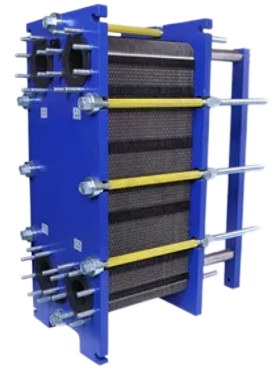
Step 5: Check Pressure Drop and Flow Distribution
Pressure drop is the most common reason a plate heat exchanger underperforms.
If pressure drop is too high:
Pumps may not meet flow
Production may slow
Cleaning may be needed more often
Energy cost rises
If pressure drop is too low:
Flow may bypass plates
Heat transfer may suffer
Fouling may increase in low-velocity zones
Set a realistic allowable pressure drop for each side. Then verify the selected plate pattern and port sizes. Unequal flow rates can require asymmetrical channels. High flow with small ports creates high velocity and erosion. Low flow with large ports creates dead zones and fouling.
Step 6: Plan for Fouling and Cleaning
Plate heat exchangers have narrow channels. They are excellent for clean fluids. They are poor for fluids with fibers, crystals, or heavy sediment unless designed for it.
Ask:
Will the fluid scale?
Will it polymerize?
Does it contain particles larger than the channel gap?
Can the unit be cleaned in place (CIP)?
Can plates be removed and cleaned manually?
How often will cleaning be required?
For fouling service, consider:
Wide-gap plates
Fewer passes
Smooth or low-chevron plates
Upstream filtration
Chemical dosing and water treatment
A spare plate pack or duplicate exchanger
Do not select a compact unit that cannot be cleaned. A compact fouled exchanger is an expensive downtime problem.
Step 7: Confirm Connections, Frame, and Code Requirements
The plate pack is only part of the exchanger. The frame and connections must fit the plant.
Check:
Connection size, type, and orientation
Nozzle loads and piping stress
Frame material and coating
Tie bolts and tightening dimensions
Available space for plate removal
Lifting points and maintenance access
Design code and certification
For European projects, PED 2014/68/EU and CE marking are often required. For North America, ASME Section VIII or CRN may apply. For food and pharmaceutical duty, sanitary connections and 3-A or EHEDG compliance may be required.
Step 8: Compare Lifecycle Cost, Not Just Purchase Price
A cheap plate heat exchanger can be the most expensive one.
Compare:
Initial cost
Pumping energy over 10 years
Cleaning cost and downtime
Gasket replacement interval
Plate replacement cost
Spare parts availability
Lead time for replacement plates
Service support
A unit with slightly higher capital cost but lower pressure drop, easier cleaning, and longer gasket life often pays back in two to three years.
Common Plate Heat Exchanger Selection Mistakes
Avoid these:
Sizing only for heat duty and ignoring pressure drop
Using 316 stainless in high-chloride water
Choosing a brazed unit for a fluid that can plug
Specifying a 1°C approach without checking area and cost
Ignoring gasket temperature limits
Forgetting cleaning access space
Using the same fouling factor for both sides
Not verifying code compliance
Buying on price alone
Quick Selection Checklist
Before you request a quote, confirm:
Heat load and design temperatures
Flow rates and allowable pressure drop
Fluid properties and corrosion risk
Fouling tendency and cleaning method
Plate material and gasket material
Type: gasketed, brazed, welded, semi-welded, wide-gap
Connection sizes and orientation
Design code and certification
Footprint and service clearance
Spare parts and lead time
When a Plate Heat Exchanger Is Not the Right Choice
A plate heat exchanger may not fit if:
The fluid contains large solids or fibers
Pressure or temperature exceeds gasket limits and welded plates are too costly
The duty requires thermal storage or phase change with large volume
The pressure drop allowance is extremely low
The fluid is highly viscous and flow is laminar
In those cases, a shell and tube, spiral, or air-cooled exchanger may be a better fit. The right answer depends on the service, not the product.