Selecting data center cooling equipment for a new facility is an engineering decision that affects IT availability, energy consumption, operating costs, and future expansion. The challenge is not simply choosing air conditioners with enough nominal cooling capacity. Engineers must design a complete heat removal system that matches the expected IT load, rack power density, building layout, outdoor conditions, and reliability requirements.
A small enterprise data center, a colocation facility, and an AI data center may require very different cooling architectures. Conventional precision air conditioning may be appropriate for moderate-density server rooms, while high-density GPU infrastructure may require in-row cooling, rear door heat exchangers, or direct-to-chip liquid cooling.
The correct approach is to define the facility’s thermal requirements first, then select compatible equipment across the entire cooling chain.
This guide explains how to select data center cooling equipment for a new facility, covering cooling load calculations, air and liquid cooling technologies, heat rejection systems, redundancy, energy efficiency, and procurement considerations.
1. Define the Facility’s Cooling Requirements Before Selecting Equipment
Before comparing CRAC units, CRAH units, chillers, or liquid cooling systems, establish the actual cooling requirements of the planned facility.
Equipment selection based only on building floor area or estimated total cooling capacity can lead to undersized systems, unnecessary investment, or poor thermal distribution.
1.1 Calculate the expected IT cooling load
The IT load is the starting point for data center cooling design.
Most electrical energy consumed by servers, storage equipment, and network devices eventually becomes heat within the facility. Therefore, IT electrical power provides a useful basis for estimating the IT heat load.
A preliminary cooling load calculation can be expressed as:
[
Q_{total}=Q_{IT}+Q_{electrical}+Q_{lighting}+Q_{envelope}+Q_{ventilation}
]
Where:
(Q_{total}) = total cooling load.
(Q_{IT}) = heat generated by IT equipment.
(Q_{electrical}) = heat from UPS and other electrical equipment located within the conditioned space.
(Q_{lighting}) = heat from lighting and occupants.
(Q_{envelope}) = heat transferred through walls, roofs, floors, and other building elements.
(Q_{ventilation}) = heat introduced through ventilation and infiltration.
For example, consider a proposed data center with:
IT load: 500 kW
Internal electrical losses: 20 kW
Lighting and occupancy: 5 kW
Envelope and ventilation gains: 15 kW
The preliminary total cooling load is:
[
Q_{total}=500+20+5+15=540\ kW
]
This represents the estimated thermal load, not automatically the required installed equipment capacity. Final sizing must account for design conditions, sensible and latent loads, equipment performance, redundancy, operating margins, and future expansion.
1.2 Determine rack power density
Total IT load does not reveal how heat is distributed throughout the data center.
For example, a facility with 500 kW of IT load distributed evenly across many racks has different cooling requirements from a facility with the same total load concentrated in a smaller number of high-density racks.
Collect the following information:
Planned number of server racks.
Rack dimensions and layout.
Expected average rack power.
Maximum rack power.
GPU and high-performance computing rack requirements.
Expected changes in rack density over time.
Rack-level power density helps determine whether room-level cooling is sufficient or whether localized cooling technologies are needed.
1.3 Establish environmental and operating conditions
Cooling equipment must be selected according to the conditions in which it will operate.
Important design inputs include:
Outdoor dry-bulb and wet-bulb temperatures, as applicable.
Required server inlet temperature range.
Humidity and dew-point requirements.
Equipment installation location.
Available electrical supply.
Chilled-water supply and return temperatures, if applicable.
Required operating hours.
Maintenance and redundancy requirements.
For international projects, outdoor design conditions can vary substantially. A facility in a hot, humid climate may require a different heat rejection strategy from one in a cooler region.
The equipment’s rated capacity must be checked against the actual design conditions rather than assumed to remain constant under all operating environments.
2. Choose Between Air Cooling and Liquid Cooling
The next major decision is the cooling architecture.
Air cooling and liquid cooling use different heat transfer mechanisms, infrastructure, and maintenance requirements. Neither is universally suitable for every new data center.
2.1 Air cooling for conventional data center infrastructure
Air cooling transfers heat from IT components into server exhaust air. Cooling units then remove this heat and return conditioned air to the IT space.
Common equipment includes:
Precision air conditioners.
Computer Room Air Conditioners (CRAC).
Computer Room Air Handlers (CRAH).
In-row cooling units.
Rear door heat exchangers.
Cold aisle and hot aisle containment systems.
Air cooling is commonly used for enterprise data centers, network rooms, colocation facilities, and server environments whose rack densities are compatible with the selected equipment and airflow design.
Its advantages include established operating practices, broad equipment availability, and compatibility with many existing IT configurations.
However, higher rack densities can require substantial airflow and careful thermal management. The design must prevent hot-air recirculation and ensure that sufficient cold air reaches server inlets.
2.2 Liquid cooling for high-density IT infrastructure
Liquid cooling transfers heat through a liquid circuit rather than relying exclusively on server airflow.
It is increasingly relevant for compatible high-density GPU servers, HPC systems, and other applications with concentrated component heat loads.
Common technologies include:
Direct-to-chip liquid cooling
Cold plates are installed on supported components such as CPUs and GPUs. Coolant flows through the cold plates and transfers heat to a liquid loop.
A coolant distribution unit manages the liquid circuit and provides the required interface between the technology cooling system and the facility cooling infrastructure.
Immersion cooling
IT equipment is immersed in a dielectric fluid within a specially designed tank. Heat transfers from the equipment to the fluid and is subsequently removed through an appropriate heat rejection arrangement.
Immersion cooling requires specific server, fluid, tank, electrical, and maintenance compatibility. It is not interchangeable with direct-to-chip cooling.
Rear door heat exchangers
A rear door heat exchanger removes heat from server exhaust air as it leaves the rack. Depending on its configuration, it can use chilled water or another specified cooling fluid.
It can help support higher-density racks without requiring every server component to have a direct liquid connection.
2.3 Air cooling vs. liquid cooling
| Selection factor | Air cooling | Liquid cooling |
|---|---|---|
| Heat transfer medium | Air | Liquid coolant |
| Typical application | Conventional server environments | High-density GPU and HPC infrastructure, depending on technology |
| Main equipment | CRAC, CRAH, in-row units | CDUs, cold plates, liquid-cooled racks, immersion tanks |
| Infrastructure | Air distribution and heat rejection | Liquid distribution and heat rejection |
| Main design challenge | Airflow and hot spots | Flow, pressure, coolant compatibility, leakage control |
| Maintenance focus | Filters, coils, fans, refrigerant or water circuits | Coolant quality, pumps, connections, filters, leak detection |
| Key limitation | Airflow requirements at high heat densities | Greater liquid-side integration and compatibility requirements |
A new facility does not necessarily need to choose only one technology. Hybrid cooling can combine air cooling for general IT loads with liquid cooling for selected high-density racks.
The decision should be based on the actual server specifications and projected rack power densities.
3. Select the Appropriate Precision Air Cooling Equipment
If the facility uses air cooling, the next step is to select the right room-level or rack-level equipment.
CRAC, CRAH, precision air conditioners, and in-row cooling units serve related but different roles.
3.1 Precision air conditioners and CRAC units
Precision air conditioners are designed for environments requiring controlled temperature and, depending on the system configuration, humidity management.
CRAC units commonly use a direct-expansion refrigeration system. Their cooling performance depends on the refrigeration circuit, indoor airflow, condenser arrangement, and operating conditions.
Consider CRAC or precision air-conditioning equipment when:
The facility needs dedicated room-level cooling.
A direct-expansion architecture is appropriate.
Chilled-water infrastructure is unavailable or not preferred.
The project requires a defined precision cooling configuration.
Check the available electrical supply, condenser location, refrigerant piping route, service access, operating conditions, and actual sensible cooling capacity.
3.2 CRAH units
CRAH units use chilled water supplied by an external cooling plant rather than relying on an integral direct-expansion refrigeration circuit.
They are commonly used in facilities with central chilled-water infrastructure.
When selecting CRAH equipment, evaluate:
Chilled-water supply and return temperatures.
Required water flow.
Coil performance.
Airflow and external static pressure.
Control valve arrangement.
Condensate management.
Compatibility with the central cooling plant.
A CRAH unit’s performance depends on the chilled-water conditions available at the unit. Selecting equipment without confirming chiller and pump capacity can create system-level problems.
3.3 In-row cooling
In-row cooling units are positioned close to server racks, typically within or adjacent to rack rows.
They provide localized cooling and can reduce the distance between cold-air delivery and heat removal.
Consider in-row cooling when:
Rack power density varies significantly.
Selected rack groups require additional cooling.
Room-level cooling struggles with localized hot spots.
The facility needs a more distributed cooling arrangement.
Before selecting in-row units, check installation space, maintenance access, airflow direction, power supply, piping or refrigerant connections, and integration with the overall control system.
3.4 Equipment comparison
| Equipment | Cooling mechanism | Typical application | Important selection factor |
|---|---|---|---|
| Precision AC / CRAC | Direct-expansion air cooling | Dedicated server rooms and data centers | Refrigeration configuration and sensible capacity |
| CRAH | Chilled-water air cooling | Central chilled-water facilities | Water temperature and flow |
| In-row cooling | Localized air cooling | High-density rack rows | Rack layout and airflow |
| Rear door heat exchanger | Heat removal from rack exhaust | Higher-density server racks | Rack compatibility and liquid-side conditions |
Do not compare equipment using nominal kW ratings alone. Review actual operating conditions, airflow, sensible capacity, electrical consumption, and the way each unit integrates with the facility.
4. Select the Chiller and Heat Rejection System
Room-level cooling equipment is only one part of a complete data center cooling system.
For chilled-water and many liquid-cooling configurations, the facility also needs a reliable way to reject heat to the outdoor environment.
Depending on the architecture, this may involve chillers, dry coolers, cooling towers, pumps, and heat exchangers.
4.1 Data center chiller selection
A chiller removes heat from a circulating fluid and transfers it to a heat rejection system.
When selecting a data center chiller, consider:
Required cooling capacity.
Chilled-water supply and return temperatures.
Outdoor design conditions.
Part-load operating requirements.
Available electrical capacity.
Refrigerant and equipment requirements.
Redundancy architecture.
Maintenance access.
Integration with CRAH units or liquid-cooling infrastructure.
The chiller’s rated capacity must be verified at the actual design conditions. A nominal capacity stated under different conditions may not represent the cooling output available at the project site.
4.2 Dry coolers
A dry cooler transfers heat from a circulating fluid to outdoor air through a heat exchanger.
It may be used in suitable chilled-water or liquid-cooling arrangements, including systems designed to operate at fluid temperatures that allow effective air-side heat rejection.
Dry cooler selection depends on:
Outdoor dry-bulb temperature.
Required fluid supply temperature.
Heat rejection load.
Fluid flow and pressure drop.
Fan power.
Noise restrictions.
Available installation space.
A dry cooler should not be assumed to replace a chiller in every climate or application. Its ability to reject heat depends on the required fluid temperature relative to outdoor conditions.
4.3 Cooling towers
Cooling towers reject heat through evaporation and are commonly associated with water-cooled chiller systems.
Selection requires consideration of:
Heat rejection capacity.
Outdoor wet-bulb design conditions.
Water consumption.
Water treatment.
Drift control.
Blowdown requirements.
Maintenance access.
Local environmental and water regulations.
Cooling towers may offer an appropriate heat rejection approach for certain large facilities, but water availability and operating requirements must be considered from the beginning of the project.
4.4 Compare heat rejection options
| Equipment | Heat rejection method | Main consideration |
|---|---|---|
| Air-cooled chiller | Refrigeration cycle rejects heat to outdoor air | Outdoor temperature and chiller performance |
| Water-cooled chiller with cooling tower | Heat transferred to condenser water and rejected through evaporation | Water availability and treatment |
| Dry cooler | Fluid heat transferred directly to outdoor air | Outdoor dry-bulb temperature and fluid temperature |
| Hybrid heat rejection arrangement | Combines different heat rejection methods | Controls, operating modes, and system integration |
The appropriate configuration depends on climate, water availability, energy strategy, site restrictions, and the required operating temperatures.
5. Design for Energy Efficiency, Reliability, and Future Expansion
A data center cooling system must support the current IT load while remaining practical to operate and expand.
The lowest initial equipment price does not necessarily produce the lowest long-term cost. Energy consumption, maintenance, redundancy, and equipment replacement should be evaluated together.
5.1 Evaluate energy efficiency at system level
Consider the electrical consumption of the complete cooling system, including:
CRAC and CRAH fans.
Compressors.
Chillers.
Chilled-water pumps.
Condenser water pumps.
Cooling tower fans.
Dry cooler fans.
Liquid-cooling pumps and CDUs.
Power Usage Effectiveness (PUE) is calculated as:
[
PUE=\frac{Total\ Facility\ Energy}{IT\ Equipment\ Energy}
]
PUE provides a facility-level measure of energy overhead. It does not independently identify the efficiency of a particular cooling component.
For equipment selection, also request performance data at the project’s intended operating conditions and evaluate part-load performance where relevant.
5.2 Consider variable-speed control
Variable-speed fans and pumps can adjust output to changing cooling demand.
Potential benefits include better load matching and reduced unnecessary power consumption. However, equipment minimum flow, minimum speed, stable operating ranges, and control compatibility must be considered.
The control strategy should prevent unstable operation, inadequate airflow, and poor water distribution at low loads.
5.3 Plan cooling redundancy
Common cooling redundancy arrangements include:
N: The installed capacity meets the required design load.
N+1: One additional unit or component is provided beyond the required capacity.
2N: Two independent systems are each designed to support the required load.
The appropriate configuration depends on availability requirements, maintenance strategy, project cost, and operational risk.
Redundancy must cover the entire cooling path. For example, multiple CRAH units do not provide full resilience if they depend on a single vulnerable pump, power source, control system, or heat rejection component.
5.4 Allow for future IT expansion
A new data center should be designed around a realistic growth plan.
Consider:
Future rack quantities.
Changes in average and maximum rack power.
Potential GPU deployments.
Additional cooling unit locations.
Chiller and heat rejection expansion.
Electrical infrastructure capacity.
Piping routes and connection points.
Space for maintenance and equipment replacement.
Modular equipment arrangements may help facilities expand in stages, but expansion plans must account for the capacity and operating limits of shared infrastructure.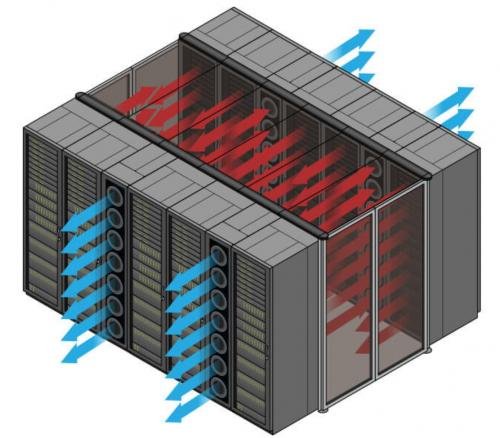
6. What Information Should Be Prepared Before Purchasing Data Center Cooling Equipment?
Before requesting a quotation, provide suppliers and engineering teams with enough information to assess equipment performance and compatibility.
A useful project specification should include the following.
| Project information | Why it is needed |
|---|---|
| Total IT load (kW) | Establishes the preliminary heat load |
| Rack quantity and dimensions | Determines layout and equipment arrangement |
| Average and maximum rack power | Identifies rack-level thermal requirements |
| Required server inlet conditions | Defines environmental targets |
| Facility location and outdoor design conditions | Affects equipment performance |
| Cooling architecture preference | Determines compatible equipment options |
| Available electrical supply | Confirms equipment power compatibility |
| Chilled-water temperatures and flow, if applicable | Required for CRAH and water-cooled equipment selection |
| Water availability and quality | Relevant to cooling towers and water circuits |
| Available plant and installation space | Determines equipment placement |
| Redundancy requirements | Defines capacity and system configuration |
| Future expansion plan | Prevents premature capacity limitations |
For liquid-cooling projects, also provide server manufacturer requirements, cold-plate compatibility, coolant specifications, CDU interface requirements, flow and pressure conditions, and the proposed heat rejection arrangement.
Supplier evaluation checklist
When comparing data center cooling equipment suppliers, evaluate:
Technical performance: Cooling capacity, airflow, water flow, pressure drop, and operating conditions.
System compatibility: Electrical, mechanical, piping, and control interfaces.
Equipment documentation: Technical datasheets, drawings, installation instructions, and maintenance information.
Reliability considerations: Component selection, redundancy compatibility, and service access.
Quality assurance: Available inspection, testing, and quality documentation.
Warranty and support: Warranty conditions, spare parts availability, and after-sales arrangements.
Project coordination: Delivery requirements, equipment dimensions, installation planning, and interface responsibilities.
Do not select equipment solely because it has the highest nominal capacity or lowest purchase price. The final decision should consider the complete operating and maintenance requirements of the facility.
Conclusion
Selecting data center cooling equipment for a new facility requires a coordinated approach to thermal load calculation, rack density, cooling architecture, heat rejection, energy efficiency, and reliability.
For conventional IT environments, precision air conditioners, CRAC units, CRAH units, and airflow management systems may provide an appropriate solution. For higher-density deployments, in-row cooling, rear door heat exchangers, and liquid cooling technologies may be required. Chillers, dry coolers, and cooling towers must then be selected to support the complete heat removal system under actual site conditions.
The most important step is to define the facility’s current and future requirements before comparing equipment models.
Planning a new data center cooling project? Contact our team to discuss your IT load, rack density, operating conditions, and cooling infrastructure requirements. Request a technical consultation and equipment quotation based on your project specifications.
Frequently Asked Questions
1. What factors should I consider when selecting data center cooling equipment?
The main factors include IT load, rack power density, required server inlet conditions, outdoor design temperatures, cooling architecture, heat rejection capacity, redundancy, electrical supply, available space, and future expansion requirements.
2. Should a new data center use CRAC or CRAH units?
CRAC units commonly use direct-expansion refrigeration, while CRAH units use chilled water supplied by an external cooling plant. The choice depends on the facility’s cooling architecture, available infrastructure, operating conditions, maintenance strategy, and project requirements.
3. Is liquid cooling necessary for a new AI data center?
Not every AI data center requires the same cooling technology. The decision depends on server design, GPU power, rack density, and thermal requirements. Direct-to-chip liquid cooling may be suitable for compatible high-density servers, while other IT loads may continue to use air cooling.
4. How do I calculate the required cooling capacity for a new data center?
Start with the IT electrical load and add other heat gains within the conditioned space, including electrical losses, lighting, occupants, envelope heat transfer, and ventilation loads. Final equipment sizing must also consider design conditions, sensible and latent loads, redundancy, and future expansion.
5. Which is better for a data center: a dry cooler or a cooling tower?
Neither is universally better. Dry coolers reject heat directly to outdoor air and avoid evaporative cooling water consumption in the heat rejection process. Cooling towers use evaporation and are commonly paired with water-cooled chillers. Climate, water availability, fluid temperatures, energy requirements, and maintenance determine suitability.
6. What information should I provide when requesting a data center cooling equipment quotation?
Provide the facility location, IT load, rack quantity and power density, required cooling capacity, operating conditions, preferred cooling architecture, available electrical supply, chilled-water conditions where applicable, redundancy requirements, and site drawings. For liquid cooling, include server and coolant interface specifications.