Choosing between water-cooled and air-cooled data center cooling systems affects more than equipment selection. It influences energy consumption, infrastructure requirements, installation costs, maintenance procedures, water usage, and long-term operating reliability.
Both approaches remove heat from IT equipment, but they use different methods to reject that heat into the outdoor environment.
Air-cooled systems typically use outdoor air and heat exchangers to remove heat from the cooling circuit. Water-cooled systems commonly use cooling towers and water-cooled chillers, with heat ultimately rejected through evaporation. However, the distinction is not simply whether a system contains water or air. Many data center cooling architectures use both air and water at different stages.
For data center owners, facility managers, HVAC engineers, and EPC contractors, the right choice depends on climate, cooling capacity, rack density, water availability, energy costs, site conditions, and redundancy requirements.
This guide compares water-cooled and air-cooled data center cooling systems, explains how they work, and identifies the factors that should determine equipment selection.
1. What Is the Difference Between Water-Cooled and Air-Cooled Data Center Cooling?
The fundamental difference is how the cooling system rejects heat from the facility to the outdoor environment.
Air-Cooled Data Center Cooling Systems
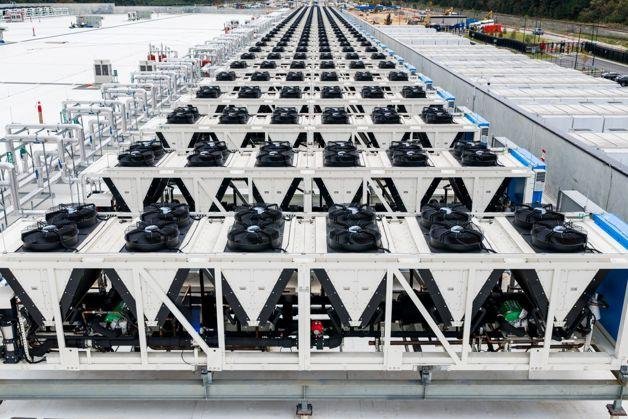
An air-cooled cooling system uses outdoor air to remove heat from a refrigerant or circulating fluid.
In a typical air-cooled chiller, refrigerant absorbs heat from the chilled-water circuit through the evaporator. The compressor raises the refrigerant pressure and temperature, and the condenser transfers heat directly to outdoor air through finned coils and fans.
The main equipment may include:
Air-cooled chillers.
Chilled-water pumps.
CRAH units.
Precision air conditioning systems.
Dry coolers, where applicable.
Piping, valves, sensors, and control systems.
A dry cooler is another form of air-based heat-rejection equipment. Unlike an air-cooled chiller, it does not itself provide mechanical refrigeration. It transfers heat from a circulating fluid to outdoor air through a coil and fans.
Key characteristics:
Does not require a cooling tower for heat rejection.
Generally avoids evaporative cooling-water consumption at the heat-rejection stage.
Can simplify water infrastructure.
Performance depends strongly on outdoor dry-bulb temperature.
May require more electrical power for compressors and fans under certain operating conditions.
Water-Cooled Data Center Cooling Systems
A water-cooled system commonly uses a water-cooled chiller connected to a cooling tower.
The system transfers heat from the data center’s chilled-water circuit to a separate condenser-water circuit. The cooling tower then rejects heat to the outdoor environment through evaporation and air movement.
A typical configuration includes:
Water-cooled chillers.
Cooling towers.
Chilled-water pumps.
Condenser-water pumps.
CRAH units or chilled-water cooling coils.
Water-treatment equipment.
Piping, valves, sensors, and control systems.
The cooling tower uses evaporation to cool the circulating condenser water. This can allow the chiller to operate with a lower condensing temperature than some air-cooled alternatives under suitable conditions.
Key characteristics:
Uses a cooling tower and condenser-water loop in common configurations.
Requires water management and treatment.
Can achieve favorable operating efficiency under suitable conditions.
Requires additional mechanical infrastructure.
Must account for water consumption, water quality, and local environmental regulations.
Key Differences at a Glance
Comparison | Air-cooled system | Water-cooled system |
|---|---|---|
Main heat-rejection medium | Outdoor air | Cooling water and outdoor air |
Typical equipment | Air-cooled chiller | Water-cooled chiller and cooling tower |
Cooling tower | Not normally required | Commonly required |
Evaporative water consumption | Generally none at the heat-rejection stage | Yes, in conventional cooling-tower systems |
Mechanical infrastructure | Generally simpler | Generally more complex |
Water treatment | Usually not required for heat rejection | Required for cooling-tower water systems |
Performance sensitivity | Outdoor dry-bulb temperature | Wet-bulb temperature and cooling-tower performance |
Maintenance | Coils, fans, compressors, refrigerant circuits | Chillers, pumps, towers, water treatment, piping |
Common consideration | Simpler installation and water independence | Potentially favorable energy performance with additional infrastructure |
The table describes common configurations. Actual systems may combine air-cooled chillers, dry coolers, cooling towers, heat exchangers, and other technologies.
2. How Do Air-Cooled and Water-Cooled Systems Work?
Understanding the heat-transfer process helps engineers evaluate the differences in system efficiency and operating requirements.
How an Air-Cooled Chiller Works

An air-cooled chiller uses a vapor-compression refrigeration cycle.
The basic process involves four stages:
Evaporation: Refrigerant absorbs heat from the chilled-water circuit through the evaporator.
Compression: The compressor raises the refrigerant pressure and temperature.
Condensation: Outdoor air passes across the condenser coils, removing heat from the refrigerant.
Expansion: The refrigerant pressure and temperature decrease through the expansion device before returning to the evaporator.
The chilled water is circulated to CRAH units or other cooling equipment, where it absorbs heat from the data center environment.
The warmed water returns to the chiller to repeat the process.
Because the condenser rejects heat directly to outdoor air, the system does not need a separate cooling-tower water circuit.
How a Water-Cooled Chiller Works
A water-cooled chiller also uses a vapor-compression refrigeration cycle, but its condenser rejects heat to water rather than directly to outdoor air.
The process works as follows:
Chilled water absorbs heat from the data center cooling equipment.
Warm return water passes through the chiller evaporator.
The refrigerant absorbs heat from the chilled water.
The compressor raises the refrigerant pressure and temperature.
The condenser transfers refrigerant heat to the condenser-water circuit.
Condenser water carries the heat to the cooling tower.
The cooling tower rejects heat through air movement and evaporation.
Cooled condenser water returns to the chiller.
The cooling tower’s performance depends on outdoor wet-bulb temperature, airflow, water distribution, and tower condition.
This is an important difference: air-cooled chillers are strongly affected by outdoor dry-bulb temperature, while cooling-tower-based systems are strongly influenced by outdoor wet-bulb temperature.
The wet-bulb temperature can be lower than the dry-bulb temperature because it accounts for evaporative cooling potential. This is one reason water-cooled systems can achieve favorable heat-rejection conditions in suitable climates.
3. Energy Efficiency: Which Cooling System Uses Less Electricity?
There is no universal answer. Water-cooled systems can offer lower chiller energy consumption under suitable conditions, but total system efficiency must include every major component.
Comparing only the chiller’s rated efficiency can lead to an incorrect decision.
Why Water-Cooled Systems Can Be More Energy-Efficient
A cooling tower can reject heat through evaporation, allowing condenser water to approach the outdoor wet-bulb temperature.
Under favorable conditions, this can reduce the chiller’s condensing temperature and compressor workload.
Potential advantages include:
Lower chiller compressor energy.
Favorable heat-rejection conditions in suitable climates.
Potentially better efficiency at larger cooling capacities.
Opportunities for integrated waterside economizer operation.
However, the system also consumes electricity through:
Condenser-water pumps.
Chilled-water pumps.
Cooling-tower fans.
Water-treatment equipment.
Other auxiliary equipment.
It also consumes water through evaporation, blowdown, and drift losses.
Why Air-Cooled Systems Can Still Be a Practical Choice
Air-cooled chillers reject heat directly to outdoor air. They generally avoid cooling-tower water consumption and the additional condenser-water infrastructure.
Their advantages can include:
Lower water-management requirements.
Fewer major water-side components.
Simpler installation in some projects.
Easier deployment where water supply is limited.
Reduced exposure to cooling-tower water-treatment problems.
However, compressor energy may increase when outdoor temperatures are high because the chiller must reject heat to warmer air.
Compare Total Cooling-System Energy
A meaningful comparison should include all major energy-consuming components.
For an air-cooled system:
For a water-cooled system:
Where:
\(P_{\text{chiller}}\) = chiller electrical input.
\(P_{\text{CHW pumps}}\) = chilled-water pump power.
\(P_{\text{CW pumps}}\) = condenser-water pump power.
\(P_{\text{tower fans}}\) = cooling-tower fan power.
\(P_{\text{fans}}\) = relevant air-moving equipment power.
\(P_{\text{aux}}\) = other system auxiliary loads.
The comparison should use actual or modeled operating conditions, including part-load performance, outdoor weather, water temperatures, flow rates, and expected IT load.
For annual operating cost:
Where:
\(C_{\text{energy}}\) = annual electricity cost.
\(E_{\text{annual}}\) = annual electricity consumption.
\(R_{\text{electricity}}\) = applicable electricity tariff.
Water costs, treatment chemicals, maintenance, and equipment replacement should be evaluated separately.
Practical recommendation: Request annual performance estimates based on local weather data and the expected load profile. Do not select a system solely because its rated chiller efficiency appears better.
4. Water Consumption, Installation Cost, and Maintenance
Energy efficiency is only one part of data center cooling economics. Water availability, infrastructure investment, and maintenance requirements can materially change the preferred solution.
Water Consumption

Water-cooled systems with cooling towers consume water through evaporation, blowdown, and drift.
Evaporation is the primary mechanism for rejecting heat in a conventional cooling tower. Blowdown removes concentrated dissolved solids to control water quality, while drift refers to small water droplets carried out with the exhaust air.
Water consumption depends on:
Heat rejection load.
Cooling-tower operating conditions.
Cycles of concentration.
Makeup-water quality.
Blowdown control.
Tower efficiency and maintenance.
Air-cooled chillers generally avoid this evaporative water consumption at the heat-rejection stage, although the broader facility may still use water for other purposes.
For facilities in water-stressed regions, this distinction can be important.
Initial Installation Cost
Air-cooled systems may have lower infrastructure complexity because they typically do not require cooling towers, condenser-water pumps, or associated water-treatment systems.
Water-cooled systems may require additional investment in:
Cooling towers.
Condenser-water piping.
Condenser-water pumps.
Water-treatment systems.
Tower basins and structural support.
Water supply and drainage infrastructure.
However, the total project cost depends on capacity, equipment arrangement, site conditions, building design, and local construction costs.
A water-cooled system may still be justified where its operating advantages offset the additional initial investment.
Maintenance Requirements
Maintenance area | Air-cooled system | Water-cooled system |
|---|---|---|
Condenser or heat exchanger | Clean coils and inspect airflow | Inspect condenser and cooling-tower heat-transfer surfaces |
Fans | Inspect fan motors, blades, and controls | Inspect chiller condenser fans if applicable and tower fans |
Pumps | Maintain chilled-water pumps | Maintain chilled-water and condenser-water pumps |
Water treatment | Usually limited to closed-loop fluid management | Cooling-tower water treatment is essential |
Corrosion control | Inspect coils and exposed components | Monitor water chemistry and corrosion |
Biological control | Not normally a cooling-tower requirement | Manage biological risks, including Legionella, under applicable regulations |
Seasonal operation | Check controls and outdoor operating limits | Check tower operation, water systems, and freeze protection where applicable |
Cooling-tower systems require a structured water-management program. This should address water quality, scaling, corrosion, microbial growth, and applicable public-health requirements.
Air-cooled systems are not maintenance-free. Dirty condenser coils, restricted airflow, fan failures, and refrigerant-circuit problems can all reduce performance.
5. Which Cooling System Is Better for High-Density and AI Data Centers?
High-density AI infrastructure introduces additional cooling challenges because GPU servers can concentrate substantial heat within individual racks.
The choice between air-cooled and water-cooled infrastructure should therefore consider both facility-level heat rejection and the method used to remove heat from IT equipment.
Traditional Air-Cooled IT Infrastructure
For conventional server environments, cooling commonly involves:
CRAC or CRAH units.
Chilled-water cooling coils.
In-row cooling.
Cold aisle containment.
Hot aisle containment.
Air-cooled or water-cooled central chillers.
The heat is transferred from server exhaust air to the cooling equipment and then rejected outdoors.
The cooling plant can be either air-cooled or water-cooled. A facility using air-cooled server-room cooling does not necessarily need an air-cooled chiller.
For example, a data center can use CRAH units with chilled water supplied by a water-cooled chiller and cooling tower.
AI Data Centers Using Direct-to-Chip Liquid Cooling

Direct-to-chip liquid cooling transfers heat from selected high-power components, such as CPUs and GPUs, through cold plates and a circulating coolant loop.
A typical arrangement may include:
Cold plates installed on compatible IT components.
Coolant distribution units (CDUs).
Facility water or another heat-rejection loop.
Pumps, manifolds, valves, and monitoring equipment.
Dry coolers, chillers, or cooling towers for heat rejection.
The presence of liquid cooling does not automatically determine whether the facility should use an air-cooled or water-cooled heat-rejection system.
For example:
A liquid-cooled rack may reject heat through a facility water loop connected to dry coolers.
A separate chiller may provide additional cooling when outdoor conditions are insufficient.
A water-cooled chiller and cooling tower may be selected where site conditions and operating requirements justify them.
Engineers must verify the coolant supply temperature, return temperature, flow rate, pressure drop, heat load, and interface requirements of the IT and facility systems.
Residual air cooling may also be necessary for components that are not liquid-cooled.
Does Water-Cooled Infrastructure Always Suit AI Data Centers Better?
No. High-density IT loads may make water-cooled infrastructure attractive, but the decision must account for the complete cooling architecture.
Important considerations include:
Cooling capacity: Can the plant reject the total heat load at the required operating conditions?
Rack density: Are cooling loads distributed evenly, or are some racks significantly denser?
Coolant temperature: Can the heat-rejection system maintain the required supply temperature?
Water availability: Can the site support cooling-tower water demand?
Redundancy: Can the cooling system maintain operation during equipment failures or maintenance?
Expansion: Can the system accommodate future GPU deployment?
Maintenance: Does the operator have the resources to manage the selected equipment and water infrastructure?
The right solution may combine liquid cooling at the rack level with either air-cooled or water-cooled central heat rejection.
6. How to Choose Between Water-Cooled and Air-Cooled Data Center Cooling Systems
The selection process should begin with the project’s actual operating conditions rather than a preference for one technology.
Step 1: Assess the Site Climate
Collect local hourly weather data, including:
Dry-bulb temperature.
Wet-bulb temperature.
Relative humidity.
Seasonal extremes.
Air-cooled chillers and dry coolers are affected by outdoor dry-bulb temperature. Cooling towers are strongly affected by wet-bulb temperature.
These differences should be reflected in annual energy modeling.
Step 2: Calculate the Cooling Load
Determine the total cooling requirement, including:
IT equipment heat load.
Electrical losses within the conditioned space.
Lighting and occupancy.
Building envelope and ventilation heat gains, where applicable.
Future expansion requirements.
For high-density facilities, calculate rack-level cooling requirements rather than relying only on total facility IT load.
Step 3: Evaluate Water Availability
Determine whether the site has sufficient water supply and appropriate water quality for cooling-tower operation.
Review:
Water supply reliability.
Water tariffs.
Discharge regulations.
Treatment requirements.
Water-stress risks.
Restrictions on evaporative cooling.
If water availability is limited, an air-cooled chiller or dry cooler-based system may be more practical.
Step 4: Compare Lifecycle Cost
Compare capital expenditure and annual operating costs.
Include:
Chiller and heat-rejection equipment.
Pumps and fans.
Piping and installation.
Electrical infrastructure.
Water consumption and treatment.
Maintenance and spare parts.
Expected replacement costs.
A lifecycle-cost assessment should use realistic equipment performance and local energy and water tariffs.
Step 5: Confirm Redundancy and Maintainability
Cooling infrastructure must support the required availability level.
Consider N, N+1, and 2N arrangements where appropriate.
Do not evaluate redundancy only at the chiller level. Check the complete cooling path, including:
Pumps.
Heat-rejection equipment.
Electrical supplies.
Cooling distribution.
Control systems.
Valves and other critical components.
Maintenance access and the ability to isolate equipment without interrupting critical cooling should also be considered.
Step 6: Plan for Future Expansion
Data center cooling demand may change as server generations, rack densities, and computing workloads evolve.
The selected cooling plant should account for:
Future IT load.
Additional rack deployment.
Higher rack power density.
Potential liquid cooling integration.
Available plant-room and outdoor space.
Expansion of electrical and water infrastructure.
Modular equipment arrangements can support phased deployment, provided the hydraulic, electrical, and control architecture is designed accordingly.
8. Frequently Asked Questions
1. Is a water-cooled or air-cooled chiller more efficient for a data center?
A water-cooled chiller can achieve favorable efficiency because a cooling tower uses evaporative heat rejection. However, the complete system must include condenser-water pumps, cooling-tower fans, water treatment, and other auxiliary loads. The better option depends on local climate, operating conditions, and annual system energy consumption.
2. Do air-cooled data center cooling systems use water?
Air-cooled chillers generally do not consume evaporative cooling-tower water for heat rejection. However, the wider facility may still use water for other applications. Some air-cooled systems also use closed-loop fluid circuits that require filling and maintenance.
3. Why are cooling towers used with water-cooled chillers?
Cooling towers remove heat from the condenser-water circuit through air movement and evaporation. They provide an outdoor heat-rejection path that allows the water-cooled chiller to operate without rejecting condenser heat directly to outdoor air.
4. Which system is better for a data center in a hot climate?
There is no universal answer. Air-cooled chillers may experience reduced efficiency at high outdoor dry-bulb temperatures. Water-cooled systems may benefit from favorable wet-bulb conditions, but humidity, water availability, and cooling-tower performance must be considered. Annual energy modeling is the most reliable way to compare them.
5. Is a water-cooled system necessary for an AI data center?
No. AI data centers can use air-cooled or water-cooled central cooling plants, depending on the facility design. Direct-to-chip liquid cooling can be integrated with different heat-rejection architectures, including dry coolers and chiller-based systems.
6. What information is required to select a data center cooling system?
A preliminary selection requires the data center location, total IT load, rack power density, required cooling capacity, supply and return temperatures, water availability, electrical supply, redundancy requirements, installation constraints, and future expansion plans.